Showing posts sorted by relevance for query sTEREO rtty. Sort by date Show all posts

Sunday, May 1, 2022

Stereo-RTTY: Is It Possible? (What can We Do with it?)

Since January, I have been learning the In's / Out's of a newly acquired Yaesu FT-2000 Transceiver.  Like its predecessor (the FT-1000mp) it effectively utilizes in-band dual-RX, making possible an operating technique known SO2-V: Single-OP 2-VFO's.  When running Cw or Ssb, I can either operate SO2-V (with RX-A audio to the Left-Ear and RX-B audio to the Right-Ear) or, I can run
things using the Stereo-Cw/Ssb method(s) I have written so much about.

With both the FT-1000mp and the FT-2000, SO2-V is largely a no-Brainer, regardless of the mode; even mixed-mode (Cw / Ssb for example); I can run a frequency with one VFO while S&P'ing
with the other.  The array of external audio & DSP filters enhance these methods considerably.

However when it comes to actually decoding RTTY, by default, external audio filters are of no
use as RTTY decoders (like the RigExpert Plus unit I use) take their audio input BEFORE the
audio is sent to the audio output jacks on these radios.  In preparation for Part II of this Blog
series on Stereo-RTTY, I will find a way to intercept the RX-audio line for the RigExpert decoder. 
By redirecting this line to an RCA plug/jack arrangement the external filter array can be "inserted"
into this audio line, enabling peaking/notching the audio-data stream to make it more QRM/QRN
free and therefore the data becomes more easily decoded.

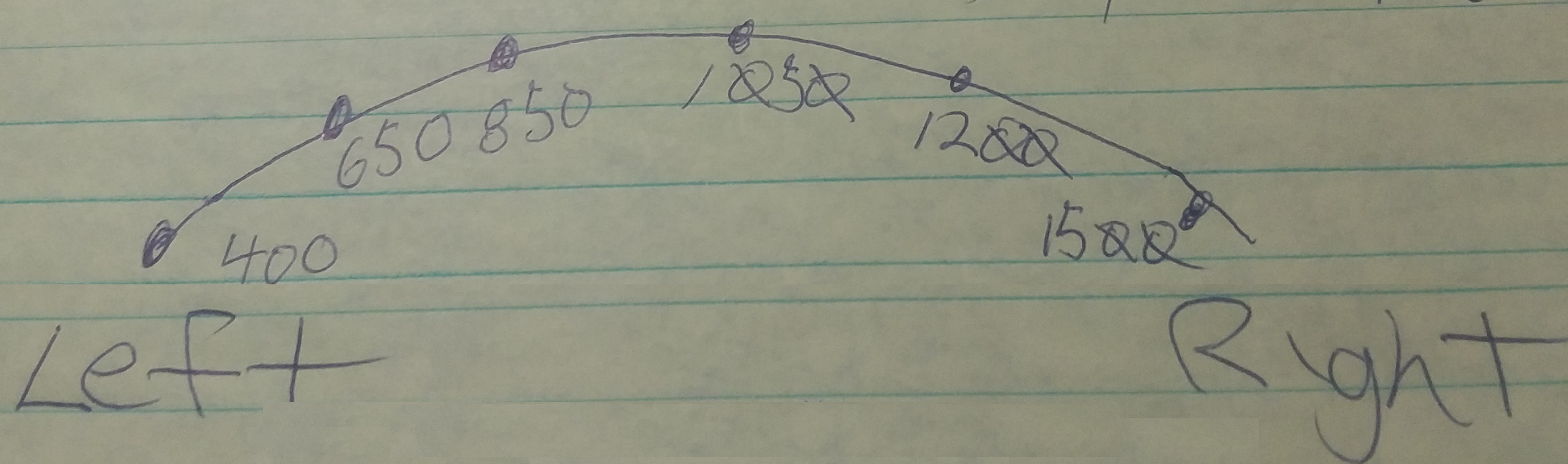
Using the Stereo-Cw method, with the filters properly adjusted, multiple calling stations seem to appear (spatially) at different "locations" in the listening experience.  While I can use the clarifier (CLAR) knob to position a signal at an audio frequency that one of the PEAK filters can peak into "better" readability, usually it isn't necessary, in order for my brain to "decode" a given Cw station.

With RTTY it is a different situation altogether; in order to achieve proper/accurate decoding, the station must be tuned-in more-or-less precisely on the correct frequency for the individual tones
to be properly decoded.  It is for this reason that Stereo-RTTY has different operating objectives.

Because the essential benefit of the "Stereo" concept is to have calling stations arranged "around" the operating position in a more-or-less 180-degree azimuth arc, I have questioned the value of stereo audio in a RTTY contest.  As it turns out, Stereo-RTTY is most useful when calling stations are off frequency.  When you think about it, if several stations are calling on EXACTLY the correct frequency (as they should be), they will jumble over each other, making proper decoding tricky at best.

With Stereo-RTTY, the idea is to adjust the Peak Frequency of the external filters (which for WQ6X
is a pair of Autek QF-1A's) such that the signal "appears directly in front" of the operator.  Off-frequency calling stations will appear "to the left" and "to the right".  We of course use the (CLAR) control for tuning-in the station until property RTTY-decoding is achieved.  With Stereo-RTTY, the listening "position" of that station should shift more-or-less towards the center of the listening experience.  The individual RTTY tones should "appear" more-or-less on either side of the center listening experience.

Because all this is being accomplished using the PEAK function of the external filters, theoretically the signal/noise ratio should improve, enhancing the decoder software's ability to interpret relatively weak signals.  Prior to inserting the QF-1A's into the RTTY audio line, the improved listening-aesthetic was discovered which led to the question of whether or not [so-called] Stereo-RTTY
could actually improve operating efficiency.

I invite you to use a pair of (ideally identical) audio filters to hear what Stereo-RTTY actually sounds like; if you like it, then insert those filters into the decode-audio line and take your RTTY operations
to the next level, in the same way we did with Stereo-CW.

[CLICK HERE] to read Part 2.


Thursday, February 19, 2026

SoMe MoRe ThoTs on SteReo RTTY

While Stereo-RTTY (a late descendant of Stereo-CW) is hardly a new idea, recent months have
found me experimenting with different ways to actually achieve the most effective results using this method.  In summary, the "Stereo" audio approach involves using a pair of audio filters (I prefer Autek QF-1A's) to create a near 180-degree wide listening experience.  Overall, this audio effect in essence creates/generates a "bandpass filter" within which to "play around" inside.

Before writing this Blog, a SEARCH was done regarding Stereo RTTY posts in this Blogspot:
  • [X] - (2o22): Stereo-RTTY: Is It Possible? (What can We Do with it?)
  • [X] - (2o22): Stereo-RTTY: How can We Leverage It?
  • [X] - (2o24): Stereo-RTTY Revisited (Yet Again)
  • [X] - (2o20): BLAST from the Past: External Audio Filters I have Known
  • [X] - (2o24): Demonstrating the Stereo-Radio concept - for YOUR Satisfaction
  • [X] - (2o24): Using Stereo Ssb in Worldwide DX Contests
  • [X] - (2o24):  BLASTS from the PAST: Stereo CW and it's many Variants.

With RTTY, because we use 2 (170-hz separated) tones, we can adjust the individual filters to "peak" those tones in each ear.  Stations who call in off-frequency will be attenuated to the degree that they are off frequency.  The selectivity control on most filters enables us to control the breadth and depth
of that attenuation.


Using the R-I-T control, off-frequency stations can be "centered" by peaking both tones in both ears. 
You should notice a noticeable improvement in the RTTY decoding as the tones are peaked in each ear.  Because RTTY tones are ALWAYS 170-hz apart, the external audio filters can be set to enhance the audio frequency pair of your choosing.

Experimenting with different decoders can also enhance the quality of the decoding process.
Some operators keep 2 or even 3 different decoders running (often on separate screens) with the
hope that at any given moment, one of the decoders will make sense out of seeming-gibberish to the other programs.

Like ANY of the "Stereo" methods I make use of in Radiosport, to get the most out of these methods, spending LoTs of listening time to learn the proper filter adjustments will find you more than ready when the next RTTY contest comes up.

Do YOU run RTTY?

If you're not using Stereo-RTTY, then you are missing out on leveraging 20th-century analog
technology in today's 21st-century radiosport world.  GO ahead - Give it a try.

Sunday, May 1, 2022

Stereo-RTTY: How can We Leverage It?


Last evening, I finally found time to find graphic images for Part 1 of this Blog topic. 
In reviewing the text of Part 1, it occurred to me that there is more to say about using
the  Stereo-RTTY concepts as an enhanced tuning aid.  I still remember a dozen years
ago working towards "getting the hang" of tuning in RTTY signals.  Properly tuning-in RTTY
signals is TRULY an ART.

Today, my decoder of choice is the classic Freebie App MMTTY and it's FIR tuning display. 
When a signal with sufficient signal/noise ratio is properly tuned in, the tones align perfectly
with the "goal posts" and happiness, more-or-less reigns.  What follows is an edited cut/paste
from Part 1 of this Blog, explaining this a bit more succinctly.

With RTTY, in order to achieve proper/accurate decoding, the station must be precisely tuned-in
more-or-less on the EXACT frequency in order for the individual tones to be properly decoded. 
Stereo-RTTY makes this operation more quickly accurate.

Remember: the essential benefit of the "Stereo" concept is to have calling stations arranged
"around" the operating position in a more-or-less 180-degree azimuth arc.  As it turns out, Stereo-RTTY is most useful when calling stations are considerably off frequency.  When you think about
it,  if several stations are calling on EXACTLY the correct frequency (as technically they should be), they will jumble over each other, making proper decoding tricky at best.

With Stereo-RTTY, the idea is to adjust the Peak Frequency of the external filters (which for WQ6X
is a pair of Autek QF-1A's) such that the signal "appears directly in front" of the operator; the idea being that the Mark/Space tones should be PEAKED by each QF-1A filter.  From that moment forward, tuning in other callers becomes considerably easier.  Off-frequency calling stations will
then appear "to the left" and "to the right" of the listening experience.  We of course use the (CLAR) control for tuning-in the station until property RTTY-decoding is achieved.  

With Stereo-RTTY, the listening "position" of that station should shift more-or-less towards the center of the listening experience.  The individual RTTY tones should "appear" more-or-less on either side of the center listening experience, peaking precisely over the goal posts and giving us a near-PERFECT "+" decoder icon.

During the intensity of a contest, it's easy to forget reset the Clarifier after each QSO.  Luckily,
many radios (such as the Yaesu FT-1000mp and FT-2000) have an easily-accessible CLEAR button.  Additionally, logging software (such as N1MM+) have a MACRO command ({CLEARRIT}) shifting the radio back to the original RUN frequency.  I have added this Macro to the F3-Key.

I've yet to conduct the RigExpert audio intercept (as mentioned in Part 1). 
That gives us something to look forward to.

Have you ever tried futzing around with Stereo-RTTY?

It's actually a LoT of FUN!


Wednesday, August 26, 2026

WQ6X - SARTG RTTY Remembrances -

The Scandinavian Amateur Radio Teleprinter Group (SART) RTTY events are uniquely structured 24-hour radiosport contest events that are "stretched out" over a 40-hour time frame, inside which there are two 8-hour mandatory off periods.

I did a backwards look at the different SARTG RTTY GiGs documented over the years and found
a surprising JUMP chronologically.
  • [X] 2o13 - WQ6X operates NAQP-SSB & SARTG RTTY while hunting for Lighthouses

    This was WQ6X's entry into the SARTG RTTY contest from N6GEO's QTH in Brentwood California.  In between working the NAQP Ssb GiG 40 SARTG RTTY QSOs eventually
    made it into the log on 15 & 20 meters (40 & 80 were DOA for RTTY).

  • [X] 2o21 - WQ6X Works another WEIRD NAQP Dual-OP

    After nearly 5-hours of frustrating full-duty RTTY running, from W7AYT's QTH in Concord,
    it was certainly time to give the FT-1000mp a rest.  The biggest problem was actually
    in-shack RFI on 20-meters, disrupting computer USB ports of all things, encouraging
    15-meter operating whenever possible.

  • [X] 2o24 - WQ6X Wanders around a WEIRD Saturday-contest WeekEnd

    This was a weird attempt at running SARTG RTTY remotely.  Unable to directly
    control the radio, it was a simple matter to swap the audio lines and turn on VOX.
    Because of splotchy internet, I devised the idea of recording the F1 and F3 keys
    into the Elecraft K3's DVK channels 1 & 3.  Because the contest exchange involves
    an ever-increasing serial #, the contest exchange was sent out newly for every QSO.
    While 30-QSOs (11k points) isn't much of a score, what was actually learned in the process is what matters.

  • [X] 2o24 - Reminiscing RTTY Running Realistically

    This was a variation on Blast from the Past (BFP) Blogs I have written,
    altho it included the many different RTTY GiGs I have participated in during
    the last 15+ radiosport years.  Being a unique 3-part contest, the SARTG events
    certainly belong in that retrospective.

  • [X] 2o25 (Jan.) - WQ6X Uses SARTG-NY as a RTTY RU Training Ground

    The SARTG NY (New Year) RTTY contest became more of a training ground for adaptive RTTY cabling than it was about how many QSOs could be added to the log.  The gimmick documented in that blog entry was using N1MM+ to key the Yaesu FT-2000 PTT circuit which was parallel hooked to the K3/0-mini footswitch line.  Doing this eliminated the need for using VOX to activate the remote radio (VOX can get into an infinite feedback loop.).  While it was still necessary to type in the run frequency, by running instead of S&P'ing,
    the correct frequency was always in-place.

  • [X] 2o25 (Aug.) - WQ6X Works a Weirdly disjointed Radiosport weekend

    Contest calendar wise, the 2o25 3rd August weekend produced a bevy of different
    radiosport contests, one of which, the SARTG RTTY, GiG was in the middle of that. 
    The strategy was operating the correct contest (SARTG / NAQP) at the correct time
    for the current band conditions & to predict what the evening propagation will bring us.
    While playing SARTG RTTY, WQ6X also ran the NAQP Ssb contest at QRP power
    and managed to take 1st-place for QRP in that event - I DiD NoT see that one coming.

  • [X] 2o26 - WQ6X Wanders thru YeT another SARTG - NAQP Ssb
                      and International Lighthouse WeeKend

    For 2o26, equipment cabling problems kept the RTTY operation off the air during
    the 1st 8-hour segment and part of the 2nd segment.  When it was all over the 96-QSO score was considerably less than 2o25's 110 Q's, due to the noticeable lack in multipliers.
    What made the 2o26 event fun was purposely running frequencies most of the time.
    It also gave me the opportunity to make some improvements to the Stereo-RTTY method.
    ([CLICK HERE] to read about Stereo-RTTY.)

Friday, July 19, 2024

Stereo-RTTY Revisited (Yet Again)

It could be said that the "Stereo Radio" concept is actually BEST EXPRESSED when running
a RTTY CONTEST.  Having recently upgraded the antenna system @W7AYT's QTH in the SF
East Bay (Grid-Square: CM87xx), the decision was made to run the 2024 summer NAQP RTTY contest from this configuration while fully leveraging the Stereo-Audio setup that is a prominent
part of the operation there.  The IARU HF Championship gave the Stereo-CW method a thorough test.  Two Blogs emerged from that operation:

  • [X] - Using Stereo-CW When Running Pile-UPs
  • [X] - WQ6X Leverages Stereo-CW for 2024 IARU HF Championship

My filter combination of choice for nearly 10 years has been a pair of old-school Autek QF-1A SSB/CW/AM analog audio filters.  Using the PEAK Filter, Stereo-CW and Stereo-RTTY are
easily accommodated.  The LowPass (and sometimes HighPass) filters are the Secret to
running Stereo-SSB - [CLICK HERE] to read more about Stereo-SSB.

As a function of the FREQUENCY knobs on the Autek QF-1A filters, we can PEAK
the  individual MARK/SPACE tones, specifically for each ear, which determines the
[so-called] "position" of each tone in the listening experience.
With the SELECTIVITY knobs we can fine-tune the amplitude of each tone individually. 
The Aux. Notch filters can be used to null any offending carriers or noises in each ear
individually.

Once everything is properly setup, spend some time tuning around the different bands and modes.  The aural-spatial effects are subtly AMAZING.  Properly done, tuning a signal towards zero-beat shifts the signal from the left side to the right (or right-side to the left-side) of the listening experience.  

With weak signals, using RiT can reposition that signal in the listening experience
to match the Stereo-CW filter frequency settings for that moment in time. 
Correctly done, the signal peaks and literally "jumps out" of the RX-Passband.

Do YOU Play around in RTTY Contests?

Has the idea of running Stereo-RTTY ever occurred to you?


Thursday, August 7, 2025

WQ6X Blast from the PAST: NAQP RTTY - Part 2

After having been informed that WQ6X took 1st-place in the QRP assisted category for the NAQP RTTY contest, K6UFO wrote me and asked for a write-up and pictures.  Altho I had just published
a Blog on that event, it occurred to me that the last Blast from the Past Blog on this contest was written 6 years, creating the impetus to create a Part 2 on this topic.

Beginning with the original BLAST Blog, there are quite a number of entries regarding NAQP RTTY:
  • [X] - July 2019 - WQ6X Blast from the PAST: NAQP RTTY
  • [X] - July 2019 - WQ6X Solo-OP's NAQP RTTY - It Ain't Over 'Til it's Over
  • [X] - July 2020 - WQ6X Works a slippery-slope NAQP RTTY Contest
  • [X] - July 2021 - WQ6X Negotiates another Summertime NAQP RTTY Contest
  • [X] - July 2022 - WQ6X NiT PiCKs another NAQP RTTY Contest
  • [X] - July 2023 - WQ6X Runs a near-Negligible NAQP RTTY Contest
  • [X] - Feb  2024 - WQ6X Weasels a Weird Multi-remote Radiosport Weekend
  • [X] - July 2024 - WQ6X SQUEAKs Thru another NAQP RTTY Contest
  • [X] - Feb  2025 - WQ6X Wobbles thru a WEIRD CQ-160 + NAQP RTTY WeeKend

Thursday, February 22, 2024

BLASTS from the PAST: Stereo CW and it's many Variants.


It seems like DECADES ago that I published the 1st Blog on the [then] newly discovered (for me anyway) Stereo-CW concept.  Since then I have made a number of improvements to the filtering methods and even found ways to implement the "stereo" concept using Ssb and RTTY modes.  Sharing the concept with some amateurs on75-meters, it occurred to me that having easy access
to the various Blogs on these topics can make for useful research information.

  • [X] - WQ6X SOUND PROCESSING: Stereo-CW - it's EASIER than You Think (Mar/2018)
  • [X] - Some Further Thoughts regarding Stereo CW (Apr/2019)
  • [X] - How Stereo-Cw becomes Stereo-Ssb (Mar/2021)
  • [X] - Stereo-Cw: The Filters behind the Filtering (Sep 2021)
  • [X] - Stereo-CW: Learning to Navigate PILE-Ups (Sep 2021)
  • [X] - Stereo-CW: Enhancing Your FAVorite Radio receiver (Mar 2022)
  • [X] - Stereo Cw: Advancing the Art of Equalization (Mar 2022)
  • [X] - Stereo-RTTY: Is It Possible? (What can We Do with it?) (May 2022)
  • [X] - Stereo-RTTY: How can We Leverage It? (May 2022)
  • [X] - Stereo Ssb: It's STILL Easier than you Think (Oct 2022)
  • [X] - Stereo-SSB: Turns out There's More To It (Dec 2022)
  • [X] - Stereo-Ssb Revisited (Yet Again) (Mar 2023)
  • [X] - Stereo-CW Revisited (Yet Again) (Apr 2023)
  • [X] - STEREO Stereo-Cw: It All begins with a Concept (Aug 2023)
  • [X] - For WQ6X: Stereo-SSB creates Quite a Saucy sensation
             for a Sensational Sweepstakes (Nov 2023)
If the above Blog entries are not enough to give you a bunch of things to THINGK about,
then I dunno what to tell ya'.  I'm still learning new things about the "Stereo" techniques.

GiViT a try and lemme know what YOU discover.

Thursday, March 6, 2025

WQ6X Blasts from the Past: a LooK back at a Look Back - Part 2

Posting Blast from the Past Blogs from time to time makes it easier to look back years later recollecting about past experiences with upcoming radiosport event.  In Sept. of 2019, for the helluvit, I published a compendium of all the Blast From the Past Blogs up to that point.  ([CLICK HERE]
to read that.)  Over a period of 7 years, only 8 B-F-P Blog entries were written.

As a research project, it was determined that since 2019 19 B-F-P Blogs have been posted
on all manner of differing topics. Check out this list:

  • [X] Blast from the Past: California QSO Party (CQP)
  • [X] WQ6X Blast from the Past: ARRL Dx Phone Contest
  • [X] WQ6X Blast from the Past: ARRL Dx Phone Contest => Part 2
  • [X] WQ6X Blast from the Past: CQ WPX RTTY
  • [X] WQ6X Blast from the Past: CQ WPX RTTY - Part 2
  • [X] BLASTS from the Past: The WPX Weird Prefix Cw Contest
  • [X] BLASTS from the Past: The WPX Weird Prefix Ssb Contest
  • [X] BLAST from the Past: External Audio Filters I have Known
  • [X] BLAST from the Past: Memories of Marconi Memorial
  • [X] BLAST from the Past: NAQP Ssb Contest
  • [X] BLAST from the Past: CQ W.W. RTTY Contest
  • [X] BLAST from the Past: CQ W.W. RTTY Contest - Part 2
  • [X] BLAST from the PAST: QRP Reconsidered
  • [X] A WQ6X as W6J Retrospective
  • [X] Blasts from the PAST: Worked All Europe (WAE) Cw contest
  • [X] Blasts from the PAST: End of August Contests
  • [X] BLASTs From the Past: Cinco de Contest
  • [X] BLASTS from the PAST: Stereo CW and it's many Variants.
  • [X] Blast from the Past: California QSO Party (CQP) - Part 2
  • [X] BLAST from the PAST: 2024 Radiosport in Review
wOw!  Whatta buncha STUFF?!!
  1. Blast from the Past: California QSO Party (CQP) - Parts 1 and 2

    Next to the ARRL November Sweepstakes (SS) GiGs, the California QSO Party (CQP)
    is my favorite domestic radiosport event.  Since 2000 I have NoT missed somehow participating during the 1st weekend of October event.  For county hunters, it is realistic
    and feasible that you can work all 58 California counties in ONE (count 'em "1") WeeKEnd;
    one state done with 49 to go towards your USA-CA (Worked All U.S. Counties) Award.
    CQP is so much one of my favorite events that 2 Blast from the Past Blogs have been
    written about this event.  Before long, it will be time for Part 3.


  2. BLASTS from the Past: The WPX Weird Prefix Cw & Ssb Contests

    What I specifically LIKE about the CQ WPX (Weird Prefix) contest, is THAT - WEIRD Prefixes.  Of course, my "WQ6" callsign certainly qualifies as a WEIRD prefix.  Additionally, it is certainly No accident that I define the N1MM FK-12 Key to send out some form of "W-E-I-R-D" message when people do WEIRD things.


  3. WQ6X Blast from the Past: CQ WPX RTTY - Parts 1 and 2
    The WPX RTTY Contest is one of my overall favorite events - I don't have to copy
    Morse code, nor do I have to strain my voice.  I can often experience the RTTY
    tones as synchronistically soothing.


  4. WQ6X Blast from the Past: ARRL Dx Phone Contest - Parts 1 and 2
    Overall, for me, the ARRL DX Phone contest is usually, overall, a ho-Hummer.
    Then again, coming to each iteration of this event found me exploring new ideas to
    alleviate what I call Ssb-Boredumb.  It is from this, the Stereo-SSB concept was perfected. 
    40-plus year-old technology (the Autek QF-1A) still outperforms most DSP technology built-in
    to today's transceivers.  The proof of perfection came with setting a Southwest Division record
    in 2024.

  5. BLAST from the Past: External Audio Filters I have Known
    Long before I began seriously working on the Stereo-CW concept, I added a number
    of different analog and DSP filters to the audio lines, experimenting with the different combinations that eventually became the Stereo Audio concept.

  6. BLAST from the Past: Memories of Marconi Memorial
    Every year, the Marconi Memorial radiosport offers outstanding opportunities and every
    year, it becomes a Ho-Hummer.  Nevertheless, I find time in between the other GiGs that weekend to play around and submit a log.  At the very least, it adds another entry to the number of contests submitted to 3830Scores.com.


  7. BLAST from the Past: NAQP Ssb Contest
    The North American QSO Party (NAQP) makes for a GREAT introduction to domestic
    radiosport contesting.  With the exchange of NAME and STATE, it is EASY and FUN. 
    Back in the day, I used to join the multi-OP crew live in Fallbrook.  In recent years the
    current crew has been running REMOTE from ANZA.


  8. BLAST from the Past: CQ W.W. RTTY Contest
    My first introduction to serious RTTY came from the encouragement provided by N6GEO.
    It wasn't long before I found my groove and we began making high scores in RTTY contests, highlighted by our appearance on St. Croix for the Jan-2014 RTTY-RU contest, operating as WP2/WQ6X.  Around our 1st-Place (worldwide) win, I spent time running pileups from 80 to 10 meters (Ssb and Cw), including the WARC bands.  From an amateur radio standpoint, it was
    a complete success.


  9. BLAST from the Past: CQ W.W. RTTY Contest - Part 2
    In recent years, running RTTY has largely been a remote running affair.
    Then again, because the FT-1000mp and FT-2000 can run FULL-Duty RTTY,
    running RTTY live is still a viable approach.  Even more recently is running the above transceivers by way of the RigExpert unit to accomplish PTT keying for running the K3/0
    and K3/0-Minit control units to make RTTY transmissions remotely, even though the tones
    are generated locally.


  10. BLAST from the PAST: QRP Reconsidered
    Beginning in 2023, WQ6X found it more imaginative and exciting to run as many events using QRP as can be successfully accomplished.  Running remote from Ramona and Anza makes
    it possible to leverage hilltop QTH's as well as the antenna configurations that go with them.


  11. A WQ6X as W6J Retrospective

    Over the years, I have registered the W6J callsign, mainly for running variations on
    the Japanese JIDX DX contest, while also joining NX6T in one of our 1st-place finishes. 
    Last year the rules for JIDX were changed, no longer allowing me to do both.  Now, I
    either join NX6T or else run as a Single-OP station.  The JIDX Ssb contest in November
    runs concurrent with the WAE RTTY contest, to enable running BOTH during the same weekend.


  12. Blasts from the PAST: Worked All Europe (WAE) Cw contest
    Due to the sending of QTC messages, the Worked All Europe is the most complex of all radiosport contests - even more than the November Sweepstakes.  Thanks to the Ctrl-Z
    capability built into the N1MM software, sending QTC messages is about as easy as it
    will ever get.


  13. Blasts from the PAST: End of August Contests
    The last weekend in August presents us with a number of disparate events.  In some cases,
    I ran the same event as WQ6X (from EB section) and NX6T (in the SDG section).  In all cases,
    the goal was to up the number of 3830 Score events submitted.


  14. BLASTs From the Past: Cinco de Contest
    The 1st weekend in May I call Cinco De Contest, running for State QSO Parties and the Italian ARI contest.  I have won two 1st-place plaques in the 7QP event, one for LP and more recently one for QRP.


  15. BLASTS from the PAST: Stereo CW and it's many Variants.
    While I have written about Stereo-Cw and its variants, I finally got around to writing a BLAST Blog about my audio filter discoveries since the original Blogs, which now include Stereo-Ssb and Stereo-RTTY.  Despite the fact I am a Californian, it is no secret that CQP is the most populous state QSO Party of them all.  Running for 30 continuous hour


  16. BLAST from the PAST: 2024 Radiosport in Review
    Ending 2024, I did something new by briefly reviewing the contest activity for the entire year, beginning with the RTTY-RU in January, followed by the NAQP GiGs during the 2nd and 3rd weekends.  The above graphic demonstrates contest activity from 2020 - 2024.

Friday, October 2, 2026

WQ6X Wangles another QRP World-Wide RTTY ConTesT


As solar cycle 25 continues its inevitable decline, this year's Sept. CQ W.W. RTTY contest paled significantly to this same event last year, when we experienced a noticeably higher solar flux index (~150).  Attempting a duplication of last year's 391 QRP QSOs once again the decision was made
to run QRP from WA6TQT's Anza STN-1, base rotor for the 10/15-meter stacked arrays was out for repairs, leaving the yagi's fixed at 35-degrees - more-or-less perfect for working EU.
(For working AS, OC & SA, a rotatable KT-36 yagi is always at the ready)/

The last weekend in September brings us 3 radiosport events:

  • [X] - CQ W.W. RTTY Contest 
  • [X] -Maine QSO Party (MEQP)
  • [X] - The YU DX Contest

Band-condition wise, overall signal-levels were way down.  Additionally, 15 and 20 meters were plagued with slow to medium fading.  It is for this reason that stations calling CQ should repeat their callsign several times; that way, when their callsign gets "clipped by QSB" we get another chance
to copy it, instead of having to wait for the next CQ call.

As part of ongoing research for my upcoming book on Stereo Audio, the weekend decision was
made to diddle with the Stereo-RTTY method moving the cables into various different configurations between a WinDoze-11 an MSI gaming laptop and the RRC-1258 coupled to a k3/0-Mini control head.
([CLICK HERE] to learn more about Stereo-RTTY.)


In previous years, time was spent on the MEQP and YUDX.  This year's focus on Stereo-RTTY sidelined those two events.  The SFI being a lowly 106 made for relatively POOR band conditions.  
The biggest problem experienced universally was QSB everywhere requiring repeats.  Unfortunately, many stations would give up after my 2nd repeat request - what's the big hurry?

There were many VK stations on Friday/Saturday, but none on Sunday. There were no ZL stations heard this year - missing Zone 32.  EU was also noticeably lacking on the West coast.  JA participation also seemed to be considerably less than last year.


Wassup with RTTY operation EXACTLY on 14.100 QRM'ing the NCDXF beacon - that is pretty LAME (and LiDDiSH) if you ask me. 

There is plenty of room on 20-meters that we can give the 14.100 frequency plenty of room.  I heard stations on 20 meters all the way up to 14.148.


The last 2-hours was spent working random stations on 15 and then 20 meters, alternating between Japan,
the Caribbean and South America.

With such a low SFI, this was considerably challenging.  At least the A-Index and K-Index numbers were near the bottom.

Overall, propagation was weak, and combined with excessive QSB, accurate signal decoding a challenge requiring multiple repeats.  Unfortunately, many stations would give up after my 2nd repeat request - what's the big hurry?

When it was all over, 202 QSOs made
it into the log.  The distribution was 28
countries and `9 zones.

DiD YOU operate the CQ W.W. RTTY Contest?

How many countries and zones did you manage to work?

Is WQ6X in YOUR LoG?

Tuesday, December 13, 2022

Stereo-SSB: Turns out There's More To It


I've been playing with stereo audio for many years; Stereo-CW (and even Stereo-RTTY)
is a Given, a no-Brainer.  While I've written extensively on the Stereo-Cw concept ([CLICK HERE]), there seemed to have been fewer ideas/uses for Stereo-Ssb - until this last weekend's ARRL
10-meter mixed-mode contest.

  • [X] - How Stereo-Cw becomes Stereo-Ssb
  • [X] - Stereo Ssb: It's STILL Easier than you Think
  • [X] - Stereo-RTTY: Is It Possible? (What can We Do with it?)
  • [X] - Stereo-RTTY: How can We Leverage It
     

As always, using Stereo-Cw revolutionizes Cw-mode contesting. 
Because the ARRL-10 GiG is a worldwide contest different accents and dialects
make Ssb copy tricky, at best; nearly impossible, at worst.  This is where Stereo-SSB
comes to the rescue.

As I write this, the ARRL contest is over.  In its place, I am listening to QSOs in the 75-meter
DX Window using the K3FEF Web SDR.

I mentioned in a previous Blog that the Aux. Notch Freq. knob on each QF-1A unit offers the
ability to notch-out a specific "SPRITZ" inside of the peaked passband for each Left/Right ear.  

While the FT-2000 is equipped with an effective IF-based dual manual notch facility, when receiving split-VFO audio, those notch filters (as well as the ANF auto-notch) only apply to signals in the left ear.  It is for this reason that a Rockville mixer box has been implemented, offering up the ability to "patch-in" the NIR-10 & NIR-12 DSP units for the right ear, somewhat equivalent to the DSP facilities built-in to the FT-2000 and the older FT-1000mp.

A major secret to making Stereo-SSB effective is to adjust both filters to emphasize each ear properly.
Then, using the RIT control, individual calling stations can be more-or-less "centered" in the audio passband.

Have you ever played around with the concept of Stereo-SSB?
If SO, what kind of results DiD you get?
IF NoT, WHY Knot?

Tuesday, July 21, 2026

WQ6X TipToes through another NAQP RTTY ConTesT

Because NAQP contests allow us to operate only 10-hours out of the full 12 for the event,
the question is always WHEN to take those 2-hours.  Some operators start an hour or two later
and then end an hour or two earlier.  Some operators take an hour break when the propagation gets
dicey, on the hopes that it will again improve, or QSY'ing to the next lower band will make up for it.
In my situation, client commitments kept me out of the char for nearly 4 hours.  I started up in the afternoon just as 15-meters was closing-out for the day.

With the starting time "pre-ordained", the major focus became how to maximize the more-or-less
~8-hours remaining in the contest event.  For this remote operation, the decision was made to use
an MSI gaming-oriented (4-Ghz) laptop, with its relatively stable internet access.  The downside to
this approach is that N1MM+ was unable to establish CAT control of the RRC-1258 interface unit, requiring that operating frequencies required manual entry, an encouragement to run frequencies
as much as possible.

A goeswith in remoting to Ramona was the periodic drop in internet signal levels from the remote
end, creating a sort-of "internet jitter" effect.  Similar to running remote-Cw a couple of weeks earlier was the need to be able to decode signals in between the dropouts.  
 
I frustrated a number of S-9+ calling stations by asking for multiple repeats.  I lost count of the stations who weren't waiting around for a "mere W6" station, altho I really dunno what their hurry really was.  Adding a 2nd RTTY decoder is of no use when the difficulty is due to dropped audio.

Switching to Search & Pounce (S&P) mode enabled entering the other station's exchange
(name and state) into the N1MM+ entry screen BEFORE calling in.  This at least insured the
correct data made it into the log when the QSO was made.

Thanks to a significantly lower Solar Flux Index (SFI) 20-meters became THE band - same
as in the NA SPRINT contest which usually opens on 20-meters, working down to 40 & 80 later.  Around 02:30 it was time to make the transition downward running 40-meters until no new stations could be worked.  The rest of the evening was spent "leapfrogging" between 80 & 40 and then back again.

Using a Shorty-40 yagi allowed slowly sweeping between 30- and 100-degrees azimuth. 
On 80-meters the inverted-vee (@55') offered reasonable coverage between Illinois and Texas
(and all points in between).  On the higher bands the 3-el Stepp-IR offers the option to instantly
switch a N-E pointing antenna 180-degrees to pick up a quick KH6 multiplier or run BI-directional.  With the Shorty-40, a F/B ratio of 20db means that my 69-watt RTTY was often heard somewhat
off the back end.  (The Front/Side ration of yagis are usually quite exceptional.)

By the 06:00 contest end, only 142 QSOs made it into the log on 80 to 15-meters after 7+ hours
of OP-time.  Let the 3830Scores score entry document the actual operation.  While an 8.7k score
isn't much, it keeps WQ6X callsign recognition very much alive.
 
As much a struggle as the contest, a side-benefit of operating physically from the Concord location
was the availability of the necessary filters required to run what I call Stereo-RTTY.  The essential idea behind Stereo-RTTY method is to utilize the peaking function of both external audio filters to specifically PEAK the MARK/SPACE tones (effectively deemphasizing the frequencies surrounding the tones).

When running AFSK, my choice of MARK frequency is quite low: 915-Hz (with a SPACE frequency
of 1085-Hz). Running S&P early in the contest enables the opportunity to determine the best L/R filter settings providing the most legible/intelligible RTTY decoding.  When running a frequency the aux. notch control in those filters can knock-out single tones from joker's attempting to disrupt legible copy.  Also when running a frequency, using the R-I-T control, the desired signal can be centered between the "goal posts".  Stations calling slightly off frequency will be shifted away from the goal posts.  

When 2 or more stations are perfectly aligned
with the MARK frequency, their tones often "collide" resulting in garbled copy.  By shifting the R-I-T, one of those signals might "jump out of the jumble"
just enough to be copyable over the other callers.  

Each station worked will reduce the layered jumble somewhat unless new stations show up and add more jumble to the jumble.  Because the internet dropouts were so annoyingly problematic, w/o Stereo-RTTY things would've been utterly hopeless.  

Theoretically Stereo-RTTY could be applied to the transmit audio eliminating the potentially troublesome 2nd-harmonic (1830-Hz).  A multi-band equalizer slipped in the transmit audio line
can make for a simple yet effective approach to cleaning up transmit audio.  However, remember
to check the audio drive BEFORE and AFTER the filtering - overdriving will of course create new
(and potentially worse) harmonics.

When it was all over, WQ6X submitted a 142-QSO Low Power Log - enough to say we wuz there.

What about YOU?  Were YOU there?

Is WQ6X in YOUR Log?