Showing posts sorted by relevance for query Stereo Cw. Sort by date Show all posts

Thursday, February 22, 2024

BLASTS from the PAST: Stereo CW and it's many Variants.


It seems like DECADES ago that I published the 1st Blog on the [then] newly discovered (for me anyway) Stereo-CW concept.  Since then I have made a number of improvements to the filtering methods and even found ways to implement the "stereo" concept using Ssb and RTTY modes.  Sharing the concept with some amateurs on75-meters, it occurred to me that having easy access
to the various Blogs on these topics can make for useful research information.

  • [X] - WQ6X SOUND PROCESSING: Stereo-CW - it's EASIER than You Think (Mar/2018)
  • [X] - Some Further Thoughts regarding Stereo CW (Apr/2019)
  • [X] - How Stereo-Cw becomes Stereo-Ssb (Mar/2021)
  • [X] - Stereo-Cw: The Filters behind the Filtering (Sep 2021)
  • [X] - Stereo-CW: Learning to Navigate PILE-Ups (Sep 2021)
  • [X] - Stereo-CW: Enhancing Your FAVorite Radio receiver (Mar 2022)
  • [X] - Stereo Cw: Advancing the Art of Equalization (Mar 2022)
  • [X] - Stereo-RTTY: Is It Possible? (What can We Do with it?) (May 2022)
  • [X] - Stereo-RTTY: How can We Leverage It? (May 2022)
  • [X] - Stereo Ssb: It's STILL Easier than you Think (Oct 2022)
  • [X] - Stereo-SSB: Turns out There's More To It (Dec 2022)
  • [X] - Stereo-Ssb Revisited (Yet Again) (Mar 2023)
  • [X] - Stereo-CW Revisited (Yet Again) (Apr 2023)
  • [X] - STEREO Stereo-Cw: It All begins with a Concept (Aug 2023)
  • [X] - For WQ6X: Stereo-SSB creates Quite a Saucy sensation
             for a Sensational Sweepstakes (Nov 2023)
If the above Blog entries are not enough to give you a bunch of things to THINGK about,
then I dunno what to tell ya'.  I'm still learning new things about the "Stereo" techniques.

GiViT a try and lemme know what YOU discover.

Sunday, September 5, 2021

Stereo-CW: Learning to Navigate PILE-Ups


I've written a number of Blogs on the topic of Stereo-Cw, and (more recently) on Stereo Ssb. 
There is a Bibliography of links to these Blogs at the end of this one.  The original 1976 73-magazine article did NoT really consider the implication of using Stereo-Cw when running pileups; whether in a contest or as a DX (or otherwise sought after) station.

Also, at the time that article was written there were no popular XCVR's on the market capable of
dual-RX, such as the Kenwood TS-950SDX/TS-990, the Yaesu-FT-1000mp/FT-2000/FTDX-5000, the Icom 756-PRO/7600/7800 series, the Elecraft K3S and the FLEX & Ten Tec Orion II transceivers.

The idea behind Stereo -Cw was/is to create an enhanced spatial experience from mono audio. 
In a dual-RX environment it can become a bit tricky operationally, altho it just becomes a new challenge to master.  Because of the simplex nature of Cw, Stereo-Cw makes complete sense.

Sometimes when calling a run station, while it seems my signal is not being heard, it might be the case that my frequency selection is just outside of the calling Cw station's narrow filter.  By shifting frequency up to +/- 200z around the run frequency, often, all of a sudden I find the opening and the stations replies back immediately.  I've noticed that experienced contest stations often call me slightly off frequency but within the receive passband.

If ALL stations call on the EXACT same frequency, separating them out can be quite difficult.  However if the callers are spread out +/- around the run frequency, with the Stereo-Cw an
interesting thing happens- they seem to be spread out spatially "around" my listening experience. 
Depending on their audio frequency, I might hear them more-or-less to the left of my listening experience, somewhere in the middle, or more-or-less to the right of my listening experience

With the external audio filters properly set, next, look back down into the I-F to insure that the I-F filter selections are compatible with the audio.  Recognize that while we are largely using audio processing as the MAIN tool, indirectly, we are "evaluating" what is in the I-F passband.  On that basis, also consider whether the passband should be Sharp, Medium or WIDE.  Widening the I-F passband brings more signals to the A-F passband to be "sorted out" by our stereo-assisted brain.  

An undocumented "goeswith" to using Stereo-Cw is the [inadvertent]  "Binary-beating" effect caused by the "heterodyne action" built into the parietal areas of our brain.  In the Superheterodyne, we combine 2 signals to purposely produce a 3rd (intermediate I-F) frequency.  

A consequence of having 2 ears equi-spaced around your head and 2 parietal lobes, your aural circuits are designed to combine audio frequencies from the Left/Right in order to "echo-locate"
(i.e. GPS).  In the process, frequencies from both sides heterodyne, creating a 3rd frequency
that seems to move between the Left/Right sides of our experience.

As a Light/Sound therapist, I purposely use the binaural-beating phenomenon to effect an overall influence of brainwave frequencies.  As Cw signals come and go inside the Stereo-Cw passband,
an occasional "false" signal will inadvertently seem to come and go.  By shifting the BFO/Clarifier control, that "station" may suddenly disappear, as the frequency shift alters the binaural-beating - from which I ask "was it REALLY there to begin with?"

With practice you can learn to navigate a near-180 degree ARC of signals all around you. 
A boringly-flat passband becomes transformed into a vibrant, spacious passband.

From this weekend's QSO Party and CWOPS GiGs, I noticed the above separation while waiting
in line to work popular stations.  I found that by "positioning" the to-be-worked station at about the
10:00 o'clock position in my listening experience, the calling stations are more-or-less positioned around the remainder of the listening experience, with most position "to the right" of the station
I am going for.


Stereo Cw Bibliography:

  • [X] - Stereo-CW - it's EASIER than You Think - the Blog which started it all.
  • [X] - Some Further Thoughts regarding Stereo Cw
  • [X] - Leveraging the Art of Dual Receive - Another Look (with additional Blog links)


Monday, March 21, 2022

Stereo-CW: Enhancing Your FAVorite Radio receiver

I've written numerous BLOG Entries on the topic of (and variations on) Stereo-Cw.  Last year I wrote
a little piece describing the filters BEHIND the Stereo-Cw technique ([CLICK HERE] to read that.)  Recently, it occurred to me that many readers may have concluded that because I am running
Stereo-Cw using high-end Yaesu transceivers (an FT-1000mp and an FT-2000), a super-duper
radio is necessary to enjoy the merits of this method.

Because the Stereo-Cw  method is accomplished using external audio filter units, in fact, virtually ANY receiver (even a 2-tube regenerative receiver) can benefit by sending it's audio output to these filters.  Then again, receivers with better selectivity will keep adjacent-channel QRM (essentially artifact) out of the input to the separate filters that split the audio into the Left and Right ear. 
Stereo-Cw would seem to deliver its BEST performance when the input filters get their audio
AFTER all IF / AF selectivity circuits have "shaped" the listening passband.

Then again, the PEAK function built into filters like the Autek QF-1 can bring a modicum of selectivity to less-expensive/older receiving equipment (similar to the way that the Heathkit QF-1 brought selectivity to the I-F of cheaply-designed Sw receivers).

Because Stereo-Cw is accomplished simply by splitting and shaping the audio passband, for me,
a question arises about Pre/Post equalization of the audio.  It may be prudent to put an equalizer BEFORE the stereo-Cw facility.  The equalizer can be adjusted to eliminate specific frequencies
in the passband before they get "mixed" with the input audio (resulting in audio-artifact). 
Essentially, an equalizer is a multi-frequency NOTCH Filter, useful for receivers w/o one.

Putting a dual-channel equalizer on the output enables us to do a final cleanup of the audio before it reaches our ears.  My equalizer of choice is the Radio Shack 32-2059 unit, a Dual 15 Band unit that offers full spectrum audio enhancement.  It is an amazingly inexpensive low-profile unit that is quite aesthetically attractive; the position-able sliders provide an at-a-glance graphical representation of
the audio passband.

While upgrading to better receiving equipment is AN answer to our receive WOAHs, a properly designed Stereo-Cw system can be switched to the output of virtually any receiver or transceiver.  When properly adjusted, every receiver circuit including SDR (Software Defined Receiver) units
can be taken to the next level.

In my station configuration, a downside to using the JPS NIR Dsp units in the right channel audio
is that a 130ms delay is introduced which can result in a sort of Left-to-Right "echo" effect.  Using 1990's Dsp chip technology, the 130ms delay is a feature that can't be remedied.  It would therefore seem that the operational answer is to add a switchable time-delay circuit to the left channel which matches the already existing delay in the right channel.

Stay Tuned while I look into adding this design to the interface cabling currently in use.

I guess it all comes down to Experimentation.  Stereo-Cw began as an on-going experiment.

What about YOU?  What audio experimentation have you played around with?


Monday, October 31, 2022

Stereo Ssb: It's STILL Easier than you Think

For WQ6X, the use of stereo receive audio has revolutionized station operations, especially
when it comes to running radiosport contest events.  While stereo-Cw makes for most stereo
audio processing, I have also found dual-channel audio separation to be effective when running
RTTY contests; and yes, even in Ssb GiGs.  Here is what I have said about it before:

  • [X] - Stereo Cw: It's easier than you think
  • [X] - Stereo Cw: Advancing the Art of Equalization
  • [X] - Stereo RTTY - Is it Possible?
  • [X] - Stereo Cw - Enhancing your FAVorite Radio receiver
  • [X] - How Stereo-Cw becomes Stereo Ssb
  • [X] - Stereo Cw - Learning to Navigate PILE-Ups

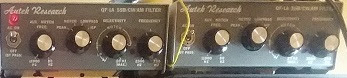
Yes, I have found many ways to leverage the stereo audio facility built-in to the Yaesu FT-1000mp, and now this year, the Yaesu FT-2000.  While I have used many different audio filters and DSP units, the Autek QF-1A SSB/Cw AM Filter is in a sense the most versatile of all the filters.  

For the 2022 CQ W.W. Ssb contest, I used a pair of QF-1A's to process the dual-receive audio
from the Yaesu FT-2000 and the remote audio from the K3/0.  As I said in my write-up about the event, the QF-1A's provided notch-filtering and audio shaping that neither the Yaesu or the Elecraft transceivers could match.

With Stereo-Cw, the goal is to have stations arrayed audio-wise around the more-or-less 180-degree (left-to-right) listening experience.  With Stereo Ssb, the goal was to process the audio differently in the left and right ears to make a given voice become readable. 

Bottom-Line: Stereo audio processing can be JUST as useful for Ssb operation as it can be for Cw and RTTY.  And, with devices like the Autek QF-1A's I get more knobs to twiddle, enforcing the illusion that every signal can be copied through all manner of uncomfortable conditions.

Have YOU ever run stereo audio processing in your station operations?

How DiD it work out for YOU?


Tuesday, August 15, 2023

STEREO Stereo-Cw: It All begins with a Concept


As you probably know, I am a fan of the Stereo-Cw receive audio enhancement idea.
In preparation for this BLOG entry I DiD a BLOG-wide search on "Stereo CW" phrase.
[CLICK HERE] to see some of the more relevant Blogs written on this subject and related
areas (Ssb and RTTY) in particular).

While Stereo-Cw is usually run into a pair of stereo headphones, using speakers can not
only relieve ear strain, it can create an incredible listening effect for visitors to the radio shack. 
Until recently, I've been using stereo speakers (and sub woofer) from a retired home entertainment system, which unfortunately is highly prone to RFI distortions when transmitting at power levels above
QRP (5-watts).

Recently I happened onto a LEKATO JA-02 Mini guitar amplifier running around 5-watts. 
Altho the unit uses a rechargeable battery; it comes with a charge cable that can plug into any
USB port.  It occurred to me that a PAIR of these speakers could take the Stereo-Cw to the next
level - what I call STEREO Stereo-Cw.  This approach relies on the fact that each amplifier unit
is actually a pair of stereo speakers.

The Yaesu FT-1000mp, FT-2000 & FTDX-5000 transceivers (thru menu settings) enable complete separation between left/right ear, or a mixture of both in each ear.  Devising a simple switch arrangement enables creating the same kind of effect with a pair of JA-02 amplifier units.
After doodling on the whiteboard, I scrawled these notes, from which a simple 2-pole
3-position switch makes it all work.

An advantage to using a PAIR of LEKATO JA-02 units is that the speakers can be moved apart
(or closer together) creating the most dramatic listening effect for a given listening environment.   Because the power/input connectors are on the REAR of each unit, aesthetically, these speakers look AMAZING together.

While there is more to say about this Stereo Stereo-Cw idea, we shall wait until we have
a few weeks operation behind this installation.

Have YOU Ever attempted the Stereo-Cw concept???

How DiD it Turn Out for YOU?


Friday, February 5, 2021

WQ6X Dual-OPs 1st-Ever CQ-160 Cw Contest

wOw!  As I write this, January is Already OVER.  Because they gave us 5-weekends last month,
the CQ-160 Cw contest managed to be tucked right into the last two days (Daze?).  Dual-OP'ing certain contest events (usually Cw & RTTY) has become a new sub-hobby within the HOBBY Amateur Radio.

For this 160 GiG, remote operating came in two flavors: ANZA-based (as NO6T) and Fallbrook-based (as WQ6X); "officially" NX6T was dark, off the air.  Additionally, I put in a reservation for the W6C callsign, creating a Concord signal-vortex investigation; more on that later.

Equipment-wise this weekend opened with some subtle (but not-insignificant) changes to the
audio-line.  Thanks to the newly added Radio Shaft A/V switch box (4-channels of stereo audio & mono audio) it is now possible to switch either the FT-1000mp, ICOM-7000 or Elecraft K3/0 into the main audio filter line.  I've never been impressed with the K3's APF (Audio Peak Filter); with the external audio filters we get the best of both modalities.

Being able to combine the already AWEsome DSP in the ICOM-7000 with the AUTEK, NIR & MFJ filters in the audio line makes for some amazing receive capabilities; more on that later.

-----------------------------------

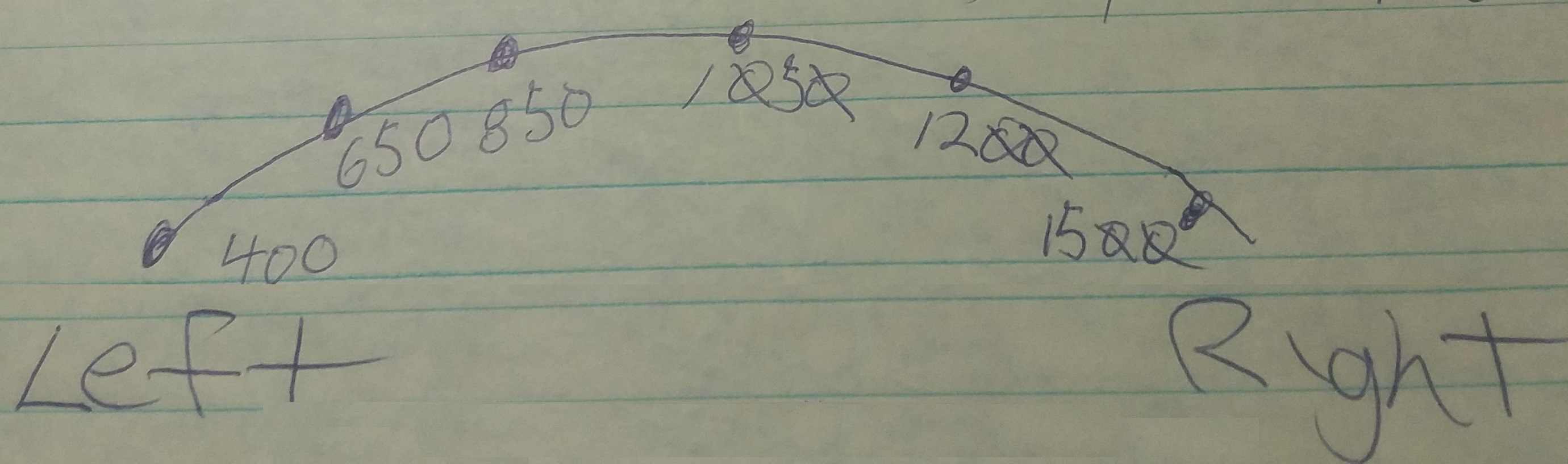
While I've been utilizing the "Stereo-CW" modality in WQ6X operations for years, this CQ-160 GiG (being a Cw contest) allowed me to knob-twiddle, looking for the EXACT Left/Right adjustment of the Autek QF-1A filter pair.  You may remember, for me the idea is for lower-pitched signals to appear
in the left-side of my Experience, while the higher-pitched signals appear in the right-side of my Experience.  The Stereo-CW concept must be Experienced to really GROK the jist of what I am saying.  All you need is a pair of identical filters intercepting the audio-line to Experience it.
I circled the frequency-settings demonstrating how "subtle" these settings really are for
a TRUE Stereo-CW Experience.

I've written a LoT about this idea, the most recent being AUGUST of 2020.  Based on this weekend's experiment, another BLOG-installment should be forth-coming.  When running a Cw pile-up, having different signals appear at different "locations" in my experience allows me to mentally-focus more-easily on that specific signal.  Used in conjunction with the R-i-T, allows me to position signals around in my listening-Experience.  During the CQ-160 contest (both from Anza and from Fallbrook) having Stereo-CW capability with the K3 made for an AWEsome operating Experience.

DISCLAIMER:
WARNING!: Stereo-CW should NoT be undertaken when seriously under the influence.

As weird as it may seem, the W6C Experiment was a marginal success, although the W6C callsign confused nearly everyone I worked; I had to reassure them that I was for real (because I was).  What
I unfortunately confirmed was the FACT that Concord California (at least locations near the creek) is indeed a signal-vortex.  As to what I should DO about it, that is fodder for a future BLOG entry.

When it was all over, it would seem that NO6T took 47th-place W.W., 10-place for USA, 2nd-place for the Southwest Division and 1st-place for California - GO Figure.  At #284, WQ6X was in the REAR of the Single-OP Assisted (HP) category.  As for W6C's 9 QSOs, we have to get the magnifying glass out to find them.

DiD YOU work the CQ-160 Cw contest?

Is NO6T, WQ6X and/or W6C in YOUR LoG?


Monday, March 26, 2018

WQ6X SOUND PROCESSING: Stereo-CW - it's EASIER than You Think


WQ6X's loaded FT-1000mp + two QF-1A Filters
It was last summer when I came up with the idea to put together a bunch of the BEST external audio sound processing circuits in one box.  Altho the Yaesu FT-1000mp is loaded with knobs and goodies, there can never be enough for me. Since last summer, I have been combing back issues of QST & 73 magazine, picking out the ideas I like; kind of like going to a fabric store and purchasing cloth and patterns allowing you to cobble-together your own unique designs and expressions.

First and foremost in nearly every design I contemplate is the fact that it MUST give me more switches to throw and knobs to twiddle. It's no secret I love to knob-twiddle, Knob-twiddling during contest activities helps alleviate boredom and at least gives me the illusion that I can improve reception for each individual signal, by resolutely twiddling the correct order of knobs,

When writing each installment in this audio-filter BLOG series, as I introduce each circuit possibly
I will include a reference to the article(s) consulted to make that circuit happen, even if I significantly deviated from the original design; as will be the case in this article.


Stereo-CW Concept

 
Have you ever heard of Stereo CW? Neither had I until I accidentally came upon an article in 73 Magazine (March 1976) by Robert Anderson (W8KZM) on this very subject. The idea is to provide
an extra measure of QRM rejection by way of the space discernment "circuitry" resident in the parietal lobes of our brain.

As you can see from the original circuit, the idea is to run the audio through an LP (low-pass)
filter centered on 800hz to 1000hz for the Left Ear and an HP (high-pass) filter centered on 1000hz
to 1200hz
for the Right Ear. The actual audio frequency of each signal will determine which ear you hear it in.


Original Stereo-CW Circuit

Tones around 1000hz actually seem to "appear" in the "middle" of the listener's experience.
As you tune through a signal (from high pitch to low pitch) the signal will start at the "far right"
of one's experience, shifting "thru your head" over to the "left side" of your experience. Anderson
ran the radio audio through his high powered stereo speakers for some dramatic effect(s); especially
if you add in echo/reverb.

Anderson also made reference to a little known technique known as the "center" channel (or 3rd channel); essentially a 3rd speaker slipped electrically "between" the left and right channel speakers. With a center channel you can TRULY experience wall-to-wall receive audio, that travels LEFT to RIGHT in Your Experience.

For my particular use in WQ6X portable operations it occurred to me that I already HAVE the LP
and HP filters, in the form of a pair of outboard Autek QF-1A filters; an advantage to their use being that they are tuneable (variable), whereas the filters in the Stereo-CW circuit are FIXED (in relation to Frequency and "Q").


WQ6X's QF-1A Selection schematic

So in fact, all I REALLY need is the stereo balance part of the original circuit; and while I'm
at it, a pair of LEDs to indicate relative positioning (Left .vs. Right).

While waiting for components to arrive, I conducted a simple experiment. Using a sound generator
on my laptop for a signal reference, I peaked the left-ear QF-1A at 800-hz and the right-ear QF-1A at 1200-hz. Listening to CW signals using the LSB approach, tuning a signal from high pitch to low did indeed shift the signal from right ear to left ear until it "disappeared" on my "left side". Tuning from low pitch to high shifted the signal from the left ear, thru my head, to the right side and eventually, up-up-and-away.


The FT-1000mp has a front-panel AF-REV (reverse) button for swapping left/right channels.


Now, when listening to signals using the USB approach, tuning UP in frequency from high pitch to low shifts the signal from left ear to right.


Of course without the AF-Rev it will shift from right to left as it did originally.


FT-1000mp Dual Volume Controls


With the FT-1000mp, controlling receiver audio separately for VFO-A & VFO-B has been the way
I've always done it.

Then, I noticed pictures of the ICOM 756 PRO III showing concentric volume/balance knobs for their approach to dual-receive.


Studying the 1000mp operators manual I discovered
a firmware setting (Menu Item 4-9) wherein the Yaesu radio can be configured just like the ICOM.


AF-Gain Menu Settings
Now, without soldering a single wire
or using a single IC-chip, I am able
to duplicate the Stereo-CW concept described in the 73-magazine article.
The QRM fighting advantage afforded
by stereo-CW is truly magnificent.

For fun and excitement, when
the dual-ganged 2K pots arrive from RadioShaft.Com, I will devise the QF-1A selector circuit (diagrammed above), just to say I did, and to make the Stereo-CW available for any receiver I wish to route through the QF-1A filters.

As you can see, there are a lot of novel ideas that can be cobbled together giving us superior
QRM-immunity, sometimes without spending any money beyond the equipment we already have.
This article is a representation of one of the many ideas I have been playing around with.

MFJ 752-B (Above) + MFJ 752-C (Below)

In future articles on audio processing I will detail how I use outboard MFJ-752's and the JPS NIR-12
to process laptop audio when I run NX6T (in Fallbrook) remotely from the SF bay area.  I will also detail how I incorporated an MFJ CWF-2 filter INSIDE of the MFJ 752-B for added CW selectivity.

Do YOU process receive audio in a unique way.
Write me and share your comments.

I would love to try out your ideas and write it up as another installment in this BLOG series.

You can e-mail me at: Ron @ WQ6X.Info
 

Saturday, July 13, 2024

Using Stereo-CW When Running Pile-UPs


Due to the franticness and volume of calling stations, navigating a pile-up can be a perplexing affair, whether you are a calling station, or the station being sought after.  Judicious use of the RiT/XiT controls can certainly make a difference.  However, when the different stations are barely 25-Hz
apart, they can sound like more-or-less unintelligent jumble - enter Stereo-CW.

SEARCH the WQ6X contest Blog and you will discover much has been written about the subject.  While the concept of running pileups using Stereo-CW is hardly a new idea, the nuances behind
making it al work could use further clarification.

Essentially, the idea is to split a single receive audio stream into Left/Right channels tuned above/below a more-or-less center frequency.  Depending on the individual filter settings, lower-pitched signals can favor one ear while higher-pitched signals favor the other.  Because I favor using CW-reverse (tuning from low-frequency to high), the correct setting is for the left ear set to favor high frequencies and the right ear to favor low frequencies.


Properly done, tuning a signal towards zero-beat shifts the signal from the left side to the right side
of the listening experience.  With weak signals, using RiT can reposition that signal in the listening experience to match the Stereo-CW filter frequency settings for that moment in time.


The FREQUENCY knob in each filter determines WHERE in the listening experience a specific 
signal will appear.  The SELECTIVITY knob in each filter enables balancing the LOUDNESS between the two ears.  Using QF-1 filters brings an additional NOTCH filter to remove carriers or other junk in the passband, while leaving the Stereo-CW effect intact.

If the idea of running a pile-up by way of Stereo-CW seems a bit intimidating, get some practice first.  Tune the bands looking for a semi-rare station running a sizeable pile-up.  Put VFO-B on the DX stations' run frequency.  Set VFO-A to the MIDDLE of the calling frequency area.  Using RIT or the tuning knob tune thru the calling-window and notice where the different stations appear and how
they shift position in your listening experience as you tune thru the window.  At some point you
should encounter an "AHA!" experience.  Now is the time to try things with YOU as the run station.

Stereo-CW is being shown to have a dozen different applications, most specifically in radiosport contests.  Isn't it time for YOU to put a pair of adjustable filters in YOUR audio line?


Friday, April 14, 2023

Stereo-CW Revisited (Yet Again)


It would SEEM that the topic of STEREO Cw (or even Stereo-anything in amateur radio) keeps coming up in the varied radiosport activities I engage in.  While distantly different, running a radio remote from Ramona or Anza (both in So. California), or running the FT-2000 locally (in Concord),
the audio output of ALL these devices end up connected to the SAME switch panel, and eventually find their way to the pair of Autek QF-1 a filters, which create the "Stereo Radio" effect.

The audio frequency "direction of movement" (low-to-high or high-to-low) can be reversed/altered
in 2 different ways:

  • Switch between sidebands (Lower / Upper) on the transceiver.
  • Set the audio filter frequency different for each ear (Ex.: Low on left - High on right)

Spend an afternoon tuning around the Cw bands and notice how the different audio filter frequency settings affect the direction and rapidity of tuning through Cw signals.  Then again, next time you are running a frequency, pay attention to how the stations spread out AROUND your listening experience, depending upon their offset from your run frequency.

I wrote motr

If need be, you can use the RiT/Clarifier control on your transceiver to shift the station you are working to a different "position" in the received passband.  With logging software like N1MM+ you can declare the F3 ("TU") key macro to "CLEARRIT" after each contact, returning the receive passband back to your original settings.

Because the QF-1A filters ALSO come with an auxiliary notch filter, you can remove offending
carriers (or other junk) as needed; something the digital notch filters can't do w/o also eliminating
the Cw signals themselves.

Additionally, several filters can be series-cascaded to provide any additional filtering needed.   
I have accomplished this by way of MFJ-752 & MFJ-784 filters (for the left ear) along with JPS
NIR-10 & NIR-12 filters (for the right ear).  Because any of these filters can be switched out-of-line, virtually any combination filtering and Stereo-Cw effects can be created to enhance the listening experience.  I wrote more about this in September-2021 ([CLICK HERE] to read that).

Cw has been with us for over 100 years.  Stereo-Cw brings us a 21st century solution to a 20th century problem.  Have YOU ever played around with Stereo-Cw?  If NoT, you're missing out.


Thursday, March 31, 2022

Stereo Cw: Advancing the Art of Equalization

I've written numerous Blogs on the concept of Stereo-Cw and Stereo-Ssb.  The original 73-Magazine concept used fixed-value R/C circuits to accomplish the split-ear technique.  I transformed this idea into a variable frequency approach using a pair of Autek QF-1A analog IC-audio filters; a more expensive, yet more readily flexible approach.

Another advantage to using the QF-1A's for stereo-CW is the built-in Aux. Notch Filter in addition
to the PEAK/LP filter circuits.  This is useful when I have an array of callers "spaced around" my listening Experience, with one Tuneup-Turkey (IDIOT) in the middle of it all.  The QF-1A's Aux.
Notch filter can eliminate the Turkey w/o affecting the Stereo-Cw balance.

While equalizers can do the same thing (on multiple frequencies even), using a single knob to
"swoop in" and notch an offending carrier is more effective.  With BOTH Autek QF-1A's and the equalizer inline, the equalizer can clean up the filter artifacts, while the notch filter knocks out
the Tuneup-Turkeys.

While writing Part-4 of the blog series on Mastering the Art of Experimentation, it occurred to me
that we can accomplish the Stereo-Cw/Ssb idea thru the use of a multi-band stereo equalizer unit.  Because it is so compact (as equalizer units go), I prefer the Radio Shaft 32-2059 15-band/ch unit.

Essentially, the Stereo-Cw method involves splitting the audio stream into 2 channels tuned above and below a center frequency (usually around 1000hz).  In general, lower-pitched signals appear
on one side of the listening Experience, while higher-pitched signals gravitate to the opposite side.

A downside of cascading several units on each channel is the possibility of so-called ground-loops between the units introducing all manner of hum artifacts in each channel.  Then again, by cascading the stereo equalizer AFTER all the filter units, individual artifact sounds can be effectively NOTCHED out by the individual frequency slider knobs related to that artifact signal.

Another advantage to introducing a stereo equalizer is that it gives me 30 more knobs to slide
around - you KNOW how I love to diddle knobs.

What about you? 
Have YOU ever utilized a stereo equalizer in your amateur radio setup?
How DiD it turn out?

Friday, July 19, 2024

Stereo-RTTY Revisited (Yet Again)

It could be said that the "Stereo Radio" concept is actually BEST EXPRESSED when running
a RTTY CONTEST.  Having recently upgraded the antenna system @W7AYT's QTH in the SF
East Bay (Grid-Square: CM87xx), the decision was made to run the 2024 summer NAQP RTTY contest from this configuration while fully leveraging the Stereo-Audio setup that is a prominent
part of the operation there.  The IARU HF Championship gave the Stereo-CW method a thorough test.  Two Blogs emerged from that operation:

  • [X] - Using Stereo-CW When Running Pile-UPs
  • [X] - WQ6X Leverages Stereo-CW for 2024 IARU HF Championship

My filter combination of choice for nearly 10 years has been a pair of old-school Autek QF-1A SSB/CW/AM analog audio filters.  Using the PEAK Filter, Stereo-CW and Stereo-RTTY are
easily accommodated.  The LowPass (and sometimes HighPass) filters are the Secret to
running Stereo-SSB - [CLICK HERE] to read more about Stereo-SSB.

As a function of the FREQUENCY knobs on the Autek QF-1A filters, we can PEAK
the  individual MARK/SPACE tones, specifically for each ear, which determines the
[so-called] "position" of each tone in the listening experience.
With the SELECTIVITY knobs we can fine-tune the amplitude of each tone individually. 
The Aux. Notch filters can be used to null any offending carriers or noises in each ear
individually.

Once everything is properly setup, spend some time tuning around the different bands and modes.  The aural-spatial effects are subtly AMAZING.  Properly done, tuning a signal towards zero-beat shifts the signal from the left side to the right (or right-side to the left-side) of the listening experience.  

With weak signals, using RiT can reposition that signal in the listening experience
to match the Stereo-CW filter frequency settings for that moment in time. 
Correctly done, the signal peaks and literally "jumps out" of the RX-Passband.

Do YOU Play around in RTTY Contests?

Has the idea of running Stereo-RTTY ever occurred to you?


Tuesday, December 13, 2022

Stereo-SSB: Turns out There's More To It


I've been playing with stereo audio for many years; Stereo-CW (and even Stereo-RTTY)
is a Given, a no-Brainer.  While I've written extensively on the Stereo-Cw concept ([CLICK HERE]), there seemed to have been fewer ideas/uses for Stereo-Ssb - until this last weekend's ARRL
10-meter mixed-mode contest.

  • [X] - How Stereo-Cw becomes Stereo-Ssb
  • [X] - Stereo Ssb: It's STILL Easier than you Think
  • [X] - Stereo-RTTY: Is It Possible? (What can We Do with it?)
  • [X] - Stereo-RTTY: How can We Leverage It
     

As always, using Stereo-Cw revolutionizes Cw-mode contesting. 
Because the ARRL-10 GiG is a worldwide contest different accents and dialects
make Ssb copy tricky, at best; nearly impossible, at worst.  This is where Stereo-SSB
comes to the rescue.

As I write this, the ARRL contest is over.  In its place, I am listening to QSOs in the 75-meter
DX Window using the K3FEF Web SDR.

I mentioned in a previous Blog that the Aux. Notch Freq. knob on each QF-1A unit offers the
ability to notch-out a specific "SPRITZ" inside of the peaked passband for each Left/Right ear.  

While the FT-2000 is equipped with an effective IF-based dual manual notch facility, when receiving split-VFO audio, those notch filters (as well as the ANF auto-notch) only apply to signals in the left ear.  It is for this reason that a Rockville mixer box has been implemented, offering up the ability to "patch-in" the NIR-10 & NIR-12 DSP units for the right ear, somewhat equivalent to the DSP facilities built-in to the FT-2000 and the older FT-1000mp.

A major secret to making Stereo-SSB effective is to adjust both filters to emphasize each ear properly.
Then, using the RIT control, individual calling stations can be more-or-less "centered" in the audio passband.

Have you ever played around with the concept of Stereo-SSB?
If SO, what kind of results DiD you get?
IF NoT, WHY Knot?

Sunday, May 1, 2022

Stereo-RTTY: Is It Possible? (What can We Do with it?)

Since January, I have been learning the In's / Out's of a newly acquired Yaesu FT-2000 Transceiver.  Like its predecessor (the FT-1000mp) it effectively utilizes in-band dual-RX, making possible an operating technique known SO2-V: Single-OP 2-VFO's.  When running Cw or Ssb, I can either operate SO2-V (with RX-A audio to the Left-Ear and RX-B audio to the Right-Ear) or, I can run
things using the Stereo-Cw/Ssb method(s) I have written so much about.

With both the FT-1000mp and the FT-2000, SO2-V is largely a no-Brainer, regardless of the mode; even mixed-mode (Cw / Ssb for example); I can run a frequency with one VFO while S&P'ing
with the other.  The array of external audio & DSP filters enhance these methods considerably.

However when it comes to actually decoding RTTY, by default, external audio filters are of no
use as RTTY decoders (like the RigExpert Plus unit I use) take their audio input BEFORE the
audio is sent to the audio output jacks on these radios.  In preparation for Part II of this Blog
series on Stereo-RTTY, I will find a way to intercept the RX-audio line for the RigExpert decoder. 
By redirecting this line to an RCA plug/jack arrangement the external filter array can be "inserted"
into this audio line, enabling peaking/notching the audio-data stream to make it more QRM/QRN
free and therefore the data becomes more easily decoded.

Using the Stereo-Cw method, with the filters properly adjusted, multiple calling stations seem to appear (spatially) at different "locations" in the listening experience.  While I can use the clarifier (CLAR) knob to position a signal at an audio frequency that one of the PEAK filters can peak into "better" readability, usually it isn't necessary, in order for my brain to "decode" a given Cw station.

With RTTY it is a different situation altogether; in order to achieve proper/accurate decoding, the station must be tuned-in more-or-less precisely on the correct frequency for the individual tones
to be properly decoded.  It is for this reason that Stereo-RTTY has different operating objectives.

Because the essential benefit of the "Stereo" concept is to have calling stations arranged "around" the operating position in a more-or-less 180-degree azimuth arc, I have questioned the value of stereo audio in a RTTY contest.  As it turns out, Stereo-RTTY is most useful when calling stations are off frequency.  When you think about it, if several stations are calling on EXACTLY the correct frequency (as they should be), they will jumble over each other, making proper decoding tricky at best.

With Stereo-RTTY, the idea is to adjust the Peak Frequency of the external filters (which for WQ6X
is a pair of Autek QF-1A's) such that the signal "appears directly in front" of the operator.  Off-frequency calling stations will appear "to the left" and "to the right".  We of course use the (CLAR) control for tuning-in the station until property RTTY-decoding is achieved.  With Stereo-RTTY, the listening "position" of that station should shift more-or-less towards the center of the listening experience.  The individual RTTY tones should "appear" more-or-less on either side of the center listening experience.

Because all this is being accomplished using the PEAK function of the external filters, theoretically the signal/noise ratio should improve, enhancing the decoder software's ability to interpret relatively weak signals.  Prior to inserting the QF-1A's into the RTTY audio line, the improved listening-aesthetic was discovered which led to the question of whether or not [so-called] Stereo-RTTY
could actually improve operating efficiency.

I invite you to use a pair of (ideally identical) audio filters to hear what Stereo-RTTY actually sounds like; if you like it, then insert those filters into the decode-audio line and take your RTTY operations
to the next level, in the same way we did with Stereo-CW.

[CLICK HERE] to read Part 2.


Wednesday, March 17, 2021

How Stereo-Cw becomes Stereo-Ssb


In the last several years I have been experimenting with the concept known
as "Stereo Cw".  Several Blog entries have been written about this topic,
including:

  • [X] - WQ6X Sound Processing: Stereo CW - it's EASIER than You Think
  • [X] - Some Further Thoughts regarding Stereo Cw
  • [X] - Leveraging the Art of Dual Receive - Another Look (with additional Blog links)

Instead of building the circuit from the original article, the fixed-filter circuits have been
replaced with a pair of classic Autek QF-1A analog filters purchased at approximately $35/ea. 
The QF-1A approach allows for a continuously variable stereo shift effect.


After all these years, I'm still amazed by signals shifting from one ear to the other as a given signal
is tuned through.  Listening to the Russian military beacons on ~7.039, it is possible to hear the
3 beacons at "different locations" in the listening experience.

During a recent ARRL Dx Ssb contest, it occurred to me that a similar effect can be created for single sideband.  This was demonstrated from my Alameda remote operation QTH, which also sports a pair of QF-1A filters.  (As you might have guessed, I have high regard for these classic Autek filters.)

With the filter pair properly adjusted, a properly tuned-in signal appears in the "center" of the listening experience.  On LSB, signals slightly higher in frequency (low-pitched) appear on the left-side of the listening experience while stations slightly lower in frequency (higher in pitch) appear on the right-side.  The reverse is also true for USB; stations higher in frequency (lower in pitch) appear on the
left-side, while stations lower in frequency (higher in pitch) appear on the right-side.

Some operators have difficulty tuning in Ssb signals.  With the audio filters properly balanced,
it becomes easier - just tune the station until the voice sounds natural and appears in the "center"
of the listening experience.

During the ARRL Ssb Dx contest, Asian stations were notoriously off frequency.  Using the R-I-T control allowed me to tune those off frequency stations into the center of my listening experience allowing proper copy of their exchange.  Clearing the R-I-T quickly sets the receiver back to its
REAL center-point.

While I love the DSP circuits of today's radios, there is NO DSP that actually allows for stereo
audio filtering as described above.  Luckily, external filters are relatively inexpensive.  Currently
at the Concord location two different sets of filters are used: the MFJ-752 Signal Enhancer II and the Autek QF-1A.  The MFJ-784 and the JPS NIR-12 DSP units (also in the above picture) can probably also provide a stereo effect, altho because their major focus is Noise Reduction and Notch Filtering, adjusting for stereo is NoT so intuitive.

Stereo audio (whether for Cw or Ssb) provides another level of excitement to amateur radio operations; not JUST for radiosport contesting, but for simple ragchewing and shortwave listening.

Have YOU tried Stereo Audio yet? 

It's EASIER than you think.