Showing posts sorted by relevance for query SO2-V. Sort by date Show all posts

Wednesday, July 19, 2017

The world of SO2V - some thoughts by a newbie operator.


In the last 20 years or so I have taken quite a fancy to radio amateur competitions; known in
Europe as radio sport. While I have won numerous section awards and even a few 1st place plaques, with the kinds of operations (mostly portable) that 
I run, there has been a limit to my success.
To resolve this, in the last year I have been learning and perfecting
the art of SO2-V (Single-OP 2 VFO's). 

I recently wrote a BLOG entry entitled:
LEARNING the ART of LEVERAGING DUAL RECEIVE 
[CLICK HERE] to read this article.
 
You may have heard about SO2-R (Single-OP 2 Radios).  Altho similar in concept SO2-R requires two radios and 2 amplifiers, along with a number of control units to allocate the antennas and other units between the two radios. In addition to being quite expensive, there is a significant increase in the number of things that can go wrong at any moment.

With SO2-V only one radio and one amplifier is needed. This reduces the cost and the complexity of the station setup significantly. It is also considerably easier to learn the art of SO2-V in contrast to the more complicated SO2-R method.


In 2014 I joined up with  George N6GEO to run
the RTTY RU contest from Radio Reef (KP2M) on St. Croix using

the WP2/WQ6X callsign. 
 
For that contest we brought our own equipment to run:  a FLEX-1500 SDR radio and a Tokyo HY-Power 45b amp running the onsite Alpha 87 amplifier
at a 
cool 149 watts, qualifying as
a low power (LP) station. 
 

Before and after that contest I made use of the onsite Yaesu FT-1000mp transceiver to work
CW & SSB contacts, instead of the Elecraft K3 which 
(thanks to guest OP'ing @NX6T) I have become bored with operating.  The FT-1000mp has more knobs to twiddle and is more fun to operate.

I was so taken with the Yaesu transceiver that a couple of years ago, I brought a fully filtered
FT-1000mp radio into my operating world, replacing the cherished Yaesu FT-920. Amongst all its advanced features (such as an incredible eDSP facility), the 1000mp is equipped with in-band dual receive capabilities. 


Most radios sport dual VFOs, but it is another world altogether having access to dual-receive capability.  With the 1000mp, SO2V (Single OP 2 VFOs) became an operating possibility for WQ6X.
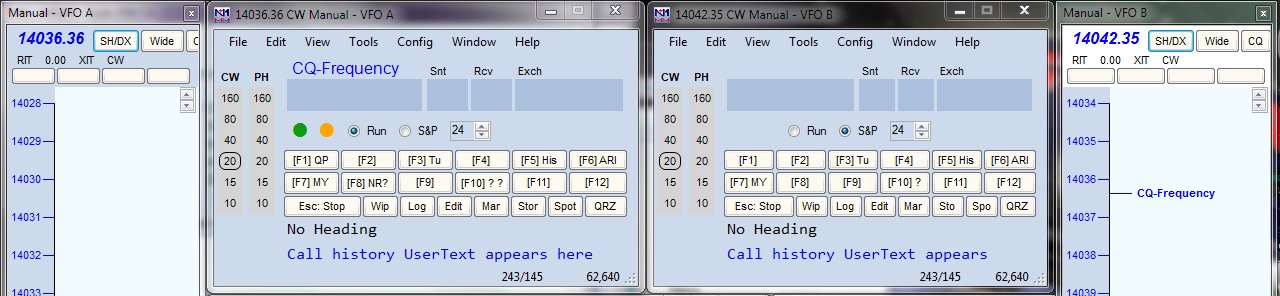
SO2-V in N1MM+ Logging Software
The major "rice box" manufacturers all offer radios sporting dual receive. 
With Kenwood, while the TS-950SDX is no longer made, the TS-2000 is still
being offered.  With ICOM, the retired 756 PRO III, along with the current 7600 & 7800
series provide dual receive. Yaesu weighs in with the FT-1000mp and the 
MK-V, as well
as the FT-2000 and FTDX-5000 radios. 


In the USA, Ten Tec offers the Orion II and of course the Elecraft K3 can be upgraded for dual-receive. Each manufacturer's approach to dual-receive have their pluses and minuses.
 
Before I switched over to the FT-1000mp, I had the incredible FT-920 at the operating helm. Unfortunately, from the true dual-receive perspective, the 920's "DualWatch" is incapable of operating in a true SO2V fashion.   The 920 DualWatch utilizes a "polling" mechanism between VFOs A & B.
As such, VFO-A & VFO-B cannot receive simultaneously.  It's either one or the other.


In contrast, the FT-1000mp utilizes two separate receive line circuits which can be active simultaneously.  (Of course during transmit BOTH receivers are silenced.). 

I configured WQ6X's 1000mp to split
the audio between left/right ears, with independent volume control in each ear. 


Unfortunately, the eDSP operates ONLY with VFO-A's receiver.  My solution to this shortcoming
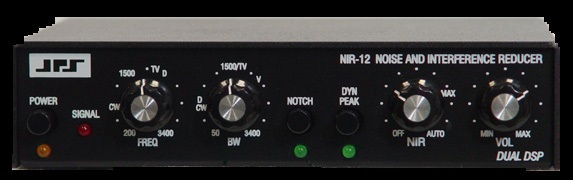
was simply to route the VFO-B's receive audio to an outboard MFJ 752-C Signal shaper and/or JPS NIR-12 DSP unit (depending on my "mood"); units which have been languishing on the shelf after acquiring the FT-1000mp.
 
MFJ 752-C
While both of these units are well over 20 years old, sometimes it is the older technology which makes the difference.  In the early 1980's, many of the more
expensive radios had Audio Peak Filters (APF) built-in. 

For the lower-end radios, the MFJ and JPS filters
essentially accomplished 
the same thing.

JPS NIR-12
Even the relatively inexpensive
Radio Shack DSP-40 outboard audio DSP filter made quite a difference w/most transceivers and receivers, surprisingly with no introduction any artifact.


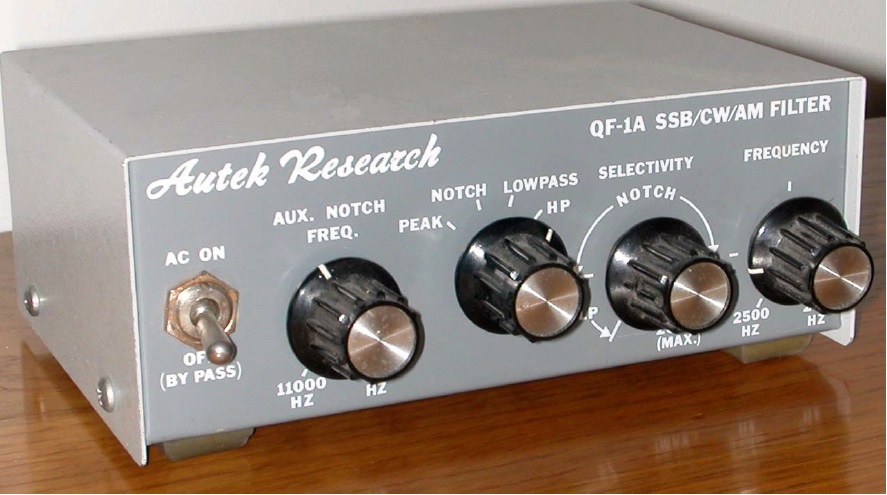
Because the FT-1000mp has no SUB-Rx shift/width/notch filters, the Autek and MFJ/JPS filters
more-or-less accomplish the same thing.


One day I would like to test an old Radio Shack DSP filter on the FT-1000mp SUB-Rx. 
This year during Field Day I test-drove running the FT-1000mp's 
sub receiver audio thru
the classic Autek QF-1A audio filter.  
I was surprisingly disappointed.
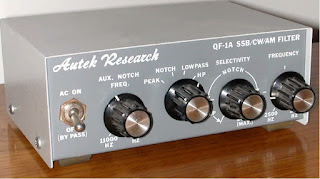

While the QF-1A is correctly a MONO device, not being able to bypass it mid-contest (by flicking a switch) limited its possibilities.  
 
However, the QF-1A is still the filter of choice when I run CW contests remotely from NX6T
in Fallbrook.


In the ideal world, dual receive allows me several possibilities:
  1. In a single mode contest, I can run a frequency (VFO-A) while tuning the band
    (VFO-B) looking for multipliers.
  2. In multi-mode contests such as state QSO parties or the 10-meter contest and Field Day,
    one VFO can tune the CW portion of the band while the other tunes the SSB segments.
    Either mode can be a RUN frequency while S&P'ing using the other mode.
  3. DX stations running "split" can use VFO-B to tune for stations while using and monitoring
    the RUN frequency. As mentioned earlier, in 2014, I spent 10 days as WP2/WQ6X at Radio Reef on the island of St. Croix.
    Outside of the contest period WP2/WQ6X put over 2,000 QSOs into the log. In retrospect, running the CW and SSB pileups should have been done split, using VFO-B. Unfortunately,
    the newness of dual-receive (and the nightly enjoyment of some island grog) kept the use of dual receive out of my reach.
  4. Dual receive also allows a technique known as "diversity reception", a methodology described briefly in the FT-1000mp operator's manual.
    Search the internet for "diversity reception" to discover what interesting things this approach can provide.  To help you with this I ran a web-search and came up with a lot of interesting items.
  5. [CLICK HERE] to see that search.


To accomplish SO2-V using the FT-1000mp, the radio was configured to direct most of VOF-A's audio to the left ear and most of VFO-B's audio to the right ear. 
 
The Yaesu FT-1000mp is equipped with firmware menu settings allowing custom-configuration of the split audio.
 
The menu settings I use for the FT-1000mp allow
both AF gain controls to act like gain controls. 
 
In contrast, with the old ICOM 756-PRO (about the same age as the 1000mp), those controls are labeled: AF Gain & BALANCE.


If you've never run split audio before, it might seem a little daunting at first.  Before jumping into actual SO2-V contesting using dual receive, I spent a couple of weeks practicing using both VFO's together until I felt comfortable with the method.  Like SO2-R, SO2-V is largely an ART, employing radio technology.
 
Being one of the first transceivers to offer up dual-receive, the FT-1000mp was well designed to locate the most used controls (for VFO-A) in the center of the radio and to the left of center. This correlates with the left ear.


The VFO-B knob is more to the right, correlating
with the right ear. 
 
When running a frequency with VFO-A, I LOCK that
VFO on the run frequency so I don't inadvertently shift frequency when 
I really mean to turn the VFO-B as I S&P elsewhere on the band.

In the contest world, properly taking advantage
of dual-receive requires 
CAT (Computer-Aided Transceive) software designed for this purpose.  
While WinTest and WriteLog can probably do the job, since N1MM has become N1MM+, I have found their approach to be the most effective match to my way of operating.


To be most effective, it is recommended to make use 
of dual computer monitors. 
 
When I run portable @W7AYT the WIN-7 Toshiba laptop I use for contest operating has an HDMI port making this an easy configuration. 


Somehow, the Toshiba laptop even "remembers" the different monitors I plug into it. Configuring the external monitor as the MAIN screen, leaves the laptop to display things
that do not need my immediate attention.

Then again, as you can see from the above photo, for the 2016 SSB Sweepstakes portable setup @ W7AYT I managed to fit everything (N1MM+ related) on the LARGE video monitor. Both methods have their advantages. 
 
To get used to the frantic nature of SO2-V using the contest pile-up trainer can help you work through the confusion before the actual contest weekend arrives.

  
Sometime ago, someone sent me a document with a detailed write up on running SO2V using N1MM. It is from this document that I learned the fundamentals of SO2-V contesting. From there, it was just practice, practice, practice. I searched the internet for this document and could not find it. Therefore, to make things easier, I uploaded a copy of it onto the WQ6X.Info web server. [CLICK HERE]
to read this document.

In summary, while a more complex method for running radiosport contests, SO2-V can certainly increase your operating efficiency if you take the time to learn the ins-and-outs of this method.
I don't wish you luck with SO2-V.  
Instead, I wish you SUCCESS.

Listen carefully for me during my next portable contest operation from the W7AYT QTH - I may well be running SO2-V.

Monday, January 13, 2025

Making the absolute transition from Reality to SO2-V: Some Operational ThoTs


Over the years I have learned the art of SO2-V (Single-OP 2-VFO's), altho I would hardly say
that I have perfected it.  Altho I've owned the Yaesu FT-1000mp for nearly 6 years, secretly I've yearned for the next level transceiver: the FT-2000; and one day an FTDX-5000mp.

18 months ago, Santa delivered a belated FT-2000 to the operating setup in Concord. 
While awaiting delivery, I spent a not-insignificant amount of time studying pictures and reading
the instruction manual cover-to-cover.  Time spent on the FT-2000 e-Ham discussion forum and AC0C's FT-2000 Mods/Info web section served to orient me to the similar but different world from
the FT-1000mp.


While the 2000 is an upgraded version of the 1000mp, they largely share the same operating philosophy; the front panel layouts are strikingly similar; overall, the FT-2000 "corrects" certain obvious ergonomic oversights in the original FT-1000xx series.  Amongst the operational enhancements, the FT-2000 makes a judicious use of color, on the LCD screen, as well
as the Sub-RX section of the transceiver.  

The front-end path icons cleverly placed across the top of the unit's LCD visually simplify understanding of the current signal path, from the antenna to the end of the AGC chain. 
For the 1000mp I considered adding and old MFJ-XXX pre-selector to the RX-ant path. 
As it turns out, the FT-2000 did just that with the VRF (Variable Roofing Filter) before
the front-end pre-amplifiers.  While this approach may seem confusing for some,
for me, it offers more knobs to twiddle; and you know how I like to twiddle knobs.

For me 6-meters is something new.  While my ICOM-7000 can run 6, 2 & 440, in my opinion
those bands are more-or-less an after-thought.  With Yaesu's FT-2000 & FTDX-5000 transceivers,
the 6-meter band is specifically accommodated.

Because this is a Blog about the concept of SO2-V techniques, I went to the WQ6X Blog homepage
and ran a Search on   SO2-V   discovering a number of references to the method in other Blog posts.  Searching for   SO2V   produced a different set of results.


Something not always understood regarding transceivers capable of dual-Receive (such as the
FT-1000mp and FT-2000) is that VFO-B usually sports less-effective (or no) selectivity offerings. 
It is for this reason I have configured a cascaded pair of JPS Dsp units (an NIR-10 and NIR-12)
inline to the VFO-B receive audio.

On a similar-but-different note, judicious use of switch boxes (for input AND output) along with
a USB mixer box (for signal input) and a Rockville mixer box to combine the audio from all the
filters into a destination audio stream is what makes the WQ6X operations work as well as they
do (when they do).


For 2025, close attention has been given to exactly which filter combination is best for which operating mode.  Overall, it would seem that the QF-1A's Stereo-Cw is best for GiGs like the
NAQP Cw contest.  The following weekend, during the NAQP Ssb contest, the MFJ 784 Dsp
(for the left ear) and the MFJ-752B (for the right ear) provided the "correct" audio balance to
improve voice inflection intelligibility.

Utilizing all the above filter combinations requires PRACTICE - LoTsa Practice.  During off-contest periods, I scan the bands and modes combining different filter settings to discover the most effective signal recovery during periods of Heavy QRM.  

The "secret" is in utilizing the filter combinations bulti-in to the transceiver to their fullest, while augmenting signal shaping with the external filters.  It may seem like a LoT of work, when in fact,
it gives me more knobs to twiddle - alleviating boredom and reinforcing the illusion that I can actually have an influence over the outcome.


With the hardware/software functional, the question becomes which VFO to use for what. 
The two main options are:

  • Run a Frequency with VFO A while Searching and Pouncing (S&P) with VFO-B
  • Search and Pounce with VFO-A, while running a Frequency with VFO B.
It could be argued that the overriding factor is the filtering system in-line with each VFO. 
Do I want more interference-free listening during S&P, or when actually running a frequency?
The only REAL way to determine that is to try both methods.  Working state QSO parties makes
for an excellent time to rehearse different operating method combinations.

Because state QSO parties and GiGs like the 10-meter contest are multi-mode weekends, another use for SO2-V is to run each mode on a separate VFO.  Because the 2ndary RX in most dual-receive transceivers has less filtering, I tend to run SSB on VFO-B while making Cw contacts using VFO-A.

Some operators feel that SO2-V (and even more so SO2-R) over complicates operating and makes
it LESS fun.  Years of experience has for proven for me otherwise.   Nothing worse than the inability
to copy incomprehensible signals due to acute Space-WX or other anomalies.  With SO2-V difficult, non-enjoyable operating periods can be transformed in a matter of minutes to fully productive run periods.

Most likely the transceiver you use has TWO VFOs.  Read the operators manual for that unit
and piece together your OWN approach to Single-OP Two-VFOs.  You'll be glad you DiD.

Thursday, May 11, 2017

LEARNING the ART of LEVERAGING DUAL RECEIVE


While most amateur transceivers support dual VFO's (A & B), only the top-tier radios support dual-receive (sometimes called Dual-Watch). Additionally, only the top-end of the top-tier radios provide
the capability of dual-receive on different bands. The Kenwood TS-950SDX, Ten Tec Orion II,
Elecraft K3 and Yaesu FT-1000mp Mk-V & FTDX-5000mp are major players in the top-end.


I personally chose a fully-filtered Yaesu FT-1000mp for my dual-receive efforts.

The Secondary (or "sub") receiver is easily invoked by way of a Blue [DUAL] button perfectly located to the right
of the tuning knob.

Using the "`" key (top-left on the keyboard under the ESC key) in the N1MM+ logging software makes it easy to enable and disable the SUB receiver.


A caveat of dual-receive is that the VFO B receiver section (sometimes called the SUB receiver) is usually not as well filtered as the Main RX.

With the FT-1000mp, the 2nd receiver
is only dual conversion; whereas the
Main RX is a triple conversion deign.

Then again, the SUB-Rx is less
prone to signal "images".

While both receivers have independent AGC systems, the Shift/Width/Notch
and eDSP circuits are functional
ONLY with the Main RX.


Originally when I decided to relegate the FT-1000mp to main radio duty, I retired the
JPS NIR-12 and MFJ 752-C outboard DSP/FILTER units.

Now that I have brought dual-receive (SO2V) into WQ6X contest activities, these outboard audio conditioners have been given renewed purpose.

These units are now cascaded to 
process the Sub-RX audio (for VFO-B) effectively providing DSP-like audio processing for BOTH sides of my head.

After considerable operating time,
you will get a proper feel for what kind
of outboard DSP filtering is right for you.

Sometimes you WANT a more wide-open sub-receiver in order to look for other stations.

Then when you find one, if needed you can SWAP VFO's to actually work the station and then
Swap them back.  If you are running SO2-V in N1MM+, you don't need to swap VFO's; pressing
keys from data entry window "B", puts the radio in SPLIT mode before making the transmission
and then returns the radio to "normal" operation - a very CLEVER way of doing things.


The 1000mp is equipped with AF Gain controls for BOTH the MAIN/SUB receivers allowing me to customize the audio balance between both ears.

Additionally, thanks to the AF-REV button on the 1000mp, I am able to swap VFO A / B audio between left and right ears.

As you can see, the transceiver's menu system allows me to declare how the sound is ACTUALLY split up between the Left/Right channel of the headphones. 

I prefer to use the Stereo-1 setting which splits the audio between left and right ears, but with only 80% isolation; not 100%, as experienced with the Stereo-2 setting.


Because the FT-1000mp was designed specifically for dual-receive, putting the 752-C and NIR-12 in the right channel audio line to process the SUB-Rx is not a difficult undertaking.

It was only recently (during the 7QP/NEQP contest weekend) that I first tested this configuration using RCA-style audio patch cords.

[CLICK HERE] to read more about that setup.

For a more permanent setting I will make a set of custom audio cables directing the output to yet another device - a Radio Shack stereo equalizer.

The equalizer's 10 settings per channel will provide final "shaping" of the frequency response for each ear individually.


Once you have your Ears sorted
out, now what do you do with it?
The possibilities are numerous.

Sometimes while operating I might

want to check the WWV space
weather forecast(s) (at :18 & :45
minutes past the hour).

In the 1000mp, I have ALL of the WWV & CHU frequencies memo'd, in order,
so they are easy to bring up.


Because the sub-receiver is intended for in band reception, the WWV signal strength will be seriously attenuated; however from my usual operating location WWV is always S9+ on one or more of the memo'd frequencies.   Normally, WWV is presented to my right ear.
For SO2-V purposes, the AF-REV button allows flopping the two ears.


If I am on 20, 15 or 10 meters,
I sometimes want to make a listen
to the NCDXF beacon for that band.

On 10 meters, the entire 28.200 - 28.300 frequency range is LOADED with numerous propagation beacons.

The SUB-Rx is a PERFECT candidate for listening to beacons while running

a frequency or S&P'ing under VFO-A.

Another use for Dual receive in a single-mode contest is that it allows me to S&P with the right ear, while running a frequency in the left ear.


In multi-mode contests (such as QSO Parties and Field Day) with two VFO's I can easily run
a CW frequency on VFO-A while using VFO-B to search and pounce SSB contacts.

Now, all this takes practice, like learning to walk and chew bubble gum. Work your way up to full blown operation by spending hours practicing JUST RECEIVING with a VFO for each ear.


Testing the MFJ 752-C & JPS NIR-12 together

The N1MM+ logging software has done an incredible job of implementing Single-OP 2-VFO (SO2-V).

N1MM's design is such that EACH sub-window in the software can be moved anywhere you choose.

When I run SO2-V I tend to use an N1MM+ configuration something

akin to the picture below.


Notice that EACH VFO has a Data Entry Window and a Bandmap.  Many operators prefer to get rid
of the bandmap for Radio A as they are running a frequency there and not S&P'ing from that VFO.
I actually PREFER to keep Bandmap-A on the screen as it allows me to be on the constant lookout for 3rd-party stations moving in on what was previously a "Clear" RUN frequency.


Some people tell me they easily get too confused so dual-receive and SO2-V is just not for them.
That sometimes happens to me when running a frequency with a lineup of stations waiting to work me. Bottom line: if I get TOO confused, I switch out the sub receiver and regain my sanity by
focusing ONLY on running the frequency with VFO-A. Practice makes perfect.


In a mixed mode contest (such as a state QSO party, the 10-meter contest or Field Day) Receiver
A & B can be leveraged into working BOTH modes; the "primary" mode being in the left ear.

In the 2016 SA-10 10 meter contest, I was running a frequency on 14.045 using VFO-A, while tuning around for SSB contacts up frequency using VFO-B. The end result was a 1st place (world-wide) finish using MIXED mode.


There are more things to be said about Single-OP 2 VFO's in contesting.
When I was operating as WP2/WQ6X from Radio Reef on St. Croix, at one point I was

running a frequency on SSB with VFO-A, while S&P'ing random stations on CW using VFO-B. 
MFJ 752-C & JPS NIR-12 in Actual Operation

The possibilities are quite varied when using DUAL VFO's, however it takes PRACTICE to make
it all operate smoothly. Equipment glitches on top of that can make things completely chaotic.

If at ANY time you find yourself out of synch with the two receivers or feeling FRANTIC, turn off
the sub receiver, re-focus and re-connect with the original RUN Frequency under VFO-A.

Things can degenerate dramatically if you don't know what you're doing.

Dual Receive can be a WONDERFUL tool, if you use it properly.

Use it properly, don't let it use you to Lose.


Wednesday, July 16, 2025

SO2-R: Why I've NeVeR made the transition


The following has been like this for "YEARS" as is evidenced by the referenced dates.

Over the years I have more-or-less figured out the art of SO2-V (Single-OP 2-Vfos);
essentially leveraging the Sub-Rx inside the Yaesu FT-1000mp to run dual-mode (for GiGs
like the 10-meter contest) or running a frequency while S&P'ing (Searching and Pouncing)
on the side.  For me, there is no doubt that SO2-V dramatically improved operating efficiency
overall.  Then again, it is just as easy for things to become hopelessly confused, turning it into
a completely wasted effort.

For 2022, WQ6X radiosport activities begin with a Yaesu FT-2000 transceiver, relegating
the FT-1000mp to 2ndary status.  The eventual goal seemed to be seamlessly integrating the
FT-2000 into the same operating position originally occupied by the older FT-1000mp, which
is then re-positioned to be ready for an actual basic SO2-R operation, later this year.

Performance-wise the FT-2000 features take the original FT-1000mp operations to the next level. 
Both transceivers integrate stereo Cw quite well, with the color screens of the 2000, adding to the
visual aesthetic experience.  While the K3/0 is a most effective radio setup for running remote operations, nothing compares to the incredibly well laid out ergonomics of the FT-2000.

So why would I want to go to all the trouble (and expense) to create a fully functional SO2-R
setup?  If you look at the above stat comparison from the 2025 ARRL DX Cw contest, notice
that MOST of the Top 20 entries (80%) were running SO2-R or 2BISQ (an SO2-R variant).

NX6T ran as a "Multi-2" operation offering two uniquely different remote radio operations. 
STN1 unfortunately was plagued by "bubbly" internet resulting in Cw character dropouts. 
While your signal may have been quite strong, the dropped characters required numerous
repeats - sorry about that folks.

Time spent running NX6T eliminated the need for separate off-time. 
This was fortunate as the final 2 hours brought last-minute openings on 80 and 160 meters.

By 10pm it was all over.  For me, there was nothing left to do but COLLAPSE on the bed listening
to Latin Jazz on shortwave using the ICOM 70000 - a GREAT SWL receiver.  As quick as the NAQP Cw made the scene, the Cw bands became silent once again - time enough to post the 3830 score and submit a log immediately.


As it turns out, MY solution to this issue is to run SOAB QRP.  Rarely, do we see a QRP
operator running some variation of SO2-R, except in this GiG K6JS who took 2nd place. 
For me, this certainly is a less expensive and less of a setup hassle approach to making
a high score.

The REAL solution is to give the SO2-R / 2BISQ operators their own "playpen", moving them out
of OUR playpen.  Some contests, solve the SO2-R "problem", by instituting a 10-minute band requirement, meaning once a QSO is made on a given band, you are not allowed to make QSOs
on other bands for at least 10-minutes.

What do you think about this?

Are YOU an SO2-R / 2BISQ operator?

Are you OK with only competing against other SO2-R / 2BISQ operators?

Share with us YOUR thoughts on this.


Tuesday, February 24, 2026

WQ6X Wangles a Weirdly Different ARRL DX Cw ConTesT


For numerous reasons (too complicated to elaborate on at this time), instead of running QRP
remote from Southern California, the decision was made to run low power (LP) assisted using
the Yaesu FT-2000 that has been languishing @W7AYT's QTH in the East Bay (EB) ARRL section.
Having recently revamped the audio lines for this setup, it made sense revamp the computer/antenna
cabling inside the shack.

The weekend operation was plagued by two issues. unfortunately, not actually resolved
until Sunday evening (after the contest was long over).

  • RFI in the shacking BOMBing the USB cable to the RigExpert CAT interface unit
    (solved by shifting the USB cable to a port several feet away from the MFJ-993b IntelliTuner).
  • HORRIBLE internet "jitters" (Solved by a thorough / lengthy modem/router restart.)

Of course, the advantage of running locally is no need for internet access to run the radio.
Then again, there are no RFI issues at the KN6NBT and WA6TQT remote installations.

As mentioned earlier, RFI was a HUGE problem on 80, 40 and 20 meters when using the "infamous" WQ6X 8JK Cobra wire array.  Dialing back the power from 90watts often down to 30-watts in some cases seemed to resolve the overloading somewhat.

For the high bands (20-15-10), a 10-meter Long John yagi worked superbly on 10-meters
and performed remarkedly well when tuned as a rotary dipole on 20 and 15 meters.  Compared
to the 8JK array, the yagi on receive resulted in relatively noise free reception, altho the 8JK array probably produced a stronger signal on transmit.

Similar to recent radiosport weekends, the ARRL DX contest was plagued by numerous
geomagnetic storms throughout the weekend.  Reading numerous soapbox comments,
there seems to be a general consensus that Friday evening and most of Saturday, propagation conditions were quite good, especially when you take into account the [relatively] low SFI (111)
and K-Index floating between 3 and 4 much of the time.

Sunday morning the high bands were so quiet (dead?) there was a concern that either the radio equipment (and/or the antenna system) had failed.  Around 20:00z conditions dramatically improved (relatively speak), altho there seemed to be a dearth of "NEW" stations for the log.  It was at this time
I switched to wireless operating the radio while laying out on a comfortable bed.

With all the different effects induced by the drastically changing Space-WX, using the Stereo-CW method made signals more readable, reducing the number of "repeats" necessary to complete a CW communication.  Making the decision to run SO2-V for this contest, Stereo-CW became an absolute
MUST, to keep the signals properly "sorted out" in each ear.  When running pile-ups, there is no need for SO2-V.  Then again, on days like Sunday in this contest, at the very least, SO2-V helps alleviate the boredumb in between QSOs and RUNs.


When it was all over, WQ6X was largely at the bottom of the heap, except for California (CA), 
East Bay (EB) Section and Pacific (PAC) Division.

DiD YOU work the ARRL DX ConTesT?

How many Countries or States/Provinces DiD YOU Get?

Is WQ6X in YOUR Log?


Sunday, May 1, 2022

Stereo-RTTY: Is It Possible? (What can We Do with it?)

Since January, I have been learning the In's / Out's of a newly acquired Yaesu FT-2000 Transceiver.  Like its predecessor (the FT-1000mp) it effectively utilizes in-band dual-RX, making possible an operating technique known SO2-V: Single-OP 2-VFO's.  When running Cw or Ssb, I can either operate SO2-V (with RX-A audio to the Left-Ear and RX-B audio to the Right-Ear) or, I can run
things using the Stereo-Cw/Ssb method(s) I have written so much about.

With both the FT-1000mp and the FT-2000, SO2-V is largely a no-Brainer, regardless of the mode; even mixed-mode (Cw / Ssb for example); I can run a frequency with one VFO while S&P'ing
with the other.  The array of external audio & DSP filters enhance these methods considerably.

However when it comes to actually decoding RTTY, by default, external audio filters are of no
use as RTTY decoders (like the RigExpert Plus unit I use) take their audio input BEFORE the
audio is sent to the audio output jacks on these radios.  In preparation for Part II of this Blog
series on Stereo-RTTY, I will find a way to intercept the RX-audio line for the RigExpert decoder. 
By redirecting this line to an RCA plug/jack arrangement the external filter array can be "inserted"
into this audio line, enabling peaking/notching the audio-data stream to make it more QRM/QRN
free and therefore the data becomes more easily decoded.

Using the Stereo-Cw method, with the filters properly adjusted, multiple calling stations seem to appear (spatially) at different "locations" in the listening experience.  While I can use the clarifier (CLAR) knob to position a signal at an audio frequency that one of the PEAK filters can peak into "better" readability, usually it isn't necessary, in order for my brain to "decode" a given Cw station.

With RTTY it is a different situation altogether; in order to achieve proper/accurate decoding, the station must be tuned-in more-or-less precisely on the correct frequency for the individual tones
to be properly decoded.  It is for this reason that Stereo-RTTY has different operating objectives.

Because the essential benefit of the "Stereo" concept is to have calling stations arranged "around" the operating position in a more-or-less 180-degree azimuth arc, I have questioned the value of stereo audio in a RTTY contest.  As it turns out, Stereo-RTTY is most useful when calling stations are off frequency.  When you think about it, if several stations are calling on EXACTLY the correct frequency (as they should be), they will jumble over each other, making proper decoding tricky at best.

With Stereo-RTTY, the idea is to adjust the Peak Frequency of the external filters (which for WQ6X
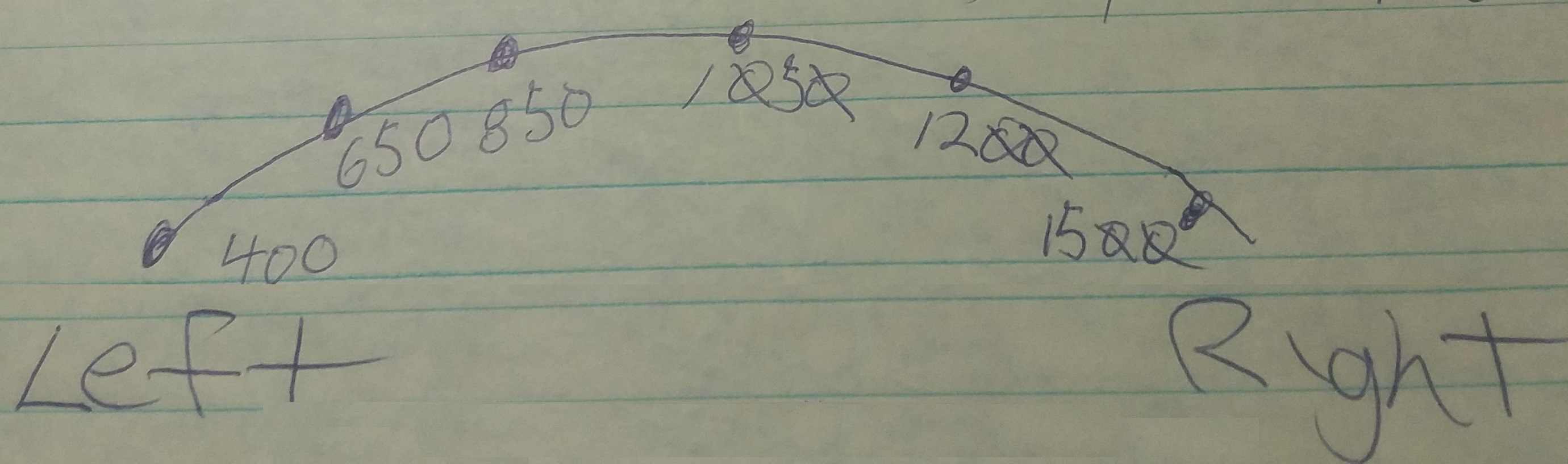
is a pair of Autek QF-1A's) such that the signal "appears directly in front" of the operator.  Off-frequency calling stations will appear "to the left" and "to the right".  We of course use the (CLAR) control for tuning-in the station until property RTTY-decoding is achieved.  With Stereo-RTTY, the listening "position" of that station should shift more-or-less towards the center of the listening experience.  The individual RTTY tones should "appear" more-or-less on either side of the center listening experience.

Because all this is being accomplished using the PEAK function of the external filters, theoretically the signal/noise ratio should improve, enhancing the decoder software's ability to interpret relatively weak signals.  Prior to inserting the QF-1A's into the RTTY audio line, the improved listening-aesthetic was discovered which led to the question of whether or not [so-called] Stereo-RTTY
could actually improve operating efficiency.

I invite you to use a pair of (ideally identical) audio filters to hear what Stereo-RTTY actually sounds like; if you like it, then insert those filters into the decode-audio line and take your RTTY operations
to the next level, in the same way we did with Stereo-CW.

[CLICK HERE] to read Part 2.


Wednesday, December 13, 2017

WQ6X Survives 2017 ARRL 10-Meter Contest

WQ6X after dark
What can I say about the
2017 ARRL 10-Meter Contest?
Considering that we are currently
 at the bottom of solar cycle 24,
I wasn't expecting a lot, however
I CERTAINLY didn't see THIS coming. While the A & K indexes were low,
so was the solar flux (SFI) - around
70 - Bummer Dewd.
(In retrospect, we should have conducted an emergency run of the
10-Meter contest during that false-hope 150+ spike in the SFI back in Sept.)


Operating portable from W7AYT's QTH, I gave the newly installed (October) Hy-Gain 3-element 10-meter yagi a good workout. The antenna had such a "narrow beam-width" that when I happened onto the "Colorado corridor) (around 06:10z) 4 Colorado stations hit the log almost immediately; however without the peak capabilities of
the outboard QF-1A filters, they would have been lost
to the noise.

This year's 10-meter event was largely a CW affair; my condolences to the SSB only operations. Throughout
the weekend I put out lengthy CQ calls on 28484.84 & 28434.34, with only a handful of takers. It seems to
me that people gave up too quickly.

Normally I would not work 10-meters past about 03:30z. Continuing another 4 hours made a big difference as that
is when several northeast multipliers made it into the log.


Altho I technically ran as an SO2-V (2 Vfo's) operation, there was so little SSB activity that SO2-V for cross-mode work was virtually unnecessary". However for CW, I could run a frequency using RX-A while S&P'ing bandmap spots with RX-B.

FT-1000mp with dual outboard QF-1A filters
Running SO2-V was much easier with an Autek QF-1A audio filter for each ear, which allowed me to simulate what is known as stereo-CW. Properly wired, with stereo-CW a signal will shift from one ear to the other while tuning "THRU" the signal (either up OR down).

While the actual QSO count in this weekend's GiG was noticeably lacking, the FT-1000mp's outboard wiring was given a a through shake-down. Simplifying audio cable clusters made the audio filter trial/error proceed more smoothly.

Because of the strange noise characteristics during the contest, the FT-1000mp's eDSP Contour/NR knobs we constantly being juggled, looking for that EXACT combination with the QF-1A filters to bring a marginal signal through. Despite all that, no states east of Colorado & Arizona made it to the log; they were simply not even HEARD.

While WQ6X CW QSOs were occasionally spotted, I think most stations either heard my call randomly, or by slowly and patiently tuning the bands. While I ran assisted, spots often disappeared as quickly as they appeared. Typing in manual spots for those frequencies kept them around longer. Unfortunately, because of weak signals there were numerous partial callsigns positioned luckily next to a callsign correction; but not always - hence the frustration.


As disappointed as I was with the QSO totals in this GiG, reading score submission reports from all call areas it is clear that my experience was hardly unique. While the 10-meter contest seemed more like the California QSO Party, in the midst of it all, CW5W and PT3T made it into the log Saturday afternoon. Spots were seen for KH6 and several VE6's & VE-4's stations, but you can't work'em if you can't hear'em.

Typical of most 48 hour contests, on Sunday, paint was drying faster than I could make QSOs. The real accomplishment was to hear my good friend N6GEO calling me on SSB. A QSX to 14.032 picked him up on CW as well. He was 1 of only 2 other stations that worked WQ6X multi-mode. Pointing the yagi towards Twain Harte made the CW QSO possible. Were we communicating via skip, or (more likely) ground wave?

That evening I worked W7AYT as he ran his FT-450D into the CHA-250 vertical, also at the QTH. This was technically his FIRST contest QSO - how cool is that?!


RF susceptible cable equipment


During a recent contest, I received
a visit by the local cable guy to check their pole-based equipment.  For the ARRL 10-meter contest he was back again.

A few questions and answers between us pinpointed that their equipment is susceptible to 2nd harmonic interference from 28mhz
(i.e.. 10 meters). 


What Dingle Dork came up with the brilliance to park a system critical component on a frequency which is the 2nd harmonic of a potentially signal-riddled amateur band; amateurs can run up to
1.5kw, which can envelope cable equipment. Pointing the antenna towards the Southeast and
South America positioned the yagi; in an end-fire null-position of the cable unit.

However point the antenna to the Southwest (Oceana) or Northeast USA,
the antenna
is then BROADSIDE to the cable equipment; over-powering it and disrupting it.
While the yagi's F/B is 24db, that close, -24dbm means nothing.
My next operation @W7AYT is not for a few weeks; there's time for
them to get their act together. Can you say "Faraday" shielding?
We shall soon know the answer.


When I think back on it, the poor 10-meter propagation kept me CQ'ing more which kept the cable equipment offline longer; until nearly 07:00z (10pm) on Friday AND Saturday evening; primetime cable viewing time.

You have heard me say "When in Doubt CHEAT, but within the rules".  I even wrote a BLOG entry about this.  [CLICK] here to read that BLOG Entry.  Along this line, I saw fit to employ an EASY button bringing humor into this deplorably dismal 10-meter contest.


The 2017 ARRL 10-meter contest is now "ancient history". It would seem that my complaints (other than the cable problem) were shared by most amateurs around North America; altho to varying degrees. From the East Bay (EB) section, evening propagation to the North Northeast direction
was a noticeable reality Friday evening; whereas as Saturday evening, no such path was evident.


Based on score submissions to the 3830 Scores website, it would seem that WQ6X took a 1st place for East Bay section and a 2nd place for W6 (California). That is based on the assumption that
the Log Checking Robot (LCR) doesn't ding my submitted score too much.

Do YOU work the ARRL 10-meter contest.

Did YOU survive the horrible condx?

Is WQ6X in YOUR log?


P.S. The wildfires which threatened NX6T died out just a mile from the hilltop. 
N6KI operated from home until Sunday when Dennis and K6AM (John) put NX6T
on the air for a few hours.

Monday, June 3, 2019

WQ6X Nearly Drowns Again during 2019 SEANET

Long John Yagi, Lazy 8JK Sloper & JA Sloper
(CH-250 Vertical upper-right)
You may recall, exactly one year ago today, I was complaining about how the SEANET contest went (meaning how it DIDN'T went).  I went on to detail
how beacon tracking saved me from drowning. 
([CLICK HERE] to read that write up.) 

Fast forward to 2019 and beacon tracking; the importance of it is now part of my operating "fabric". 
In fact, just 2 weeks ago I revamped the beacon discussion with some newly discovered information.  ([CLICK HERE] to read that).

While reprising a SEANET operation was indeed on
my mind, ostensibly, the actual real reason for my appearance at W7AYT's QTH was to thoroughly evaluate the antenna system and perform an audio cable shakedown in conjunction with proper CAT control of the entire operation. 
I also took the time to experiment with what I am
calling SO2-V 3.0 (more on that later).


Scrolling through the WA7BNM Contest Calendar for June, I came across 5 unique (altho mostly foreign) radiosport events which caught my attention as worthy of looking into further:
  1. [O] - The 3-Part DigiFest - beginning 04:00z on Saturday
  2. [O] -The [infamous] SEANET Contest - 12:00z
  3. [O] - The Kentucky QSO Party (KQP) - 14:00z
  4. [O] - RSGB National Field Day (FD) - 15:00z
  5. [O] - Dutch Kingdom Contest - also 15:00z


While the Space Weather SFI finally rose to 69 after the contest period, during the actual weekend itself it never rose above 67 as the A-Index worked its way down from 20 ==> 5.  Here in the SF
bay area there was a lot of high noise-level;  at least the lower-level stuff was easily massaged
out by the FT-1000mp's DNR (for the L. Ear) and the JPS NIR-12 (for the R. Ear).

Contest-wise, the DigiFest never materialized; not @ W7AYT and not @ NX6T - Bummer Dewd! 
The Dutch Kingdom GiG was also a no-show for WQ6X; although plenty of European spots were seen on the bandmaps, nothing workable was actually heard.

Because the SEANET GiG is largely a Pacific Rim affair, I turned NX6T's Shorty-40 and Stepp-IR antennas to approximately 300-degrees hoping for some SeaNet Calls; there were none. 
OH NO! - 3 GiGs down, only 2 left.


Saturday morning, tuning the bands
from BOTH NX6T and W7AYT, no KQP (Kentucky) stations were heard at that time.  Additionally, 20 meters did not provide the hoped-for opening to
Europe for the RSGB and Dutch GiGs.

Client commitments kept me out of the ham shack most of the afternoon, giving me only one final hour to look for KQP stations. 

One of my biggest beefs with state QSO parties (other than CQP) is the fact that not nearly enough [target] stations participate
in their own QSO parties. 

It's one thing to blame propagation to
my area(s).  If the stations exist and for whatever reason I can't hear them, at LEAST they should appear in the logging software's Telnet-influenced bandmaps. 


The only spots found were for the TWO QSOs which eventually made it to the WQ6X KQP log. 
Let's tell the truth about it - if the SPOTs aren't there, then stations are NoT transmitting.

Despite a disappointingly low Solar Flux (SFI), in recent weeks there have been more strong
openings to Europe (on 40-m & 20-m) than we left-coasters have experienced in several years. 
During the WPX Cw contest, several European QSOs made it to WQ6X's log from the SF bay area, testament to the N-E low-angle directionality provided by the Lazy 8JK Sloper's recently-replaced 110-Ohm termination resistors.

With 4-of-the-5 radiosport GiGs behind me, it would be up to the RSGB Field Day to make this weekend worth something.  While East and Mid-West stations take working England for granted,
on the LEFT coast, England is considerably more of a rarity than an expected occurrence. 

During the 05:15z - 05:45z period two "G" stations and one "M" call made it into the RSGB FD log. 
Being weak signals to begin with, there is only so much the DSP/Audio filters can do to bring them above the noise-level to copy an exchange #.  By 09:00z on Sunday, Europe had all but faded out. 

Pointing the Shorty-40 towards Asia and the Pacific yielded numerous Japanese stations working each other in some sort of domestic JA event, however nothing was heard having anything to do with SEANET.  A tipoff that SEANET may have problems attracting players is that looking at their website, everything BUT how to call CQ for their event is documented.

Leftover for the weekend was to get some sleep and spend time practicing using split audio most effectively for running dual-RX with the Yaesu FT-1000mp in preparation for properly documenting what I am calling SO2-V 3.0 - a more balanced approach to SO2-V, taking advantage of the feature-set built-in to the 1000mp in conjunction with the external filtering.

Because the Yaesu radio sports TRUE stereo separation (and various "flavors" in between), stereo-CW (and even stereo-SSB) are very much a reality.  Admittedly it takes getting used to tracking two different happenings at the same time.  However, when one ear is copying CW while the other ear is listening for SSB, it is actually a joy to run both simultaneously.

What about YOU? 
Do you ever run Dual-receive?
How has it worked for you?