Showing posts sorted by relevance for query SO2V. Sort by date Show all posts

Friday, June 28, 2019

For Little Pistols: Why CQ is Important

During radiosport contests, do YOU
ever call CQ during the event?
If NoT, WHY NoT?
If so, are those CQ's effective?

In a recent BLOG entry I made the point "if everybody is listening and no one is transmitting...", a band will appear to be dead when in fact it could well be WIDE-Open.

Despite the low SFI. I encounter this phenomenon regularly on 10 meters. 

In the early afternoon, tuning the band and not hearing anything, pointing the yagi towards South America and calling CQ, I am not surprised to have a half-dozen SA callers returning the call. 
As quickly as they come, the band again appears dead.  When I run radiosport events, depending
on the circumstances, operating time is divided between S&P'ing (Search & Pounce) and calling CQ.

There is a myth that we have to use high power amplifiers if we are going to call CQ and run a frequency, whereas the truth is something else entirely.  During the November Sweepstakes I have called Q-Power stations (QRP) calling CQ, running a frequency for an hour or more; now THAT
takes courage.

Ending this BLOG, I will suggest situations that are ideal for being the CQ-caller, regardless of the power level you are running.  It is manifestly provable that low power stations actually have several advantages that many high power stations don't.

In Part 7 of the "WHY I Do Radiosport" Blog, I suggested that utilizing SO2V as part of your operating-repertoire can improve the QSOs/hr rate considerably.

Essentially, the SO2V method is simply a combination of Search-and-Pouncing and calling "CQ Contest".

In order to run SO2V you must be comfortable with running a frequency, which implies being comfortable with calling CQ.

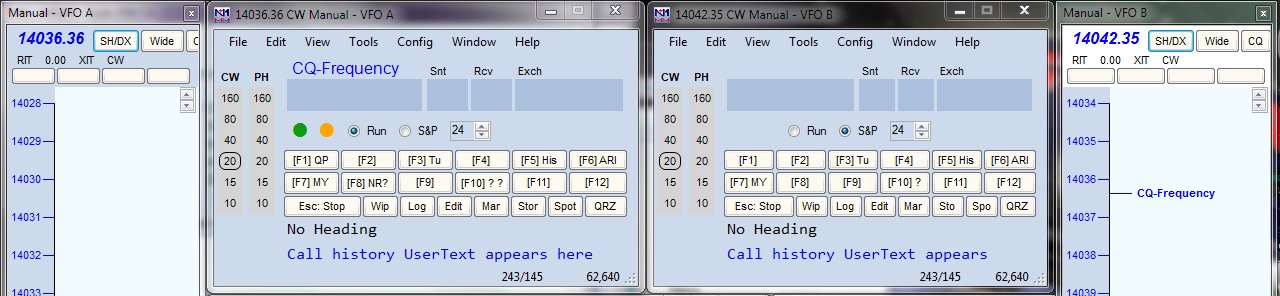
  • In The World of SO2V Blog I explain how VFO A & B are utilized to maximize the hourly QSO-rate.  Doing this requires you to be comfortable with dual (i.e. stereo) receive.
  • In the Learning the Art of Dual-receive Blog, I detail the importance of properly processing the audio in each ear as many sub-RX units have poor selectivity (compared to the main-RX) needing outboard filter assistance in order to be effective for SO2V.
  • In the WQ6X SOUND PROCESSING Blog, I explore the above problem more thoroughly.
As you can see, I am advocating the use of SO2V and dual-receive. 
Here are some things we can do with SO2V:
  • In single-mode contests (SS, NAQP, DX/160-GiGs, WPX GiGs and RTTY contests)
    • A) Search & Pounce w/VFO-A
    • B) Call CQ (same band) w/VFO-B
  • In mixed-mode contests (FD, IARU HF contest, 10-Meter GiGs & state QSO Parties)
    • S&P both modes (Ex: Cw w/VFO-A & Ssb w/VFO-B)
    • Call CQ in one mode (Ex: Cw w/VFO-B) and S&P using the other mode
      (Ex: Ssb w/VFO-A)
Now, back to the issue of Calling CQ. 
Regardless of power level, there are times when calling CQ is to your advantage:
  • When you activate a county in a state QSO party, or a state park.
    One of my beefs with state QSO parties (other than CQP) is that there is not enough
    in-state activity; put simply, not enough people participate in their own QSO parties.
    Several years ago I won the 7QP QSO party because I spent a considerable amount
    of time calling "CQ 7QP".  Most of those stations who called me should have been
    calling CQ for themselves, not me.
  • Being in a "Rare" ARRL section such as DE, NNY, VI, NE or NT.  Spend 2/3's of the
    time calling CQ - stations will FLOOD your passband.  Eventually you will have to S&P
    to find the other rare sections; then again, they may find you first.  Many a contest I have been surprised by a call from stations in VE8, VE9, VY1 & 2, VO1 & 2, SC, and yes, even Nebraska (NE).
  • Having a "weird prefix" (Ex: WQ6X or NX6T) is an excellent reason to call CQ in the WPX contests.  Each weird prefix adds to the multiplier count which makes calling CQ an obvious thing to do - contest participants are LooKing for us weirdoes.
Some operators are reluctant to call CQ Contest in Cw GiGs because their code speed is slow;
a couple of weeks listening to W1AW code practice bulletins will remedy that somewhat. 
Then again, when you run a frequency, YOU control the WPM speed you are comfortable with. 
Don't be intimidated by 30 Wpm callers; it's ok to send "QRS" - don't apologize for doing so. 
While I personally like to run at 23 - 24 wpm, if you are more comfortable running at 20 wpm or less, then that is what YOU should do.  Remember when you run a frequency, YOU control the parameters regarding how "business is conducted" on that frequency.

You may be ok with faster Cw speeds but are intimidated by running a frequency in a contest. 
There is "pileup trainer" software freely available on the internet that will allow you to work up
your courage-level.  (LooK for a separate Blog entry about this software soon.)

That's all I got for now on this subject folks.
Bottom line: Calling CQ is the heart & soul of radiosport.
Don't let running low power stop you from running a contest frequency.  As it turns out, in
general, there is less competition in most radiosport GiGs running LOW power, than running high. 
Most of my important contest wins have come from running < 150 watts than from running 1300.

When was the last time YOU called CQ and ran a frequency in a radiosport contest?

How did it turn out?

Monday, August 8, 2016

WQ6X Joins SCCC Team #1 for NAQP CW

WQ6X operating position
Comet CH-250 Vertical

The CW/SSB NAQP 12 hour contests happen twice a year: January and August.  (RTTY variations of NAQP happen in February and July).

For the August 2016 NAQP gig, I joined SCCC (Southern California Contest Club) team #1, again operating portable from W7AYT's QTH in Concord (East Bay ARRL section).

While the location sports only a vertical antenna, for ease of setup the location can't be beat.  Dennis' other contribution to my operation was some EXCELLENT homebrew food Saturday evening.

For this NAQP event my main goal was to learn/perfect the art of SO2V (Single OP, 2 VFOs) encouraged by a VE3 writeup on the subject.  Reading all about SO2V is one thing; making it actually work is a completely different contesting challenge than what I am used to.

Luckily, the FT-1000mp and N1MM software are integrally integrated.  The N1MM keyboard layout to make SO2V work was well thought out; using keys on both sides of the alpha key structure.  My only beef with N1MM is that during program startup the ENTRY window for VFO-B is hidden behind the window for VFO A - even if you save window positions before shutting down the software.


In implementing SO2V, a number of times I got frustrated and manually swapped VFO A & B to quickly make the contact so as not to confuse the station on the other end.  Eventually I got the feel for SO2V and it became more "fluid".  Practice (and not giving up) breeds more precision.  It will be interesting to see if I can repeat the SO2V experience in 2 weeks for the NAQP SSB contest.


Space weather wise band conditions above 15 mhz were rather bleak at the W7AYT QTH; altho it seems that most W6 stations shared a similar experience.  I only worked one W6 station above 15 mhz (on 10 meter CW).

Other W6 stations suggested that 15 meters possessed sudden propagation shifts allowing them to work other countries.  In retrospect I should have checked 15 meters more often.


Country wise, the only entity I worked was NP2X (Virgin Islands) on 40 meters.


20 meters became the predominate daytime band followed by40 meters during the evening. Although I made a number of 40-meter run attempts throughout the afternoon, they yielded merely a handful of QSOs.  Considering that I had run out of 20-meter stations at that moment I guess the switch to 40 meters at those times were warranted.


Surprisingly, altho I ran the Yaesu into a roof-mounted Comet CH-250 vertical, the noise level at W7AYT's QTH was quite low - no need for the 1000 MP's DSP noise reduction facilities.

Unfortunately, signal levels were ALSO way down.  Whether that was due to the use of a (no-gain) vertical or the poor propagation conditions has yet to be determined.  Nevertheless I managed to work virtually every station I heard.


As a part of SCCC Team #1, I operated in conjunction with a lot of "heavyweight" operators.  Out of the 6 members of Team #1 while my score was at the bottom of the heap, the bottom line is that I did the best I knew how with the setup I had available to me and improved my operating skills considerably this weekend, making it a worthwhile endeavor for all concerned.

Because NAQP requires a minimum of 2 hours off time for single-OP stations, part of the contest strategy must include when to start and when to take the mandatory 30+ minute (minimum) breaks.  I took a risk and began operations at 19:00z (12 pm local) - one hour into the contest.  Due to poor band condx I found two other off time opportunities, for lunch while ostensibly "waiting" for space WX condx to improve; which it eventually did.


On 40 meters, while I did hear the Russian "K" beacon (on 7.039), there was not the usual intentional QRM I am used to on 40; no belches, no VFO swoops and no bursts of RTTY out of the blue.


Unfortunately, this contest's 80 meter activity was quite a disappointment.  While I was able to work up into Washington, east to Colorado and Kansas and into Southern California, the actual number of stations on 80 meters was very small.


The CH-250 does not natively work 160 and I did not bring a manual line tuner so working top band did not happen in this contest.


In retrospect while the QSO count in this summer's NAQP contest was much less than I am used to, the upside is that there were no equipment failures.


The WQ6X callsign made yet another contest appearance for 2016; becoming one of my more contest-active years.


Before I forget, the WEIRDEST thing about this NAQP-CW was working a DOZEN people with the name MILT; most of them in AZ.  Before this event, I RARELY see the name Milt in NAQP.  Wassup with Milt?

Did you play in the NAQP CW contest?

Is WQ6X in Your log?

Monday, November 7, 2016

WQ6X wins another Cw Sweepstakes 1st place from EB section

This year I made another arrangement with W7AYT (Dennis) to setup the FT-1000mp from his home QTH in Concord California - East Bay (EB) section.

Because the location already sports a Comet CH-250 vertical, I no longer have to bring my old and battered HF2-V vertical to the site.  However I always bring one of the trusty Cobra dipoles and hang it as a semi inverted Vee from a tree branch about 8mh - it ain't much but works surprisingly well.


With assistance from Dennis, we retrofitted the spare bedroom by moving in a large dinning room table outfitted with a piece of wood to hold the 35" TV used as a station monitor.  The Toshiba laptop was configured to use the monitor for most of the N1MM+ windows, relegating the laptop itself as a secondary screen for things like the score statistics, greyline and Telnet windows.


Other than 10 meters being DOA and 160 meters sporting no W6/W7 stations, space weather conditions were a bit of an improvement over last weekend's CQ W.W. SSB contest.  Nevertheless, 15 meters was largely a disappointment and 80 meters not much better.


My goal of attaining a SWEEP (running single-OP) has yet to materialize.
This weekend found WQ6X lacking QSOs with NE, RI, DE, WV, EWA, GTA and MB. 
I heard a GTA station calling another station and saw alleged spots for RI, WV & MB, however the suspicious side of me felt someone was just messing with me.  Many stations DiD claim a Clean Sweep, so I guess those stations were on the air somewhere.

Main screen layout
This contest allowed me to give the SO2V (Single-OP 2 VFO's) method a real go.  For me, the trick to running SO2V is to make it work WITHOUT stranding callers on my run frequency while I get lost in whatever VFO-B is presenting me.

From time to time I would get so confused that the only answer was to turn off VFO-B, paying attention to the pile of stations calling me on the run frequency.  Overall, thanks to dual-receive the FT-1000mp handles
SO2V superbly.


Additionally, because of the way the radio was elevated on the operating table, it ran a full 100 watts w/o even being warm to the touch; proof that you get what you pay for.

This year, Sweepstakes CW started during daylight savings time and ended in standard time.  Normally SS begins at 13:00 local time (PST), but during daylight time the contest begins at 14:00 local time.  During the hour preceding the contest while running
a number of last minute station tests, I heard a couple of stations not only calling CQ SS but making QSOs.

At first I thought my clock was wrong; then I realized those operator's brains were wrong.  After making his 3rd "QSO"
I informed one operator that we still had 45 minutes before
contest start; to which his was reply was essentially "OOOOOPPPPSSSS".

This year, some of the rarer sections were made early in the 1st hour, starting with VY1AAA (Northern Territories) as QSO #1.
During the weekend my CQ calls were rewarded with some nice sections as VI (KP2M running QRP), PR, QC, AK, WY, ONN, ONS, MAR & SC.  Why is there always a shortage of SC & WV stations in CW Sweepstakes when there are plenty to be had in Field Day, NAQP and the 10 meter contest?

Comet CH-250 Vertical
This year, one of my major complaints were stations that were CLEARLY running SO2R or SO2V and doing a POOR job of it.  When a station is calling CQ and is 599 but does not reply to callers or has a 1-second delay between CQ calls, that too me is unacceptable behavior.  Stations would not answer many callers and then would suddenly "show up" to work everybody waiting.

Why should we have to wait because you are BUSY on another frequency?  That is ethically unfair to those stations spending time to work you.  If you can't manage two frequencies without making us wait then you should not be running SO2V/SO2R.

My solution to this "problem" is to make 3 calls to the station.  If I hear no reply then I send "QRL?" twice. 
If still no reply, then I press F1 (CQ SS) and the frequency is now mine.  If the station then comes back, I press F11 to send "QRL QSY". 
When they complain (as they often do) I let them know that the frequency was SILENT so I took it over.

Remember this folks, our frequency allocations are a SHARED RESOURCE, you have no right to any particular frequency at any moment in time except if you are ACTUALLY using it.  It is for this reason that we also have to put up with intentional QRM during contests; most specifically on 40 meters. 

During contests, typically around 06:00z on 40 meters I am greeted with belches, VFO swoops, bursts of RTTY data (below 7.025) and of course the Russian "M" and "K" beacons on 7039.  This year the only "joker" I heard was on 7022.23 sending strings of continuous dits followed by a warbling/drifting carrier wave.  Because the signal was only S-4 in the background I thought it was cute more than an annoyance.  I didn't notice the Russian beacons until early Monday morning, surrounded by Region 1 SSB stations.

SS-2016 Final Results
Another complaint I have are stations (usually running high power) who just JUMP on a frequency w/o 1st inquiring "QRL?".  If they had LISTENED FIRST, they would have heard me calling CQ.

I can count on ONE HAND this weekend the number of stations I actually heard inquire "QRL?" before taking over a new frequency; something I do every time. 
No wonder non-contesters HATE us.

Any BULLY can push people around and get their way.  The ethical challenge is to treat people fairly en route to a winning operation.  If you can't muster that then maybe you should take up a different hobby like playing hand grenade tossing with your friends.


Laptop auxiliary screen
Another beef I have is with operators who feel the need to send CW at 35 WPM, requiring us to ask them to REPEAT their exchange several times; which of course pisses them off - too bad.

I had one 30 WPM operator ask ME to QRS.  It could not have been because of me making keying mistakes - N1MM was sending the code for me. 
How about this - if you want ME to QRS then you should take the initiative and QRS FIRST.

When I come upon an operator sending at a slower speed (say 17 to 20 WPM), I make my call to that station at THEIR speed.  It's the courteous thing to do.

Remember what Sweepstakes is: a simulated traffic handling event.  Successful traffic handling is about ACCURACY FIRST, speed comes ONLY when conditions allow it.  To illustrate that point the Sweepstakes page on the WQ6X.Info website has a picture of the ARRL Radiogram; which is what the Sweepstakes contest is modeled after.

Checking in with the 3830Scores website, it would seem that I didn't take Pacific Division however I may well have accomplished a 1st place for East bay section.  When I operate from W7AYT, not being blessed with kilowatts and 70' towers I like to play Sweepstakes as an assisted station because I need all the help I can get.


Did YOU play in this year's CW Sweepstakes?

Did you manage a Clean Sweep?

Is WQ6X in YOUR Log?


August 30, 2017 - This just in:

Monday, January 23, 2017

WQ6X survives space WX to run NAQP SSB from W7AYT

The 2017 radiosport contest season opened with a dubiously auspicious start. WQ6X began this contest year with a "barely" showing running the RTTY RU (Roundup) remotely from NX6T's Station #1.

This was followed by last weekend's minimal show in the NAQP Cw contest, operating portable from W7AYT's QTH. This weekend again found me running portable from W7AYT - test-driving a couple of new ideas hardware-wise.

RTTY/SSB audio cable
For last year's CQ WW RTTY contest, I devised a simple RTTY (audio) interface cable (built from a Radio Shack audio isolation xfmr) between the laptop and the FT-1000mp's rarely-used rear PATCH socket, providing a minimal approach to AFSK.

Well, audio is audio - what works for AFSK should be even better for SSB. Using VOX, N1MM+ played .WAV files flawlessly.

For once I was setup well in advance of the start of NAQP - the trickiest part being the creation of .WAV files to be played by the N1MM+ function keys.

During previous NAQP's because I am only allowed to operate 10 out of the 12 contest hours, I tend to forgo the first contest hour on the premise that the high bands may not be open enough by 18:00z to be worthwhile.


Because we are nearing the bottom of the sunspot cycle, for this year I decided to take a reverse approach - starting as close to 18:00z as possible - on the theory that the high bands may well shutdown earlier in the afternoon. 
Space WX be-4 NAQP


As it turns out, because of recent solar storms I probably should have stuck to the usual plan.

Working W0ZYT (Alex) in North Dakota on 20 meters @ 17:45z (with S-9 reports both ways) led me to conclude the rest of 20 meters would follow suit - NOPE.


CH-250 Vertical & Cobra sloper


The space WX reports prior to the contest were bleak, at best (as you can see in the picture above).  However predictions don't always dictate individual band openings.

The portable setup I erected at W7AYT consisted of the now usual run of a Yaesu FT-1000mp into either Dennis' CH-250 vertical as well as an 8Mh sloping-V cobra antenna I hang before the contest starts.

The FT-1000mp sports an excellent A/B antenna switching mechanism along with built-in memories to "remember" which antenna works best for each band.

While I was able to tune the CH-250 on 160 meters (as I did in NAQP-Cw), altho I could hear many strong stations, Saturday evening, unlike last weekend, they could not hear me.


Because band condx were so poor I decided to take the 1st 1/2 hour break @19:32z, before returning to 15 meters, netting as many QSOs as possible while the band struggled to hold up.

Slow QSB (fading) made that a difficult task, resulting in only 23 QSOs (the same as last weekend's 15-meter figure).

Later in the day due to continued poor bay area condx. I inadvertently went an entire hour w/o QSOs, qualifying as another hour in the total off period. It don't matter how you doit, as long as you doit. Fining yet another 1/2 hour during dinner then allowed me to run the contest to the 06:00z end time.

SO2V in action
During recent contests I have been perfecting my understanding and utilization of SO2V (Single-OP 2-VFO) techniques. The FT-1000mp is blessed with dual-receive making it all possible by way of splitting each receiver's audio to the left and right ears.

The 1000mp even allows the operator to switch the audio to opposite ears . It recently occurred to me that a psychological benefit of SO2V is that it somewhat relieves the boredom-factor during slow frequency run periods.

 However, it is important to ALWAYS give priority-attention to the RUN frequency (VFO-A) over VFO-B. If I get too confused, I immediately turn off VFO-B until I have the equipment and/or run frequency back under control.

Late Saturday afternoon when 20 meters abruptly took its final dive I moved down to 40-meters (7185.85) hoping 40 and 80 would salvage the low QSO rate.


At 00:30z K9RM in Indiana said I was very strong; which because of the heavy slow-QSB turned out to bring false hope.  The incessant QSB seemed to ruin openings almost as soon as they started. It seemed that the lower bands were "late" in opening and then quickly went "long".

During the last hour of the contest, the iBoost keyboard (with large yellow keys) began malfunctioning, it would seem, shortly after I made a worthless attempt at 160-meter contest activity; altho the two events may not be related.

In summary, I think the main thing that can be said about this weekend's NAQP contest can be summed up thus: K-Index = 3 ==> 4. As a result, the solar noise was incessant - albeit sporadic;
more on 40-meters than anywhere else. What I don't understand is how the space WX app on DXMAPS.Com can report that there was/is a solar storm, and yet an hour later, WWV's + :18 forecast detailed that NO space weather storms were observed for the last 24 hours.
HuH? I thought the space WX app got its data from WWV/WWVH.  Am I missing something?

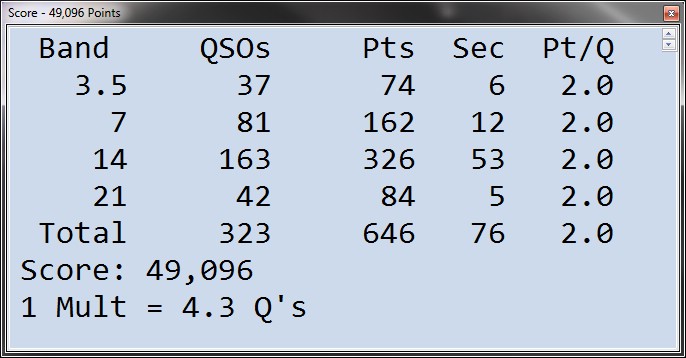
NAQP Ending Statistics
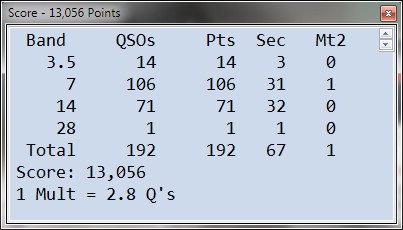
Being assigned to join contest team #1 (which included: WN6K, KI6QDH, W6AFA & W6TK) as part of the Southern California Contest Club's NAQP team entry I predicted the WQ6X log would contain 300 QSOs, surpassing last weekend's dismal 260 Cw QSOs.

When it was all over my 160 contacts resulted in barely half the previous weekend. Luckily, W6TK and W6AFA did a superb job carrying team #1.


While this year's NAQP SSB affair was filled with frustration, there were pockets of fun throughout. Working NP2X & KP4CPC, along with VY1MB & XK150YUKON in the Northern Territories using the Cobra-sloper made it all worthwhile.

 Because I chose to run frequencies a lot, it was quite a thrill to have stations pop-in out of nowhere, resulting in a new multiplier. I also noticed that MANY "0" call area stations were identifying themselves as "Tod" in honor of K0TO(sk). Tributes like this make radiosport contests more personal.

This winter California is receiving its share of rainfall so staying inside to work a radiosport contest made a lot of sense to me. The more I operate SO2V, the more comfortable I become doing it.


Thus far, the FT-1000mp has given WQ6X nearly 18 months of unparalleled portable contest operation. I love any opportunity to sit down and spin the radio's REAL knobs,
in addition to running the Yaesu via computer (CAT) control.

Did YOU play in this weekend's NAQP SSB contest?

Is WQ6X in YOUR log?

Sunday, January 15, 2017

WQ6X Runs NAQP portable from East Bay section


Unless you are a RTTY operator (who participates in the ARRL RTTY RU contest), NAQP-Cw is the first major radiosport event of each new year. For this year I chose to operate NAQP from W7AYT's QTH where I have conducted many radio contest operations before.


The equipment setup was nothing special - a computer controlled Yaesu FT-1000mp was all I needed to make things work. Antenna-wise I used the CH-250 vertical already at the site and hoisted up a Cobra dipole 7mh into the air to make a crude sloper antenna. Because the radio allows A/B antenna selections, I could immediately switch between the two looking for the best signal. Amazingly, the vertical was often quieter (noise-wise) than the sloper - go figure. I was even able to tune the vertical on 160 working as far as Montana (probably with barely an S-2 signal).

As a single-OP operation I was only allowed to work 10 out of the 12 hours so I started up shortly after 19:00z on Saturday and wrapped things up at 05:00z on Sunday. Band conditions left a lot to be desired. 10-meters never happened in Concord. 15-meters barely produced 2 dozen QSOs, leaving 20 and 40 for most of the action, with a little activity on 80 and 160.


There were a few notable callsigns in this contest, like my friend Loco XE2MX. However the wildest callsign in the contest was from XK150YUKON; one of two Yukon stations on the air. DX-wise, aside from KP2M and KP3W, the only other DX stations in WQ6X's log were with HI3Y, HI3TT and 6Y4K.
Name-wise, 3 handles stood out:
BUZZ, VLAD & NIZ.

In recent months I have been learning the art of SO2V (Single-OP 2-VFOs). SO2V played an important role for me in this contest. Throughout the contest I was able to run a frequency using VFO-A while tuning around the band looking for stations via Search & Pounce (S & P).
 The FT-1000mp allows me to split the audio from each receiver into left and right ears. When I operate SO2V, the run frequency always takes priority. At times, having both ears active would become confusing so I would turn off VFO-B until I regained my sanity long enough to continue with both VFOs.


NAQP is a unique contest in that there is no Single-OP assisted category, so I was rather surprised to discover that WQ6X was listed on the DX-map (as you see in the photo). 
At times there did seem to be a flood of callers, leading me to suspect that people were finding WQ6X via some sort of spotting facility.

For this contest, QSB was a major issue. Stations would pop in and disappear almost immediately. This is another reason to keep exchanges SHORT, sending ONLY the required information. 


Many stations would send 599 (not required in NAQP) which lengthened the exchange just enough for the signal to fade before sending
the QTH.  Every time this happens a repeat is required, wasting TIME.


I encountered no intentional-QRM during this contest. In other events it usually happens on 40 meters but well after midnight,which is long after NAQP is over; so I guess we lucked out. There was the usual SSB activity on the top end of the 40-meter Cw spectrum.
They have as much right to that space as I do, so overall we work together in this shared environment.

One of my main beefs in CW contests is with the operators who persist in sending CW at 30+ WPM speed, making it difficult to easily copy weird callsigns such as the aforementioned XK150YUKON station.


I never once sent Cw faster than 25 wpm; my top limit for radio contests. When slower stations call me, I usually slow down to accommodate them. Sending too fast is not an example of superior operating skill but a
sign of stupidity as repeats will be required to get the information through slowing EVERYONE down.

Another beef is the plurality of stations with callsigns not matching the call area they are operating from. For example, there were many non-W7 callsigns operating out of Arizona (AZ). My personal policy is if I am operating outside of California I ALWAYS sign portable; for example WQ6X/7 when I operated from a Las Vegas hotel. While technically it is not required, experience has shown that the confusion-level reduces considerably when we properly sign portable. In some RTTY contests, even if your callsign is registered in say AZ (a W7) if your call does not have a 7 in it you are required to sign as portable to keep everyone happy.


Did YOU work the NAQP Cw contest?

Is WQ6X in YOUR log?

Tuesday, November 29, 2016

WQ6X dabbles in CQ W.W. CW Contest


Convening a congress of CW ops for the W.W. Dx contest never seems to happen at NX6T.

Because of this, in 2015, I ran the CQ WW SSB event solo onsite from NX6T. For the CW GiG I operated WQ6X from NX6T remotely from two different hotels during a driving trip from the SF bay area to Burbank. ([CLICK HERE] to read that write up.)


This weekend work commitments kept me in the bay area so I chose to reprise the 2015 remote operation idea interspersed with client work. Because I would be running barefoot - a disadvantage against kilowatt mega stations - the choice was made to run as an assisted station.
Unfortunately, by the 00:00z (4pm) start time the network backbone at "Nashville" (NX6T in Fallbrook) was being revamped and was unavailable.

Around 07:00z the VPN network became available allowing me to setup N1MM+ over the internet.
The 1st contest QSO was made at 07:45z as N6KI was driving down the hill back to "civilization".


The RCForb control screen

Equipment-wise, running STN#1 gave me access to a barefoot Elecraft K3 (run remotely via the RCForb control software) running into a 13mh C-31 yagi for the high bands.


For 40 meters a 2-el yagi did the job on tower #2 with an 80 meter inverted Vee atop that same tower.


C-31 Yagi

While I was not able to rotate the antennas, a surprising number of QSOs were made from all continents, except central Europe (where the C-31 was in fact pointed); only contacts with Scandinavia made it into the log.

I was pleasantly surprised to hear LOUD signals from West/South Africa although the QUANTITY of African stations was certainly lacking.


Space WX at contest start

Throughout the contest I encountered seemingly "dead" bands on 10, 15 & 20 meters. Then, out of nowhere a lone station would BooM through.

This suggests to me that the bands were in fact open the entire time; the only thing missing were stations calling CQ. What this mean is that bands SOUND dead when everyone is listening and no one is transmitting.

This phenomenon occurs more often on 10 and 160 meters than you might realize.

Of course the 194 QSOs in my log will not win any awards, however it did add a number of country & prefix variations to the WQ6X country total. Once things got underway there were no equipment failures; only internet latency failures.  Out of boredom from clicking spots, from time to time I took a chance and ran a frequency.

Tower 2: Stepp-IR + 2-el. 40 + 80-m inv. Vee

Frequency-running during remote operations can be risky because poor internet-latency often ruins the operating rhythm, however it sure beats wading through pileups when running low power.

While many of the callers were statesiders and Canadians, I was also surprised to receive calls from:
PJ2T, VE9AA, VE9ML,CN2AA, KH6TU, V28K, 6Y3T & ZS2NF.


During this contest, I was surprised to encounter no intentional QRM. Unfortunately, the contest participants generated even more QRM by being poor listeners and during pileups, simply BLASTing their callsign when only a specific callsign was asked for.


STN#1 @NX6T
Just as wasteful were the stations who made a QSO with me and then 20 minutes or an hour later are calling me again on the same band. Often times the QRM is so bad that it takes several repeats to get their callsign, only to discover we just worked.
The 30 seconds to a minute of time that is wasted with all that could have been better utilized adding QSOs to MY log. One of the reasons we use logging software is for the built-in callsign lookup facility, which all but eliminates duplicate QSOs.

What confused me this weekend were the number of super stations that would call CQ and then have 5 to 10 callers from different parts of the globe call them only to call CQ again. This suggests to me that these stations were "busy", most likely on another radio or VFO - SO2R or SO2V.
While I have recently been successful with SO2V, anytime I get confused,
I disable VFO B and focus on the run frequency.

Stations should not have to wait around because I am busy doing something else. If I can't keep up with stations on my run frequency then I should not be dividing my attention between it and other bands or frequencies.
When it goes well SO2V/SO2R can be an incredibly fun increase in the QSO rate. 
However when it goes bad, not only does it alienate calling stations waiting on your run frequency,
it also violates contest operating ethics.

Remember: most contests do not allow calling CQ on 2 or more frequencies (unless you are a multi-OP station). If calling CQ is not working then you should yield your run frequency and switch to search & pounce (S&P). To blindly stumble through makes it a waste of frequency allocation resources for EVERYBODY.


While I never expect to submit a winning score for the CQ W.W. DX contest, as with the WPX GiG I am always thrilled when unusual prefixes and countries show up.

After Thanksgiving, I am always thankful I spent a few hours in the CQ W.W. operators seat - so to speak.


Did YOU play in the CQ World Wide DX contest?

Is WQ6X in YOUR Log?

Wednesday, July 19, 2017

The world of SO2V - some thoughts by a newbie operator.


In the last 20 years or so I have taken quite a fancy to radio amateur competitions; known in
Europe as radio sport. While I have won numerous section awards and even a few 1st place plaques, with the kinds of operations (mostly portable) that 
I run, there has been a limit to my success.
To resolve this, in the last year I have been learning and perfecting
the art of SO2-V (Single-OP 2 VFO's). 

I recently wrote a BLOG entry entitled:
LEARNING the ART of LEVERAGING DUAL RECEIVE 
[CLICK HERE] to read this article.
 
You may have heard about SO2-R (Single-OP 2 Radios).  Altho similar in concept SO2-R requires two radios and 2 amplifiers, along with a number of control units to allocate the antennas and other units between the two radios. In addition to being quite expensive, there is a significant increase in the number of things that can go wrong at any moment.

With SO2-V only one radio and one amplifier is needed. This reduces the cost and the complexity of the station setup significantly. It is also considerably easier to learn the art of SO2-V in contrast to the more complicated SO2-R method.


In 2014 I joined up with  George N6GEO to run
the RTTY RU contest from Radio Reef (KP2M) on St. Croix using

the WP2/WQ6X callsign. 
 
For that contest we brought our own equipment to run:  a FLEX-1500 SDR radio and a Tokyo HY-Power 45b amp running the onsite Alpha 87 amplifier
at a 
cool 149 watts, qualifying as
a low power (LP) station. 
 

Before and after that contest I made use of the onsite Yaesu FT-1000mp transceiver to work
CW & SSB contacts, instead of the Elecraft K3 which 
(thanks to guest OP'ing @NX6T) I have become bored with operating.  The FT-1000mp has more knobs to twiddle and is more fun to operate.

I was so taken with the Yaesu transceiver that a couple of years ago, I brought a fully filtered
FT-1000mp radio into my operating world, replacing the cherished Yaesu FT-920. Amongst all its advanced features (such as an incredible eDSP facility), the 1000mp is equipped with in-band dual receive capabilities. 


Most radios sport dual VFOs, but it is another world altogether having access to dual-receive capability.  With the 1000mp, SO2V (Single OP 2 VFOs) became an operating possibility for WQ6X.

SO2-V in N1MM+ Logging Software
The major "rice box" manufacturers all offer radios sporting dual receive. 
With Kenwood, while the TS-950SDX is no longer made, the TS-2000 is still
being offered.  With ICOM, the retired 756 PRO III, along with the current 7600 & 7800
series provide dual receive. Yaesu weighs in with the FT-1000mp and the 
MK-V, as well
as the FT-2000 and FTDX-5000 radios. 


In the USA, Ten Tec offers the Orion II and of course the Elecraft K3 can be upgraded for dual-receive. Each manufacturer's approach to dual-receive have their pluses and minuses.
 
Before I switched over to the FT-1000mp, I had the incredible FT-920 at the operating helm. Unfortunately, from the true dual-receive perspective, the 920's "DualWatch" is incapable of operating in a true SO2V fashion.   The 920 DualWatch utilizes a "polling" mechanism between VFOs A & B.
As such, VFO-A & VFO-B cannot receive simultaneously.  It's either one or the other.


In contrast, the FT-1000mp utilizes two separate receive line circuits which can be active simultaneously.  (Of course during transmit BOTH receivers are silenced.). 

I configured WQ6X's 1000mp to split
the audio between left/right ears, with independent volume control in each ear. 


Unfortunately, the eDSP operates ONLY with VFO-A's receiver.  My solution to this shortcoming
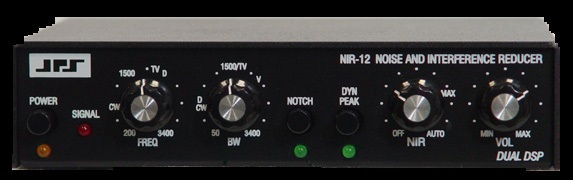
was simply to route the VFO-B's receive audio to an outboard MFJ 752-C Signal shaper and/or JPS NIR-12 DSP unit (depending on my "mood"); units which have been languishing on the shelf after acquiring the FT-1000mp.
 
MFJ 752-C
While both of these units are well over 20 years old, sometimes it is the older technology which makes the difference.  In the early 1980's, many of the more
expensive radios had Audio Peak Filters (APF) built-in. 

For the lower-end radios, the MFJ and JPS filters
essentially accomplished 
the same thing.

JPS NIR-12
Even the relatively inexpensive
Radio Shack DSP-40 outboard audio DSP filter made quite a difference w/most transceivers and receivers, surprisingly with no introduction any artifact.


Because the FT-1000mp has no SUB-Rx shift/width/notch filters, the Autek and MFJ/JPS filters
more-or-less accomplish the same thing.


One day I would like to test an old Radio Shack DSP filter on the FT-1000mp SUB-Rx. 
This year during Field Day I test-drove running the FT-1000mp's 
sub receiver audio thru
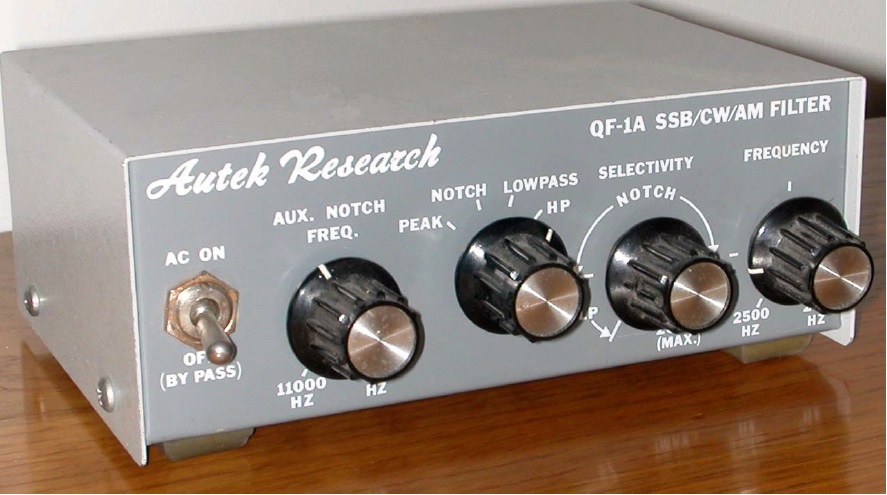
the classic Autek QF-1A audio filter.  
I was surprisingly disappointed.


While the QF-1A is correctly a MONO device, not being able to bypass it mid-contest (by flicking a switch) limited its possibilities.  
 
However, the QF-1A is still the filter of choice when I run CW contests remotely from NX6T
in Fallbrook.


In the ideal world, dual receive allows me several possibilities:
  1. In a single mode contest, I can run a frequency (VFO-A) while tuning the band
    (VFO-B) looking for multipliers.
  2. In multi-mode contests such as state QSO parties or the 10-meter contest and Field Day,
    one VFO can tune the CW portion of the band while the other tunes the SSB segments.
    Either mode can be a RUN frequency while S&P'ing using the other mode.
  3. DX stations running "split" can use VFO-B to tune for stations while using and monitoring
    the RUN frequency. As mentioned earlier, in 2014, I spent 10 days as WP2/WQ6X at Radio Reef on the island of St. Croix.
    Outside of the contest period WP2/WQ6X put over 2,000 QSOs into the log. In retrospect, running the CW and SSB pileups should have been done split, using VFO-B. Unfortunately,
    the newness of dual-receive (and the nightly enjoyment of some island grog) kept the use of dual receive out of my reach.
  4. Dual receive also allows a technique known as "diversity reception", a methodology described briefly in the FT-1000mp operator's manual.
    Search the internet for "diversity reception" to discover what interesting things this approach can provide.  To help you with this I ran a web-search and came up with a lot of interesting items.
  5. [CLICK HERE] to see that search.


To accomplish SO2-V using the FT-1000mp, the radio was configured to direct most of VOF-A's audio to the left ear and most of VFO-B's audio to the right ear. 
 
The Yaesu FT-1000mp is equipped with firmware menu settings allowing custom-configuration of the split audio.
 
The menu settings I use for the FT-1000mp allow
both AF gain controls to act like gain controls. 
 
In contrast, with the old ICOM 756-PRO (about the same age as the 1000mp), those controls are labeled: AF Gain & BALANCE.


If you've never run split audio before, it might seem a little daunting at first.  Before jumping into actual SO2-V contesting using dual receive, I spent a couple of weeks practicing using both VFO's together until I felt comfortable with the method.  Like SO2-R, SO2-V is largely an ART, employing radio technology.
 
Being one of the first transceivers to offer up dual-receive, the FT-1000mp was well designed to locate the most used controls (for VFO-A) in the center of the radio and to the left of center. This correlates with the left ear.


The VFO-B knob is more to the right, correlating
with the right ear. 
 
When running a frequency with VFO-A, I LOCK that
VFO on the run frequency so I don't inadvertently shift frequency when 
I really mean to turn the VFO-B as I S&P elsewhere on the band.

In the contest world, properly taking advantage
of dual-receive requires 
CAT (Computer-Aided Transceive) software designed for this purpose.  
While WinTest and WriteLog can probably do the job, since N1MM has become N1MM+, I have found their approach to be the most effective match to my way of operating.


To be most effective, it is recommended to make use 
of dual computer monitors. 
 
When I run portable @W7AYT the WIN-7 Toshiba laptop I use for contest operating has an HDMI port making this an easy configuration. 


Somehow, the Toshiba laptop even "remembers" the different monitors I plug into it. Configuring the external monitor as the MAIN screen, leaves the laptop to display things
that do not need my immediate attention.

Then again, as you can see from the above photo, for the 2016 SSB Sweepstakes portable setup @ W7AYT I managed to fit everything (N1MM+ related) on the LARGE video monitor. Both methods have their advantages. 
 
To get used to the frantic nature of SO2-V using the contest pile-up trainer can help you work through the confusion before the actual contest weekend arrives.

  
Sometime ago, someone sent me a document with a detailed write up on running SO2V using N1MM. It is from this document that I learned the fundamentals of SO2-V contesting. From there, it was just practice, practice, practice. I searched the internet for this document and could not find it. Therefore, to make things easier, I uploaded a copy of it onto the WQ6X.Info web server. [CLICK HERE]
to read this document.

In summary, while a more complex method for running radiosport contests, SO2-V can certainly increase your operating efficiency if you take the time to learn the ins-and-outs of this method.
I don't wish you luck with SO2-V.  
Instead, I wish you SUCCESS.

Listen carefully for me during my next portable contest operation from the W7AYT QTH - I may well be running SO2-V.