Showing posts sorted by relevance for query Russian beacon. Sort by date Show all posts

Tuesday, May 3, 2022

Propagation Beacon Tracking: By Way of SDR - Part 4

This is the 4th part (actually the 6th Blog) on the subject of Beacon Tracking.  Another approach to beacon tracking recently occurred to me - namely, the use of internet accessible Software Defined Receivers (SDR's).  While I don't normally like being dependent on the internet, having access to different listening vantage points can in fact be quite useful.

Another approach to beacon tracking is to use a TRIO of SDR receivers, allowing a triangulation
of a specific beacon frequency.  This provides three ways of determining:
  • If a given TX is on or off the air.
  • If the TX can be heard from some geographical "angles" (azimuth).
  • With 3+ SDR listening-points, we can determine/better-predict the actual "atmospheric ducts" to the beacon location(s) - there are 3 Russian beacons in East Asia, alone.
With occasional exceptions most (if not all) NCDXF beacons are on-air, all the time - somewhere
in their 3:00 minute cycle.  Using SDR receivers we can triangulate in much the same way as with
the Russian beacons, except that any given NCDXF beacon frequency is heard for only ~5 seconds, every 3 minutes.  Writing our own "decoder" for SDR data streams, we could probably sort it all out.

With the Russian military beacons, unless they are having serious operational problems, the "ID" letter is sent every 1 - 2 seconds.  Then again (as has been noted in my previous blogs on this subject), occasionally (albeit rarely) a given Russian beacon alters the style with which the
ID is sent.  There has been considerable speculation on why the change in "ID" is made
(when they are made); there seems to be no real pattern to those changes.

To aid in tracking the Russian beacons, I've added a specific screen to the WQ6X Beacon Tracking software.  At the very least, this screen is a reminder that there is a considerable amount of on-going Russian beacon activity all over Europe and Asia, all of the time.

In recent weeks, the "F" beacon has been AWOL and the "M" beacon has been on and off. 
For a couple of weeks, the "K" beacon shifted from sending the ID-letter every 1.5 seconds to
sending "K K K K" and then pausing for 2 seconds.  Then, it was back to ID'ing every 1.5 seconds.  

I have been wondering what effect the Ukrainian conflict conflict would have on beacon operations.  Listening around the bands on the Dutch utwente.nl recently found the "P", "S" and "C" beacons operating as I would expect, however the "D" and "A" beacons seem to not be active.  I will check back later this week to see if that was just a fluke-day.  A couple of evenings back, listening to 7038.8, the "K" beacon has again become AWOL, while the "M" beacon (Magadan) is now back, just as if it
had never left.
 
I do not understand what all of this means, however it DOES seem to be a fascinating mystery, looking to be deciphered.

What about YOU?

Have you ever tracked propagation beacons via SDR.

What DiD YOU Discover?

Saturday, January 29, 2022

WQ6X Wonders Aloud about Russian Military Beacons - Part 3

While I have posted several Blogs regarding the subject of Russian Military Beacons (and the ones on ~7.039 in particular) every radiosport event with an Asian component to it brings about NEW questions regarding what these beacons are REALLY about and how we 40-meter radiosport operators can take advantage of the propagation information they provide.

Most 40-meter Cw operators have no
idea their band has been invaded for over 50 years with these Russian beacons. 
At first, I was somewhat incensed by the invasion.  After having thought it through,
it occurred to me these beacons are actually doing us a favor in a way; the hijack of one lone frequency is hardly anything to get worked up about.

The following WQ6X Contest Blogs have been written about Military Beacons. 
Included in these posts are:

  • [X] - Beacon Tracking saves WQ6X from drowning in 2018 SEA NET
  • [X] - WQ6X operations: the Weekend of BEACONS and RTTY
  • [X] - Russian Letter Beacons Rescue 40 meters
  • [X] - Wassup with Those Mysterious Russian Letter Beacons?
  • [X] - Wassup with Those Mysterious Russian Letter Beacons? - Part 2

I wrote the last Blog in May (2021) after having noticed a number on anomalies with the "K" beacon. 
Since then, I have been monitoring the 7.039 beacons during virtually every contest weekend,
whether I run the events from Anza OR from Concord.


Recently, I took off on another SDR receiver search for letter beacons, partially motivated by the seemingly lengthy disappearance of the "K" (Kamchatsky) beacon in far-east Asia on ~7.039.

It occurred to me that while the rest of the amateur bands sport no Russian beacons inside their boundaries (I've never heard the alleged beacons on 3.594), some of the other beacons are close enough in proximity to amateur bands that they can serve as reasonable propagation predictors. 
For Example:

      •   4.557~ ===> 75m Ssb
      •   7.508~ ===> 40m Ssb
      • 10.871~ ===> 30m
      • 13.527~ ===> 20m Cw
      • 16.331~ ===> 17m
      • 20.047~ ===> 15m

Because the Russian beacons transmit every second of every day, we don't need a beacon tracking program per se' (like the WQ6X Beacon Tracker).  All we need is to put a receiver on one-or-more of those frequencies to get an idea of what areas in Europe are open to the area of the receiving station.

During the week prior to 2021 Field Day, I spent some hours going through the WEB SDR list looking for receivers that can help to locate the various letter beacons around Europe.  Also useful is the ENIGMA 2000 Website.  While some beacons have NoT changed over the years, others have continued to "evolve" (if that's the correct descriptor) and are often heard doing "strange" things
from time to time.

 As of January 2022, some interesting developments have occurred in the Russian Beacon world; at least, on the Eastern Asian front.  Listening several evenings from the West coast (WA6TQT's QTH and WQ6X @W7AYT), it would seem that the "F" and "M" beacons have not been active for several weeks.  

The long-AWOL "K" is the only one of the three eastern beacons that is active.  Instead of a "- . -" ("K") every 1 - 2 seconds, currently it sends "- . -  - . -  - . -  - . -" ("K" "K" "K" "K") and then pauses briefly before repeating the sequence.  Why the difference in transmit sequence?  I have no clue.
I simply observe what is.

An interesting way to flush out the TRUTH about Russian beacon activity is by making use of Software Defined Receivers (SDR's) around the world.  I am about to embark on just such an experiment and will report my findings in an upcoming Blog.

Do you make use of the Russian military beacons?

IF so, what have YOU Discovered?


Friday, May 29, 2020

Wassup with Those Mysterious Russian Letter Beacons?

 In retrospect, it amazes me to think that years back, I used to consider the Russian Letter beacons on ~7.039 to be a nuisance.  If you read BLOG entries from 2013 & 2014, I erroneously compared those beacons to the hassle of RTTY QRM; something FAR worse.  Today, I not only RELY on those beacon signals, I take a listen for them any evening I happen to be tuning around on 40 meters.  (While these beacons live in the Cw band, there are just as useful for Ssb operations to Asia.)

In case you're not familiar with the Russian Letter beacons, take a moment to read what has been written thus far about these beacons and radiosport competitions.
  • [x] - Beacon Tracking saves WQ6X from drowning in 2018 SEA NET
  • [x] - Russian Letter Beacons Rescue 40 meters
  • [x] - WQ6X operations: the Weekend of BEACONS and RTTY
  • [x] - MX Russian Letter Beacons: a Dutch .Pdf article
  • [x] - Russian Navy 7039.3 kHz "K" Cluster Beacon
  • [x] - Single-letter beacons - a frequency list
When doing the original homework for the above BLOG entries, I happened across a pair of articles from Popular Communications Magazine (DEC-1984) & (JAN-1985) and a 3rd article (JUN-1986).  While these articles
are 35 years old and many listed frequencies may no longer be in use, amazingly, the 40-meter beacons on 7.039 are still active.  Unless you are a Cw operator and/or know when to listen, you are probably unaware of these beacons.


Like the NCDXF Beacons, the Russian Letter beacons can help determine propagation paths open on 40 meters.  An advantage of the letter beacons is that they transmit every second; unlike the NCDXF beacons which transmit once every 3 minutes.  Unlike the NCDXF beacons which transmit
at 4 power levels (100w, 10w, 1w & 0.1w) the letter beacons operate at a constant power level;
altho that power-level has never been officially documented.

The Popular Communications articles led me to believe that Russian Letter Beacons operate largely
(if not completely) unattended, altho recent K-beacon signal spots have led me to question that.

On May 9th, I made the following observation:
Turning the 2-el Shorty-40 yagi towards Asia, tuning to ~7.039 the F-K-M beacons were heard,
however for the 1st time ever the "K" beacon was transmitting differently than I've ever heard it. 
Repeated over and over again I heard "K K K  T T T..." - why the change, I am not certain. 
I guess the question becomes how long will this difference continue to manifest.


Then on May 16th the following observation was made:
By 07:00 new callers in the contest had all but disappeared.  Hoping for an Asian connection, the Shorty-40
yagi was turned to 320-degrees.  Tuning to ~7.039, the Russian "K" and "M" beacons were heard.  Similar but different to last weekend, 
the K-beacon wasn't transmitting "K" repeatedly; instead, the transmission was "K K K K T T".  Last weekend it was:  "K K K T T T".   
I have no idea why the transmission content has changed for a 2nd time.  Continued listening may provide a clue.

Then on May 23rd, the K-beacon was back to transmitting "K" once every second. 
As to what this is all about, I have no clue.  Nevertheless, I thought it worth reporting. 

Bottom-line?  The Russian Letter beacons have become my friends. 
Altho I have heard a couple of the European letter beacons, the main focus for WQ6X
operations are the Asian F-K-M beacons.  I only wish that other continents & countries
would join in the 7.039 beacon game; if the Russians can doit, why not other countries?

Do YOU make use of the Single-Letter-Beacons?

Please share your results with me and I will write it up.

Wednesday, April 1, 2026

Further Investigations into those ubiquitous Russian Military Beacons

Over the last 9 years, I have written extensively about the ubiquitous Russian military beacons.  Recently, using those beacons during numerous radiosport contests, it occurred to me that due to recent Russian military escalations, we are overdue for an update on the status of these beacons,
at least the Eastern Asian ones.  ([CLICK HERE] to read some of those Blogs.)

In my thinking, there are two groups of Russian beacons: those based in North/Central Europe
and the beacon trio operating in Eastern Asia ("F", "M" & "K").  I first heard the EU beacons on the University enTwente Dutch SDR.  In doing research for this new Blog entry, it made sense to return
to that SDR during the EU evening/nighttime hours to discover which ones could be heard.

On the Asian end of things, while I frequently rely on the Eastern Asia beacons
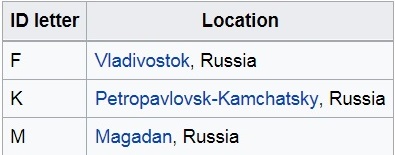
("F" (Vladivostok), "M" (Magadan) and "K" (Kamchatsky)), frequently for whatever
reason, one or more of those beacons appear on the west coast to be AWOL.
To investigate that situation, a search was made to find web SDR in and around
Asia solely for the purpose of listening for this trio of beacons.

For some time, only the [relatively LOUD] "K" beacon could be heard in California. 
Recently, the "F" beacon could be weakly heard, altho the "M" seemed dormant. 
Having bookmarked over a dozen Asian-based web SDR sites, late in the morning
(evening in Asia) I cycled thru the SDR list noting which beacons were being heard
when / where at times when the bands should be open to those areas.

As it turns out, all 3 Asian beacons are active, altho the "F" and "M" beacons are clearly
running on reduced power (compared to past years) or there are antenna problems (or both). 
Being geographically closer to California, the "K" beacon is always reasonably LOUD. 
The fact that we have difficulty hearing "F" and "M" beacons may have less to do with lack
of propagation, then it does with the beacon installations themselves.

Tuning around, it was noticed that the "A" & "P" beacons seem to be off the air.  Near those frequencies an "I" beacon and "L" beacon were heard. The "I" beacon was very weak, while
the faster "L" beacon was relatively strong.  The PRIYOM.org website is where I first discovered
these beacons.  At this time. it would seem that the "I" and "L" beacons are not yet documented.

Now that the operational status of the Asian beacons have been [relatively] confirmed, attention
can be given to Europe - the missing "A" and "P" beacons and the arrival of the "I" & "L" beacons.
Then again while writing this Blog entry, listening one the 10.871 frequency, the "A" beacon was heard, albeit barely - very weak.

This brings us to a final conclusion.  While signal levels from each of the individual beacons are certainly affected by atmospheric propagation (the main reason we listen for them), remember that these beacons are what I call self-autonomous - a human being initiates their operation and then comes back every few years to check out the hardware.

With the Japanese JIDX Cw contest coming up on April 11th, closer attention/scrutiny will be given to the East Asian beacons ("K", "F" and "M").  Awhile back, with the assistance of the Gemini A-I facility, I unearthed the mysteries regarding the "DW" (Desert Whooper) beacon. 
([CLICK HERE] to read that.)

Whether we pay attention or not, the HF radio spectrum is LITTERED with propagation beacons
that we radio amateurs (especially radiosport contesters) can take advantage of.

Have YOU ever listened to the above mentioned propagation beacons?

What Discoveries have YOU made?


Thursday, June 4, 2020

Wassup with Those Mysterious Russian Letter Beacons? - Part 2

When I wrote Part 1 of this recent BLOG topic, it certainly didn't occur to me that I would have so much more to say about it so soon.  It would seem that this is the fourth installment of my [seemingly] random thoughts on the Russian Single Letter Beacons (SLB's).

As reported in last week's 3rd post, the Kamchatsky "K" beacon has been recently observed altering its transmission ID, for at least a 3rd time in less than a month.  This weekend's observation got me to wondering what else may be going on with regard to this beacon network.

Saturday evening while listening on 7.039 for the "F", "K" & "M" Asian beacons, I almost missed
the "K" beacon because its format was even more different than I've ever heard it.  In the previous BLOG installment I raised the question of whether the Russian beacons run completely unattended, or are they in some way easily manipulated by human operators.  With the "K" beacon, someone is obviously changing the transmission content.
While considering material for this Blog entry, I checked out the beacon frequency list documented
in the previous Blog ([Click Here] to see it.)  I wondered what the Russian Letter beacons must sound like in Europe.  Remembering there is an SDR receiver in the Netherlands, it made sense to make
use of it's prime European location.

As shown in this Blog's opening graphic, the EU beacons were not hearable @NX6T and the
Asian beacons could not be heard in Europe.  In many respects, this observation was not surprising.  However what DiD surprise me was hearing a signal on the 7.039 channel not documented on any of the websites.  What was heard repeated over and over again was:
          "V V V  V V V  V V V  DE FDE2  FDE2 FDE2 AR" - [CLICK HERE] to hear this station.
What is THIS all about?  Some sort of traffic marker?  The station never stops the repeated transmission, nor does it transmit anything else.  There is no indication of QSX (listening for a
calling station).  Is this JUST another beacon?  Or, is there more to this station than just marking
a frequency?
As it turns out, it is a good thing a recording was made of the FDE2 - 3+ days later it is no longer heard on the ~7.039 frequency.  My observation suggests that FDE2 was deliberately run on that frequency and for whatever reason, the transmission was deliberately ended.

The more I learn about these Russian Single Letter Beacons, the more there is to learn. 
In the meantime, while these beacons seem to be used by Russians for propagation purposes,
they are also valuable to radio amateurs for the same purpose.

For the next part of this BLOG series, I'm going to listen in from other SDR receivers around the
globe to get a better understanding of how to leverage this free beacon resource.

Do YOU make use of the Single Letter Beacons?

What have YOU learned?

Friday, November 18, 2022

More Random Thots on Russia's Random Beacons

Remember: beacon tracking can be relatively random with beacons such as the 18 NCDXF beacons.
When/how they operate is publicly published knowledge; we know their specific purpose, and, w/in 24-hours, we know when a beacon is out of service, as well as the status for bringing it back on the air.  The NCDXF beacons transmit the EXACT same message at the EXACT same time 24 hours
a day, into perpetuity.


With the Russian letter beacons, we can reliably determine very little.  We really don't even know EXACTLY "where" they are and "why they are there"; especially when you consider that Russian military does not even acknowledge their existence in the first place.

Recently, every evening before bed, finds me checking 7.038.8 as propagation opens up in
the Asian direction.  In recent weeks, the "F" beacon has been AWOL, while the "M" beacon has
been lacking signal strength; a result of hardware problems or poor propagation?  Meanwhile the "K" beacon has been switching its ID from "K"-"K"-"K" to "K"-"K"-"K"-"K"-"K" and then -"K"-"K"-"K"-"K" 
One evening listening on ~7.039, the "K" was silent while the "M" beacon was LOUDER than ever.   AMAZING!

It also occurred to me that I've been neglecting the Northern European beacons.  Using the Dutch university of TWENTE SDR is the best way I know to restart an EU beacon listening exercise; it is thru that system I heard all the Russian EU beacons for the 1st time.  With the Russia vs. Ukraine nonsense happening since late March, it was my hope to spot a not-known relationship between
the conflict and the beacon activity.  Thus far, no correlation has been observed.

There are NUMEROUS Numbers of SDR's available for our use, all around planet earth.


Because the Asian beacons have me so confounded, I am on the lookout for reliable SDR receivers around the E. Asian area of the "F", "M" AND "K" beacons.  It is possible they are not AWOL at all,
but simply targeting different directions other than the West coast.

On a related note, recently tuning the KFS SDR below 3.500 Mhz (80-meters), I of course encountered CHU - the Canadian Time station on 3.330.  Below that, I was surprised to
encounter a rhythmic "SQUAWK" noise.  Every minute the station ID's in Cw as "DW". 
Then, approximately every 5 minutes it sends a set of alphanumeric data; sometimes
the same as what was sent 5 minutes ago, altho sometimes one or more of the numbers
are different.  Listening on USA/Pacific SDR's, this DW station is only heard on the KFS
Web SDR in Half Moon Bay California.

What IS the "DW" station all about.  I sent an e-mail to Hugh Stegman (writer for the Spectrum Monitor magazine) about this station, hoping in all of HIS listening, he has come across it many
times and/or knows the direction to turn for finding out more about it.

 There's NO doubt about it - Beacons are fascinating mysteries to delve into on the Shortwave bands.

What beacon stations, have YOU encountered?


Tuesday, March 21, 2017

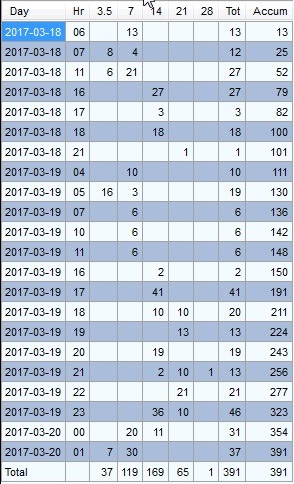
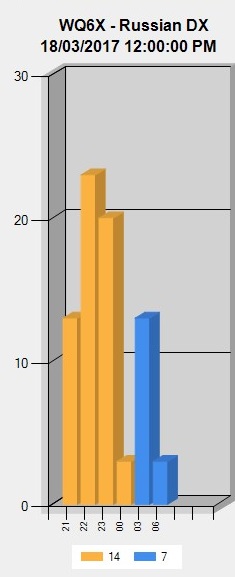
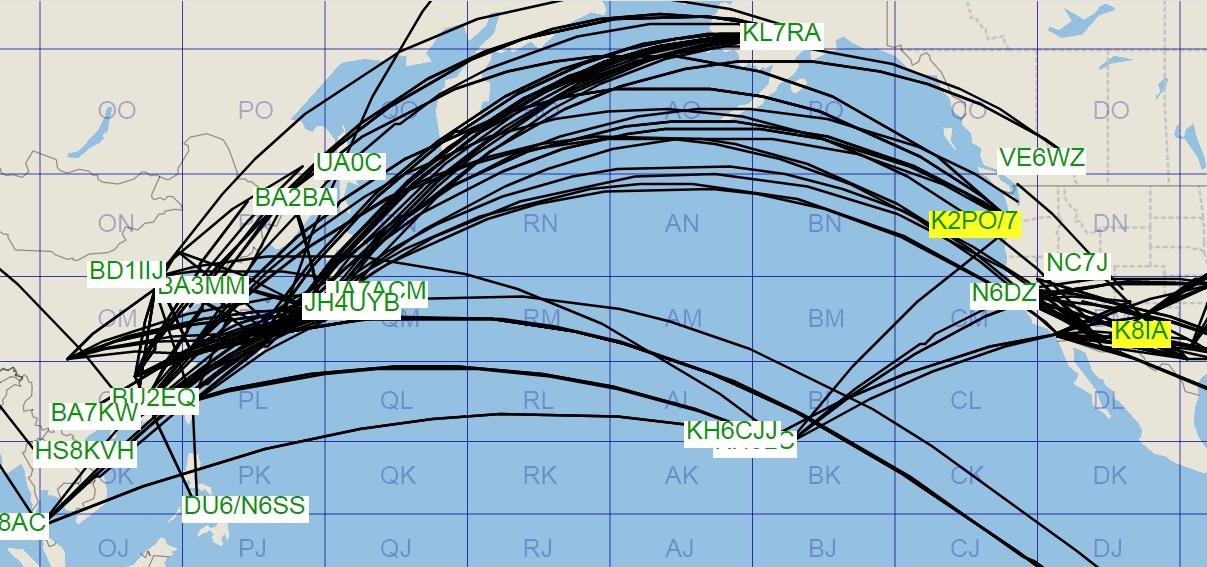
WQ6X dual-runs Russian DX and BARTG contests

NX6T - STATION #1
For the 2nd year in a row I have found the time and wherewithal to again run the BARTG RTTY and Russian DX contests remotely from NX6T.

To read my write up on last year's event [CLICK HERE].

[CLICK HERE] to read the 2017 BARTG contest rules.

Similar to 2016, an attempt was made to work the LAQP and VAQP QSO parties.
Unlike last year, in 2017 I actually made QSOs in those parties (2 Q's with Virginia
and 3 Q's with Louisiana). Ironically, the two VA QSOs should technically win a 1st place,
being that I submitted the log as a single-band 20-meter CW entry. 

Because many state QSO parties are only 12 hour GiGs, by the time 40 meters opens to
the right-coast (for us on the left-coast), unfortunately, the QSO party is usually over.


Tower-1 (below)
Tower-2 (above)
Overall, my goal for the weekend was to recreate the spirit of last year's operation. With an 02:00z start and end time (48 hours later) the BARTG contest bracketed the Russian DX contest (with a 12:00z begin/end time),
as well as the state QSO parties.

To make things easier, I used the Elecraft K3 to drive the ACOM 2000-a amplifier to a comfortable 550 watts; on both CW and RTTY.  While the amp warmed the room considerably, it ran cool - as amplifiers go.

In order to be effective in 4 contests, somehow, SLEEP needs to occur in sufficient quantity; whether in large blocks, or hour-long swatches, when the eyes can no longer remain open.

Compared to the 2016 setup, the quality of remote operating @ NX6T has improved considerably. 

This last weekend, when the internet was happening
in Fallbrook, it was like a super highway.


Unfortunately, there were unexpected and unexplained connection failures which would

end up costing upwards of 30 minutes in lost OP time. I missed a number of brief band
openings because of that.

Typical of most contests I participate in, I made a late start - 06:17z being the 1st log entry as it took several hours to resolve some internet and then audio conflicts. However once things got started what was left of friday evening became immediately productive.


One of my goals for the BARTG RTTY contest was to utilize it as a "training ground" for improving my RTTY operating style.


When I have a radio in front of me, tuning RTTY signals "by hand" is relatively EASY; that same action

when made by way of the internet
can be tricky at best.


Something new for this contest was the inclusion of the F-10 key as a "NOW" key.  Properly designed, the NOW key allows you to invoke F3 ("TU QRZ?"), log the QSO, pop the next call

off the stack into the callsign window and invoke F2; all from one key press.

While I ran frequencies most of the time, circumstances were such that I only got to use the NOW feature twice. What makes the NOW key tricky is when the decoder deciphers what it thinks is a callsign while I am copying the exchange from the current station. Now that GARBAGE is on
the call stack and needs to be deleted before the NOW key will work properly.

Unless I just "happen" onto a properly tuned RTTY signal (as happened for 2% of contacts made),

or bandmap-click a perfectly spotted spot, I simply look for a "clear" frequency from which to
send: "CQ BARTG Test de WQ6X WQ6X Test". 

In RTTY contests, it is expected that stations will be operating above the .100 boundary in each amateur band.  The WQ6X run frequencies fit in with this:
14114.14, 21104.04, 14109.09, 14110.10, and even 21099.99.

One of my RTTY contest BEEFs is that the 14.100 beacon frequency is ALWAYS FLOODed
with RTTY stations because operators are either ignorant of the fact, or do not care, that non-RTTY amateurs rely on that NCDXF beacon.  Having a beacon does us NO good if no one can hear it due to RTTY QRM.  What?  You didn't KNOW 14.100 was a beacon frequency?  Well, NOW you Do!
Do the right thing; offer +/- 3 or more Kc to beacons and make EVERYONE happy.


In virtually EVERY contest I operate, once my callsign is heard calling [effectively] "CQ Contest", my run frequencies become fair game for intentional QRM.

Running RTTY hardly shields me from intentional QRM. Sometimes it is REAL OBVIOUS. 


I PURPOSELY choose weird (i.e. unique) run frequencies. Therefore when I see a PERFECT COPY "CQ Test..." message decode before me,
I KNOW that station's choice of frequency is no accident;

especially if I have been on that frequency for nearly an hour.


To resolve this, whether the mode is CW or RTTY, I always have a specific N1MM+ function key defined that allows me to essentially send "QRL / QSY" each time the key is pressed. If that does not work, I type QSYLID into the callsign field and press F5 as needed until the IDIOT finally vacates.

During the Russian DX contest, at one point while calling CQ, at 22:30z a station came on frequency just below my run frequency (14025.75), first tuning up and then sending a series of continuous dits, for what turned out to be over an hour. After 30 minutes I vacated the frequency for other pursuits, finding the dits singing away over 1/2 hour later when I checked back. Amazing. While CQ'ing on 7018.18 I was greeted with what sounded like a "data cranker" machine. 

The polar flutter made it sound like a toilet flushing.

Auroral influenced signal flutter was all over 20 meters. At 17:00z the flutter was so pronounced it put a weird flutter on "G" stations (England) and made a W5 station sound like it was coming from EU. This is good reason for sending your callsign THREE TIMES. 
The demodulator may garble
one of them, but the other two will confirm each other.

One of the things I like about the BARTG contest is its adherence to what I call the

multiplier/call-area rule.  Taken from the BARTG rules web page, it reads:
 

"Stations in areas that count as multipliers whose callsign does not reflects the correct area must append the area after their call. E.G. W1XXX/4. Penalty will be the log becomes CHECKLOG"


Amidst the BARTG RTTY pandemonium I found time to play in the Russian DX contest.

While it is a multi-mode contest, when I am running remotely, I prefer sending serial numbers by way of CW; pressing a key is easier than configuring transmit audio signals over the internet and using my
own voice (voice keyers are no good
for Serial #'s).


Propagation-wise, 10 & 15 meters were virtually a no-show on Saturday, even though I put out numerous "CQ Test"

calls throughout the day. 

On Sunday, pointing the C-31 yagi to 240-degrees yielded KH6CJJ on 28084.84; what turned out to be the ONLY 10 meter contact.
At least I can now say that I played 10 meters. 
Did YOU play 10 meters?

When 10 meters could deliver no more, the switch was made to 15 meters just in time for an extensive JA opening, while also working persistent U.S. stations off the end of the C-31 yagi.

As usual, because my preoccupation was with the BARTG RTTY contest, I did not make my way down into the CW band for the Russian DX contest until 21:30z (2:30 PDT). I had JUST run out of EU
stations to work on RTTY; knowing the band was wide-open
dropping down to CW to pick them up made sense to me.

Eventually I settled in on several run frequencies including 14007.07, 14026.26 & 14036.36, before transitioning down to 40-meters at 03:00z Unlike RTTY, on 40-meter CW I spent most of the time S&P'ing, instead of frequency running. The worth in EU multipliers is inestimable.


While I didn't spend nearly enough time on CW, the Russian DX contest helped reinforce my recognition of the fact that we are at the bottom of sunspot cycle 24. That means considerably earlier 40-meter openings to EU; even from the San Diego area. 

In looking at the log, I am confused by the fact that there are no 80 meter QSOs made in the Russian DX contest. While not a GREAT antenna, the 80-m inverted vee @ NX6T has been known to work EU, and in particular, those countries bordering the Atlantic like EA, CR, CT, DR, and all their variants. 

I guess I can't think of EVERYTHING.


In the midst off BARTG and the Russian DX GiGs, I put in several
CW listens for and VA or LA stations calling for their QSO party.

The LAQP ended at 02:00z (Saturday evening for me). Unfortunately, by the time I made it to 40-meters the QSO party had JUST ended. This is yet ANOTHER reason QSO parties should have extended ending times.

At least the VAQP had another 12 hour slot on Sunday allowing me to take the number of log entries from ONE to TWO. Ironically, according to 3830Scores.com, that may be enough to qualify for a 1st place in the 20-meter CW category.


This is once again proof of why you should ALWAYS submit your log
after dabbling in a radio contest. 

If I am capable of setting up that contest in N1MM+, then the LEAST I can do is submit the resultant log when it is all over. Time-wise, less than 10 minutes
is needed to make it all happen.

To sum it all up, this was a typical last minute radiosport contest operation. While the radio equipment performed flawlessly (no amplifier faults), sudden internet "collapses" made this a tricky operation. 

If I seemed to "disappear" on you, and then come back suddenly, it was NOT because I was improperly running SO2R, it is because something I could not control (an internet outage) suddenly made the scene . 
While I probably won't receive any awards (except the 2-QSO 1st place in the VAQP), this weekend gave my operating skills a REAL workout.


Did YOU operate in the BARTG RTTY or Russian DX contest on CW?

If so, is WQ6X in YOUR Log?

------------------------------------------------------------------------------------------------------------------------------
June 16th Update:
Today I received a 1st place certificate for the VAQP.
This is again the reason to ALWAYS submit a log - no matter how small the score.


Saturday, April 30, 2022

WQ6X Works a WEIRD CQMM Weekend


While technically this was an 8-contest weekend, in reality, only 3 events actually ended
up in the log: the CQ-MM contest and 2 poorly participated QSO parties:

  • [X] - CQ MM - South American contest
  • [X] - MQP - Michigan QSO Party
  • [X] - ONQP Ontario QSO Party

 Like other contest disappointments, every year I hope to finally hear Chinese stations, in their own contest and never do.  There were NO Chinese spots during the weekend; not even for the CQMM GiG.  Both QSO parties were poorly participated; I worked more MI W8 stations and VE3's in the CQMM contest than in their respective QSO parties.  HuH?

Being a Brazilian sponsored contest,  CQMM encourages plenty of South American activity. 
Looking at DXMAPS, it was clear that the East coast USA stations had a DIRECT pipeline to South America; explaining their higher scores overall (USA to SA contacts are worth 3 or 6 points apiece).

Questionable space-WX throughout the weekend put a damper on signal quality.  40, 15 and 20 meters produced more-or-less the same number of QSOs, altho the 40-meter SA Q's were worth 6-Points  80-meters produced only a handful of QSOs, despite calling CQ throughout the contest. 
Oh WAIL, next year, I guess - yeah RIGHT!

Sunday was spent mopping up contacts on 20 and 15 (10-meters was a 1-QSO no-show).  While
the ONQP had a 2nd run (on Sunday), the only VE3 station making it to the log sent me their ONQP exchange during a CQMM contact (I quickly switched to the ONQP log, enter the QSO and switched back to calling "CQMM w/o missing a QSO).

In the middle of it all, more Russian beacon monitoring found the "M" beacon weak on Saturday morning and AWOL on Sunday.  The "K" beacon no longer sends "K K K K" and then pauses; now
it ID's every 1.5 seconds like most of the other Russian military beacons.  The mystery of the Asiatic Russian letter beacons continues on.

During the weekend I heard several calls for the Holy land contest, yet NONE for the YU DX contest; the same as last year.  As for CQMM, approximately 20% of the calling stations OBVIOUSLY had not read the rules; they probably had no clue what "CQMM" even meant.  They would either send
me their state code (we were sending Serial #'s) or send me their name and QTH.  In this Blog post,
I included links to the event rules that YOU should have read PRIOR to each contest participation.

DiD YOU engage in any radiosport events during Easter weekend?

DiD you read the rules FIRST?

Is WQ6X in YOUR LoG?


Tuesday, June 23, 2020

For WQ6X it's all about All Asian (& W. Virginia-Kinda)

The weekend before Field Day, the Asians host a DX party known as the All Asian DX Contest. 
Last week I wrote a Blog about why I still like to play in the All Asian Dx contest.  In last year's
Blast from the Past Blog about the All Asian contest, I described the different venues I have
used to run this GiG, which include from a 4 story office building (Ca. 1982), a campsite on
Mt. Abel (June-2013) and a sailboat in Alameda's Aeolian yacht harbor (2019).

In preparation for last weekend's dual operation, I glanced thru the WA7BNM Contest Calendar, getting the low-down on what to expect activity-wise on the bands.  It turns out there were
4 contest events of interest to me, altho the Asian contest is always Priority 1.
  1. [x] - The 61st All Asian Dx Cw Contest
  2. [x] - Ukrainian DX Classic RTTY Contest
  3. [x] - Stew Perry Topband Challenge
  4. [x] - West Virginia QSO Party
While NX6T usually participates in the Stew Perry GiG, this last weekend we had enough headaches from running the All Asian GiG; adding a 160 meter run to the confusion woulda been too much. 

From time to time I tuned around the RTTY sections of 20 & 40 meters looking for some significant
RTTY activity.  Less than a handful of RTTY signals were heard, with no evidence that they were even working the Ukrainian GiG.  As WQ6X (but from NX6T-Stn1) I managed a SINGLE QSO (WA8KAN) in the WVQP event, echoing my beef that (outside of CQP) not enough stations play
in their own QSO parties.  While I heard WA8KAN on 40 from the SF East Bay, unfortunately he
could not hear WQ6X calling him.

The All Asian webpage was a bit confusing as the browser title-bar labeled this year as the 60th running of A.A. whereas the web text correctly designated this as the 61st running of the event.

The goal for the All Asian contest is for us non-Asians to work as many Asian prefixes as we can throughout the 48 hour contest weekend.  For NX6T our 4 operators (N6CY, N6KI, N6NC & WQ6X) ended with a prefix count of 333 (190 unique) from our 878 QSOs, giving us a 294k point score.

Friday began things as a BiG disappointment.  By 06:00z only 58 QSOs made it to the 20 meter log.  By the time I took over (around 09:20z) N6KI had managed a total of 131 QSOs.  After a short stint
on 20 meters, I moved on down to 40 meters working one pile up after another.  More multipliers
were logged in those 3 hours than the rest of the contest.

Because this is an Asian contest, it makes a LoT of sense to check the Russian Letter Beacons on ~7.039 - in the middle of the 40-meter Cw band. 

I've recently written about these beacons:
  • [x] - Wassup with Those Mysterious Russian Letter Beacons?
  • [x] - Wassup with Those Mysterious Russian Letter Beacons? - Part 2

  • For the All Asian contest these beacons become important for tracking 40-meter propagation to Asia.

  • = The M-Beacon give us an idea of Propagation
        to UA9 / UA0.  Azimuth 330-Degrees
  • = The K-Beacon give us an idea of Propagation
        to UA0 / JA8.  Azimuth 300-Degrees
  • = The F-Beacon give us an idea of Propagation
        to BV / BY / JA / HL.  Azimuth 270-Degrees
  • This weekend the F / M / K beacons were heard in Fallbrook and the M / K beacons were heard in the
    SF East Bay.


    At one point I made a listen for the Letter Beacons on 7.508 hoping to check middle-east propagation; unfortunately, none were heard.  Then again, the Shorty-40 antenna mismatch @ 7.5mhz probably attenuated beacon signals significantly giving me a false indication of band openings to those areas. 
    At 20:00z I gave a listen for the NCDXF beacons (14.100 & 21.150) looking for Asian propagation indications.  On 15 meters, nothing was heard and on 20 meters some IDIOT was transmitting RTTY
    ZERO-BEAT with the 14.100 NCDXF beacon frequency - WTF is THAT all about?

    80-meters was almost a no-show were it not for N6CY bagging 6 contacts after 12:00z Saturday morning.  We never checked 160 meters; probably just as well, considering the Stew Perry GiG
    was going on at the time.

    At 09:54z Sunday morning while running 20-meters the Cw band was obliterated by your friend
    and mine - the Woodpecker (on about 13.950).  About the time I had enough of 20, the Woodpecker stopped.  (Note: earlier this year the Woodpecker was logged zero-beat with 6.996 - HuH?)

    At 11:55z N6CY took over 40 meters so I could get some sleep.  At 20:00z I came back to STN-1
    and began that almost-futile search for Asian stations.  When it's mid-afternoon in California,
    in Asia, operators are either sleeping or beginning the commute to work (if they still do that). 
    Making use of the DX-Maps helped get an idea of the band openings as they happened.

    Of the 23 stations worked Sunday afternoon, 19 of those operators raged in age from 59 - 81. 
    We DEFINATELY need to bring some young blood into the All Asian event.  Youth operators were:
    UA9P (15), BY1CY(15), JO4FDC(16), JS2FLS(16), RK9Q(17) & the youngest OP JK1ACA(12). 
    We also need more YL Op's. 
    The 8 YL QSOs made were with: 7L3PFH, JF1UOX, JQ1ARQ, JH1ACA & JA6CNX.

    When it was all over, it would seem that NX6T took 2nd place for North America
    and 4th place worldwide in the Multi-Single category.  While I submitted WQ6X's
    6-QSOs as a 20-meter log to the JARL contest committee, it will win no awards;
    however it serves to keep the WQ6X callsign in next year's callsign files.

    Did YOU work the All Asian Dx Cw contest?

    Is NX6T or WQ6X in YOUR Log?

    Friday, March 27, 2020

    WQ6X Survives COVID w/BARTG

    As you probably know, planet dirtball Earth is in the middle of WAY overreacting to the COVID situation; people all over have decided to stay indoors, but dunno what it is they wanna do during
    this time.  For those of us who play radiosport, at least on the weekends, there is nearly always some sort of radiosport competition that can be engaged in. 

    For this last weekend, the main event was the British BARTG RTTY contest and in the background, the VA (Virginia) QSO party, which I chose to run remotely from W7AYT's QTH in Concord.  I also took the opportunity to integrate a Rockville 4-channel stereo audio mixer into the station operation; but after the radiosport events were over.

    While I have participated in the BARTG Springtime HF RTTY GiGs before, 2020 was my first real effort at making a presence in this contest.  Fortunately, the above 4 events have been written up in this Contest Blog,
    • [x] 2016 BARTG Contest Weekend
    • [x] 2017 BARTG Contest Weekend
    • [x] 2018 BARTG Contest Weekend
    • [x] 2019 BARTG Contest Weekend
    As you can see, depending on the year, more attention was given to the Russian DX contest,
    versus the BARTG RTTY GiG and vice-versa.  In the VAQP WQ6X won a number of 1st/2nd place wins for California.  While there was also participation in the LAQP QSO party, no certificates have ever been received.  Looking at the 2020 WA7BNM Contest Calendar, I see that the LAQP has
    been moved to the 1st weekend in April; I guess not to be in contention with VAQP QSO party.


    The BARTG RTTY Contest
    is strikingly similar to the CQ WPX RTTY GiG just weeks before. 

    The difference is that in the BARTG contest we also exchange the Time-of-Day
    (T-o-D) in addition to sending 5xx and a Serial #; the time
    is normally obtained from the transmitting station computer.

    During this year's events,
    I was more focused on RTTY operations than anything else; as such, Russian DX Contest signals never made it to the headphones.  Having never
    won a certificate in this GiG
    I wasn't too disappointed.


    Being a 48 hour contest, the BARTG RTTY GiG gives many opportunities to explore each band
    more than once.  Using the NCDXF beacons for predicting band openings only work on 15 & 10 meters as stations RUDELY congregate on the 14,100 beacon frequency.  It's one thing to "accidentally" be in the vicinity of the beacon frequency; it's quite another to be EXACTLY
    on 14.100. In my opinion, stations operating exactly on 14.100 should have their log entry DQ'd;
    or at least, those 20 meter QSOs should not count towards the score.

    On 40 meters, officially, we have no official beacon system; unless of course you consider the
    not-well-known Russian Single Letter Beacons (SLB's).  I have written about these beacons before.  ([CLICK HERE] to read about that.)
    During this contest weekend, only the "F" & "K" beacons were heard.  In fact, the "M"
    beacon has not been heard in several weeks, leading me to believe that the transmitter
    in Magadan is not currently operational.

    A couple of times during the weekend, it seems that NX6T ran out of new stations to work. 
    This gave an opportunity to put WQ6X on the air from W7AYT's QTH in Concord.  Not many
    WQ6X QSOs were made, altho it was a nice diversion; however, the time prolly shoulda been
    spent sleeping.

    The world around us may be in considerable turmoil, however thanks to radiosport we can
    do what we've ALWAYS done (operate) and contribute to the safety of everyone on the planet.

    Did YOU play in the BARTG RTTY GiGs?

    Is NX6T or WQ6X in YOUR Log?

    Wednesday, November 15, 2023

    WQ6X Works a WEIRD JIDX & WAE Weekend


    With the Sweepstakes Cw contest well behind us, the 2nd weekend is all about Europe and Japan; so-called Europe with the WAE (Worked All Europe) RTTY contest with the Japanese DX Ssb contest sandwiched in the middle.  RTTY, I run by way of the FT-2000 in the SF East Bay.  

    For the JIDX contest, I put in 2-shifts for NX6T at 2am to 5am and then 6 to 10pm (both on Saturday) running the Anza station (WA6TQT) remotely from the bay area.  WQ6X ran a last-minute operation
    on 40-meters before the contest ended.  Here is what I wrote about it in my WQ6X 3830-scores submission:
    This TRULY was a last-minute WQ6X ad-HOC JIDX operation.
    Running operator shifts for NX6T and numerous commitments in Alameda
    kept me out of the OP-chair until waking up @11:00z reminded me that
    WQ6X had yet to make a JIDX appearance.  Remembering that the best
    openings to JA are after midnight, I settled in on 7131.31 for 90 mins.
    Rude stations and purposeful RTTY QRM required I move the run
    frequency +/- 100-cycles.

    For this Blog entry, I have decided to let the soapbox comments tell much of the story.

    ...seemed like activity down as many times bands open with good sigs from JA 
    but no takers of our CQs.  We missed Friday nite 80 Mtr action as new antenna
    management software locked our 80 4 square in NE Azimuth plus knocked us
    off air for 30 minutes. Lost another 2 hours due lack of operators at couple time
    slots.  20 meters still doesn't yield many QS and 40 Qs were way down for us
    this year.
    Thanks to WA6TQT for use of great site. 
     73 Dennis N6KI


    It would seem that NX6T took another worldwide 1st-place (ToP MoP as the Japanese call it) for
    the multi-single category.  (K3EST @N6RO has advanced to the Multi-2 classification, leaving NX6T to dominate the multi-single category.)  Assuming that no one submits a SOSB-40 LoG, WQ6X takes
    a 1st-place in that category - by default.

    Because this was an Asian-focused weekend, it made sense to look for Russian beacon activity
    on their ~7.038 cluster frequency.  The "F" beacon has been AWOLE in W6-land for nearly a year. 
    As recent as Friday evening before JIDX, only the "K" beacon has been heard.  Sunday morning,
    out of nowhere the "M" beacon makes a mediumly-strong appearance.

    Sunday, June 3, 2018

    Beacon Tracking saves WQ6X from drowning in 2018 SEA NET


    Radiosport-wise, the 1st weekend
    in June is usually very quiet.
    Thinking I may have missed something,
    I took a gander thru WA7BNM's Contest Calendar for June.

    All I came across was
    the SEA net contest.
    ([CLICK HERE] to read the
    rules for this contest GiG.)

    Altho the event started at 12:00z,
    there was NO WAY I was ready to
    get up THAT early; in fact, the WQ6X starting time was more like 23:00z
    (mid afternoon PDT).

    Originally, the contest was not a part of WQ6X's N1MM installation, I downloaded the SEAnet.UDC (User Defined Contest) file and imported it into the N1MM+ software on the WQ6X laptop, as well as Station #1 @ NX6T. It lists itself as the SEAnet RTTY contest and yet sets the operating modes as CW+SSB - GO Figure.

    To make a BORing long story short, bottom line: the 2018 SEAnet contest was - from the WQ6X perspective - a NO SHOW. Devising custom CQ macros for this contest, I auto-CQ'd from the NX6T station for what seemed like hours. The only comebacks were stateside idiots who sent me 5NN and their state CODE (ex: AL & NM), to which I pressed the F3 key (TU QRZ?) and then used Ctrl-W to WIPE the QSO rather than log it.

    What is frustrating about this weekend is that there were JA's & VK's (amongst others) who QUALIFIED to be in the contest but in fact were not. HuH?! This is the beef I have with stateside contests - operators don't play in their own contests. Somehow I thought this weekend would be different; and, it wasn't.

    Now I coulda moped around about how I got screwed, however instead, I used this weekend to learn
    a LoT MoRe about the radio beacons which populate the amateur bands; some you may know about, and some you may have never heard of before.

    To open this discussion, I invite you to consider a set of beacon stations that have been around
    (in one form or other) since the 1930's; none other than WWV, WWVH & CHU Canada.

    When I purchase a transceiver (such as
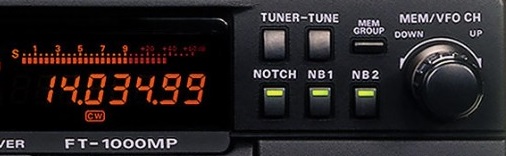
    my Yaesu FT-1000mp or its FT-920 & FT-900 predecessors) or a shortwave receiver (such as the current Tecsun PL-600), one of the immediate things
    I do is to load up the 1st 10 frequency memories with the WWV/WWVH/CHU frequencies (leaving #10 available). 

    A couple of weeks ago at W7AYT's QTH during a non solar storm weekend, in the evening I was able to copy ALL of the WWV/WWVH frequencies: 2.5, 5.0, 10.0, 15.0, 20.0 & 25.0 Mhz., as well as CHU
    on 7.850. Scrolling thru the time stations gives me a sense of what
    the LUF & MUF frequencies are at that time of day.

    As a backup reference, several more memory allocations allow listening to various commercial
    RTTY stations in the 7.5 and 8.5 Mhz frequency ranges as well as the Pirate Radio Spectrum
    (6.500 - 7.000 Mhz) giving an indication of the propagation on those frequency segments.

    Manually scrolling or invoking a channel scan gives me a good overview of the shortwave spectrum.
    At W7AYT I use the CH-250 vertical to check band openings, BECAUSE it is a vertical, and because the FT-1000mp has a dozen+ auto tuner memories set to match the vertical.  Within 5 minutes I can get a quick look at overall propagation.   In addition to 100+ frequency memories, the thing I like most about the 1000mp is it's antenna tuner and dual receive capability.

    Russian "Letter" Beacons
    I often bitch about military incursions into our amateur bands  (such as the Chinese military M8JF calling the Russian RIS9 on 3772.84 @13:00z).

    Then again, an upside to their activities is that inadvertently they give us LoTs of propagation information from North
    and North-Central Asia.

    I often hear the 40-meter letter
    beacons (7.039 Mhz) nearly every
    day after around 07:00z. Depending
    on where I am listening from (NX6T, W7AYT or N6GEO) one or more beacons will drift through.


    This weekend, only the "M" beacon (Magadan) was heard at NX6T.
    I've covered the lower frequency beacon offerings first because they are not well known
    to amateurs and shortwave listeners. More familiar are the 18 NCDXF beacons stationed
    strategically around the globe.

    I devised the WQ6X Beacon Tracker to help determine which beacon
    I am hearing at any given moment. While this is not necessarily a new idea, combining
    it with a Space WX sub-window and the ability to capture screen pictures IS unique.

    3-EL Stepp-IR + 2-el Shorty-40
     

    One of the useful functions of the NCDXF beacons is that they can give us an indication of whether or not a band is actually open and to where.


    Throughout this weekend
    I set the Stepp-IR yagi (atop Tower #2) to BI-Directional, pointing it in various directions to listen for several 3 minute periods as each beacon went through its 20 meter transmissions.


    Considering that this weekend seemed to have a dearth of Oceania/Asia stations, I was surprised
    to hear the W6WX, KH6RS, VK6RBP, JA2IGY & VR2B beacons, altho ZL6B never made it to Fallbrook. While it didn't count for the SEAnet contest, signals from YV5B (Venezuela) were heard throughout the night and even on 15 meters Sunday afternoon along with LU4AA in Argentina
    (altho the rest of the band seemed dead).

    It is BECAUSE I could copy KH6RS, VK6RBP & JA2IGY that I spent as much time calling
    "CQ SEA Test" as I did. While it effectively accomplished nothing, it DiD get me into listen
    and evaluation mode; something I sometimes don't do enough of.

    Do YOU ever make use of the various propagation beacons on the shortwave bands?

    How many beacons have YOU heard?