Showing posts sorted by relevance for query stereo ssb. Sort by date Show all posts

Monday, March 4, 2024

Using Stereo Ssb in Worldwide DX Contests


I recently published a compendium Blog on the Stereo-Audio concept.  What began as Stereo-Cw quickly evolved into Stereo-RTTY and eventually Stereo-Ssb.  The Stereo-Ssb world is quite unique.  The Blogs written on this sub-subject include:
  • [X] - How Stereo-Cw becomes Stereo-Ssb (Mar/2021)
  • [X] - Stereo Ssb: It's STILL Easier than you Think (Oct 2022)
  • [X] - Stereo-SSB: Turns out There's More To It (Dec 2022)
  • [X] - Stereo-Ssb Revisited (Yet Again) (Mar 2023)
  • [X] - For WQ6X: Stereo-SSB creates Quite a Saucy sensation
             for a Sensational Sweepstakes (Nov 2023)
For the 2024 ARRL Dx Ssb contest, complicated Space-WX conditions contributed to experimenting with using Stereo-Ssb to improve the signal-to-noise ratio, transforming jumbled speech patterns into something more intelligible.

Running remote to the WA6TQT and KN6NBT stations means I am using an Elecraft K3/0-Mini to access the fully configured K3 radios on the remote end of the radio connection.  While the dynamic range specifications of the K3 may be numerically superior to other transceivers, the Shift/Width controls, the DSP DNR and auto-notch facilities (in my opinion) leave a LoT to be desired.  

From my operating experience the FT-2000's Shift/Width manual-notch/Contour controls are far more effective that the K3 facilities, and, are way-more ergonomically pleasing - if it ain't pleasing, we don't use it.  Back-ending DSP reception by way of analog Stereo-Ssb stereo techniques make up for the perceived audio inadequacies of the Elecraft design.

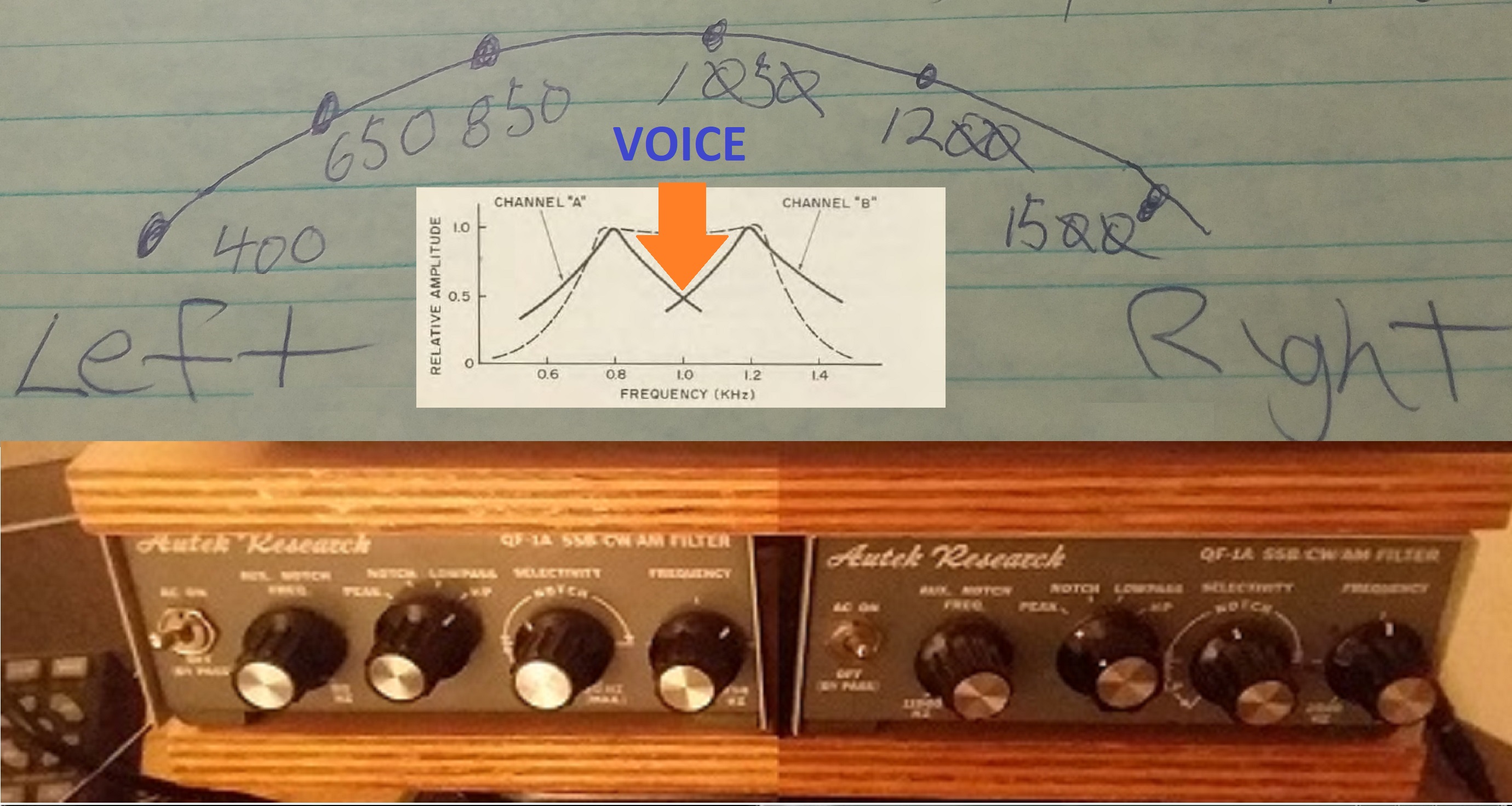
Using the QF-1A Frequency knobs to effectively alter the "shape" of the audio passband helps
eliminate the offending signal components, while peaking the more-desirable voice characteristics. 
With the individual Frequency knobs, we can actually "move" (i.e. "emphasize") a component of the voice, shifting its significance, which enhances our experience of it all.


Of course, Stereo-Ssb in a dual-RX (FT-2000) environment becomes even MORE interesting. 
Because I sometimes run a frequency with one VFO and S&P using the other, having adjustable filters (the QF-1A's) in-line makes what was once confusing cacophony much less cacophonic.

It was quickly realized that L -- R ear settings which work for one operating frequency and specific voice characteristics don't work for others.  Another realization is that while some audio frequencies are peaked by the process, Stereo-Ssb is largely a SUBTRACTIVE process, eliminating things that we don't like, which often induces its own artifact components (as the K3 does).

In WQ6X stereo-audio configurations, to overcome amplitude-drop when cascading different audio filters I have been experimenting with various stereo audio amplifier boards and commercial audio amplifier units following the last filter in each audio line to overcome those amplitude losses. 
This may also be an appropriate place to insert a stereo audio equalizer - just prior to the final amplification, reducing any audio filter-induced artifact(s).  

For a more visual indication of the Stereo-Ssb effects, an oscilloscope or audio spectrum analyzer can provide additional insight (feedback) to our overall aural-experience.  For the March 2024 ARRL Dx Ssb contest, the Stereo-Ssb filtering actually provided more effective noise-reduction (w/virtually
no artifact) than the K3's built-in DSP-NR facility.

Have YOU ever experimented w/Stereo-Ssb in amateur radio?

If NoT, whut are you WAITing for?

If so, what kind of results DiD You achieve?

Friday, March 31, 2023

Stereo-Ssb Revisited (Yet Again)


You may remember (from previous blogs on this topic) that at the heart of the Stereo-Ssb
process is a pair of tunable filters - ONE for EACH Ear.  For WQ6X, the preferred filter pair
is a pair of Autek QF-1A filters - ONE for EACH Ear. 
This is what has been written about Stereo-SSB thus far:
  • [X] - How Stereo-Cw becomes Stereo-Ssb
  • [X] - Stereo Ssb: It's STILL Easier than you Think
  • [X] - Stereo-SSB: Turns out There's More To It
Running 15-meters during the recent Weird Prefix (WPX) contest, the filter-pair provided the
ability to Peak-tune each ear independently.  This facilitates more-easily discerning different
English "accents" more readily.


While Stereo-Cw is about spacing signals of different pitch-frequencies around the Listening Experience, Stereo-Ssb is about improving speech intelligibility of a specific voice being copied. 
Similar to Stereo-Cw, the secret to Stereo-SSB is frequency separation.  With the FREQUENCY settings on both filters set more-or-less around MID-range, the speech will appear to originate
more-or-less from the middle of the listening experience.

By "moving" the voice to be copied to the "center" of the Listening Experience, properly done,
splatter is often experienced in the "outer reaches" of the Listening Experience.  Additionally,
adjusting the individual QF-1A selectivity knobs allows compensation for the frequency-response differences in each ear.

Have YOUI ever tried Stereo-Ssb?"

What Discoveries have YOU made?


Tuesday, December 13, 2022

Stereo-SSB: Turns out There's More To It


I've been playing with stereo audio for many years; Stereo-CW (and even Stereo-RTTY)
is a Given, a no-Brainer.  While I've written extensively on the Stereo-Cw concept ([CLICK HERE]), there seemed to have been fewer ideas/uses for Stereo-Ssb - until this last weekend's ARRL
10-meter mixed-mode contest.

  • [X] - How Stereo-Cw becomes Stereo-Ssb
  • [X] - Stereo Ssb: It's STILL Easier than you Think
  • [X] - Stereo-RTTY: Is It Possible? (What can We Do with it?)
  • [X] - Stereo-RTTY: How can We Leverage It
     

As always, using Stereo-Cw revolutionizes Cw-mode contesting. 
Because the ARRL-10 GiG is a worldwide contest different accents and dialects
make Ssb copy tricky, at best; nearly impossible, at worst.  This is where Stereo-SSB
comes to the rescue.

As I write this, the ARRL contest is over.  In its place, I am listening to QSOs in the 75-meter
DX Window using the K3FEF Web SDR.

I mentioned in a previous Blog that the Aux. Notch Freq. knob on each QF-1A unit offers the
ability to notch-out a specific "SPRITZ" inside of the peaked passband for each Left/Right ear.  

While the FT-2000 is equipped with an effective IF-based dual manual notch facility, when receiving split-VFO audio, those notch filters (as well as the ANF auto-notch) only apply to signals in the left ear.  It is for this reason that a Rockville mixer box has been implemented, offering up the ability to "patch-in" the NIR-10 & NIR-12 DSP units for the right ear, somewhat equivalent to the DSP facilities built-in to the FT-2000 and the older FT-1000mp.

A major secret to making Stereo-SSB effective is to adjust both filters to emphasize each ear properly.
Then, using the RIT control, individual calling stations can be more-or-less "centered" in the audio passband.

Have you ever played around with the concept of Stereo-SSB?
If SO, what kind of results DiD you get?
IF NoT, WHY Knot?

Thursday, February 22, 2024

BLASTS from the PAST: Stereo CW and it's many Variants.


It seems like DECADES ago that I published the 1st Blog on the [then] newly discovered (for me anyway) Stereo-CW concept.  Since then I have made a number of improvements to the filtering methods and even found ways to implement the "stereo" concept using Ssb and RTTY modes.  Sharing the concept with some amateurs on75-meters, it occurred to me that having easy access
to the various Blogs on these topics can make for useful research information.

  • [X] - WQ6X SOUND PROCESSING: Stereo-CW - it's EASIER than You Think (Mar/2018)
  • [X] - Some Further Thoughts regarding Stereo CW (Apr/2019)
  • [X] - How Stereo-Cw becomes Stereo-Ssb (Mar/2021)
  • [X] - Stereo-Cw: The Filters behind the Filtering (Sep 2021)
  • [X] - Stereo-CW: Learning to Navigate PILE-Ups (Sep 2021)
  • [X] - Stereo-CW: Enhancing Your FAVorite Radio receiver (Mar 2022)
  • [X] - Stereo Cw: Advancing the Art of Equalization (Mar 2022)
  • [X] - Stereo-RTTY: Is It Possible? (What can We Do with it?) (May 2022)
  • [X] - Stereo-RTTY: How can We Leverage It? (May 2022)
  • [X] - Stereo Ssb: It's STILL Easier than you Think (Oct 2022)
  • [X] - Stereo-SSB: Turns out There's More To It (Dec 2022)
  • [X] - Stereo-Ssb Revisited (Yet Again) (Mar 2023)
  • [X] - Stereo-CW Revisited (Yet Again) (Apr 2023)
  • [X] - STEREO Stereo-Cw: It All begins with a Concept (Aug 2023)
  • [X] - For WQ6X: Stereo-SSB creates Quite a Saucy sensation
             for a Sensational Sweepstakes (Nov 2023)
If the above Blog entries are not enough to give you a bunch of things to THINGK about,
then I dunno what to tell ya'.  I'm still learning new things about the "Stereo" techniques.

GiViT a try and lemme know what YOU discover.

Thursday, February 27, 2025

WQ6X Blast from the Past: ARRL Dx Phone Contest => Part 2

While reviewing material for a flurry of "Blast from the Past" Blog entries, it occurred to me that during the current decade (6 years), the ARRL DX Phone contest has taken on a radically different operating form; from NX6T Division-winning Multi-OP operations, all the way to Single-OP QRP GiGs.
([CLICK HERE] to read Part 1 of this series.)

CZECH DiS OuT!:
  • [X] (2020) - WQ6X Joins NX6T Dual-OP'ing another ad-HOC ARRL Dx Ssb GiG
  • [X] (2021) - WQ6X joins NX6T remotely for another ARRL Dx Ssb Contest
  • [X] (2022) - WQ6X Squeezes in Another ARRL Dx Ssb Contest GiG
  • [X] (2023) - WQ6X Works a Wonderfully WEIRD Dx Contest
  • [X] (2024) - WQ6X Works a WOBBLY QRP ARRL Dx Ssb Contest
  • [X] (2025) - (Coming Soon)

(2o2o) - DUAL-OP's as WQ6X & NX6T
This event was from back in the daze where we ran Multi-OP (onsite and remote) while I managed
to put some time in as WQ6X running the modest antenna setup from the Concord California - East Bay (EB) section.  This was one of those contest years when the intentional 40-meter QRM was RAMPANT from many sources, including Ssb hecklers and random RTTY in the phone bands,
all of which followed me around as I changed frequency - proving that it was hardly an accident.
This was also the year I paid more attention to the ~7.039 Russian military beacons, offering indications of propagation favoring the Asian aspects of the globe.

(2o21) - WQ6X joins NX6T remotely for another ARRL Dx Ssb Contest
For the 2021 ARRL DX Ssb contest, the decision was made to run completely from my Alameda office rather than making the drive to the Concord QTH only to run remotely from there.  Unfortunately, the P-T-T switch in Concord, not my office.  Thanks to a leftover pill, a simple pushbutton switch and
a chopped cable from a previously failed P-T-T switch was all I needed to make it all work.


(2o22) - WQ6X Squeezes in Another ARRL Dx Ssb Contest GiG
This was the 1st ARRL DX Ssb contest run with the newly added FT-2000 at the
Concord QTH.  It was also around this time that the Art of Stereo Ssb was perfected,
important for a worldwide voice competition.  ([CLICK HERE] for the original Stereo Ssb
Blog.)  More was written about Stereo Ssb later in 2022 and even more in 2023 and 2024.
When it was all over, NX6T took 1st-place for Orange (ORG) section while WQ6X took 2nd-place
for East Bay (EB) section from the SF East Bay area - NoT bad for solar storm HiTs all weekend.


(2o23) - WQ6X Works a Wonderfully WEIRD Dx Contest
For the 2023 ARRL DX Ssb GiG, I was back to dual-OP running from Anza and East Bay
(EB) section.  The BiG problem was internet outages in Anza making running NX6T remotely
a considerable challenge.  The upside for WQ6X was more time to run on 40-meters from the
Concord location.


(2o24) - WQ6X Works a WOBBLY QRP ARRL Dx Ssb Contest
For this Ssb GiG, I accomplished two goals.  I perfected the Stereo-SSB concept making for amazingly coherent voice decoding.  It could be argued that is/was a major component in taking
a 1st-place QRP win for the Southwest Division.  The above picture contains all the details behind
the operation.

Bottom Line:  The last five years of the ARRL DX Phone contest have been thru some utterly amazing contortions.  The REAL Question is how to once again leverage running QRP to chase the OTHER QRP category for the Southwest Division.  STaY TuNeD!

Monday, October 31, 2022

Stereo Ssb: It's STILL Easier than you Think

For WQ6X, the use of stereo receive audio has revolutionized station operations, especially
when it comes to running radiosport contest events.  While stereo-Cw makes for most stereo
audio processing, I have also found dual-channel audio separation to be effective when running
RTTY contests; and yes, even in Ssb GiGs.  Here is what I have said about it before:

  • [X] - Stereo Cw: It's easier than you think
  • [X] - Stereo Cw: Advancing the Art of Equalization
  • [X] - Stereo RTTY - Is it Possible?
  • [X] - Stereo Cw - Enhancing your FAVorite Radio receiver
  • [X] - How Stereo-Cw becomes Stereo Ssb
  • [X] - Stereo Cw - Learning to Navigate PILE-Ups

Yes, I have found many ways to leverage the stereo audio facility built-in to the Yaesu FT-1000mp, and now this year, the Yaesu FT-2000.  While I have used many different audio filters and DSP units, the Autek QF-1A SSB/Cw AM Filter is in a sense the most versatile of all the filters.  

For the 2022 CQ W.W. Ssb contest, I used a pair of QF-1A's to process the dual-receive audio
from the Yaesu FT-2000 and the remote audio from the K3/0.  As I said in my write-up about the event, the QF-1A's provided notch-filtering and audio shaping that neither the Yaesu or the Elecraft transceivers could match.

With Stereo-Cw, the goal is to have stations arrayed audio-wise around the more-or-less 180-degree (left-to-right) listening experience.  With Stereo Ssb, the goal was to process the audio differently in the left and right ears to make a given voice become readable. 

Bottom-Line: Stereo audio processing can be JUST as useful for Ssb operation as it can be for Cw and RTTY.  And, with devices like the Autek QF-1A's I get more knobs to twiddle, enforcing the illusion that every signal can be copied through all manner of uncomfortable conditions.

Have YOU ever run stereo audio processing in your station operations?

How DiD it work out for YOU?


Wednesday, November 12, 2025

BLAST's from the PAST: November Sweepstakes Ssb (Part 2)

The days preceding the 2025 ARRL November Sweepstakes ssb contest, I got to looking back in the Ssb Sweepstakes past, since I wrote Part 1 of this Blog.  ([CLICK HERE] to reread that Blog entry.)
Since then, I have written numerous Blogs about Ssb Sweepstakes.  Here is what I found looking back in the archive:

  • [X] 2018 - WQ6X Signs up for another SSB Sweepstakes
  • [X] 2019 - SS-Ssb 2019: The Radiosport GiG that Faded into Obscurity
  • [X] 2020 - WQ6X Survives another Frazzled Dual-OP Sweepstakes
  • [X] 2021 - WQ6X Wanders thru a Weirdly Wonderful Ssb Sweepstakes
  • [X] 2022 - WQ6X dual-OP's another ad-HOC Ssb Sweepstakes
  • [X] 2023 - For WQ6X SS-Ssb is FULL of Surprises
  • [X] 2024 - What Do We SaY about Ssb November Sweepstakes?

  1. 2018 - WQ6X Signs up for another SSB Sweepstakes

    It is amazing to look at the Solar Flux Index (SFI) in 2018 which was coming up to 75.
    The antenna system @W7AYT's QTH underwent a complete overhaul enabling WQ6X
    to operate from EB section when not putting hours for NX6T.  While the 3000-point score
    won no awards, at least the new antenna configuration got a thorough workout.

  2. 2019 - SS-Ssb 2019: The Radiosport GiG that Faded into Obscurity
    This Blog post accomplish a pre-blog look back at Sweepstakes events I have run in the distant past.  Overall, the operation that weekend was a tough run, with bands fading out prematurely.   I bitched about the time wasted by saying "PLEASE COPY", made it necessary for repeats of Check and Section.  The final result was a 1st-place for EB section and a 2nd for PAC Division.

  3. 2020 - WQ6X Survives another Frazzled Dual-OP Sweepstakes
    The 2020 Sweepstakes was not much to get excited about other than taking another
    1st-place for EB section and a 2nd-place for PAC division.  I would've expected more competition, but evidently not.  On the NX6T end of the contest, it would seem that we
    took a VERY CLOSE 2nd-place behind WW4LL with a possible S-West Division win if
    the Arizona Outlaws (AOC) were "asleep at the wheel".

  4. 2021 - WQ6X Wanders thru a Weirdly Wonderful Ssb Sweepstakes
    This Sweepstakes was not super exciting, however NX6T and WQ6X both turned in super adequate results.  NX6T claimed 3rd-place overall and took a 1st-place for the Southwest Division and San Diego section, while WQ6X earned 2nd-place for PAC Division and another 1st-place for East Bay (EB) section.  Almost more important was enhancing the use of stereo Ssb audio to make frequency running more effective.


  5. 2022 - WQ6X dual-OP's another ad-HOC Ssb Sweepstakes
    While this was truly an ad-HOC Sweepstakes operation, there is nothing ad-HOC about the results: NX6T took another 1st place for ORG section and Southwest division.  Not only did WQ6X take 1st-place for East Bay (EB) section, but surprisingly received a PAC Division
    winner plaque in the mail nearly a year later.  Another ad-HOC aspect of this operation
    was turning an Electro Voice 664 into a mic stand for the Heil headset microphone.


  6. 2023 - For WQ6X SS-Ssb is FULL of Surprises
    For this event the goal was to run QRP remote from Ramona and set a Southwest Division section record, while assisting NX6T to a similar division win.  When it was all over NX6T DiD take the division and a strong 2nd-place to WX4W.  WQ6X of course won the division but set
    a division record.  The BiG surprise was finding out that the measly 46k point score was #1 Overall in the SOU (Single Op Unlimited) QRP category.  wOw!  How cool is THAT?


  7. 2024 - What Do We SaY about Ssb November Sweepstakes?
    This year's November Sweepstakes event was a hopeful reprise of last year's division
    wins and maybe more.  It was also another opportunity to perfect the art of Stereo Ssb,
    a hardware technique I have written about several times ([CLICK HERE]).  When it was all
    over, NX6T took 4th-place as a multi-OP while WQ6X took 3rd in the SOU QRP category.  However, BOTH operations scored wins for the Southwest Division - how COOL is THAT?
With all of this behind me, there are now plans to run yet another triple-OP operation for this year's November Sweepstakes phone contest.

Have YOU run the November Sweepstakes phone contest?

Is WQ6X or NX6T in YOUR LoG?

Thursday, November 23, 2023

For WQ6X: Stereo-SSB creates Quite a Saucy sensation for a Sensational Sweepstakes

To understand the impetus behind this Blog's exuberant title, you should understand a little
bit about a concept that I have overall embraced in many different ways - namely, the idea
of Stereo-audio in HF radiosport operations.  

Over the years I have extolled what to me are the obvious virtues of Stereo-Cw and to a much
lesser extent Stereo-SSB.  With the Sweepstakes phone GiG securely behind us, mentally replaying
the remote operations run as NX6T (from WA6TQT in Anza) and WQ6X (from KN6NBT in Ramona), operating conditions were such that making use of the Stereo-SSB approach became absolutely crucial.

WQ6X's operations always create stereo audio effects by way of a pair of 45 yr.-old analog Autek
QF-1A audio filters; one for each channel.:   LEFT = VFO-A  ---  RIGHT = VFO-B.  QF-1A filters
come equipped with an aux. notch filter built-in to the left side of the front panel.  For the most part,
the audio frequency settings on each unit were set once and then left largely unchanged throughout the entire 30-hour Sweepstakes event.


When Ssb stations would move-in on the run frequency (creating that annoying high-pitched bird-chatter), the aux. notch filters could reduce the grating intensity down to tolerable levels (if there can be any such thing).  Running a K3/0-mini (rather than the usual Yaesu FT-2000) left me w/o a Contour control - something I've come to rely on with the newer Yaesu transceivers.

Another approach was to adjust the shift control somewhat off to the left, accomplishing an equivalent of Yaesu's Contour - except that the Elecraft shift is VERY sharp on the end of the adjustment - it's easy to go too far and dramatically reduce receive levels.  Of course, it has been been well established that the Bestest audio filter is the aural circuits already wired into our brain.

From time to time, the background sound-shape would become monotonously annoying, requiring
an audio frequency adjustment in either or both of the QF-1A's, creating a different listening "feel"
to the operation.  It is clear to me that "shaping the audio" not only makes operating more fun, it also contributes significantly to fatigue-reduction.  Bottom-line: the stereo-audio concepts have many applications in the world of successful radiosport operation.

Prior to an upcoming Ssb contest, I spend time tuning the lo-bands in the evening (40 & 80)
and the high bands in the daytime simply listening to Ssb QSOs while playing around with the
QF-1A controls as I discover the proper settings for the different kinds of voices heard.  Practice tuning in each station, adjusting the filters in your transceiver in conjunction with these external filters.  For a REAL challenge, tune around on 20 or 15 meters looking for a pileup of stations after a RARE DX station.  As you twiddle those knobs, certain voice characteristics will sometimes jump right out of the otherwise unintelligible jumble.

Have YOU ever utilized stereo audio in radiosport operations or even ragchewing?

What Discoveries DiD YOU make?


Monday, January 12, 2026

WQ6X Blast from the PAST: NAQP Ssb - Part 2

In preparation for the upcoming NAQP Ssb contest, I revisited the original Blast from the Past blog written in 2o20.  ([CLICK HERE] to read that Blog).  Since then, there have been 6 (Jan) + 6 (Aug) NAQP Ssb events, many of them dual-OP operations.  Here is what was done starting in 2o20:

  • [X] JAN 2o20 - WQ6X Reviews NAQP-Ssb w/NX6T (after-the-fact)
    For this contest I ran things using the RCForb radio control software.
    Also this weekend we introduced a pair of newbie operators: KK6ZEM & KN6DLG

  • [X] AUG 2o20 - WQ6X works a Woefully Weird NAQP Ssb contest and RTTY Rookie Roundup
    This was an NAQP event that was riddled and littered with murphy encounters.
    There were LoTs of other things going on that weekend to offset the chaos.

  • [X] JAN 2o21 - WQ6X joins up with NO6T for another NAQP-Ssb Contest 1st-Place
    For this contest we used the NO6T callsign and confused everybody in the process.

  • [X] AUG 2o21 - WQ6X Works another WEIRD NAQP Dual-OP
    This was a 1st-time dual-OP joining up with NX6T and in the off time running
    as WQ6X from the SF East Bay.

  • [X] JAN 2o22 - WQ6X runs another NAQP Ssb contest: ad-HOC All the Way
    This was the 1st time running the NAQP using the newly acquired FT-2000 transceiver
    after first delivering a talk for the ARCA radio club on why they should run NAQP.

  • [X] AUG 2o22 - WQ6X Dual-OPs another NAQP Ssb contest
    This was another WQ6X Dual-OP NAQP Ssb contest running the FT-2000 again from the SF East Bay.  What made this GiG unique was running a Heil headset using an EV-664 microphone as a microphone stand.

  • [X] JAN 2o23 - WQ6X dual-OPs a 1st NAQP Ssb GiG
    While this was not my 1st time dual-OP'ing the NAQP Ssb GiG, it WAS the 1st time running QRP with the FT-2000 from the SF East Bay.  When it was all over, WQ6X
    and NX6T made 1st-place finishes.

  • [X] AUG 2o23 - WQ6X Runs a Sizzling NAQP Ssb Dual-OP Operation
    This was a 1st time running NAQP Ssb using the Stereo-Ssb method.
    WQ6X ran QRP from Ramona while NX6T ran Multi-2 from Anza.

  • [X] JAN 2o24 - WQ6X Dual-OP's another NAQP Ssb contest - running QRP
    This was another typic NAQP dual-OP running QRP from Ramona.
    Running QRP during dual-OP operations is getting to be quite a habit.

  • [X] AUG 2o24 - WQ6X Wanders around a WEIRD Saturday-contest WeekEnd
    This was a combined weekend running the International Lighthouse GiG,
    the SARTG RTTY contest and almost as an afterthought - the NAQP Ssb contest. 
    Somehow WQ6X managed a 1st-place for the NAQP GiG.

  • [X] JAN 2o25 - WQ6X Wangles another NAQP-Ssb QRP Dual-OP
    This was another QRP NAQP Ssb dual-OP weekend with both NX6T and WQ6X
    taking 3rd-place for their events.

  • [X] AUG 2o25 - WQ6X Works a Weirdly disjointed Radiosport weekend
    This was a multi-faceted radiosport weekend with NAQP Ssb right in the middle of it all.
    Working RTTY, SSB and CW all in one weekend certainly qualifies as a disjointed weekend.
With all of this behind me, it is now time to get ready for yet another (but different) NAQP Ssb contest.

Do YOU run the NAQP Ssb contests?

Are WQ6X and NX6T in YOUR Logs?


Thursday, December 15, 2022

WQ6X reprises K6T for a 10-Meter triple-OP Operation

Prior to this last weekend's ARRL 10-meter contest, I spent some time reflecting on the 10-meter contest operations I have run over the last 10 years.  This led to putting together a couple of Blogs about different ways to run this Iconic 10-meter contest:
  • [X] - Triple-Thots about Triple-OP'ing the Ten-Meter Contest
  • [X] - BLAST from the Past:  ARRL 10-meter contest
This 10-meter contest offered up the opportunity to accomplish a handful of goals
over a 48-hour radiosport period.  Among these goals were:
  • Reprise use of the "K6T" callsign: "Kilowatt SIX Tango".
  • Operate K6T mixed-mode @ 100-watts - taking 1st-place for at LEAST EB section.
  • Run WQ6X as a QRP Entry- taking 1st-place for at LEAST EB section.
  • Run Cw and Ssb shifts for NX6T - contributing to a M/S Low Power win
    for S-West Division.
  • Properly leverage the Autek QF-1A audio filters, not only for Stereo-Cw,
    but for Stereo Ssb as well.

Completely oblivious to the M/S record set by N6GEO & WQ6X (in 2014), I put in several 1-hour
shifts (1st on Cw, the mostly Ssb) for the remote NX6T operation from our low power location in Ramona - [Southern] California.  K6T began the contest locally on Friday evening.  After an hour running Cw, K6T found a latent pipeline opening to W0, W9 & W8 before the 10-meter band frittered away around 06:20z.  Both Saturday/Sunday mornings found me opening 10-meters for NX6T on Ssb - K4RB ran the Cw hours in between my Ssb shifts.

Both days, in between shifts @NX6T, operating time was divided between running frequencies w/occasional S&P as K6T, interspersed w/5-watt S&P'ing as WQ6X.  Running frequencies as WQ6X yielded very few responses to those calls, except on Sunday afternoon, when callers were becoming desperate.  For this 4th WQ6X QRP contest-run, I have been amazed at the geographical reach of a mere 5-watts; then again, 10-meters amidst an SFI of 145+ makes it relatively easier to accomplish. 
We can only muse over what 10-meters will be like with an SFI of 175+ (next year?).

Running assisted encourages the use of virtually any and all available online assistance, including Contest Scoreboard, Reverse Beacon Network (RBN), DX Maps and NCDXF beacon tracking. 
The E. coast operators experienced mediocre access to Europe, while on the Left coast we experienced a mediocre shot into Asia.  In addition to Saturday's opening to JA in the East Bay, on Sunday we had a brief shot at: BD4, HL2, VR2 & 9V7.  The real surprise
was working EA9 & EA8 late Sunday morning.

Running Ssb in the 10-meter contest
is a world unto itself.  While Space-WX disturbances were minimal, there was lots of quick-fading.  Atop that was a local noise-source virtually dead-east
of the 3-element Long John yagi.  


It took a combination of the FT-2000's I-F dual-notch facility, and the Aux. notch knobs on both
QF-1A's to make some voices intelligible.

For the 10-meter contest, Cw has some major advantages:
  • Easier to copy signals (versus Ssb).
  • Function keys are more easily macro-driven
  • Each QSO is worth 4-points (instead of 2).
  • Full Stereo-Cw implementation.


While Stereo-Ssb made an important contribution to intelligibility, there's nothing quite like
Stereo-Cw to make running Cw frequencies more enjoyable.

While 10-meter contests are largely daytime events, we experience our share of WEIRD QRM. 
While different from the JUNK we often experience on the narrow 40-meter Ssb spectrum, it is annoying, nonetheless.
  • Saturday 18:17z: 28304.63 - LOUD bursts of RTTY.
    • 04:30z: 28424.93 - an annoying All-Day Woodpecker signal - with yagi pointed more-or-less Northeast.
  • Sunday 17:15z: 28032.32 - another Woodpecker signal - with yagi pointed more-or-less Southeast.
    • 19:59z: 28368.92 - FAX / SSTV signal


Overall, this was the most extraordinary 10-meter contest we have seen in about 7 long years. 
Now that the event is way behind us, the 3830 Scores website listings indicate the following:
  • K6T (running mixed-unlimited low power), took 1st-place for EB section, W6 (California) and maybe even PAC (Pacific) Division.
  • WQ6X (running mixed-unlimited QRP), took 1st-place for EB section and 2nd-place  for W6 (California) and PAC Division.
  • NX6T took 1st-place for multi-Single (low power), setting a new record (to beat the record set by N6GEO and WQ6X back in 2014) and probably took the Southwest Division plaque.
DiD YOU work the 2022 ARRL 10-meter contest?

Is WQ6X, K6T or NX6T in YOUR LoG?

Friday, March 15, 2024

Demonstrating the Stereo-Radio concept - for YOUR Satisfaction


I've written ad-nauseum about exploiting the use of stereo-audio in amateur radio operations.
The most recent Blog posts in the stereo audio genre include:

  • [X] - Using Stereo Ssb in Worldwide DX Contests
  • [X] - BLASTS from the PAST: Stereo CW and it's many Variants.

I originally discovered that using two adjustable audio filters (one for each ear) in contrast with the
fixed-filter approach documented in the original 73-magazine article on the concept of "Stereo Cw", transformed the original idea into a method for enhancing not only Cw reception, but Ssb and RTTY reception as well.

As documented in previous blogs on the stereo concept, a number of different audio filter units were evaluated for use in a dual-filter configuration, including: MFJ-752's & JPS NIR Dsp filters.  It was finally determined that a pair of classic analog Autek QF-1A filters (one for each ear) provided the most optimum improvement to the listening experience.

We can talk ABOUT stereo audio ad-nauseum.  However, when you actually experience it during live operation, you will experience an [indescribable] a-Hah realization.  To experience the full impact of the stereo audio concept, find a RUN frequency (either your own or that of a station working a pile-up).  For purposes of this discussion, I will be referring to the control knobs on the Autek QF-1A filter.

on CW:

  • Choose/Lock a run frequency.
  • While "studying" the effect(s) of adjusting the QF-1A Selectivity/Frequency
    controls for different spatial-audio experiences, notice how it makes you feel.
  • NoTiCe "where" the stations seem to "appear", "inside" of your listening experience.
  • Using the R-I-T (Clarifier) control, notice how you can "shift" a signal's location
    "in your head".
  • Notice how certain Left/Right filter settings seem to cause certain signals to
    JUMP OUT in relation to signals at other audio frequencies.
on SSB:

  • Choose/Lock a 'listening" frequency.
  • Use either VFO-B or the R-I-T (Clarifier) for tuning stations in, noticing how
    the other stations/voices shift-around "inside" of the listening experience.
  • The Selectivity/Frequency knobs enable you to slightly shift the audio passband
    offering improved intelligibility of difficult voice accents, reducing the number/frequency
    of "REPEATS".


SPEAKERS vs. HEADPHONES
The picture heading up this Blog post shows the use of a pair of LEKATO speakers, which are of course stereo speakers.  A custom-designed cable separates the Left/Right audio to each speaker pair.  The further apart the speakers are, the greater the stereo-separation effect.


THE ACTUAL LISTENING EXPERIENCE
Begin the listening session using identical knob positions with both filters.  Notice that the signals (voices or code) seem to be monaural - more-or-less in the middle of your experience.  Then, shift
one filter's FREQUENCY Knob higher in frequency and the other one lower in frequency.  (If you have hearing losses, switching the high/lows from left to right can compensate for those losses, improving intelligibility.)

It should be pointed out that being essentially a filtering-process, the use of stereo audio may inadvertently introduce what is known as artifact - false signals generated as a result of combining left/right signals in unique combinations.

While this Blog mainly details the use of stereo audio for Ssb and Cw use, in a RTTY environment, the filter adjustment should be more along the lines of enhancing the MARK/SPACE decode process.  When a station calls in off-frequency, as you tune them in (lining up with the "goal posts"), you will experience a shift of the signal to the "center" of your listening experience, similar to using a "center-channel" in conventional stereo audio.

Have YOU ever played around with the stereo audio in Amateur Radio?

What has been YOUR experience?


Monday, March 16, 2026

SSB in Radiosport: LEARNING the ART of HoW to Listen

It is no secret that in radiosport I prefer CW contests 1st, RTTY contests 2nd and Ssb contests
a distant 3rd.  I have previously written about what makes Cw contests my favorite ([CLICK HERE]
to read about this).  With CW/RTTY contests, speaking dialects are NoT a problem - we use limited variations on English to get the message thru.  (The use of Q-Codes makes a HUGE difference.)

While it is true that Crappy Cw and off-frequency RTTY signals can make for tricky copy, RTTY signals can be tuned in using the R-I-T (Clarifier) control, and we can ask for repeats on Cw until
we get it right.  With Ssb (voice), in DX contests, repeats are all too often necessary. 
As I mentioned in the write-up on the ARRL DX Ssb contest ([CLICK HERE] to read that),

Non-English-speaking stations often think they heard me say:

  • WQ4X - Whiskey Quebec Four Xray - HuH? - How does SIX become FOUR?
  • Whiskey Quebec Six Foxtrot - HuH? - How does XRAY become FOXTROT?
I would then say "California - Charlie Alpha" - transl. "Charlie Alpha" is in the SIXTH (6th)
call area.  In retrospect, I should have used several of the pre-recorded .WAV files to say
my callsign in four different ways. As they say - maybe next time.

Things to do for an improved Ssb radiosport operating experience include:
For RECEIVE
  • Leverage the filter systems built-in to the radio itself.
    Example: the FT-1000mp and FT-2000 transceivers I use are equipped with
    some form of a CONTOUR facility (the FT-2000 Contour control is linearly-variable)

  • Implement external audio filters to contour the audio passband to improve the listening experience.
  • I utilize a pair of audio mixers:
    - A USB powered unit for processing 1/8" cables to blend the input.
    - A Rockville 4-channel stereo unit supporting RCA cables.

  • The Rockville unit combines audio from a number of different filter units:
    - A pair of Autek QF-1a units to run Stereo-Cw and Stereo-RTTY
    These filters are front ended by a Radio Shaft 16-band Stereo Equalizer
    - A pair of MFJ 752 "Signal Enhancer" units for Stereo-Ssb

  • An MFJ-783 Super DSP filter to supplement Ssb audio in the left channel.
  • A JPS NIR-10 cascaded into an NIR-12 to supplement filtering in the right channel.
For many operators the above layout may seem daunting.  In fact, once a "sweet spot" is found,
these settings can then be left for future operations.  Altho I don't use one, you might find it useful
to create an audio filter "cheat sheet" to record the ideal settings for each approach used, similar to the way we do with manually adjusted antenna tuners.

I am a hopeless knob twiddler, living under the probably delusional illusion that proper knob
twiddling can make a hopelessly unreadable signal to become readable.

It's one thing to improve Ssb reception to reduce the number of repeats.  However, if the quality
of your Ssb audio is questionable, repeats will still be necessary.  Once we have the receive-side of the equation worked out, next up is to optimize the transmit side of the operation; first mic filter wise, followed by perfecting how we actually use the hardwire to get our vocal communication thru.

The choice of microphone(s) makes all the difference.  Using a simply 4-port switch box
the following can be switched into the transmit audio line:
  • A $13 Ebay-special full frequency microphone
  • A Heil PRO-set
  • A Radio Shaft stereo microphone (intended for reel-to-reel tape recorders)
  • RTTY transmit audio from the laptop sound card
While many of the newer design transceivers come equipped with (usually menu driven) equalizer capabilities, we can front-end older transmitters and transceivers with equalizers similar (if not identical) to the ones we use on receive.  Different microphones offer different frequency response curves and output levels; a stereo equalizer can be set for two different microphones (or audio sources).

Using an audio switch box or audio mixing unit to select the microphone appropriate to the operation at that time (Ex: ragchewing, net control work or contest running).  
Of course, the efficacy of proper equalization can easily be undermined by having the mic gain and/or speech processor settings set exceedingly high.

To gain certainty on how our transmit audio sounds, listen to the audio via
the MONI circuit built-in to many transceivers. 


However, if "distortion products" enter the PA amp after the Moni circuits, the only accurate way
 to know that is an external receiver (w/the RF gain turned down to prevent front-end overload distortion). 

Another approach is to listen to your signal by way of a webSDR that can hear the signal at a decent level.  Many SDR's sport "waterfall" spectrum displays offering a visual representation of signal quality.  Additionally, many SDRs support signal recording for replay and analysis later.

The final step in perfecting Ssb audio is to rehearse/practice what you will be saying in advance of
the contest event.  While you're at it, recording .WAV/.MP3 files will not only save your voice later,
it will capture and repeat perfect pronunciation (when you eventually do get it right).

As you can see, successful listening isn't JUST about listening - there are many factors involved.

Do YOU run Ssb radiosport contests?

What do YOU use to improve audio continuity?