Wednesday, August 28, 2024

WQ6X Talks About: HERE-KiTs and THERE-KiTs - Pt. 2


I recently posted a WQ6X BLOG Entry about HERE-KITs and THERE-KITs ([CLICK HERE] to read that) as preparation for sending a message to John Bisset, columnist with Radio World Magazine on the topic of "GO KiTs".  He used my original picture and created a reasonable facsimile for his rewrite of my message to him.


The above text began some momentum that I endeavor to keep alive from time to time in this
contest BLOG.  KUDOS to Radio World for keeping the world of radio relevant for not only the broadcast community, but we Wanna-Be broadcasters - radio amateurs.  I have learned a LoT
about station and equipment maintenance from the magazine - John Bisset's columns in particular
as he frequently writes about the nuts-and-bolts of electronics and radio.

Thank you John and Thank You Radio World.

   Ron
WQ6X


Monday, August 26, 2024

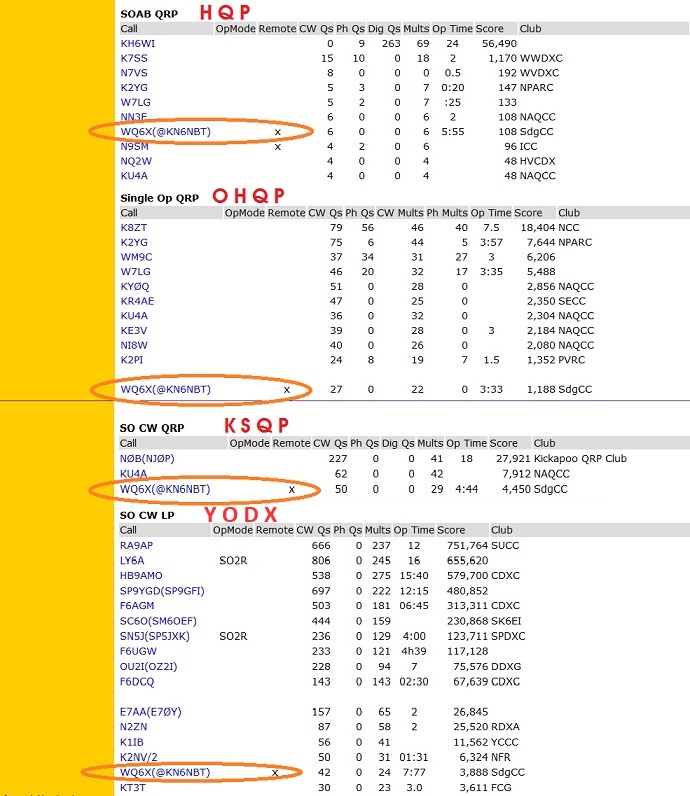
WQ6X runs Triple QRP QSO Parties from Ramona

This is the radiosport weekend every year that opens with so MANY possibilities, yet usually
ends with mild disappointment.  This year in particular, it seems that despite AWEsome Space-WX conditions, QSO Party participation was completely sub-PAR (saying it nicely).

KQP ending at 02:00z shuts down JUST as 40-meters is finally opening to Kansas; we NEVER
get a chance on 80-meters on the Left Coast.  Having another KQP run on Sunday is certainly nice, however it doesn't resolve the 40/80-meter discrepancy.  By default, KQP became a Cw-only GiG when on Saturday, band sweeps on 20/15/10 found no Ssb stations.
The BiG Sunday surprise was hearing OM2VL on 10-meter Cw (sounding like he is next door), frantically looking for KS stations.

OHQP is not much better.  While 80-meter contacts DiD occur (just before the QSO Party's 04:00z ending), like with Kansas, we largely get cheated out of 40-meter action.  Sweeping the Ssb areas Saturday afternoon found no Ssb stations, making this a GiG a Cw-only affair.

The Hawaii QSO Party GiG  (HQP), while giving us a whopping 48 hours to look for KH6, isn't
worth very much if only THREE stations are on the air all weekend.  When I sent (on CW) "S S B?"
to KH6AQ, his reply was "no MIC".

The YO DX contest provided a few dozen contacts from Ramona, altho the bandmaps were LOADED with EU stations - which was great for East Coast operators, but not so hot on the Left Coast.  Not having a QRP category in this contest, I ran the remote K3 at about 88-watts, which was enough to snag 3-EU stations on 40-meters.

At 5pm Sunday, the only thing of significance for the weekend was adding 4-more operating
events to the WQ6X 3830 Score list for the 2024 calendar year.

Here is how it all turned out:

DiD YOU work the state QSO Parties or YO DX contest?

Is WQ6X in YOUR LoG?


Thursday, August 22, 2024

WQ6X Wanders around a WEIRD Saturday-contest WeekEnd

For THIS weekend, it was NEITHER the Best Nor Worst of times - but certainly was the Weirdest, no 
matter how you look at it - at least for ME anyway.  Lesse if I can document some of the weekend's weirdness.

We could say that this contest operations qualified as an "Almost" weekend, all weekend.
The contest agenda showcased:
  • ILLW - International Lighthouse and Lightship Weekend
  • SARTG - Scandinavian Amateur Radio [Teleprinter Group]
  • NAQP - North American QSO Party (Ssb)
Behind the different radiosport events the weekend opened and closed with the annual International Lighthouse and Lightship Weekend.  During the NAQP Ssb GiG several lighthouse stations made it
to the WQ6X and NX6T logs.


The SARTG RTTY GiG is one of several [RTTY] contests which break the contest operating
period into three 8-hour operating slots: 8-hours ON, 8-hours OFF, 8-hours ON, 8-hours OFF,
ending with 8-hours ON.

My BiG OOPS for this event was failing to pack a DB-9 gender changer adapter for the RigExpert PLUS external RTTY decoder/encoder.  Rummaging thru my "THERE-KIT", a couple of 1/8" patch cables enabled cross-directing the audio between Laptop #2 and the K3/0 Mini control head mic and
audio ports.  Because the SARTG GiG has no QRP category, the K3 was dialed back to 75 watts, running as a Low Power (LP) operating entry.

Unfortunately, client commitments kept me out of the operating chair for the first six hours,
probably missing a juicy 40-meter opening.  The Sunday morning opening (to Asia?) was
marred by the ubiquitous East Asian OTH RaDaR NoNsense.

The 9am restart of the SARTG GiG offered 2-hours of RTTY running until the NAQP Ssb contest started @18:00z (11am PDT).  I checked back with RTTY throughout the day, blissfully unaware
of the pending solar activity slowly tweaking upper bands.

Amongst the different WEIRDNESS encountered throughout the contest weekend I include:
  • At EXACTLY 20:00z, my 28417.77 QRP Run Frequency became the National Tuneup Frequency (NTF) for about 10 continuous minutes.  While the auto-notch filter (ANF) worked on the Ramona end, potential calling stations may not have been so lucky
  • OTH RaDaR with its carrier ZERO-BEAT at 7.033 INSIDE the worldwide 40-meter
    Cw band segment - wassup with THAT?  Rotating the Shorty-40 yagi toward East Asia confirmed its geographical origin.
  • The real question is why there was [English-speaking] USB ragchewing happening
    on 14.080 (middle of the RTTY spectrum) - with no callsigns, of course.  I'm used to
    the usual Spanish-speaking ragchewers (w/o callsigns) on 40 and 75 meters, however hearing English in the RTTY band is a new experience.
  • Internet dropouts on Laptop #2 resulted in "Blue Screens" every time the decision was made to restart the computer - but FIRST, the BLUE Screen.


When it was ALL OVER, it would seem that WQ6X took 1st-place over WC7S, while NX6T
took an overall 3rd place, pushing N6RO into 4th-place.  For SARTG while I submitted a log,
I believe I will end up in 50+ place - not bad for just screwing around.
 
DiD YOU work the NAQP Ssb Contest?

Is NX6T or WQ6X in YOUR LoG?

Wednesday, August 14, 2024

WQ6X Wobbles thru another WEIRD WAE Cw Contest


The middle of August brings us the 1st of THREE Worked All Europe (WAE) radiosport contests. 
As a function of pre-contest research, I harked back to the BLAST-from-the-PAST Blog written last
year about the WAE Contest overall.  ([CLICK HERE] to review it.)  For the August 2024 WAE Cw GiG, I opened the 3830 Score submission to read:

"It was the BEST of Times --- It was the WORST of Times".

The above summarizes the WAE weekend which began with GUSTO and declined on Sunday
into abysmal walls of uncertainty and noise.  For me, one of the downsides of competing in 48-hour radiosport contest GiGs like the WAE is that I often miss the opening 5 - 6 hours.  Currently, my Alameda internet connection seems to be unable to connect over I-P (it used to work just fine). 
Because I often see neurofeedback clients on Friday evenings, the arrival time @W7AYT's QTH
is often around 05:00z (10pm PDT).  

Technically, there are only TWO 40-meter openings during the entire contest period, missing
most of Friday evening is a lost opportunity.  (Unlike Asian-based contests, there are no 40-meter openings to EU after midnight.  Instead for Europe, with the SFI index @300+, it is reasonable to expect a 20-meter opening before-during-after the midnight period.  While the QSO-rate was less
than I would have liked, dozens of multipliers made it to the 20-meter log section.


Because sending QTC traffic is nearly 50-percent of the ending score, the decision was made to
NoT initiate QTC message sending until I've had a double dose of Black coffee Saturday morning.  Sometimes European stations can be a bit aggressive in asking "QTC?".  When there were no overt QTC seekers, while running a frequency I would use the F1-Key followed by the F-10 key to send:
                    "CQ  EU  TEST  WQ6X  WQ6X  HV  QTC"
An important operating goal is to "Dump" your QTC traffic before the final 00:00z ending time. 
One year I got stuck with 50+ unsent QTC messages when propagation to Europe suddenly disappeared.  For 2024, I was left with only 5 undelivered QTC messages.

Band conditions on 15 & 20 meters were amazing on Saturday.  Unfortunately, 10-meters was
its currently usual virtual no-show throughout the weekend.  Reading the soapbox comments from
other operators confirm that in the USA (at least in California and the Northwest), 10-meters was
a MASSIVE-DuD!  The one 40-meter opening for WQ6X occurred Saturday evening at 02:55z. 
After nearly 90 minutes only seven 40-meter QSOs actually made it to the log.

Being an EU only contest made it EASY to point the 40-meter Shorty-40 and 20-15-10
STEPP-IR Yagi's to around 38-degrees azimuth and more-or-less leave them in that position. 
(We do something similar when working ASIA-only contests - point the Yagi's to ~300-degs azimuth.)

A number of interesting anomalies presented themselves this weekend:

  • Throughout the weekend (and especially on Sunday), the bands would seem to be dead and then out of NOWHERE an S9+ (usually mid-European) signal would PUNCH through.
  • As the weekend moved forward and atmospheric conditions quietly worsened, signals (mostly coming over the North pole) began to sound scratchy and raspy.  
  • At one point, with some signals I heard what sounded like another station transmitting
    on top of my caller, but in fact was simply a quickly delayed echo of the signal itself.
  • EU stations have a tendency to feel that running 35+ words-minute in CW contests
    is CooL.   The truth is that under marginal conditions (like this weekend), dits/dahs get
    clipped from the individual letters of your callsign producing copy-errors.  Has it ever occurred to these BOZOs that one of the reasons their run-rate has dropped is because nobody can copy their callsigns?  Stations with callsigns like S55S, OE2S, SE5E, DM5EE, 9A/EI5LA, II8K, UT2II, II2C, SE4E & IO0A should be sent MUCH MORE SLOWLY.
  • DiD you hear me send QRS throughout the contest?  Between the raspy signals,
    polar flutter and noise barrage, callsign copy was often quite difficult.  If you check the RBN Stats for WQ6X, you will see that I ran EXACTLY at 25-WPM the entire weekend. 
    While speeding up to 30-WPM might have added 5 more QSOs to the log, that's NoT enough to make a usable difference w/o increasing the repeat-rate considerably.

After 6+ hours of sleep, I was back in the chair at 14:26z.  15-meters seemed to be already reasonably open to EU.  In fact, only 19 QSOs made it into the log (and 10 of them were QTC messages).  Frustrated, I enjoyed 2 more hours sleep, only to discover that some sort of solar disturbance had occurred during my sleep periods.  

Restarting @17:32z during the remaining 6 1/2 hours produced on 29 QSOs and enabled me dump all of my QTC traffic except the last 5 messages.  15-meters disappeared at 20:00z leaving the last
4 hours to utilize the "crowbar" method to wangle a MASSIVE 11 QSOs in 4 hours - PATHETIC.


When it was ALL over, I was relieved to be able to do something else that DiD NoT involve looking
for stations to work on the radio.  Instead, I tuned the K3FEF to the 6.925 - 6.931 Pirate Radio window and enjoyed some unique stuff hearable ONLY on the East Coast.


DiD YOU work the 2024 WAE CW Dx radiosport contest?

Is WQ6X in YOUR LoG?

Friday, August 9, 2024

WQ6X Dual-OP's Yet Another NAQP Cw Contest


While the above is a typical BLOG TiTLe, there was NoThing Typical about THIS 12-Hour NAQP Cw Contest - NoT a SPRINT and yet, nowhere NEAR a full 24 or 48 hours.  We could say that NAQP GiGs are the Goldilocks of domestic radiosport contest events- JUST Right!  Not since the All Asian contest has NX6T put together a multi-single event and even MORE months before that a Multi-2 from NX6T.  The August NAQP Cw GiG was the logical choice to run a Multi-2, altho we will face serious left-coast competition from N6RO in Oakley (N. California.

The finalized NX6T operator schedule put me in for the 4-hour 5pm to 9pm "Dinner Shift" (00:00z
to 04:00z).  Running this shift solved for me the the question of the single-OP mandatory 2-hour off-time.  Off time is defined as a time-period when NO contacts are being logged; checking for internet spots and manually tuning the bands IS allowed during off-periods.  When it was all over, WQ6X/QRP put ~8-hours in the OP chair, whereas WQ6X as NX6T ran 4-hours in the middle of it all.


Because Anza and Ramona are so close geographically, reasonably identical propagation conditions [should have] existed at both locations.  15-meters was THE Band, while 10-meters offered only a brief opening, not only in Ramona and Anza, but all over California and the West coast.  As usual, calling CVQ produced dozens of RBN spots with very few human operators actually spending time
on 10-meters.

Most of the afternoon was spent jumping between 20 & 15 meters.  When the rate dropped on one band, a switch was made to the other and then back again when that band produced nothing. 
At 00:00 (5pm), my shift with NX6T put me on 20-meters for the 1st 2-hours, while N6KI finished
15-meters and then moved down to 40-meters.  


By 02:30z 20-meters was over relegating my move to 80-meters, using the "crowbar" approach to open the band "early" for the Left coast.  At 04:00z WQ6X was again QRP from Ramona running
40-meters until an 80-meter opening finally materialized at 05:20z, just in time for a CQ call on
the Redwood Radio Roundtable.  Hearing no callers, the last 20 minutes of the contest was spent running frequencies on 80-meters.  When that was over, one last QSO on 7.037 w/N4VI ended the
August 2024 NAQP Cw contest.


When it was all over, WQ6X took 4th-place overall, 3rd-place for USA and 2nd-place for CA.
NX6T (in So. California) surpassed N6RO (in No. California) by a mere 18K points.
The scores are so close, that a not-insignificant number of QSO errors could make all the difference.

DiD YOU work the NAQP Cw contest?
Is NX6T or WQ6X in YOUR LoG?


Monday, July 22, 2024

WQ6X SQUEAKs Thru another NAQP RTTY Contest


Rather than play the remote QRP game, this year's July NAQP RTTY GiG was run Low Power
to test the new antenna system at W7AYT's QTH.  It also provided the opportunity to re-evaluate
the Stereo-RTTY method, recently written up in a recent Blog ([CLICK HERE] to read that).

While both goals were accomplished, despite super-fine Space-WX conditions, signal-levels
were extremely POOR throughout the 12 hours of the NAQP RTTY GiG.

For Single-OP operations, we are limited to operating only 10 out of the 12 contest hours,
raising the question of which two hours to NoT be transmitting (off times must be 30+ minutes). 
From this, four different approaches come to mind:

  • Start at 20:00z (1pm PDT) and run the contest all the way thru, ending @06:00z.
  • Start EXACTLY at 18:00z (11am PDT), eventually ending operations at 04:00z (9pm PDT).
  • Begin @19:00z (NooN PDT) and end at 05:00z (10pm PDT).
  • Some combination of the above, converting a slow-rate operating period into a 30-minute off-period, should we go more than 15-minutes w/o a QSO added to the log.
The above choices assume that band propagation is cooperating, which is wasn't for this NAQP event.  Surprisingly 20-meters was a complete no-Show in the WQ6X LoG.


It turns out, the 3-el 10-meter Long John yagi tunes very nicely on 15 & 20 meters as a rotatable dipole, thanks to the MFJ-993B Intellituner.  Hoping that the 20-meter situation was simply one of
a low M-U-F (Maximum Usable Frequency), an early appearance was made on 40-meters,
which didn't actually until nearly 03:00z.

At 05:00z 80-meters finally provided a handful of QSOs / MULTs.  At 05:30z (10:30pm PT), I joined Barbara (NK6Y) on the Redwood Radio Roundtable (3.849 MHz) for a brief ragchew made difficult by poor low-band propagation between Ben Lomond (NK6Y) and Concord (WQ6X).  We both ended up listening on the KFS web SDR (which is situated between both QTH locations) to improve readability.

With 20-minutes left, a couple of QSOs were added on 80-meters and then on 40-meters. 
While the goal of 100 QSOs never quite materialized (96 was the final total), more important was running RTTY into the recently revamped antenna system in Concord.

DiD YOU work the NAQP RTTY Contest?

Is WQ6X in YOUR LoG?

WQ6X Talks About: HERE-KiTs and THERE-KiTs


Over recent months, John Bissel's WORKBENCH column with Radio World Magazine has been
sharing different readers ideas of what constitutes a useful "GO-BoX" for onsite upgrade and repair work.  In amateur radio, most Field Day and CERT operations utilize variations on the GO-Box theme.

As a traffic handler and radiosport operator, whenever possible, I always make thorough equipment checks a day or two prior to an upcoming event:  the equipment locally, as well as any station equipment I will be running remotely.  Even with all those precautions, "little" things can and
will go wrong that disrupt a smooth operating flow.

What at first looks to be a pile of junk or bunch of toys, is actually a carefully acquired set
of implements designed to further the response to the different things which routinely occur
during operating events.


Over the last couple of years, I have accumulated a useful pile of "trinkets" which adorn the
upper-left area of the clear plexiglass covered operating desk.  The largest most prominent item
is the 8 1/2" x 11" white tablet I wrote the notes for this Blog on.   

Throughout a radiosport contest weekend, various things occur during the operation that are often
"So bizarre" I am compelled to jot a bullet-item or even a paragraph regarding what just happened.  Frequently these blurbs evolve into contest blog segment pieces themselves or even an entire Blog series as happened recently with the Revised Radiosport Rules post ([CLICK HERE]) published
in June.  Underneath the BiG PaD is a smaller 5" x 8" pad for jotting down relevant callsigns and
frequencies during the seemingly near-chaotic operation in progress.

The majority of the "tools" in the above picture are more-or-less self-explanatory in their use,
although some may need more of an explanation.

  • The cosmetic brush allows a quick Swoosh away of crumbs and dust on the keyboard.
  • The half-open paper clip is used to diddle reset buttons on the back of equipment units
    that occasionally need a last resort reset.
  • A (double-female) audio connector block enables trying out an audio configuration
    or path that presents itself in a given situation.  It is supplanted by a USB-powered
    4-channel mini mixer, offering more than JUST ground loop isolation.
  • A Harbor Freight freebie flashlight, making for easier front panel adjustments under marginal lighting conditions (I HATE bright, overbearing lighting).
  • 3 styles of screwdrivers for last minute whatever-adjustments.
  • Tweezers and Forceps for picking up and holding little screws/nuts.
  • A lighted dollar store magnifying lens.
Underneath the clear plexiglass are frequency lists, zone lists and Q-Code lists
that may be needed during a typical operating event.

Some things belong in BOTH the HERE-KiT and THERE-KiT.
In particular is a pair of OWN-Zone Wireless stereo headphones ("as seen on TV").
I can use one set (for up to 3-hours) while the other set is charging, or the 2nd-set can be
worn by a guest in the shack attempting to understand the insanity of radiosport operating.
I have evaluated numerous headset combinations, most of which turn out NoT to be stereo,
(required when running Stereo-CW, for example) - the main reason I still use OWNZONE.

My THERE-KiT is essentially a bag of cables, filters and other units that may be needed at
almost any location I happen to operate from.  Included in the THERE-Kit are the following:
  • Install files for WQ6X Beacon Tracker & EASY-Button software as well as 
    SNAP-Shot screenshot software.

  • 2-pair of OWN-Zone headphones as well as a WIRED stereo headset.

  • a generic electret microphone with adapter cables to fit most transceivers.

  • a CW Keying paddle with a pair of adapter plugs.


  • a PL-600 SW receiver for checking propagation and RFI sources.


  • a LEKATO JA-02 II Bluetooth stereo speaker unit (1 or 2).

  • a USB-powered 4-channel audio mixing unit.

  • a USB-drive for moving files on/off the operation computer.
  • a set of 4-each A-A and A-A-A batteries.
  • Several 1/8" stereo patch cables.
  • an EASY Button.

Whether a HERE-KiT or THERE-KiT, the important thing is to think it through well in advance of when you might actually need it.  Then, as you learn from experience, you can update/upgrade the kits as the need arises.  KiTs are like an insurance policy - you hope you never need it and then are thankful in retrospect for having everything more-or-less easily at hand.

Have YOU put together a HERE-KiT and THERE-KiT?

If NoT, WHY KNoT?

Friday, July 19, 2024

WQ6X Leverages Stereo-CW for 2024 IARU HF Championship


Sitting on BART enroute to W7AYT's QTH, I was reflecting on the importance of using Stereo-CW
and in particular, ways to maximize its use when running pileups.  ([CLICK HERE] to read that.)  
While I have dual-OP'd the IARU HF Championship in recent years, having recently revamped the antenna configuration @W7AYT, the decision was made to run the IARU GiG as Single-OP (assisted) CW-only, affording the opportunity to utilize the Reverse Beacon Network (RBN) to evaluate and compare signal levels from the 8JK-Cobra array and the 3-el 10m Long John yagi (which works reasonably well as a "BuddiPole" on 30 thru 15 meters).  Running CW-only enabled making yet another investigation into the efficacy of running Stereo-CW.

The downside of this weekend came on Friday evening when the wireless keyboard was discovered
to be non-operational.  I remembered there was a USB-cabled keyboard sitting forlornly on the shelf.  Plugging it in, I remembered why it got sidelined: the [SPACEBAR], FK4, FK6 "G" & "H" keys were non-functional, requiring those keys to be pressed on the laptop with the right hand, using the left-hand for the rest of the data entry.  While a trip to my Alameda office on Sunday brought in a replacement wireless keyboard, by then the IARU GiG had been over for nearly 8 hours.

As I mentioned in the 3830 Score submission, it seems that stations hear WQ6X (from W7AYT)
better than we hear them.  Numerous times I heard callers right at the noise floor, while it was
clear that WQ6X was reasonably strong on the other end.

While signals on the yagi were weaker than with the 8JK Cobras, the signal-to-noise (SNR) was dramatically superior.  Realizing this prompted the installation of a 2-position coax switch, switching the yagi between COAX-2 on the MFJ-993B auto tuner (for 10-meters) and the RX-Ant connector
on the Yaesu FT-2000 for other bands.  With considerably less background noise, picking out weak stations using the yagi on receive improved performance dramatically.


Based on RBN-reported signal levels, it would seem that running the 3-element 10m yagi on
20 & 15 meters transformed the yagi from a broadside array to more-or-less an end-fire pattern. 
The secret was to rotate the yagi for the strongest signal during Search and Pounce (S&P) operations.

DiD YOU work the 24-hour IARU HF Championship radiosport contest?

Is WQ6X in YOUR LoG?


Stereo-RTTY Revisited (Yet Again)

It could be said that the "Stereo Radio" concept is actually BEST EXPRESSED when running
a RTTY CONTEST.  Having recently upgraded the antenna system @W7AYT's QTH in the SF
East Bay (Grid-Square: CM87xx), the decision was made to run the 2024 summer NAQP RTTY contest from this configuration while fully leveraging the Stereo-Audio setup that is a prominent
part of the operation there.  The IARU HF Championship gave the Stereo-CW method a thorough test.  Two Blogs emerged from that operation:

  • [X] - Using Stereo-CW When Running Pile-UPs
  • [X] - WQ6X Leverages Stereo-CW for 2024 IARU HF Championship

My filter combination of choice for nearly 10 years has been a pair of old-school Autek QF-1A SSB/CW/AM analog audio filters.  Using the PEAK Filter, Stereo-CW and Stereo-RTTY are
easily accommodated.  The LowPass (and sometimes HighPass) filters are the Secret to
running Stereo-SSB - [CLICK HERE] to read more about Stereo-SSB.

As a function of the FREQUENCY knobs on the Autek QF-1A filters, we can PEAK
the  individual MARK/SPACE tones, specifically for each ear, which determines the
[so-called] "position" of each tone in the listening experience.
With the SELECTIVITY knobs we can fine-tune the amplitude of each tone individually. 
The Aux. Notch filters can be used to null any offending carriers or noises in each ear
individually.

Once everything is properly setup, spend some time tuning around the different bands and modes.  The aural-spatial effects are subtly AMAZING.  Properly done, tuning a signal towards zero-beat shifts the signal from the left side to the right (or right-side to the left-side) of the listening experience.  

With weak signals, using RiT can reposition that signal in the listening experience
to match the Stereo-CW filter frequency settings for that moment in time. 
Correctly done, the signal peaks and literally "jumps out" of the RX-Passband.

Do YOU Play around in RTTY Contests?

Has the idea of running Stereo-RTTY ever occurred to you?