Sunday, September 8, 2019

Blast From the PAST: All Asian DX Ssb Contest

While I operate the All Asian Cw contest nearly every year (thanks to its close proximity to the annual Field Day event), finding time and wherewithal to make the A.A. phone contest work has been more difficult.

In many respects All Asian phone is a more difficult contest than its Cw counterpart.  Under marginal space-WX conditions voice communications are more difficult.  Additionally, the "language barrier" contributes to comprehension difficulty.  In Part 3 of the BLOG Series "The Role of Respect in Radiosport", BEEF #13 is "Stations with choppy English". 
This is what I had to say about it:
"This is another variation of the previous BEEF. Your callsign is your trademark.
If we can't understand you, your call will never make it to the log correctly. Now, I AM impressed by
non-English speaking operators who make an attempt at using English during Radiosport contests. 

However, saying your callsign correctly and intelligibly is SO important that you should practice
it OVER-and-OVER again BEFORE the contest. 
Recording your rehearsed-voice in a .WAV
or .MP3 file allows you to play it  through your transmit audio over and over again.  If necessary,
have someone ELSE (whose voice is similar to yours) say your callsign and YOU record him/her."


Depending on the calendar year, the All Asian phone contest often shares the same weekend
as the KSQP and TNQP QSO parties.  At least we contest OPs can have another GiG to engage
in while waiting for propagation to Asia.  In years like 2019, All Asian often shares the spotlight with Nebraska's NEQP event.
Being a competitive person, I am always looking for legitimate ways to earn a winner's certificate. 
In 2013 I made an ad-Hoc All Asian run from N6GEO's QTH in Brentwood.  Because many of the QSOs were made on 20-meters, I submitted the log as a SOSB-20 (single-OP 20 meters) resulting
in a 1st-place win for Zone-3.  I wrote this operation up in an early WQ6X contest BLOG entry ([CLICK HERE] to read about that).
 
This is again another reason to ALWAYS submit a log no matter how FEW QSOs are in it. 
If no one submits a log with a higher score - or if their log is DQ'd or the score is drastically
reduced by the LCR (LoG Czeching Robot) then by default we win for that category. 
 
I learned that in reverse in the 1973 Cw-SS  Had I submitted my log, an EB-Section win would've been mine, as the WA6 station ahead of me was eventually DQ'd; the actual 3rd-place station
walked away with the certificate and probably thought his win was a FLUKE.  Actually his win
occurred by "Cheating, but within the rules" (from a BLOG I wrote on the subject in 2017).


In 2015 I made the drive to Fallbrook a day early
in order that I have the opportunity to load up on
sleep Thursday evening. 

Due to a shortage of operators (N6KI, WQ6X & KK6NON running full-time and 3 other OPs coming
in for a couple hours apiece) I knew that sleep would be in short supply. 

In the 2 weeks preceding the Asian contest, there were a number of solar storms, even a couple of radio blackouts.  For KK6NON, this made for great contest training under adverse space-WX conditions.
 
When it was all over we took 1st place for North America and 2nd place worldwide - who woulda thunk?!....


For the 2016 event, tired of driving, I rode the Amtrak San Joaquin and Surfliner trains to Oceanside and hopped a ride to Fallbrook to join up with the crew which included a surprise visit from Fabio (IZ4AFW) and a newcomer to contest operating - AA6TU.  Tu joined the ham ranks less than 60
days ago, passing all 3 exams to upgrade his call from KM6ECB to a more respectable AA6TU
joining us in the Extra Class Club.
Having an excellent crew sporting a wide-variety of operating skills,
it's no wonder that we were the 1st-Place Multi-Single team in North America.

For 2017 a number of events had transpired earlier in the year, beginning with my Honda Accord being stolen (twice).  Unless I rented a car or made the 12 hour Amtrak trip to Oceanside, the likelihood of a physical appearance in Fallbrook was not likely.

Comet  C H - 2 5 0  &  WQ6X  Lazy  U-Vee
For 2017, equipment failures and power outages at NX6T took the station QRT
Friday afternoon with its last minute
"Bummer Dewd!" notification.

Having just put up a Cobra Inverted Vee
(a WQ6X Lazy U-Vee) at W7AYT's QTH to complement the CH-250 vertical, I used this weekend to test-drive the antenna installation.

This picture (from that BLOG entry) portrays the tenuous setup; later I added a 2nd Cobra dipole creating the "Infamous" WQ6X Lazy 8JK Sloper , with its accompanying JA-Sloper (that rarely hears any JA's).

Contest-wise, only 1 JA QSO ended up in the All Asian log.  Instead, I ran the COQP, TNQP and the CWOPS Cw open contest.


As you can see from the Blog, I used that contest weekend to test drive an early audio filter combination and a custom antenna switch to phase the antennas (without an external tuner to the
FT-1000mp).  Today, I no longer phase the antennas (altho I still can); using an MFJ-949E tuner allows me to select one of 3 antennas.


For 2018 I did a split contest operation from W7AYT.  Interspersed with running NX6T remotely,
I looked for Alabama stations in the ALQP and experimented with different audio and antenna configurations.
 
N 6 K I  +  N N 6 X  +  N 6 E E G
At NX6T we had plenty of operators but unfortunately condx were so POOR that they sat
around much of the time listening to static and playing with their figit spinners.  However when the "dust settled", our modest operation ended up in 4th place (worldwide), 2nd-place for North America and #1 for the W6 area; proof once again to never give up.  Or as I explained it in a recent BLOG,
it ain't over until it's over; and then some.
 
While I enjoy the All Asian contest, because of its fickle nature, a lesson to be learned is to have other (backup) contest plans that weekend if you desire the most efficient utilization of your operating time.
 
So, what can we say about All Asian for 2019? 
As I currently write this, the 2019 event just ended, a little over an hour ago.  
While this seems like one of the WORST A-A Ssb GiGs this sunspot cycle, I've said that before.
Stay tuned for my 2019 write up.
 
Do YOU work the All Asian Phone contest?
What have YOUR results been like?
 

Thursday, September 5, 2019

WQ6X Learns LoTs from COQP & TNQP Double-OP

W Q 6 X  remoting  in  from  Alameda
State and area QSO parties can be a lot of fun; especially if a significant number of stations participate in their own QP (party).  As I gear up for another monumental California QSO Party (CQP), I participate in other parties to keep my skills sharpened, pay closer attention to Space-WX and propagation and test-run new hardware configurations that may be introduced in the next CQP.
W Q 6 X  running  S T N - 1  remotely
This last weekend, August ended with the Colorado QSO Party (COQP) while September [1st] began with the Tennessee QSO Party (TNQP). Right in the MIDDLE of it all, a NASTY Solar-disturbance occurred giving us an A-Index of 38 and a K-Index of 4.  Reading through the 3830Scores Log submissions, it is clear that I was HARDLY the ONLY station with a "hearing problem". 
From what I can determine, 15-meters was a no-show for just about everyone.

I chose to run a Cw only operation from STN-1 @ NX6T while Axel KI6RRN ran mixed mode in these QSO parties from NX6T's STN-2.  We worked out a cellphone signaling system guaranteeing that we didn't work the same band at the same time. 

For the upper bands, by default STN-1 utilizes a 3-el StePP-IR while STN-2 uses a C-31 (multi-element) yagi.  The shorty-40 yagi and Stepp-IR are on the same tower mast (offset by 90 degrees); finding a compromise azimuth position can be a bit tricky.  Nevertheless, Axel and I managed to work both QSO parties sharing resources.  Power-wise, for heat reasons I chose to run the Expert-2K @ around 580 watts.

During this year's COQP event, I encountered two beefs; one a 2-parter.  While the weekend's solar storm certainly put a limit on the signal strength & SNR, as usual, there were HARDLY enough CO stations calling CQ.  From the Left (California) Coast we usually experience a "pipeline" to Colorado, leading me to expect a plethora of COQP signals; even QRP.

Lately, when I experience a DEARTH of QSO party CQ's, I find a run frequency and put out a QP CQ call.  For the most part, stations responding to my CQ COQP call were NO WHERE NEAR Colorado - wassup with that?  Out of frustration I added Part 2 to the "7 Reasons you should not call me" BLOG entry.

My other COQP beef for 2019, was the number of CO stations w/o a "0" in their call.  When they call CQ, they should append a /County to their callsign; when they respond to my CQ calls they should add a /0 to their call so I don't think they are non-CO and ignore them.
 
When it was all over (@04:00z) a whopping 14 Colorado QSOs (in 10 counties) made it to the log.  The COQP guys either need to add MORE HOURS to their QP event (how about on Sunday?) and/or recruit MORE CO STATIONS to participate in their own even.  Nevertheless the stations that DiD participate were fun to hunt for.
 
The Tennessee QSO Party (TNQP), wisely runs on Sunday, altho I wish they would start earlier
than 18:00z to give us a possible morning AND evening TN access on 40 meters; how about
starting @ 14:00z?
 
One of the things I like about TNQP is the existence of bonus stations; in this case, K4TCG worth
a whopping 100 points.  Bonus stations add to the operating excitement, and therefore, gives us added incentive to participate in the TNQP events.  Fortunately, K4TCG usually has a LOUD signal.
 
There are QSO Parties with rules that state unless we make 50+ QSOs we cannot qualify for a Certificate or a Plaque, yet there are often way less that 50 in-state stations, or stations work
3 - 4 bands, giving us a chance for multiple QSOs.
 
In the TNQP event, a 1st-place win is a 1st-place win, no matter how FEW QSOs are made. 
If your submitted score is higher than other submitted scores for that category, then, you win .
 
DiD YOU participate in the COQP or TNQP QSO parties?
 
How many [new] counties made it to YOUR LoG?


Tuesday, September 3, 2019

7 Reasons You [probably] Should Not Call Me - Part 2


When I wrote Part 1 of this BLOG topic, altho I sub-titled it "Part 1" - implying there was more to say on this subject - I had no idea that the "more to say" would come up so soon.

In looking for real-life examples to illustrate the 7 points
I wrote up in Part 1, I had to look no further than the recent HQP and COQP state QSO parties. 

One of my bitches regarding most state QSO parties (California excepted) is that not enough in-state stations participate in their own party event; or at least, they are not calling CQ for their party.  Therefore, if THEY are not calling CQ, then I WILL.  There are often 10x the out-of-state callers than in-state stations to be called.


Out of desperation, I will find a run frequency (such as this weekend's CQ COQP calls on 7053.53).  With few exceptions, the stations calling me, SHOULD NOT BE CALLING ME.  Pay attention as I go over this a second time based on my recent operation in the COQP Colorado QSO party.

I defined N1MM's F1 key to send: "CQ COQP  WQ6X  WQ6X/CA"
Later I defined N1MM's F1 key to send: "CQ COQP  WQ6X  WQ6X/6"
From those CQ's I received calls from MO, 2 W7's, a K9, a WB8, a K6 and a KG5 - NONE of
them in CO (Colorado).

Then I defined the F-10 key to send  "I wrk Colorado Only"
Based on this I ask the following Questions:
  • Do You know what "COQP" means?  If not, then YOU SHOULD NOT  CALL ME.
  • Do You know the rules for the COQP?  If not, then YOU SHOULD NOT  CALL ME.
  • Do You know what "WQ6X/CA" means?  If not, then YOU SHOULD NOT  CALL ME.
  • Do You know what "WQ6X/6" means?  If not, then YOU SHOULD NOT  CALL ME.
  • Do You know that "WQ6X/CA" or "WQ6X/6" means I am in California and NoT Colorado?  If not, then in the COQP contest, YOU SHOULD NOT  CALL ME.
  • Do You know what "I wrk Colorado Only" means?  If not, then YOU SHOULD NOT 
    CALL ME.
  • Do You know what it means to listen before responding to a COQP contest call? 
    If not, then YOU SHOULD NOT  CALL ME.
  • Do You know that when I  send "CQ COQP  WQ6X  WQ6X/CA" that I am NoT looking to ragchew?  If so, then YOU SHOULD NOT  CALL ME.
While I understand that you may be looking to work a WQ6 station, or a station in California,
the Colorado QSO party is NoT the time to do that; there are other stations making a general
CQ call - call them instead.

The way to win friends and make QSOs is to find out what the rules of engagement are and work within those rules.  To do otherwise is to waste everyone's time as well as the frequency spectrum.  One of the EASIEST ways to know what the rules are is to look up the event(s) using your favorite search engine (as shown above).

My recommendation is to read the rules for the given QSO party and then, like me, look for stations
in that state.  Do this long enough and you may have enough U.S. counties in your log to qualify for Worked All USA Counties award.

Meanwhile, the California QSO Party (CQP) is just weeks away.
Feel free to call me then.

WQ6X StePP's Through Another 7 Contest Weekend

This BLOG entry is not meant to be an outright PLUG for the Stepp-IR antenna concept; rather,
this a description of how utilizing the correct configuration at correct time can up your radiosport
score by 12% - it just so happens that I was using a 3-element Stepp-IR at the time I was doing it.

The last full weekend in August brings several radiosport activities to the shared frequency spectrum.  Similar to last year, I took the opportunity to run 6 contest events; 5 as NX6T and one (HQP) as WQ6X.  Overall, there were an additional handful of contest events during the 4th weekend of
August, including:
  • The Hawaii QSO Party [CLICK HERE] to see the rules.
  • The Ohio QSO Party [CLICK HERE] to see the rules.
  • The Kansas QSO Party [CLICK HERE] to see the rules.
  • The SCC RTTY Contest [CLICK HERE] to see the rules.
  • The W/VE Islands Contest [CLICK HERE] to see the rules.
  • The YO DX Contest [CLICK HERE] to see the rules.
Circumstances (no stations heard) did not allow participation in the W/VE GiG.  Where were the players in that GiG?  I would have thoroughly enjoyed working W/VE islands, if ONLY they had
been active.


As for HQP it is always a letdown.  One of my bitches about other QSO parties is that they are
too SHORT; so short that there is no opportunity to work QP stations on 80 & 160 meters. 
KQP on the other hand is a generously wondrous 48 hours. 

Unfortunately less than a dozen unique KH6/KH7/WH6/NH7 stations actually made it to the receiver in Fallbrook; which brings me to my 2nd QSO party bitch: not enough in-state stations play in their own QSO party; there seem to be 10x more county-seeking vultures than there are in-state stations
to satisfy that "hunger".

This year I was so desperate for Zone 31 QSOs that NX6T called CQ HQP (and of course was immediately called by a W4 station).  I eventually set up an N1MM function key to send "KH6 Only"; instead, I should've signed as WQ6X/CA.

In multi-contest weekends like this one, proper planning is essential.  Each radiosport event has
a specific start/ending time; while events may start @ the same time, being different events their ending times are quite different.  By 14:00z all of the contest events WERE in some way active.


HQP is like a mini-DX contest @5pm (local time) on Friday and ending @5pm (local time on Sunday.  Ideally, this gives us twice access to each radio band (assuming the band is open and operates are "playing" on each band).  Typical of most state QSO parties (except CQP) the in-state turnout for HQP, KQP and OHQP was quite a disappointment.  What is the point of hosting a QSO party without [some sort] of activity representation for EACH county?  The CQP.Org website is a PERFECT example of how to "sign-up" for all the state counties (58 in California) well before the contest event.

Friday evening was easy; if the callsign didn't contain a KH6/KH7, WH6/WH7 or NH6/NH7 then I simply ignored it.  Due to a shortage of active Hawaiian stations, out of desperation I began to call
CQ HQP.  Unfortunately, (except for WH6R) the only callers were the usual Southeast stations that don't have a clue (and therefore) should not call me.  Just as I said in a recent Blog ([CLICK HERE]), if you don't know what KQP is or if you don't know that NX6X/WQ6X is in California (and not in Hawaii), then YOU SHOULD NOT CALL ME.  I guess to make it easier I should've signed as WQ6X/CA.

To maximize contest operation amongst all the different events, I took the opportunity to learn the art of StePP-in' it, allowing effective overlapping operation in each of the 3 QSO parties, while looking for Europe in the YO Dx Cw contest, along with the SCC RTTY GiG from Slovenia.

When there was propagation to Hawaii, I would click the 180-degree setting on the StePP-IR antenna.  If HQP and OHQP/KSQP were producing signals, running the antenna in BI-Directional mode allowed working "both ends" without having to rotate the antenna.  When Hawaii faded out, switching the antenna to "Normal" (Northeast) brought the minutely-weak signals into the I-F passband, while the Autek QF-1a audio peak setting boosted those signals above the noise.


In order to run 3 interleaved QSO parties (as NX6T & WQ6X), a separate log file was created for each.  I purposely ran these GiGs as an assisted operation.  In the Kansas QSO party GiG, rover stations were switching counties on a regular basis; an updated band map made all the difference
in sorting the different stations out.

Because my original ideas was to run dual-OP from Concord, I purposely used the NX6T call. 
For various reasons I never made it to W7AYT's QTH in Concord.  Instead, on Sunday, having worked most QSO party stations, I created separate HQP and KQP logs to run as WQ6X in those events.  Occasionally a new Kansas county would activate.  A quick switch-and-back to the NX6T
log quickly snagged those new multipliers (for both callsigns).


By mid Sunday afternoon, only the HQP contest was left; by 04:00z it was over, leaving me with no new Hawaiian QSOs in the log.  Once again, my beef of not enough QSO party participation is levied - this time, "across the pond".  If hams don't play in their own QSO party, then what's the point of having it?

Did YOU play in the various contests ending August?

How did YOUR efforts turn out?

Wednesday, August 28, 2019

Blast From the PAST: Hawaiian QSO Party (HQP)

2 0 1 1 - H Q P  (from Mt. Diablo)
HQP is an "interesting" QSO party;
as QSO Parties go.  Being in the
South Pacific, band opening times are different from other QSO parties. 

Just like the other 49 states, Hawaii is also segmented into counties.  The purpose of a QSO Party is to activate
as many counties as possible, during a relatively short period; although the 48 hour length of this GiG makes it the lengthiest of all state QSO parties.


During after-math "processing" of this years KQP event I took an insightful look into the past, recollecting the handful of HQP GiGs, many of which resulted in 2nd & 3rd place certificates.

It all began with a 2011 camping trip (powered by a pair of poorly-charged marine batteries) atop
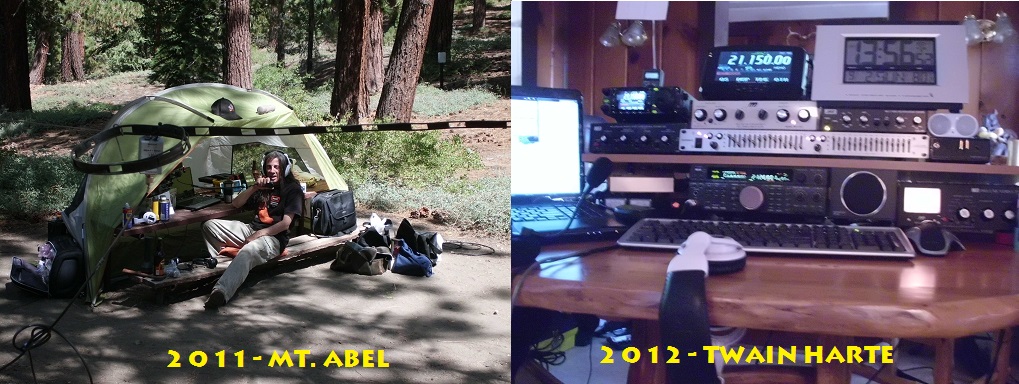
Mt. Diablo, overlooking the SF bay, giving more-or-less direct access to the South Pacific.  I've run the All Asia contest from atop Mt. Abel in So. California several times; running HQP from atop Diablo was done in the same spirit.


During the time-period for the 2012 & 2013 HQP events, I happened to be running portable from
the Phoenix Lodge.  The point of those exercises was to demonstrate the viability of a 2nd-story operation using only an MFJ "Apartment antenna".  While it of course could not compare to a full-sized vertical, and was more-or-less pointing away from the South Pacific, somehow KH6/KH7
was heard and worked.

During 2014 - 2016, I was doing other things during HQP weekends.  In 2017 WQ6X found time to put a meager 28 QSOs in the HQP Log while working other QSO parties and YO DX contest remotely from NX6T in Fallbrook.

The BI-directional capability of the Stepp-IR allows working Hawaii as well as the N-E USA, on into Europe.  If a desired signal is marginal, the Stepp-IR can be pointed "directly" at that station, returning to BI-directional mode after
the QSO is snagged.


For 2019, the goal is to Dual-OP the multi-contest from W7AYT's QTH.
LooK for an upcoming BLOG entry describing what actually happened.

Do YOU ever play around in the Hawaiian QSO party?
How many Hawaiians are in YOUR LoG?

Wednesday, August 21, 2019

7 Reasons You [probably] Should Not Call Me - Part 1

 
Because radio amateurs utilize a shared frequency spectrum, during radiosport weekends when
I make a "CQ Contest" call, other hams (often BORED out of their Minds) will call-in, looking for attention; which may or may not be the correct thing to do.  In all too many cases, if they had read
the contest rules (who does THAT anymore?) they would have known that working me offers no
QSO credit in that particular contest event.

You too may also be wondering when it is appropriate to call me during a radiosport event. 
To assist your understanding in this, here is my list of times YOU  SHOULD NOT CALL ME;
when to actually call me you can then deduce for yourself.

This first point should actually be a "no-brainer", and it often isn't.

When I am calling "CQ JA" or "CQ EU", what part of that call actually indicates that I am looking for calling stations residing in Florida, Georgia, Alabama, Texas or Louisiana?


If I am not calling for you, then please do not call me.  If you don't know what "JA" or "EU" means, then, YOU SHOULD NOT CALL ME.


Here is another no brainer:
If I am having trouble deciphering a callsign
and send something like "KX6?", if your callsign
is WB4XYZ, then, YOU SHOULD NOT CALL ME.

You may be louder than the KX6 station, covering him up, making me send "KX6? AGN?".  This wastes everyone's time.

If you don't know what I mean when I send "KX6?", then, YOU SHOULD NOT CALL ME.

What part of "KX6" sounds like "WB4XYZ"?
Am I missing something?


If I send "CQ SS" and
you don't know what the "SS" means, then, YOU SHOULD NOT
CALL ME.

In this November contest event, I DO NOT want a signal report and I DON'T CARE what your name is. 

If you have read the Sweepstakes rules, then you know EXACTLY the six pieces of information I am expecting; if not, ask.  Otherwise, DO NOT
CALL ME.


If you hear me calling "CQ California QSO Party" (or "CQ CQP") and you are looking for a 20 minute ragchew, then, YOU SHOULD NOT CALL ME.

If you have read the CQP rules, then you know that what I am looking for is a QSO # and what State/Province you are located in - that is all I need and want. 

I could care less how much power you are running, what kind of antenna you are feeding into, what the weather is like, what you had for dinner, or what kind of beagle dog you have.

I may be interested in those things AFTER the contest, but for now, if you can't give me the required CQP information, then, DO NOT
CALL ME.


If I am making a typical "CQ CONTEST" call and you are simply looking for a signal report to verify your LOUDENBOOMER amplifier or the 12-element Signal-Pumper antenna are doing their job, unless you are willing to give me a proper contest exchange, then,
DO NOT CALL ME.
As it is, even if I DO send you "5-9-9" or "5-9" as part of the contest exchange, you may really only be S-2".  If you want a REAL signal report, catch me AFTER the contest.


If I am in the middle of making a contest exchange with ANOTHER station and I miss a piece of sent information, I may well send "AGN?  AGN?" until I receive
the information I need.

This is NoT the time to send
your "KB6LID" callsign.  This is the time for YOU to STFU and give me a clear frequency to complete the current QSO. 

Then (and only then) should you send your callsign; assuming you know what the contest rules are, FIRST.

If you do not know the contest rules, then, YOU SHOULD NOT CALL ME - read the contest rules first and THEN call me when you know how the game is played.


Sometimes things can get so out of hand on a run frequency that I end up sending "QRX!" many times until everybody listens and agrees to STFU while I regain my sanity and begin the frequency run all over again.

At other times LID operators will start calling CQ on my run frequency; had they been listening first they would know that THE FREQUENCY is IN USE.  Correct me if I am wrong, but this is why we should ALWAYS listen before we transmit.  When idiots like this attempt to move-in on my operation
I use the F-11 key to send "QRL QSY" again and again.  If they persist, then I send "KU6LID QRL QSY".

Bottom-line, if you are not sure whether or not you should call me, then most likely, YOU SHOULD NOT CALL ME; it's really as simple as that.  If you follow the edict of always listening before you transmit, then you will ALWAYS know whether or not calling me is the right thing to do.

What part of the above do you NoT understand?

If you have any questions about this, let me know.

"7  3"
C U in the next contest.

Tuesday, August 20, 2019

Does Shortwave Radio have a Future?

 
A recent Op-Ed piece in Radioworld.Com raised the question of Shortwave Radio having a future.  The author, Ruxandra Obreja is unabashedly chairman of Digital Radio Mondiale giving us no surprise that she argues in favor of shortwave radio continuing, altho with some modifications
to the form those transmissions will take.

The fact that I am writing this BLOG and referencing her stance means that overall I am in agreement with her points, altho admittedly I know very little about Digital Radio Mondiale (DRM).  I am a person who was introduced to shortwave broadcasting at the age of 12 (mid 60's) when most countries were represented on the 3 - 30 mhz shortwave spectrum.  Today, the [so-called] "countries list" has been reduced by over 60 percent.

Being that my current main shortwave receiver is the venerable Icom-R71 (mine being a late model) internet searching regarding ideas for my R-71 I happened across VR2MXQ's AF thru SHF Blog (Steve's Blog), with some useful information about this legendary Icom receiver.  Receivers such
as the classic R-71 are not obsolete in the world of DRM, altho they will need some modification
to be properly compatible.

Of course Amateur Radio will remain; cellphones and internet are not a replacement for unfettered/uncensored radio communications; especially during mother nature disasters,
such as the recent devastations encountered in the Caribbean during 2017 - 2018.

Even IF all of the major SW broadcasters were to disappear tomorrow, at the very least, the Pirate broadcast window (approx. 6.900 - 6.975) would continue to bring us their "brand" of independent programming.

Another vital part of shortwave broadcasting are the time and frequency standard services such as: WWV/WWVH, CHU, JJY and other stations around the world, many of which operate on frequency harmonics of 2.5, 5, 10, 15, 20 & 25 Mhz; altho CHU can be found on 3.330, 7.850 and 14.670.

A few years back WWV took a survey asking whether we thought the Space-WX forecasts were unnecessary as most people (underscore MOST) have access to the internet.  In my reply to their survey I pointed out that during TRUE emergency operations (where there may be NO internet access), receiving the Space-WX forecast updates every 4 hours may well be our only access
to such data.  When I run Field Day with W6SW atop Mt. Abel, there is rarely access to a cell
tower that far up and out from civilization.

Today, Space-WX forecasts (at 0:18 & 0:45 mins past the hour) are still with us.  Additionally,
the proposed shutdown of WWV/WWVH and other NIST services as was lobbied for during the 2019 government shutdown period has not only been averted, even MORE funding has been provided for these services - GO Figure.  I guess somebody in Washington IS listening once
in awhile after all.

Thanks to POOR USA involvement with shortwave broadcasting during the last 30+ years, it is easy to conclude that the use of shortwaves is also not happening around the globe.  While it is true that many countries have ceased shortwave broadcasting - as has happened with the CBC in Canada,
the Australian Broadcasting Corp (ABC) and Radio Nederland - other countries have increased their number of broadcast hours.

If CRI (China Radio International) or Radio Japan interests you, they are easily found throughout
the HF spectrum.  During contest weekends I often cannot wait for the 09:00z sign-on for Radio New Zealand (RNZ) on 5.940.  Also recently heard on 49-meters were a number of Caribbean / S-America stations playing a lot of interesting music.

While Popular Communications magazine is no longer with us, at least CQ magazine runs a monthly column known as "The Listening Post" which documents some of the latest happenings in the world of Shortwave Listening.  There are a number of useful websites for finding what frequencies and time-of-day various countries can be heard on the shortwave spectrum.  While it is true that the number of actual stations has reduced, it is arguable that today's program content is often better than ever.

Here are some URL's I have found interesting and/or useful:
  • [X] AmericanRadioHistory.Com
  • [X] ShortWave.Info
  • [X] C.Crane's Shortwave Frequency List
  • [X] Japanese shortwave frequencies
  • [X] Prime Time Shortwave Broadcasts
  • [X] Shortwave schedules around the world
  • [X] Shortwave Pirates
The above list is but a handful of websites I have found useful for finding things/stations to listen to throughout the shortwave spectrum.  If you expand beyond shortwave broadcasting per se', there is an abundance of clandestine and utility stations using HF frequencies that you can listen to; whether or not you understand WHAT it is you are listening to is another situation altogether.


The variety of radio equipment that can receive shortwave broadcasts is staggering.  Many SWL'ers (shortwave listeners) enjoy using 50 - 75 year old receivers to comb the shortwaves.  Others such as myself enjoy older (yet classical) receiving equipment, such as my nearly 30 year old ICOM R-71A.  Most amateur transceivers made in the last 35+ years have the capability of "General Coverage" reception.  My 20 yr-old Yaesu FT-1000mp is an EXCELLENT shortwave receiver; easily on par
with the Icom R-71.  The Yaesu's built-in DSP takes listening to the next level; although the R-71 works well into external DSP units.

In the last 20+ years we have been blessed with the emergence of - SDR - Software Defined Radios operating all over the world.  One of my favorites is the Dutch shortwave receiver at the University of Twente ([CLICK HERE] to hear it.)  Anyone who thinks the shortwaves are "DEAD" should listen to this or other SDR receivers around the globe.

The shortwave spectrum is truly alive and well, and loaded with interesting things to listen to.

When was the last time YOU scanned the shortwave spectrum?
If not recently, I can truly say, that you are TRULY missing out.

So what are you waiting for?.......

Monday, August 19, 2019

WQ6X Slips solo thru NAQP Ssb

It's no secret that for me  Ssb contests take 3rd-place in priority (Cw and RTTY GiGs come first). 

For this last weekend's 12 hour NAQP Ssb GiG, this couldn't be more evident. 

While I usually take Saturdays off work commitments kept me in the office much of the day; for this GiG I did not make
it to W7AYT's QTH until 23:30z.

The original plan was to dual-OP
the NAQP contest, until remote access problems sidelined remote Ssb access from Concord. 

Instead, an ad-Hoc run as WQ6X was made from the W7AYT QTH.

The "secret" came from cobbling together the Yaesu FT-1000mp, feeding the laptop speaker audio
to the radio by way of a twisted tangle of twisted-pair cables into the MFJ-1227 microphone adapter.
A generous use of audio coupling transformers kept the ground loop hum out of the Xmit audio, allowing N1MM controlled .Wav files to call CQ and send the "Ron in California" exchange message.

While space-WX reports indicated no [major] solar storms, the atmospheric noise-levels at W7AYT were astronomical.  80/160 meters turned out to be relatively quiet; then again, almost no one could hear me there.  Even the multi-array antenna'd N6RO (barely 5 miles away) could not hear me.  When Ken "pointed" his 80-meter array in my direction (to work another station) his signal came
up 3 S-units and WQ6X still could not be heard at his relatively quiet Oakley location.

Altho there is a psychological "insurance policy" from having an array of analog & DSP filters
available to massage the noise, most of these circuits are noticeably LESS effective in Ssb contests,  compared to Cw/RTTY signals which are essentially "binary" (On/Off) and are therefore more easily amplified, "twisted" and overall enhanced.

This weekend because of the noise, certain vocal sounds were nearly impossible to decipher. 
With RTTY and Cw, I let the computer decode the signals; with Ssb I must rely on the left/right parietal lobes of my brain to figure out what is being said.

While I was bummed that I could not properly remote in with the NX6T crew, team leader N6KI (Dennis) brought in some backup operators to keep all three stations active most of the time. 
This gave me the opportunity to concentrate on my own dismal operation in Concord.

This weekend was wrapped around by the International Lighthouse and Lightship weekend and the Rookie Roundup (RTTY) on Sunday.  Similar to previous years, I was disappointed to hear ZERO lighthouse activity.  This is a shame because running at/near lighthouses during the August NAQP GiG is a lot of fun.  You may remember that WQ6X did this back in 2012 running as W6L (shown
in the above picture).


On Sunday (18:00z) I found that the RTTY Rookie Roundup was on the WA7BNM calendar. 
While I found the event in N1MM's list of contests, there is no reference to it on the 3830 Scores website.  Searching off/on for a couple of hours, I heard virtually NO RTTY activity on 15, 20 or 40 meters.  From what I could tell, no one was running RTTY this last weekend.  If the rookies want us
to play with them, it is up to them to get things started.  With only KI5AIF in the log, I finally wrapped things up at 22:35z and shut the station down.

Did YOU run the NAQP Ssb contest?

Is WQ6X (or NX6T) in YOUR LoG?

Monday, August 12, 2019

WQ6X runs a Quicky Yet Quirkey WAE Contest

View from the U S S  H o r n e t  @ Alameda Point
As far as radiosport challenges go, the ARRL November Sweepstakes (SS) and the DARC Worked All Europe (WAE) contests, present a unique form of complexity.  Sweepstakes requires us to send
6 (six) pieces of information in order for a contact to be considered valid. 

In WAE, the initial exchange is a no-brainer; just 599 + Serial Number.  However, that's only half
of the point score.  To get 2-points for every QSO, it must be referenced in a QTC message to a European station.  Due to frequent internet dropouts during last year's WAE Cw contest I did not
send any QTC's as my dropouts would have frustrated the European OPs on the other end;
so instead I sent "no QTC", which was in a way just as frustrating for them. 
([CLICK HERE] to read about that.)

Operating time for this weekend had to be split up into segments.  After Europe disappeared on
40 meters I got some needed sleep in time for a few morning 20-m QSOs before heading over
to the USS Hornet (an aircraft carrier docked at Alameda Point).  My Toastmaster's Club (the Alameda Tongue Twisters) was running a table at the job fair event held on the ship. 
Unfortunately, the ham shack for the amateur station was not open this weekend,
so I missed out on listening to WAE from aboard ship.


At 23:00z turning the radio to 14014.14 (my favorite 20-meter Cw Frequency)  found a FRENZY
of Cw signals, but WHERE were the Europeans?  For we Southwest West Coasters there was a seemingly impenetrable "Wall" of W8/W9/W2/W1 stations to the North-East of Fallbrook; one of the
biggest barriers to hearing the 100-w (and less) EU stations.  This is something not even the best DSP filter can eliminate; even the MFJ-1026 and ANC-4 noise cancellers can't touch that "artifact".

Amazingly, one of the best solutions to this "problem", was none other than parking WQ6X's callsign on a run frequency, hoping that they eventually find me; they did, but so did the horrible QRN levels, making 40-meter QSOs difficult (at best) and 80-meters even more impossible.


As I mentioned earlier, sending QTC messages can result in 2X the basic QSO score, making it well worth learning how to do.

From my experience,
the N1MM+ approach
to sending QTC messages
is quite efficient; the only complaint being my inability to send a single field from a given line of data and the non-working Ctrl-Z (it had to be selected from the menu)

Otherwise, it was simply clicking on one "Snd" message after the other. 
The [Exit] button allows "bailing out" at any time.


For reasons of keeping the shack temperature cool at all times, the decision was made to run the Elecraft K3 into an Expert 1.5K amp dialed back to 550 watts.  The additional heat created by running 1,300 watts was not worth attempting a mere 4-db (I.e. barely noticeable) increase in signal.  As it turns out, the NX6T/WQ6X call is often easily heard in Europe; their frustration is that we can't hear them back.  No amount of power increase fixes that; taking the noise level from S-8 down to S-3 is what we need.


While it was easy to find Europe (just point the Yagi's to 30-degrees), 38-degrees is where
a major source of noise comes from, even tho we are 700 feet above the probable source.

One of the biggest frustrations this year came from non other than Israel,  During greyline periods,
it is not surprising to hear 4X4 and 4Z4 stations; unfortunately, when those stations count (such as during the All Asia GiG), they can't be found.  This weekend they were all over the place, along with RX9 & UA0, "taunting me", yet unworkable for EU contest credit - story of my life. 

As I mentioned earlier, calling CQ was actually a major solution to the QRM problem. 
Looking back, it would seem that once I settled in on a likeable run frequency, a vortex opened
up around that frequency, not only giving plenty of QRM-free room, but also a quiet location to
send QTC messages without any problems.

During the final two hours of the WAE GiG, I could tell we were nearing the end (even without looking at the clock) by the number of nearly-frantic "QTC?" requests coming in as WQ6X called CQ.

Of course, near the end of a WAE GiG, the number
of QTC's remaining to be sent represents a dwindling commodity. 

DJ5MW was the recipient of my final 2 messages before WQ6X finally wrapped things up.
While I was disappointed by the lack of hearable European stations, it could well be said that WQ6X worked every station that was heard.

Even more amazing is how many pileups this West coast station "busted", out-signaling many stations
from the Northeast wall.


Did YOU work the WAE Cw contest?

Is WQ6X in YOUR LoG?