Monday, February 27, 2017

WQ6X joins the 2017 NAQP RTTY action

The North American QSO party contests are unique events in that they do not allow high power entries.  All stations must run 100 watts or less; putting more importance on the antenna and receiving systems.

Last month I participated in the CW & SSB NAQP events running my FT-1000mp portable from W7AYT.  A couple of weekends back I ran the WPX RTTY contest remotely from NX6T in Fallbrook putting a 550 watt signal on the air.

For NAQP RTTY this weekend I setup another remote operation from NX6T.  Because NAQP
max power is 100 watts and RTTY is considered
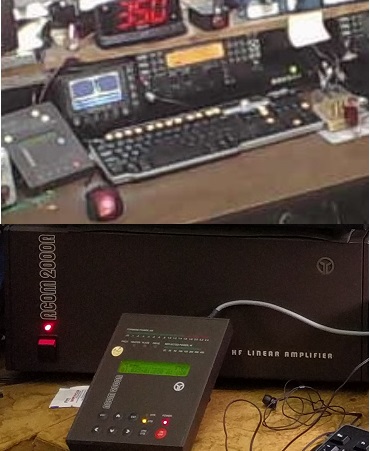
a full-duty cycle mode which can put a lot of strain on most radios, setting the k3 output power down to 4 watts and driving the ACOM 2000a amplifier to ~ 99 watts seemed to solve that problem; until the IP-remote control of the amplifier failed.

Without amplifier control I bypassed the amp and set the power to ~ 60 watts.   Unfortunately I forgot
to up the power for 80 meters and made the 1st 9 QSOs running only 4 watts - Oops.  Nevertheless calling CQ on 3575.75, I received calls from: N0NI, NV9L, VE7FO, K9GWS, N7MDS & WB6JJJ - go figure.  When I jumped the power to 62 watts several receiver front-ends probably received quite a BLAST.


(Left) 2-EL on 40 & 80-m Inv Vee
(Right) C-31 Yagi --- both @ 13mh
While I setup NX6T's station #1 the night before, before the 10 am contest start someone errantly removed the C-31 from the antenna switch.  Because the ACOM 2000a kept faulting on high SWR,
I set about discovering what the problem really was.  Because single-OPs are only allowed to operate 10 out of the 12 contest hours, this became my first off hour. Suddenly, the antenna problem was resolved and WQ6X fired-up on 21104.04.


The last several contest weekends have happened amidst poor space weather conditions.  This weekend, while the predictions were more favorable, for NAQP 10 meters was non-existent with 20 & 15 being a toss-up for best band.  Outside of one VK5 station on 20 (who called me off the back of the C-31 yagi), there were no QSOs outside of U.S. and Canada; no Central/South America, no EU and no JA - HuH?

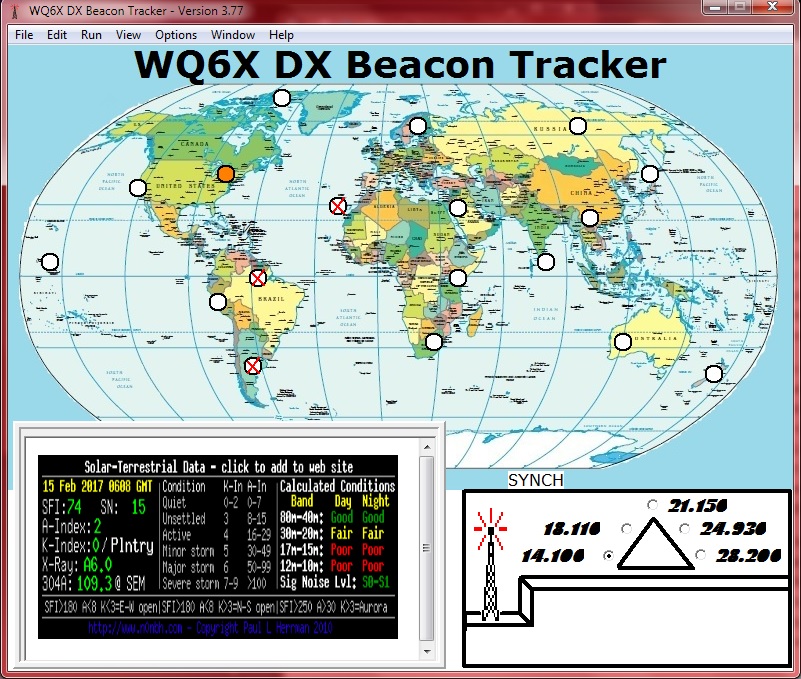
The DX-Map spotting facility spotted WQ6X being heard in Japan
and yet there was no one there to work me - Bummer Dewd!

WQ6X spotted by 7L4IOU
During NAQP we exchange Name and QTH. We do NOT send signal reports so the 40% of reports I received that had a "599" in it were wasting time and bandwidth. When the fast QSB hits, sending additional data that is not only NoT needed, it then preempts proper receipt of name or QTH when the signal fades at the end; which necessitates unnecessary repeats.


On the plus side, I liked the creative use of names such as: BIGFRANK, HILLTOP, DOYLE, CJ & JERZY (who was actually in NY).


Because this was a remote operation I chose to run frequencies 99% of the time.  Unfortunately, many stations would call me OFF FREQUENCY and then get mad when I told them to tune me in rather than using RIT (which is not possible to do using the RCForb software to run the K3).

So, instead of getting MAD at me or calling me LAZY (as one station did), the REAL solution is to BE ON FREQUENCY WHEN YOU CALL ME - HELLO!.......

If you can read my message saying your are off frequency, then synch your VFOs before calling me.  If you cannot read that message then you ARE off frequency and need to tune me in.  My message to these idiots is: "What part about being on frequency before making a radio transmission do you NOT understand?"


During the last hour while running on 3575.75

at 04:30z I got preempted by the RN6 CW traffic net so I setup camp on 3592.92.  Unfortunately, stations seemed to have trouble finding me after that so I made the final 3 QSOs on 7.100.

To wrap the weekend, on Sunday while capturing the NAQP log, I remembered the North Carolina QSO party (NAQP) was also happening so I spent the final hour of the NCQP picking off a dozen NC stations on 20 and then 40 meters.   I was amazed that I could even be heard on 40 at 00:30z.


Did you play in the NAQP RTTY contest?

Is WQ6X in YOUR log?

Monday, February 20, 2017

WQ6X works the ARRL Dx Test remotely on CW

Station #1 @ NX6T
This weekend found WQ6X running another ARRL Dx contest remotely from the NX6T station in Fallbrook
(aka "NashVille").

Last year I ran the station remotely from the Gold Strike casino hotel

with relatively horrible internet access. 
This weekend, thanks to a super internet connection I had very
few latency problems.

When the internet router would inevitably degrade, I ran a local reset program, waited about 4 minutes and voila! I was back in business.


Altho space weather predictions were horrible, not only were QSO rates quite decent, this weekend even produced a pair of 10 meter openings on Saturday and Sunday. 
On Friday evening Fallbrook was plagued with a lot of atmospheric noise which was leveled off by the K3 radio's noise reduction circuits. 
Normally I don't like the K3's DSP noise reduction, however this weekend it made the difference.


WQ6X working KH6 on 10 meters

Despite reports that we are 2 - 3 years away from the bottom of the sunspot cycle, instinct tells me we are less
than a year away; something we will not know for sure until around 2021,
or thereabouts.

During declining sunspot cycle periods, 40 meter DX opportunities take on the profile that we encountered on 20 meters several years ago.

With a good directional antenna, 40 meter DX opportunities during sunspot
cycle lows are utterly AWEsome.


WQ6X spotted on 15 meters

This manifested in my being able to run pileups with stations deep into Europe early in the evening on 40 meters.

Even Western Europe made its way to the west coast on 80 meters Saturday evening. While I was unable to work 160 (it bombs out the internet router)
I have heard many favorable west coast reports on 160 propagation.


The station setup included an Elecraft K3 front-ending an ACOM 2000a amplifier dialed back to
550 watts into an 80-meter inverted Vee and 2 elements on 40.


For the high bands I mainly used a C-31 yagi. Also available was a Stepp-IR attached to antenna #2 on the K3 although to use it I had to run barefoot. Running 100 watts on the Stepp-IR sometimes allowed me to make a quick QSO w/o having to wait for the C-31 to rotate around.


Stepp-IR + 2-el 40 (above)
C-31 Yagi (below)
This contest brought a NUMBER of questionable operating practices to light. While I don't normally "name names", I feel compelled to identify the violators in these cases; especially because they should know better.

Lets begin with stations operating OUT OF BAND.
At 08:42z I copied K3LR calling CQ with a run frequency that ZERO-beat was EXACTLY 3499.70. Later at 09:25z

I copied K1ZM with a run frequency that ZERO-beat EXACTLY at 6999.89. Lest you conclude that the
Elecraft K3 was off calibration; think again.

I verified these out of band signals with ANOTHER radio. So unless Elecraft has design flaws with their equipment, these stations were CLEARLY out of band.

This is yet another reason why we should avoid the bottom 2 - 3 khz of each radio band.


Next up is stations taking over frequencies ALREADY OCCUPIED. This entire weekend I counted less than a handful of times I heard a station ask "QRL?" before taking over a frequency. At 00:08z

on 21049.49 (a frequency I had been using for over an hour) KH7Q jumped on top of me calling CQ.
I sent "QRL QSY" a 1/2 dozen times and was ignored. When I sent "QSY LID" 3 times he went away.

Later at 11:00z on 7037.37 (having been there for nearly an hour) 7J7AAI attempted to take over the frequency less than 200hz below me. He was S-9 on my end and I assume so was I on his end. 

I put up with him for over 20 minutes when he then shifted right on top of me and said "QRL QSY". Huh? My reply to him was "QSY LID" after which he disappeared.

What ARE these people NOT thinking?


Finally during the last hour of the contest I was running the frequency 21049.49. 20 minutes in K6RR asked QRL? I replied QRL QSY several times and was ignored. So, we BOTH shared the frequency with him desperately calling CQ, making about 5 QSOs during that 40 minutes while I not only made 50 QSOs, I also added several new countries to the log including a T88 and 5T0 (which came in by long path).

Either K6RR could not hear me (unlikely) or he obstinately remained on my run frequency.
Had he moved up 1.5kc (which was clear) he could have worked several dozen stations after they were done with me. Instead, I grabbed all the QSOs he SHOULD have had. 

Being stubborn is NoT the way to succeed in radiosport.

Near the end of the final hour BA4TB proceeded to tune up EXACTLY on top of me (obliterating other stations) and then give me a call. Normally I ignore stations that do that however he was so loud I worked him to get him out of the way so I could work the stations he would have otherwise obliterated.


WQ6X run frequency rates
Speaking of getting stations out of the way, another amazing situation is that over TWO DOZEN stateside stations called me looking for contest QSOs. Rather than try to explain to them that they can't work me, I simply sent "5NN CA", let them send their exchange and then did not log their callsign.
I take it that these stations DID NOT READ THE RULES.
How can you expect to get anywhere when you don't read the contest rules?

Another weird situation was WH6ASW on 21054.47 at 23:03z with a weird sounding signal. 1.6 khz above him was a raspy sounding spurious note on his signal. I hope his radio didn't blow up. 


Around that time I noticed a weird Doppler-type shift between my left and right ear in the headphones. Several marginal signals seemed to shift back and forth between the ears; and no, it wasn't anything I was smoking.


QRM-wise, in addition to what I mentioned above I encountered the usual intentional QRM after 09:00z on 40 meters. Typically of this time period much of the QRM was RTTY based. Other QRM was SSB-based. While we DO share the CW spectrum with SSB in region 1,

this was clearly intentional as the station(s) would shift their VFO
while speaking to be annoying.

Additionally, stations would simply send strings of dits on top of me as

I attempted to copy weak calling stations.  Additionally, because the 2-element yagi was often pointed toward Asia, the Russian "M" beacon came through loud and clear on 7.040, however during
this contest the other Russian beacons could not be heard.

Overall, this was an enjoyable ARRL DX contest. While I probably

won't win any awards, I certainly contributed to my DXCC total for
solo operations from San Diego county.


Did YOU work the ARRL DX contest?


Is WQ6X in YOUR DX station log?


Thursday, February 16, 2017

WQ6X Roars Remotely in 2017 WPX RTTY contest

NX6T Station #1 (on the Left)
WQ6X's participation in the 2017 RTTY contest was ad-Hoc from the beginning. I considered setting up the Yaesu FT-1000mp @ W7AYT's QTH or making the trip to Fallbrook ("NashVille") to run NX6T live.
Both ideas seemed like too much effort. KK6NON was originally scheduled to run station #2 @ NX6T but at the last minute elected to operate from his home QTH. With that in mind, running WQ6X remotely from Fallbrook made the most sense.


Thanks to new super-duper internet access @ NX6T I was able to operate station #1 remotely w/o the 15-second timeouts I experienced when running the RTTY RU last month.

Unfortunately, the internet router was not ready until 05:00z, meaning that I missed the Friday 15 & 20 meter openings.


While the A& K indices were down, so was the SFI so I chose to run station #1's K3 into an ACOM 2000a amplifier dialed back to 550 watts to keep things cool.

Nevertheless according to N6KI the shack temperature was nearly 80 degrees most of the time; even with an open window.

Antenna-wise, I ran a C-31 multi-element yagi on the high bands along with 2 elements on 40 and an 80 meter coaxial inverted vee - on separate towers bot at 13mh

There was virtually no noise so the monster loop antenna was not necessary. The real problem was fast-fade QSB which abruptly knocked signals out.


WQ6X spotted wkg A31MM
Because I was running remote I chose to RUN frequencies 99% of the time. What amazed me this year was how many stations would work me and then immediately call CQ on MY run frequency.  Or, they would hear me work a station and then immediately call the station I just worked, oblivious to the fact that it was MY run frequency.

Near the end of the contest while running a frequency on 15 meters, A31MM gave me a call. Immediately, 3 other stations called him on MY run frequency obliterating his signal. After NINE requests for a repeat he faded into the noise. The exchange I copied will probably be wrong - Thanks ASSHOLES!


To these operators I say this: Courtesy goes a LONG way towards scoring big in a radiosport contest. When a station is running a frequency, it is THEIR frequency, until they decide to vacate it; then YOU can use it, but NOT before. You can always do something I have found successful: when you hear a desired caller, move off frequency +/- 5Kc and call your own CQ; maybe that station will find you. Remember the reason I call CQ as much as I do: I have a recognizable and WPX-desirable callsign that I think will attract callers and bring me MORE QSOs then if I search & pounce (S&P).
You can do that too; however bullying people about on THEIR run frequency is NoT
the way to win friends and make QSOs.

What amazes me is how people can be OFF frequency when they call me. Attempting to use RIT to tune them in can be tricky over the internet so I defined the F-11 key to say: "You are OFF Freq - please tune me in" followed by pressing F3 ("TU QRZ" etc.). What I don't get is if they can copy me, then how are they off freq. If they can copy my F-11 message then why weren't they on frequency to begin with.
 One guy called me LAZY for not tuning him in - GO Figure.

W6JBR offered some interesting thoughts on this:

I think that the off-frequency callers are due to one of two issues:
  1. The calling station had engaged their RIT for a prior QSO,
    and did not reset it to Zero offset, so are transmitting split.
  2. They are running AFSK and have not calibrated their sound card,
    so the transmit tones are off frequency.
So, THEY are the lazy ones!

A concern I report EVERY RTTY CONTEST is that 14.100 (the NCDXF beacon frequency) is ALWAYS JAMMED WITH STATIONS. What? You didn't know 14.100 was a beacon frequency? WAKE UP folks!
Stations the world over rely on the 14.100 beacon to predict 20-meter propagation. Beacons are WORTHLESS if a dozen stations are transmitting on top of them. I ALWAYS give them a window. The closest I came to 14.100 was to run a frequency on 14104,44, giving the beacon PLENTY of space. Unfortunately, the corridor below me was LOADED with stations.

In my experience, intentional jamming is always a problem to contend with throughout any contest. There are some BORED anti-contesters who have nothing better to do than to disrupt other on-the-air operations; even though doing so is technically a violation of FCC (and other regulating authority) regulations. This contest found me plagued with tuner-uppers on 20-meters in particular. While auto-notch circuits don't work in a RTTY contest, manual notch controls certainly do. It is my fervent hope that the only thing these idiots accomplish in doing so is to flatten the finals on their amplifier tubes.

Typically, I encounter intentional QRM by way of RTTY on 40 meters during CW contests. During RTTY contests where we take over the majority of the upper-half of the CW segment, using RTTY to QRM RTTY stations makes little sense; altho several stations did try that. There were many BRAVE cw ops calling CQ in between RTTY operations on 40 meters - they have as much right to use of the spectrum as we do. I don't know if they actually established any QSOs doing so, however I acknowledge their right to be there.

In recent contests when I run the FT-1000mp I have been perfecting the art of SO2V (Single-OP 2-VFOs).
For this remote operation, running a frequency was barely all I could manage. SO2V will have to wait until my next live operation.

With the exception of 10 meters, the remaining bands provided a decent amount of activity.
With few exceptions calling CQ resulted in very little wait time. While 15 meters could have yielded more European and Asian stations, 40 meters picked up the slack, including a couple of callers from South Africa (ZS2 & ZS6); not easy from the Left coast.

Amazingly 40 meters remained open to Asia on Saturday well after 17:00z - I guess we REALLY ARE heading to the bottom of the sunspot cycle. RTTY contests typically don't operate on 160 which is a good thing because 160 operation tends to knock the NX6T internet router offline; even at low power. Luckily, I did not miss out on anything significant.

Did YOU operate the CQ WPX RTTY contest?

Did YOU miss anything significant?

Is WQ6X in YOUR Log?

Monday, January 23, 2017

WQ6X survives space WX to run NAQP SSB from W7AYT

The 2017 radiosport contest season opened with a dubiously auspicious start. WQ6X began this contest year with a "barely" showing running the RTTY RU (Roundup) remotely from NX6T's Station #1.

This was followed by last weekend's minimal show in the NAQP Cw contest, operating portable from W7AYT's QTH. This weekend again found me running portable from W7AYT - test-driving a couple of new ideas hardware-wise.

RTTY/SSB audio cable
For last year's CQ WW RTTY contest, I devised a simple RTTY (audio) interface cable (built from a Radio Shack audio isolation xfmr) between the laptop and the FT-1000mp's rarely-used rear PATCH socket, providing a minimal approach to AFSK.

Well, audio is audio - what works for AFSK should be even better for SSB. Using VOX, N1MM+ played .WAV files flawlessly.

For once I was setup well in advance of the start of NAQP - the trickiest part being the creation of .WAV files to be played by the N1MM+ function keys.

During previous NAQP's because I am only allowed to operate 10 out of the 12 contest hours, I tend to forgo the first contest hour on the premise that the high bands may not be open enough by 18:00z to be worthwhile.


Because we are nearing the bottom of the sunspot cycle, for this year I decided to take a reverse approach - starting as close to 18:00z as possible - on the theory that the high bands may well shutdown earlier in the afternoon. 
Space WX be-4 NAQP


As it turns out, because of recent solar storms I probably should have stuck to the usual plan.

Working W0ZYT (Alex) in North Dakota on 20 meters @ 17:45z (with S-9 reports both ways) led me to conclude the rest of 20 meters would follow suit - NOPE.


CH-250 Vertical & Cobra sloper


The space WX reports prior to the contest were bleak, at best (as you can see in the picture above).  However predictions don't always dictate individual band openings.

The portable setup I erected at W7AYT consisted of the now usual run of a Yaesu FT-1000mp into either Dennis' CH-250 vertical as well as an 8Mh sloping-V cobra antenna I hang before the contest starts.

The FT-1000mp sports an excellent A/B antenna switching mechanism along with built-in memories to "remember" which antenna works best for each band.

While I was able to tune the CH-250 on 160 meters (as I did in NAQP-Cw), altho I could hear many strong stations, Saturday evening, unlike last weekend, they could not hear me.


Because band condx were so poor I decided to take the 1st 1/2 hour break @19:32z, before returning to 15 meters, netting as many QSOs as possible while the band struggled to hold up.

Slow QSB (fading) made that a difficult task, resulting in only 23 QSOs (the same as last weekend's 15-meter figure).

Later in the day due to continued poor bay area condx. I inadvertently went an entire hour w/o QSOs, qualifying as another hour in the total off period. It don't matter how you doit, as long as you doit. Fining yet another 1/2 hour during dinner then allowed me to run the contest to the 06:00z end time.

SO2V in action
During recent contests I have been perfecting my understanding and utilization of SO2V (Single-OP 2-VFO) techniques. The FT-1000mp is blessed with dual-receive making it all possible by way of splitting each receiver's audio to the left and right ears.

The 1000mp even allows the operator to switch the audio to opposite ears . It recently occurred to me that a psychological benefit of SO2V is that it somewhat relieves the boredom-factor during slow frequency run periods.

 However, it is important to ALWAYS give priority-attention to the RUN frequency (VFO-A) over VFO-B. If I get too confused, I immediately turn off VFO-B until I have the equipment and/or run frequency back under control.

Late Saturday afternoon when 20 meters abruptly took its final dive I moved down to 40-meters (7185.85) hoping 40 and 80 would salvage the low QSO rate.


At 00:30z K9RM in Indiana said I was very strong; which because of the heavy slow-QSB turned out to bring false hope.  The incessant QSB seemed to ruin openings almost as soon as they started. It seemed that the lower bands were "late" in opening and then quickly went "long".

During the last hour of the contest, the iBoost keyboard (with large yellow keys) began malfunctioning, it would seem, shortly after I made a worthless attempt at 160-meter contest activity; altho the two events may not be related.

In summary, I think the main thing that can be said about this weekend's NAQP contest can be summed up thus: K-Index = 3 ==> 4. As a result, the solar noise was incessant - albeit sporadic;
more on 40-meters than anywhere else. What I don't understand is how the space WX app on DXMAPS.Com can report that there was/is a solar storm, and yet an hour later, WWV's + :18 forecast detailed that NO space weather storms were observed for the last 24 hours.
HuH? I thought the space WX app got its data from WWV/WWVH.  Am I missing something?

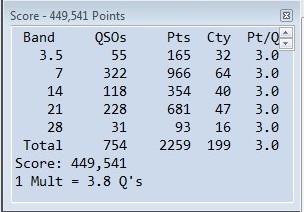
NAQP Ending Statistics
Being assigned to join contest team #1 (which included: WN6K, KI6QDH, W6AFA & W6TK) as part of the Southern California Contest Club's NAQP team entry I predicted the WQ6X log would contain 300 QSOs, surpassing last weekend's dismal 260 Cw QSOs.

When it was all over my 160 contacts resulted in barely half the previous weekend. Luckily, W6TK and W6AFA did a superb job carrying team #1.


While this year's NAQP SSB affair was filled with frustration, there were pockets of fun throughout. Working NP2X & KP4CPC, along with VY1MB & XK150YUKON in the Northern Territories using the Cobra-sloper made it all worthwhile.

 Because I chose to run frequencies a lot, it was quite a thrill to have stations pop-in out of nowhere, resulting in a new multiplier. I also noticed that MANY "0" call area stations were identifying themselves as "Tod" in honor of K0TO(sk). Tributes like this make radiosport contests more personal.

This winter California is receiving its share of rainfall so staying inside to work a radiosport contest made a lot of sense to me. The more I operate SO2V, the more comfortable I become doing it.


Thus far, the FT-1000mp has given WQ6X nearly 18 months of unparalleled portable contest operation. I love any opportunity to sit down and spin the radio's REAL knobs,
in addition to running the Yaesu via computer (CAT) control.

Did YOU play in this weekend's NAQP SSB contest?

Is WQ6X in YOUR log?
Sunday, January 15, 2017

WQ6X Runs NAQP portable from East Bay section


Unless you are a RTTY operator (who participates in the ARRL RTTY RU contest), NAQP-Cw is the first major radiosport event of each new year. For this year I chose to operate NAQP from W7AYT's QTH where I have conducted many radio contest operations before.


The equipment setup was nothing special - a computer controlled Yaesu FT-1000mp was all I needed to make things work. Antenna-wise I used the CH-250 vertical already at the site and hoisted up a Cobra dipole 7mh into the air to make a crude sloper antenna. Because the radio allows A/B antenna selections, I could immediately switch between the two looking for the best signal. Amazingly, the vertical was often quieter (noise-wise) than the sloper - go figure. I was even able to tune the vertical on 160 working as far as Montana (probably with barely an S-2 signal).

As a single-OP operation I was only allowed to work 10 out of the 12 hours so I started up shortly after 19:00z on Saturday and wrapped things up at 05:00z on Sunday. Band conditions left a lot to be desired. 10-meters never happened in Concord. 15-meters barely produced 2 dozen QSOs, leaving 20 and 40 for most of the action, with a little activity on 80 and 160.


There were a few notable callsigns in this contest, like my friend Loco XE2MX. However the wildest callsign in the contest was from XK150YUKON; one of two Yukon stations on the air. DX-wise, aside from KP2M and KP3W, the only other DX stations in WQ6X's log were with HI3Y, HI3TT and 6Y4K.
Name-wise, 3 handles stood out:
BUZZ, VLAD & NIZ.

In recent months I have been learning the art of SO2V (Single-OP 2-VFOs). SO2V played an important role for me in this contest. Throughout the contest I was able to run a frequency using VFO-A while tuning around the band looking for stations via Search & Pounce (S & P).
 The FT-1000mp allows me to split the audio from each receiver into left and right ears. When I operate SO2V, the run frequency always takes priority. At times, having both ears active would become confusing so I would turn off VFO-B until I regained my sanity long enough to continue with both VFOs.


NAQP is a unique contest in that there is no Single-OP assisted category, so I was rather surprised to discover that WQ6X was listed on the DX-map (as you see in the photo). 
At times there did seem to be a flood of callers, leading me to suspect that people were finding WQ6X via some sort of spotting facility.

For this contest, QSB was a major issue. Stations would pop in and disappear almost immediately. This is another reason to keep exchanges SHORT, sending ONLY the required information. 


Many stations would send 599 (not required in NAQP) which lengthened the exchange just enough for the signal to fade before sending
the QTH.  Every time this happens a repeat is required, wasting TIME.


I encountered no intentional-QRM during this contest. In other events it usually happens on 40 meters but well after midnight,which is long after NAQP is over; so I guess we lucked out. There was the usual SSB activity on the top end of the 40-meter Cw spectrum.
They have as much right to that space as I do, so overall we work together in this shared environment.

One of my main beefs in CW contests is with the operators who persist in sending CW at 30+ WPM speed, making it difficult to easily copy weird callsigns such as the aforementioned XK150YUKON station.


I never once sent Cw faster than 25 wpm; my top limit for radio contests. When slower stations call me, I usually slow down to accommodate them. Sending too fast is not an example of superior operating skill but a
sign of stupidity as repeats will be required to get the information through slowing EVERYONE down.

Another beef is the plurality of stations with callsigns not matching the call area they are operating from. For example, there were many non-W7 callsigns operating out of Arizona (AZ). My personal policy is if I am operating outside of California I ALWAYS sign portable; for example WQ6X/7 when I operated from a Las Vegas hotel. While technically it is not required, experience has shown that the confusion-level reduces considerably when we properly sign portable. In some RTTY contests, even if your callsign is registered in say AZ (a W7) if your call does not have a 7 in it you are required to sign as portable to keep everyone happy.


Did YOU work the NAQP Cw contest?

Is WQ6X in YOUR log?

Wednesday, January 11, 2017

WQ6X Contest Blog 100th entry! - the REAL value of Radiosport


WP2/WQ6X  
When I began the WQ6X contest blog back in 2013, I had no idea what I would actually do with the medium; it just seemed like a good idea at the time. During those 4 years, WQ6X has participated in numerous Radiosport contests; both big and small. As WQ6X, contest scores in the MILLIONS of points have been submitted (in GiGs like the CQ WPX contests). Those scores were in contrast with logs submitted to various European contests which contained 1 - 5 QSOs for the ENTIRE contest.

While most WQ6X contest BLOG entries detailed a particular contest activity, interspersed throughout the 4 years were topics relating to specific aspects of contesting itself; such as the blog series I did from St. Croix in 2014. [Click HERE]

In addition to operating the RTTY RU contest from St. Croix, as WP2/WQ6X I put over 2000 CW and SSB QSOs in the log using the Yaesu FT-1000mp provided me at the KP2M station; also known as Radio Reef. 
Yaesu FT-1000mp @ KP2M
I so much liked the 1000mp that in the fall of 2015 I relieved N6VR of one of his pair of 1000mp radios for an awesomely low price.

Ironically, it was this very radio that used to plague me (back in 2007 & 2008) when I operated November Sweepstakes portable in Ojai Ca. 

His super-station was just a mile from me up the hill, with his antennas pointed right down my throat.


For this 100th Blog entry I want to spend time looking at the benefits of contest activity. My non-Contester friends HATE contest weekends because it interferes with their ability to ragchew casually. What my friends fail to realize is that the frequency spectrum the world allows us to play in is a SHARED resource. As radio amateurs, we PRIDE ourselves on our ingenuity - the ability to get the message through, even under the most ADVERSE of conditions.

Sometimes adverse conditions have nothing to do with the frequency spectrum or the ionosphere. Because remotely run station operations are now commonplace, a NEW variable to contend with is internet latency.

STEPP-IR + 2-el 40 at NX6T
A case in point was this last weekend as I operated WQ6X remotely from the San Diego Contest Club contest station (NX6T). To make remote operations more viable they are working on a microwave connection a nearby location where there is super-fast internet access. Unfortunately, "something" is causing a disruption of the signal approximately every 15 seconds.

In RTTY contests (like this one) briefly losing the signal is not a problem because the signals are decoded digitally on the NX6T end and displayed on Station #1's computer screen. While briefly losing internet access to Fallbrook is an annoyance, when the link reconnects, the data is still waiting for the VNC Viewer software on my end to display it.
RCForb simulation of the Elecraft K3
As a result I was able to RUN frequencies most of the time w/o anyone realizing I was actually operating remote.
However S&P'ing was a different story. While it is easy to tune CW & SSB signals remotely, tuning RTTY is tricky, and all but impossible with internet dropouts.

Even if you choose NoT to participate in a given contest, there are benefits to just LISTENING to contest activity. If you use a fairly complex radio like my Yaesu FT-1000mp, during a crowded contest you can learn how to best utilize the built-in selectivity features of your equipment. My 1000mp is loaded with optional Collins filters, in addition to its super eDSP.


Additionally, I often hook up a pair of external audio filers (a JPS NIR-12 and an MFJ 752-c) in the headphone path, adding that extra bit of QRM-reduction.


I also have available the MFJ 1026 interference reducer which attempts to phase-out the QRM at the antenna end of things, before it even gets to the first front-end preamp.

Another useful aspect of contesting is that you can learn to use logging software by just listening (as an SWL) and logging all the stations that you hear. I frequently receive SWL cards (mostly from Europe) after DX contests because many countries in Europe still have a requirement that SWLing experience is a pre-requisite to applying for an amateur license.

In addition to better learning your equipment, logging software contests allows you to become familiar with the various websites that assist us in determining space weather conditions and what areas of the world are open to your QTH.


I learned the SO2V (Single OP 2 VFOs) technique by spending a weekend just listening, SWL-logging all the QSOs I heard.

Because the FT-1000mp uses split-channel audio (one radio in each ear) it is actually possible to work CW stations via the left ear and SSB stations via the right, in mixed-mode contests like State QSO parties (such as CQP).


Listening to contest activity can orient you to superior operating skills. For example, while I never participate in the Thursday nite CWT Ops events, sometimes I will listen in while experimenting with some change to the station layout (like adding in a Radio Shaft 15-band equalizer in the audio line). Just listening and not participating allows me to learn the nuances of my station configuration without any performance pressure.

WQ6X/6 in 2013 All Asian CW contest

Whether or not you participate in emergency preparedness activities, anything that points you in the direction of improving your operating skills is a good thing.

Operating contests and submitting a log afterward will allow you to hone your operating skills. Because most major contests now send Log Check Reports (LCRs) for all log submissions, comparing these reports to your actual log allows you to spot errors that you make repeatedly.


After I submit a log, I save the log-submission response e-mail in an e-mail folder for future reference. I also file a copy of the submitted Cabrillo file on my hard drive for future evaluation. Because Cabrillo file are simply text files they take up a tiny amount of space on the hard drive; even logs with several thousand QSOs are actually tiny files by comparison to most things we store on the hard drives.


San Andreas Faultline Survivors (W6SW)

Field Day is an excellent way to learn emergency preparedness. Technically, Field Day is NoT a contest, but an operating even; alto many crackerjack operators are out to produce the highest QSO totals they can.

FD brings about operators and friends in large groups.

While many amateurs don't care much about actual operating, they often like being a part of antenna raising and station setup; even being a chef.

Some hams just like to toss down a brewski or three as they wander from station to station checking out the different operations. Many a time I have grabbed them by the shirt and pulled them down to the logging chair or put them in front of the microphone. 

CW operators NEVER have to be coerced to sit down at CW station - we LOVE to operate. Several Field Days ago I was in top-form CW-wise making over 900 QSOs behind the key; in addition to my regular late Saturday night SSB operations on75 & 40 meters, where "Geraldine!" often makes the scene. Remember that in Field Day CW QSOs are worth TWO points apiece, as opposed to a SINGLE point for SSB contacts.


2016 FD as W6E from a cabin in Twain Harte
Except for 2016 (when I dual-OP'd with N6GEO from Twain Harte) for over 20 years I have always joined the W6SW Faultline Survivors crew on Mt. Abel (northwest of Los Angeles) for our usual 5 station setup which includes 3 wire yagis, several dipoles and slopers and occasionally WQ6X's 8JK arrays and HF2-V vertical for the lower bands.

In recent years, thanks to W6KC's IP expertise we have been able to network N1MM+ over a wireless Local Area Network (LAN) by hanging a specially constructed yagi from a tree centrally located between the different stations. An advantage of this is that we can stay informed on what QSOs each station is making; which is good for camaraderie as well as spotting the occasional station failure that occurs.

non-W7 1st Place

Do you like to engage in AWARD Hunting? Well guess whut? One of the BEST ways to qualify for major awards is to participate in MAJOR contests. Are you looking to earn WAS (Worked All States)?

The NAQP and WPX contests and of course, the November Sweepstakes can make that happen over the course of just ONE weekend!  Are you looking to earn DXCC? During the CQ and ARRL DX contests you can earn DXCC in one weekend.

Are you looking to work all counties in all of the United States? The State QSO parties (such as 7QP in the Northwest and CQP in California) endeavor to activate all their counties over the course of a weekend. Over a years time, by participating in every QSO party you can will find your counties-worked total skyrocket in just a few months.

BOTTOMLINE? We all use a shared resource - the Amateur Radio Bands. You complain about our contest activity? GET OVER IT! I'm just as sick and tired of listening to you at 6am every morning on 75 meters droning on and on about your lousy health conditions. In all honesty, we are NOT INTERESTED in the gory details of your recent gall bladder removal. One of the ways I avoid hams I consider annoying is to spin the tuning knob and/or switch to another band - I have 9 bands to choose from on HF alone.


NX6T Station #2
While it is true that many contesters can be brash, bratty and sometimes even PUSHY, they are in the minority. Because most contesters PRIDE themselves in playing by the rules - operationally and ethically - you will find them to be courteous and shift frequency when politely asked.

During one contest I was asked by a Net Control Station (NCS) if I could move frequency + / - 5kc in order that they conduct their daily net activities. I found a new frequency home and picked up where I left off - with happy operators on both frequencies.

Amateur Radio contesting (Radiosport) has many benefits, whether you are a rabid contester (as I am) or not. Give it a try (one contest at a time) and find out for yourself.

The WA7BNM calendar provides a monthly list of most radiosport contests. [CLICK HERE] to check it out.


Contesting can be an exciting challenge. Throughout 2017 look for me during contest weekends operating either as WQ6X, NX6T, N6GEO, or one of the 1x1 callsigns I sometimes reserve; such as W6C, W6K, W6R, K6F or K6M. Like everything else in amateur radio contests, using unique 1x1 callsigns can add to the variety of things and therefore the FUN.

Coming up early this year are the NAQP CW / SSB / RTTY contests, WPX Ssb and JIDX Cw GiGs.

I hope to find YOUR callsign in one of my contest logs.

Here are some QSL cards from previous contest activities.