Wednesday, January 8, 2014

Some additional Tips on working DX stations.

What follows are some addition thoughts that crossed my consciousness after last nite's restful sleep in the patio hammock. After looking at the operational summary stats from my non-contest operations a number of things come to mind. 

In the first installment of these musings (http://wq6x.blogspot.com/2014/01/wq6xs-tips-on-how-to-work-dx-stations.html), I described what it is like for a "beginner" (me) to be on the DX-station end of a pile-up.  
Since publishing that blog entry I received a reply from Valentin (YO6DDF) :
"Thanks Ron,I have read your blog and also have shared on FB for the YO group. 73&DX's Val,YO6DDF.
Evidently my comments have made the rounds.  Beginning Sunday nite I noticed that the European stations seem to be less frantic and more orderly.  Last night I was able to run a pileup on 160 meters for nearly an hour before a pushy Italian (an IW6 call) drove me to leave 160-cw and make a final run on 80-cw before I shut things down at 2,004 non-contest QSOs.  That IW6 is probably STILL swearing about me.
That stations were more orderly easily increased my hourly QSO rate by 25%.  Therefore, approximately 25% MORE stations got to make contact with St. Croix.  Do you SEE how that works?

Because I have been on the low power end of looking for DX stations, I know what it is like struggling to be heard through a morass of voices or cw tones, as a DX station I have endeavored to give everyone a chance; case in point being 10-meter Ssb yesterday afternoon.  In a couple of hours I managed nearly 160 QSOs.  During that time I often asked people to standby so I could listen for QRP stations, mobile stations, VE stations and even Africa.  When I put in my 5th call for Africa, HZ1AB (Saudi Arabia) asked if he would count as Africa - another country for the the log, NICE!

On 10-meters, I was amazed by how many QRP, mobile, or QRP-mobile stations had incredibly strong signals when no one else was walking over the top of them.  
This is proof you don't need power on 10-meters.  One guy in Virginia was S9+ with only 10 watts and a dipole 10 feet above ground.

While a lot of people probably hated it, when the pileups got too thick I would have to take it by call area #'s.  At one point I got creative and asked for stations with some letter in the callsign: "Anybody with an "X" in the call?", "Anybody with a "Q" in the call?", "Anybody with a "K" in the call?", etc.

Probably the part of Ssb operation I disliked the most was hearing 500 different explanations of how COLD it is.  One station in Wisconsin told me it was -40.  I reminded him that we had 85 degrees on Tuesday, making a net difference of 120 degrees, to which he replied "that is just WRONG!".

During operations here on St. Croix, I gave REAL signal reports and would ask EVERYONE to give me their name for the log.  Names make it more enjoyably personal.  Real signal reports allow BOTH sides of the QSO to assess the propagation path between the two locations.  While taking the time to do this may have "slowed things down", as we know, it's QUALITY of communication, not rapidity of communication that makes the difference.
The difference is QUALITY.  Quality is one of the premises that brought me here and Quality is what I leave with.

A number of stations worked me on BOTH Cw and Ssb on multiple bands (the top station worked me on 8 band-modes).  Working stations on multiple bands and modes is one of the reasons I spent time figuring out the amplifier and antenna arrangement.  

While I could easily have run low power  or even QRP, to give more stations a shot at working St. Croix I ran the Alpha 89 amplifier to around 800 - 1,000 watts (except on 30-meter Cw, of course).

I made a number of "bonus" contacts wuth stations here in the Caribbean, including a sked on 75-meters with KV4CF at the other end of the Island.

Did you manage to put WQ6X/WP2 or N6GEO/NP2 in your log?
If not, you missed out.

Monday, January 6, 2014

WQ6X & N6GEO Win the RTTY RU Contest as WQ6X/WP2

This is the current KP2M location
Well.... the purpose of George (N6GEO) and I coming to St. Croix has officially been met.  Less than 2 hours ago the 2014 ARRL RTTY Round came to an end; altho ironically, there were still stations handing out RTTY-RU exchanges a good 5 minutes after the contest was officially over.  Because we were running the PowerSDR software to control the FLEX-1500 radios, it was interesting to watch the "waterfall" display at 23:59:30 FULL of signals slowly..... fade..... away...... until the above mentioned stations were all that was left; which is why they stood out as much as they did.

WQ6X from above
N6GEO running 10-Meters for 2 hours
As a team, George and I amassed 1,094 QSOs w/110 multipliers - all states except North Dakota, along with over 50 countries in the log - 1/2 DXCC.  With all of the contacts I have been making outside the contest period, I easily have WAS (Worked all States), WAC (Worked All Continents) & most likely DXCC (100+ countries).  For me, the curiousity is how many bands I have managed WAS on from the KP2M QTH.  WAC on all bands is harder here because we have not heard many stations from Oceana; altho this morning I heard George working a VK6 (Austrailia) on 20 meter Ssb - good show mate!  (Note:  On Monday K3TN shared his experience of working Asia from this location.  His recommendation is to point the yagi south of Asia more towards the equator to create a zig-zag bounce into Asia.  I'm gonna try that.)

While we both bring different assets to our contest activities, the use of SDR radios to run a Rtty contest was completely George's idea, which made complete sense to me from the day he mentioned the idea.  Using software defined radios allows Rtty operators to completely leverage the many advantages that operating Rtty has.  Altho we encountered a number of "blue screens" (the worst was when Windoze crashed JUST as I was about to click on the ONLY Vermont station in the contest), overall everything performed in tandem with no glarring "Ooooooooopppssss" except for not packing an amplifier control cable for the secondary FLEX-1500.

Operationally, we ran the 5 watts from the main Flex-1500 radio into an intermediate Tokyo
HyPower HL-45b amp giving enough driving power to push an Alpha 89 amplifier
(capable of 1.5kw+) to a whopping 149.49 watts keeping us under the 150-watt limit for the low power
contest category.  As it turns out, Rtty operations don't really need a lot of power to effortlessly communicate world wide; demonstrated by the 200+ QSOs George pulled off in 2 hours on 10-meters.

Running N1MM for contest logging, the keyboard macros allowed us to pick off
stations with rapid ease.  When the operator is in synch with running a frequency, the GRAB button & F11-Now key can maximize efficiency at "cruising-attitude".  In several cases we managed to keep a line of stations going for 20 minutes or more. Unfortunately,because of band-crowding, stations on either side of our operating frequency would eventually squeeeeeeeze us out.

Speaking of crowded bands, only in Rtty contests, do stations move to higher and
higher spots in a band, virtually up to the end of their corresponding operating segments.  On 20-meters we were working stations as high as 14.132; on 15-meters, as high as 21.145.  The spectrum above 14.1 & 21.1 doesn't get enough use, so for contest periods this is simply maximizing an available resource.  On 40 meters where 7.075 - 7.100 is also shared with Ssb stations in global Regions 1 & 3, the only way to go is DOWN - into the Cw section - in counter-balance to the fact that Cw contests expand UP the band squishing Rtty operations against the 7.100 "wall".

Overall, the 2014 RTTY RU was an AWEsome experience altho I would not mind having
another 18 hours of operating time (like CQ WW RTTY) and the ability to run as a Multi-2.
As Multi-2 we could have REALLY leveraged the KP2M station location. 
Maybe one day the ARRL contest guys will finally add Multi-2 to their contests. 
Until then we simply need to be creative in how we leverage our OP time.

Did you work the RTTY RU contest?
If so, did you snag WP2/WQ6X?

Saturday, January 4, 2014

WQ6X's Tips on how to work DX Stations


This is the 2nd installment of my writeup from operations here at St. Croix.
As it turns out running pileups is quite a chore because EVERYBODY wants to make a contact.  However in your haste to make contact with a somewhat sought-after station, it is real easy to ignore proper operating protocols, so I would like to offer you a few tips that will get you contacts with WQ6X/WP2 more quickly and painlessly, as well as just about any DX station.  BTW, you should know, these ideas have only been around for 80 or 90 years, so I would think by now they would be common sense.

  1. Tip #1) LISTEN before you transmit.  I cannot stress that enough.  This evening the stations were so out of control I had to take things by call areas.  So, when I say "8 only", that means the 8th call area ONLY!  If you have a "3" in your callsign or a "1" in your callsign you are WASTING YOUR TIME calling me because I will be ignoring you.  If ten people call me who are not 8's then I cannot hear a legitimate 8 station so 1 - 2 minutes of time is wasted.  In those 2 minutes I could have worked several "8" stations and then moved on to the next call area.  So, when you call out of turn you waste EVERYBODY'S time.
  2. TIP #2) LISTEN FIRST! .  When I send "QRX" that means EVERYBODY should stop sending (I.E. STFU!).  If I have to send QRX 10 times in a row before everybody stops then we have wasted 30 - 40  seconds.
  3. Tip #3) LISTEN FIRST!  If I send "SP8XYZ only" then do not send me your callsign unless you are SP8XYZ - I ONLY want to hear SP8XYZ.
  4. Tip #4) When I am listening to a station come back to me do NOT jump in and ask me for my callsign.  When you ask that you may obliterate a weak station I am attempting to copy.  The MAIN reason you can't figure out my callsign is because everybody is sending on top of me.  Has it ever occurred to you that if you are sending at the same time I am, two things happen:
    #1 - I can't hear you.
    #2 - no one else can hear me because you are sending on top of me and may be louder than I am.
  5. Tip #5) If you continuously violate guidelines #1 to #4 eventually you will piss me off and I will get tired and do what I have done the last 3 nights - I will abruptly QRT.  So guess whut?  You STILL don't get to work me.  

    If you want your chance to work a DX station, you need to "get in line", be courteous and patient.  All too often we CAN hear you, but when you call out of turn, to be fair to others we will ignore you and do our best to work those who are more courteous.
  6. Tip #6) LISTEN (are you getting how important it is to listen?)  Friday on 15-meter Ssb I worked 190 stations in 2 hours, and you know what?  They were courteous, listened to and followed my instructions - and guess what?  It worked!!  We all had a fun time.  Why?  Because they listened.  When I asked if there are any QRP stations, the non-QRP stations (the 99%) kept their mouth shut and let me give the weak QRP stations a chance.  When I called for mobile stations, only mobile stations answered up.  As it turns out, nearly everybody who wanted to work me got their chance quickly and effortlessly.  The same thing happend on 160 meters and 80 meters this evening.  But as soon as I get on 40-meters - Ssb or CW - stations (in all honesty MOSTLY Europeans) get PUSHY & RUDE, which RUINS it for EVERYBODY.
  7. TIP #7)  If I didn't work you then you are NOT in the log.  So if you send me a QSL card and I see you are not in the log, I will tear up your card and you will have wasted your card and your stamp.

I know you want to add St. Croix to your DXCC list, but please understand that the way people get the DXCC award is to EARN IT. You earn DXCC by legitimately working 100+ countries.  You do that by LISTENING before you transmit; then transmit at the PROPER TIME.  If you are not sure if you should transmit, then you probably should not.  Instead you should listen until you are SURE it is YOUR TURN to transmit.
 

It really IS THAT EASY - listen before you transmit.  Before you know it, you will have that DXCC award, with not only 100 countries, but 200+ or even 300.  However you cant get that If you don't learn how to LISTEN BEFORE YOU TRANSMIT.

Can I make this any more easy to understand?
If so please let me know how and I will attempt to simplify the above tips even further.

Thursday, January 2, 2014

WQ6X/WP2 & N6GEO/NP2 drop anchor on ST-Croix. in the Caribbean


WQ6X/WP2 & N6GEO/NP2 are currently operating from the KP2M location on the Caribbean island of St. Croix (CQ Zone 8), ostensibly for the RTTY RU contest this coming weekend, but also to put the Virgin Islands on the air before & after the contest.  George is focusing his efforts on PSK31 and RTTY operation while I focus on running pileups on SSB & Cw from 160 to 10 meters on SSB & Cw.  Thus far in 24 hours I have passed the 500 QSO mark - not bad for an ad hoc setup. 
I found a brief opening on 160 meter Cw last night and managed to snag 10 stations.  Look for me more on 160 Ssb & Cw in the coming week.

Because this blog exists to give you my thoughts/feelings/emotions regarding operating, I would like to make a few comments about what it is like to be a sought after DX station.

The FT-1000mp gives me a lot of operating options, which are needed to successfully pull off such an operation.  I am amazed by how many stations (esp. on SSB) who are off frequency and need to be tuned in. How can they even understand me when they are that far off frequency?

I am also surprised by the number of stations who cannot follow directions.  Sometimes the pileups are so fierce that I have had to take it by call areas.  I call for area "1" and get obliterated by stations from other call areas.  My solution is to simply repeat my instructions and IGNORE the stations who don't listen and/or follow instructions.  It got so bad at 07:00z that I finally went QRT and was amazed by how PROUD many U.S. stations were that they chased me off. Remember folks, the most IMPORTANT operating tip is COURTESY. 
When you call out of turn you can obliterate the stations who are legitimately trying to get thru.

Also, while running a frequency I have been taking time to listen especially for mobiles and low-power (QRP) stations, because they deserve a break too.  The best QRP signal today was an S-9 1 watt signal on 10-meter Ssb from Maryland; proof that you don't need power on 10-meters to work the world.

Because I detest DX-peditions who only give out 5-9 or 599, I endeavor to give out REAL signal reports and exchange operator names for my log to make it more personal.

I will have more to say about our operation here, but for now, this is to let you know that St. Croix is radio-active.  My goal is to get WAS & WAC on all bands and as close to DXCC on as many bands as possible.

When we are finished here I will be uploading the WP2/WQ6X log (as well as the RTTY RU log) to the LOTW so y'all can get DXCC credit for our operations here.

Have you worked WQ6X or N6GEO on St. Croix?
There is still plenty of time.

Tuesday, December 17, 2013

WQ6X & N6GEO join up for 2013 ARRL 10-Meter contest

This last weekend wrapped up the 2013 radiosport season by way of the ARRL 10-Meter contest.  This was one of the most active 10-meter contests I have encountered in years; perhaps ever!  There were so many CW stations that they took over the 28.065 - 28.100 RTTY/Data region, extending to as high as 28.135.  SSB activity pushed up as high as 28.700.
After a false start on Friday evening (N1MM software settings got munged from the W.W. Dx contest) we got things in gear and found our 10-meter rhythm.

Using my WQ6X callsign, N6GEO and I operated a FLEX-1000 SDR radio into a cascade of 3 amplifiers: a 5-watt amplifier (boosting the Flex-1000's 1-watt) and a Tokyo Hy-Power  HL-50 (for 50-watts) ending up into an MA-500 amplifier, all to eventually give us 140 watts for the M/S LP category.   Once again we ran all this power into a TH-3 jr. atop  a 22' crank-up military mast.
  
Because the Flex-1000 is early SDR technology, all manner of things can go wrong, and many of them did this weekend.  For openers N1MM all of a sudden could not talk to the SDR radio at the start of the contest.  Once we got things resolved I was only able to snag 24 contacts (22 on Cw) before the band finally faded out to the depths of the south Pacific.  Luckily, 10-meters was open and active both Saturday & Sunday morning; altho the opening to Europe was stronger and longer lasting on Saturday than on Sunday.

Because we were using SDR technology, it made sense that we pair it up with a CW Skimmer, enabling us to pick off CW multipliers more easily.  Skimmer is essentially worthless on SSB so we had to remember to turn it off, saving CPU power for the SDR.

Operationally, a number of things surprised me this weekend.  For example, many times when running a pileup several stations would call.  After spending 10 - 15 seconds to work the first station, the other stations would disappear.  Why call me in the 1st place if you're not going to stick around for the contact?

Because of its early SDR design the FLEX-1000 has been shown to demonstrate audio latency problems.  Because of that, the 1st letter of callsigns (on BOTH Cw & Ssb) was often chopped, requiring several repeats.  On ssb I would tell people they are "too quick for my vox", and yet even then, they could not wait an extra 1-second before coming back to me.

Similar to 20-meters where we have a beacon network at 14.100, on 10 meters we have a series of beacons in the 28.280 - 29-300 spectrum.  I often heard Kw-level stations near the 28.3 bottom of the phone band.  We have 400+ khz of ssb spectrum on 10-meters, why do we need to cram stations in the bottom 10-khz?  Beacons serve a useful purpose, IF they can be heard.

This weekend was proof of what can be accomplished on 10-meters if we only give things a chance.  Friday evening the band remained open until 8-pm local time.  Both mornings I was surprised to find the band well open at 7-am local time, meaning that I should have started both days a 6-am.  Oh well.... next year. 

Unfortunately, a year from now sunspot cycle 24 could be near the end.  This last weekend we were fortunate to be in the well into what seems to be a double sunspot peak with the flux around 162 and very quiet A/K Indexes.  Next year the SFI could be back to sub-100 status.  Then again, we may well be amidst a unique triple-peak phenomenon. 

So, from now until next December give 10-meters all the attention you can muster during radiosport events.  Our lucky break won't last forever.

Saturday, November 30, 2013

WQ6X Joins the team @ NX6T for 2013 CQ W.W. Dx Contest

Despite some incredible operational tactics,  my joint operation with NX6T in Fallbrook this last weekend only netted us a 16th place (out of 17 entries) world wide in the Multi-2 transmitter category, altho we may well have taken 1st place for the W6 call area.


Similar to the JIDX GiG, we ran a pair of K3's front-ending a pair of ACOM 2000 auto-tune amplifiers putting nearly 1400 watts into a pair of Stepp-IR & 2-El 40-m yagi combinations.  Similar to JIDX, our operation got off to a shaky beginning, bouncing back a couple of hours into the event.  While N6KI &  WQ6X were primary operators @ NX6T, throughout the weekend other operators ( N0DY, NN6X, N6EEG & K4RB) took one of the helms.  Because I am willing to pull the "night shifts", I am usually given the 3am - 9am shift; especially in this contest.

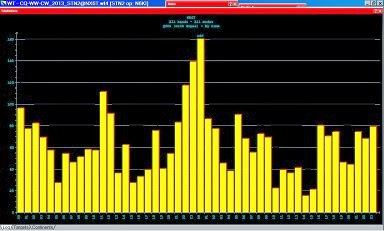
While the solar flux dropped from 170+ to 140, overall the bands were amazingly quiet.  10 meters was incredibly open, as was 15 meters.  Despite those great condx, as highlighted below, 40-meters delivered over 1/3 of our QSOs for this contest.  While we only managed 21 QSOs on 160, the California--> Asia path was certainly there; had more Asian stations made a 160 appearance they would have found great west coast propagation - too bad they didn't.


Based on spotter reports and consistently busting pile-ups on the 1st/2nd call it would seem that NX6T had a booming presence in Europe & Asia and at least a commanding presence in Central/South America.

My operations consisted of significant time spent in S & P mode, switching to running a frequency when a "hole" in the spectrum suddenly appeared.  Late Saturday evening while running solo I remembered that there was an audio switch box for combining both K3's into faux-SO2R arrangement.  The 15 minutes I spent reconfiguring the cables allowed me to run a frequency on 80 & 160 while S&P'ing on 40 and eventually 20 meters after sunrise washed out 7-mhz & below; at which time 10/15-meters became the RUN frequency.


Although not super eventful, overall, this years W.W. Cw contest was a lot of fun.  Our Multi-2 arrangement gave our 6 operators virtually all the time in the chair they wanted.  Thanks to the operator's apartment next door, I was able to catch 4-hour naps and make an appearance on virtually every operating shift.

The increasing number of "exotic" callsigns this year made CQ W.W. more exciting than ever.  We made DXCC on 40-20-15 meters and 86 countries on 10-m. 
Zone-wise we only missed Zones 34 & 39; both on Africa's east side.


Did you play in the CQ World Wide contest this year?
If so, did you make DXCC & WAZ?


Monday, November 18, 2013

WQ6X & N6GEO achieve another Clean Sweep for 2013 Sweepstakes Phone

2013 Sweepstakes phone for W6K is literally one for the log. 
Teaming up again with N6GEO from his home QTH we made Sweepstakes phone an SDR (Software Defined Radio) affair.  We originally setup a FLEX-1500 on a Vista laptop and a more robust station using a FLEX-1000 on a super desktop running Windoze XP. 


The FLEX-1500 was capable of multi-channel voice keying by way of N1MM. 
We couldn't make the audio link between N1MM and the FLEX-1000 work.  The only voice keying came from the one recording available from the SDR software.  We ran both radios thru a bevy of amplifiers to run as close to 150-w as possible.
For Sunday operations we used the FLEX-1000 exclusively.

Antenna-wise we ran the TH3-jr again with a new Yaesu G-400 rotor, which rotates jr yagis rather quickly.  The 80-meter whip on the 6-BTV vertical was upgraded with another 80-meter whip that also sported a 160-meter "inverted-L" wire to give us 160-meter access.  The vertical worked fine for 40 & 80 but failed after an operating attempt on 160; evidently the 80-whip pressed into service failed, even though the SWR on 160 was a mere 1.2:1.  We lost 3 - 4 hours of QSO opportunities from that problem.   From the reports I've read, many California stations experienced a deficiency in 40-meter contacts Saturday evening.

Propagation wise, along with a solar flux of 175 we moved into Sweepstakes weekend with a declining K-Index (from K-4 down to K-1).  10 meters was wide open on Saturday afternoon, giving us our highest band QSO total.  Unfortunately on Sunday 10-meters became solar-noised out by 22:00z.  15 and 20 meters then became the focus.  By 4:30 pm on Sunday (00:30z) we took refuge on 40-meters and finally 75, to make up for the lost local QSOs on Saturday. 
I like to end November Sweepstakes on 75-meters in the last hour to snag any leftover Calif./W-7 "local" stations.  I was disappointed that only a few stations thought to do the same thing.

While not an easy task, we managed a clean sweep in the last 4 hours of the Sweepstakes thanks to W6TK (SB section), VO1KTV (NL section) and AF7Z (UT section) to claim all 83 ARRL sections.  TheVO1 station was the only NL section entry, meaning that there will be less than 600 clean sweep log submissions.


We welcomed over a dozen new stations to the Sweepstakes.  As a "run" station while it is nice to work stations at a rapid clip, when "newbies" stumble onto our contest we are duty-bound to slow down and explain to them how to make a Sweepstakes exchange.  Who knows, next year they may turnout to be full-fledged operators in this wonderful contest.


Did you play in this year's November Sweepstakes phone?
If so, how did it turn out?  Did you manage a Sweep?

Monday, November 11, 2013

Team W6H scores another 1st-place worldwide for 2013 JIDX SSB

This last weekend's JIDX was an interesting challenge in many ways.  Registering the W6H callsign (In honor of the late Hiro - JA1FRQ) I again teamed with the NX6T group in Fallbrook Ca.  (also known as "Nashville" in honor of Nash W6HCD who passed this year).  At 1,000' elevation, physically, Nashville is ideally suited for contesting, with the exception of a nearby noise source in the direction that we point the antennas for the best path to Japan.

This contest season team leader Dennis (N6KI) has been experimenting with a multi-transmitter setup which qualifies under multi-single category.   Three radios (2 K3's and 1 TS-590) were put together allowing a "run" station (a K3), a mult station (another K3) and a search/pounce station (the TS-590) interlocked with the run station so only one or the other can transmit.  With this configuration we managed 668 Q's (versus 861 in 2012), but evidently enough to have locked up 1st-place world wide for the MOP category - at least according to the 3830 Scores website.  Ironically there were single-OP stations (both Russian) with way more QSOs than we had.

In this run of the JIDX there were indeed a dearth of Japanese stations participating; one only has to look at the highest QSO number on any individual band to figure that one.  This is consistent with my beef that Asian stations don't participate in their own contests.   While we managed to work prefectures 1 - 47, 48, 49 & 50 were not active in their own contest; altho JD1 WAS active in the WAE RTTY contest (also running during the weekend) - wassup with that ??!!??

An updated version of the WQ6X Prefecture Tracker software gives us the breakdown of the 47 prefectures worked by W6H throughout the contest weekend.


80 meter participation on the part of the Japanese was very poor - we only worked 20 stations; most of them on Sunday morning.  This year we had no 160 meter antenna so we missed out on whoever was there.  40 meters was THE band this year with about 45% of the Q's made there; mostly by the run station, with a few snuck in by the S/P station.

While the solar flux remained a medium all weekend with no real storms (until after the contest) 10 meters was somewhat of a disappointment.  20 meters to Japan has been quite a disappointment in recent years from this location, so it was up to 40 & 15 meters to carry the contest forward; with 10, 20 & 80 rounding out the activity.

We had a team of 9 operators with varying degrees of experience, which made for an interesting operation. My job was to operate a little bit throughout the weekend, on every shift within the 30 hour period.

Fresh off the high of receiving the 1st-place MOP plaque from last year's JIDX, we plowed into this contest with plenty of focus and enthusiasm - helpful when we ran into equipment glitches throughout the weekend.  While running a pair of ACOM 2000 amplifiers has its advantages, free-floating RF in the shack is not one of them.

While we made a lot of mistakes and encountered many technical difficulties it would seem that W6H will again earn a MOP 1st place plaque for 2013.

We received the plaque on Ground Hog day (Feb 2) in 2015.


Did you play in the JIDX?  How did your operation turn out?

Tuesday, November 5, 2013

WQ6X & N6GEO team up as W6K for Sweepstakes Cw

N6GEO    &    WQ6X
This last weekend again found me in Brentwood (EB section) teamed up with N6GEO as W6K for the 80th running of the Cw November Sweepstakes contest.  We had a lot of ideas for how we would operate this contest as a multi operator setup.  In the end they all didn't make it. 


The Flex Radio Power SDR Screen (w/CW Skimmer) and our superb mini antenna farm
We settled on running a FLEX SDR-1000 (Software Defined Radio) into a pair of cascaded amplifiers giving us 145 watts out; just enough to top-out at the low power limit of 150w.  We front-ended the receiver section with a CW skimmer, which is legal as multi-OP is also an assisted category.  The skimmer certainly helped cut down on code copying errors and made search & pouncing (S&P) a lot of interesting fun.  For antennas we used an 8mh TH-3 jr. yagi  for the high bands and a ground mounted 6-BTV vertical for 80 & 40.

Our goal was to beat last year's record of 469 Q's and get a clean sweep to make up for missing it by 2 sections last year and 2 in this year's CQP.  As with CQP there were a dearth of Vermont stations (2 to be exact) so we almost missed the sweep.  Finally at 20:44z N1UR popped up on the "needed station" screen.  A double-click of the mouse and a switch on the amplifiers snagged the illusive lil' bugger.  We ended up with 531 QSOs in all 83 sections for an ending score of 88,146 points.

There was a propagation rumor that a number of solar disturbances were headed our way.  While I heard that there were signal dropouts at NX6T in San Diego, in the East Bay we experienced no real signal problems other than the predictable slow-fade on 15/10 meters.  I was disappointed in the small number of stations who actually made it down to 80 meters.  Wakeup people!  80-meters was HOPPING - for those who did show up.  Even 40-meters was lacking in signals; not because of poor propagation, but because people didn't spend enough OP time there as we did.


Now that we proved we can get a sweep and beyond, preparations are under way for W6K to operate Sweepstakes phone with this same arrangement (except the Skimmer, which does us no good on SSB).


From the reported QSO numbers and submissions to the 3830 Scores website we know there were over 1500 active stations in this year's event.  This year the number of reported section sweeps seems to have significantly increased over last years action when the Ontario (ONT) section was split into 4 multipliers (ONE, ONN, ONS & GTA).


How was Sweepstakes on your end?  Did you manage a sweep?