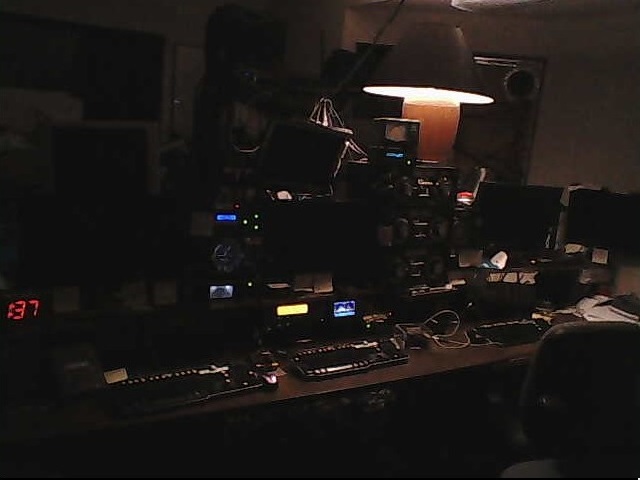
Thursday, March 7, 2019

NX6T's Fab-Four Fly Forward for CQ-160 Ssb GiG

R u n n i n g   1 8 1 5 . 1 5

After last weekend's [projected] S-W Division win in the ARRL Dx Cw contest, looking back, 160 was the low-band most lacking; altho incredibly, long-haul Dx (from the W6 viewpoint) made it into the log.
While Space-WX reports were optimistically favorable, those #'s did not take into account the reality of our being 900' up the hill, in Fallbrook.

Oblivious to this being an SSB contest weekend, several PTT switches were left languishing in various locations @W7AYT (in Concord).  Initially, shorting two wires created a crude PTT effect,
until it occurred to use one paddle of a Hamkey keyer paddle (with the unit on its side) as a pushdown PTT switch; oh what a difference technology makes

This weekend brought together a number of ssb contest-fluent operators as well as the
appearance of a nearly-new Kenwood TS-890 for use at STN-3, the multiplier-hunting OP-position. 
(I will have more to say about this TS-890 @STN-3 in coming BLOG entries - stay tuned.)

Dennis N6KI started the contest off with some B-I-C (butt in chair) action, while I cobbled together
the necessary audio cables putting the Heil HC-4 PRO into the mic audio line and then load up the Elecraft K3/0's 4 Voice Keyer memories.  With the coming of the 04:00z "dinner hour", N6KI enjoyed his traditional Sat. evening dinner break while I split the OP time between (first) S&P and layer running frequencies.


W Q 6 X  R e m o t e  S e t u p
For many years now, intentional QRM is part of WQ6X's 40 meter operations from NX6T; this weekend was certainly NO exception.  At one point a station moved atop the run frequency with a BiG carrier for 5+ minutes, followed by Ssb testing on USB.  While the K3 auto-notch works on the K3/0 eliminating it in MY ears, the IDIOT tuner-upper is STILL there and probably as LOUD as I am. 
When I changed frequency, so did the QRM; i.e., nothing accidental about that. 
I thought intentional QRM happened only on 40-meters after 08:00z.

N 6 K I  @  0 6 : 3 0 z
N6KI relieved me at 06:15z.  Less than 3 hours later WQ6X was back in the remote operator "chair".  Immediately after 09:00z the QRN-level jumped to S9+15db.  No setting of the DNR-Dsp was of
any value w/o destroying the voice quality of weak Ssb signals.

At NX6T, the 160 antenna is nothing more than a coaxial inverted vee (70' apex).  While we could
not hear many S9+ signals (due to the noise) I received e-mail notifications and spots indicating that our 1.35kw signal was being heard in Europe.  It is frustrating for me knowing that we are being heard (in the N/E - S/W direction) yet we can't hear those who are hearing us.  At one point, a VK2 station called in on Cw (which of course does not count in an Ssb contest).

N 6 E E G  +  N 6 K I
By 12:30z, continuing noise-levels and intermittent internet dropouts conspired against my continuing on further.  I shut things down knowing that NN6X and N6EEG will join up with N6KI in less than 12 hours to give it another GO.

N X 6 T  @  S u n r i s e
You may recall that last year I wrote a WQ6X BLOG series on my BEEFs regarding radio sport.  ([CLICK HERE] to read that series.)  For this year's CQ-160 Ssb contest, one of my biggest Beefs was #3 in the Beef-List: stations who work NX6T and then less than 10 minutes later they call in again.

HuH?  Am I missing something?  WTF is that all about? 
What part of DUP QSO do they not get?

Saturday evening was a slow go; partially from having "worked everyone" the night before, and partially from the fascination with the Kenwood TS-890 in Fallbrook and WQ6X (in the SF bay area) learning all the various DNR settings available via the Elecraft K3/0.


Being the nightshift operator again Saturday, operating time was split between S&P, running frequencies and dodging National Tuneup Frequencies; something, the K3/0's auto-notch DSP handled quite nicely. 

Sunday morning (14:20z), after putting RT0F into the log I finally shut things down. 
1-Qso every 8 minutes is not my idea of a GooD time; especially at 6am.

Overall the 160 contest was a mild amount of fun.
On the Fallbrook end, the test-run of the new TS-890 was (according to N6KI) a resounding
success; so much so that the new Kenwood seems to have become the current replacement
for the Elecraft K3, formerly installed at STN-#3.

Did YOU work the CQ-160 Ssb contest?
Is NX6T in YOUR Log?

Thursday, February 21, 2019

NX6T Nixes ARRL Dx Left Coast competition

W Q 6 X  @ W 7 A Y T
I more-or-less fell into the Cw ARRL Dx Contest operation @ NX6T in Fallbrook (SDG Section).  Dennis (N6KI) was at the Yuma Hamfest relegating me to cobble together inspiration from a handful of operators from around the Fallbrook/Oceanside area.  Seemingly out of nowhere a Multi-2 (M/2) operating schedule came together.

This year's NX6T Cw entry was a nice mixture of remote and B-I-C operators. 
My goal was for the group to find an operating "groove" Friday evening, Saturday morning
and early-afternoon, allowing me to make another trip to W7AYT's QTH and put WQ6X on the air.
All of this more-or-less happened.

A n t e n n a s  @  W 7 A Y T
Being a 48-hour radiosport event, the ARRL
Dx contest is loaded with operating opportunities, allowing each of the 6 operators (K4RB, N6CY, N6KI, N6NC, WM6Y & WQ6X) to operate during their peak periods.

As in recent Fallbrook events, I am no longer the lone operator during the after-midnight operating periods.  That allows me to slip an extra 90-minute sleep into my schedule, making it easier to get up
at 8am for the morning shift (and then go back to
bed for 2 hours).

Actual OP time began for WQ6X @ 05:50z, spending a couple of hours running frequencies on 160 & 80 meters.  Later an S&P journey picked up the stations who were themselves running a frequency.  Eventually it was time to migrate to 40-meters and point the 2-el shorty-40 to Asia putting 180+ QSOs into the log.

Around 08:30z while running Asia (antenna pointed to 315-degrees), a number of European calls came in from QTH's like DL3, PA5, RA1, OH1 & SM3.  HuH?  At 12:30z my DNS internet connection to Fallbrook stopped working.  Because the remote K3/0 radio is IP-based, the radio itself continued working flawlessly;  however w/o the ability to log, it does no good.  Fortunately, N6CY took over on STN-1 and I came back later.


W Q 6 X  (Remote) & W M 6 Y (B-I-C)
After a couple of more hours sleep, I awoke to a 15 meter opening, putting 38 QSOs into the log.  Unfortunately for me, 10 did not deliver.  However on Sunday the crew managed to put 11 QSOs
in the 10-meter log; all with SA.

Running Multi-2 allowed a mixture of remote and B-I-C (Butt-in-Chair) operations.  I was too lazy to drag the Elecraft K3/0 to W7AYT so from there I took a chance and ran STN-1 remotely using the antiquated (but marginally workable) RCForb software.  N6KI, back from Yuma ran STN-2 remotely while I ran STN-1.
K 4 R B  &  W M 6 Y
Sunday morning K4RB (Bob) and WM6Y (Phil) accomplished B-I-C taking the NX6T log to exciting new heights.  Due to a weird cabling glitch with the 8JK Sloper, WQ6X managed only
4 QSOs on 40 meters Saturday nite.  Sunday @ noon, switching to the CHA-250 vertical allowed 4
15-meter QSOs and 9 QSOs on 20 into the log before it was time to make the drive back to Alameda to work with clients.
N X 6 T  &  W Q 6 X  S t a t s

N6KI joined the day shift to wrap the 48 hour contest.   The day crew not only put NX6T ON 10 meters, they managed to amass nearly 100 more 15 meter QSOs in the log; not to mention taking
the 20-meter QSO total to over 600.

After it was all over, N6KI provided us with comparison stats to our most immediate rivals - the Arizona Outlaws.  Assuming we survive the Log Checking Robot (LCR), NX6T will not only submit
a high score for San Diego section, but for the entire Southwest Division.

Did YOU play in the ARRL DX Cw contest?
Is NX6T or WQ6X in YOUR Log?


Monday, February 11, 2019

N6CY and WQ6X Roar remotely in WPX RTTY


W Q 6 X  R e m o t e
This was another near-last minute contest setup at NX6T.  This is also one contest that almost didn't make it. As of Friday afternoon, our uWave microwave link (a major component in our remote internet access) was down and it didn't look GooD.  Thanks to behind-the-scenes troubleshooting from K6AM, W6JBR and N6KI, NX6T was ready to roll by 02:00z; WQ6X put the 1st QSO in the log at 02:38z.

Operating hours were split up between N6CY (Rick) and WQ6X (Ron). Both Rick and Ron operated remotely; Ron on STN-2 and Rick on STN-1. Saturday morning, N6CY made an onsite visit to NX6T, for 6 hours of actual B-I-C.  Our biggest problem was turning the amplifier powers up and down, blending max. power out while remaining under 70-degs(c) room temperature.

N 6 C Y  @  N X 6 T - S T N - 1
We ran a pair of Elecraft K3/0 controlled K3's onsite in Fallbrook. STN-1 dumped its RF into a classic ACOM 2000a amp while STN-2 dumped ITS RF into an Expert 1.5k amplifier. STN2 used the C-31 yagi for the high bands, allowing WQ6X to jump around on 10 & 15 while N6CY kept 20-meters
alive for HOURS by way of a Stepp-IR which can be switched between NORM, BI-DIRECTIONAL and 180 degrees for QUICK direction shift. 


The Shorty-Fourty 2-el. yagi and 80-meter inverted bazooka-Vee were shared between stations.
No coax switch "collisions" occurred the entire contest.  The lockouts and interlocks were in perfectly-timed operation; most desirable during dual-OP remote access.

N 6 C Y  &  W Q 6 X  R u n n i n g  R e m o t e l y
While the K3/0 radio connections ran flawlessly, because we used Hamachi & VNC Viewer to run the N1MM+ software, occasiuonally, the entry screen would freeze even though signasls could be heard thru the K3/0 - very FRUSTRATING.  If we "just disappeared" on you; that's probably why.

Because N1MM+ is equipped with some graphical stat displays it is easy to devise a hybrid display from 4 separate screens.  Having a visual on the number of QSOs and the point-value of those individual QSOs provides another look at our overall contest performance.


Because we are still in the PIT of the sunspot cycle the SFI never went
above 70.  Unfortunately, a K=3 solar disturbance put a lot of noise into the RX, while creating some weird fading effects.

It seemed quite common to turn the yagi AWAY from the direction of a signal only to receive an S-9 call from that very direction.


Having shared log access between the two station setups (whether Rick was onsite or remote) allowed us to see QSOs added from the other station running a frequency.  When BOTH OPs
were "pounding it out", the hour stats showed some nice "spikes".  Several times, I would see
a station work Rick on 20 meters and 5 minutes later find me running on 15.

Overall, N6CY & WQ6X gave it one keckuva of a GO in the WPX RTTY contest.

Based on the scores submitted to the 3830Scores.Com website, it would seem that NX6T took
12th place worldwide, 8th place for USA and 1st-place for W6 and CQ Zone 3.  How we end up
in the final results may be considerably different than the predictions.

DiD YOU work NX6T? We worked many stations on multiple-bands. Thank You for that.
What was the WPX RTTY Contest like for You?


Thursday, February 7, 2019

WQ6X Works XE-RTTY + 3 QSO Parties - TWICE

A relatively new idea I played around with throughout 2018 was the concept of dual-OP'ing
various weekends.  Dual-OP'ing manifests in many similar-but-different forms:
  1. Joining up with the crew at NX6T remotely (using either the Elecraft K3/0 or the RCForb software to control the radio on the other end) interspersed with running remotely as WQ6X
    for a state QSO party and/or "mini" DX contest.
  2. Joining up w/NX6T remotely but from W7AYT's QTH in Concord.  During off-shift periods
    (from NX6T) I can run the SAME contest as WQ6X using my FT-1000mp.
  3. Running the K3/0 as NX6T from my office internet router, followed by a trip to W7AYT's
    QTH to run the SAME contest entities as WQ6X.
For this weekend I chose method #3.  In order to test receiving with the K3/0 remote configuration,
I tuned around 40 meters listening to FOC contest members work themselves in the FOC members only Cw contest.  (Non FOC members are worth 0 points to them, so they largely ignore us..)

The main focus for this weekend
was mostly RTTY & Cw activities so
the audio lines were configured to mix electronic music (by way of Pandora)
at a low-level "behind" the radio's receive audio.

When running a frequency during a RTTY contest, Rx audio is not so important; easy access to the
computer screen is what matters.

The 1st contest weekend in February brings the following events:

  • The VT QSO Party beginning at 00:00z (4pm Friday in W6-Land).
  • The Mexican RTTY (XE-RTTY) contest beginning at 12:00z (4am in W6-Land).
  • The MN QSO Party at 14:00z (6am in W6-Land).
  • The BC QSO Party at 16:00z (8am in W6-Land).
  • The 4 hour North American (NA) Sprint contest.
In preparation for these 4 events, the latest N1MM+ updates were made and contest logs created
for each event on BOTH computers; in Fallbrook and the laptop used @ W7AYT.  Friday evening tuning the bands (during amp and antenna testing) put two VT stations in the log before finding 4 hours sleep.

Virtually @ 12:00z my eyes snapped open, enough to find my way to the kitchen and fire-UP a pot
of STRONG Kona & Juan Valdez Columbian coffee.  Last-minute equipment complications delayed the 1st RTTY QSO to 13:18z on a relatively WIDE-Open 40 meters.

N X 6 T's  T o w e r  # 1 -- C 3 1  Y a g i
While 18 QSOs in the 1st hour isn't great, it DiD bring important multipliers and multi-point QSOs, including: VE2, XE2, JO7, 7N2, E21, JH3, JH0/0 & YB2.  Working all there was to work on 40 and
20 not yet happening I caught a 30 minute nap, awakening to a 20-meter opening and the sound of MNQP and VTQP stations on BOTH Cw & Ssb. 

By 16:00z all the contest GiGs were happening, altho the first BCQP QSOs did not hit the log until 20:30z.  Switching between logs, while not easy, allowed multi-tasking the 4 events.  Later in the day, the SUB-Rx in the FT-1000mp allowed me to work one contest and check activity on the band from the other GiGs.

T h e  l a t e s t  F T - 1 0 0 0 mp  setup

Arriving @ W7AYT around 00:45z I quickly setup the FT-1000mp with immediate hopes of jumping right into the Cw Sprint contest only to encounter an S9+ noise level that turned out to be caused by the laptop's generic switching power supply.  Not having a replacement pack, the decision was made to hijack the NIR-12 power cable to run the Toshiba DynaDock, relegating its power pack to run the laptop.

Now device noise-free, the effects a K-Index = 3 geomagnetic storm kept signals weak. 


At W7AYT, 20 meters was already gone and no
Sprint signals were heard on 40.  Moving down
to 80 meters, I heard many stations, all who could
not hear me.  Switching back to 40, 7 contacts made
it into the log before the 04:00z contest end.

The MN QSO Party ended at 00:00z; 2 down, 3 to go.  Unfortunately, the BCQP also ended at 04:00z, but only for the day; part 2 resumed at 16:00z on Sunday, altho no BC stations were heard until 20:20z.

Overall, not a lot of QSOs were made as WQ6X on Sunday.  Nevertheless, the goal of operating multiple events as WQ6X at W7AYT was fulfilled.  The 8JK Sloper and CH-250 vertical enabled nation-wide coverage and even QSOs with KP4, CX7 & YV5.


Did YOU work the Mexican RTTY, BCQP, MNQP, VTQP & Sprint contents.

Is WQ6X and/or NX6T in YOUR Log?

Tuesday, January 29, 2019

WQ6X joins NX6T for CQ-160 with a few Surprises

The final contest weekend in January every year is the CQ-160 Cw contest.  In recent years (2018, 2016 & 2014), joining up with NX6T resulted in 1st place finishes (for W6).  Recently, NX6T turned
in  1st-place scores for the ARRL-160 and Stu Perry Top band challenge (TBC), leaving us with this weekend's Cw event.

This year was my 1st time joining NX6T's CQ-160 contest operation with an Elecraft K3/0 instead
of the usual RCForb remote access software.  My personal operating goals including perfecting the
K3/0 remote operation from Alameda.  Additionally, I wanted to give a classic ICOM IC-R71A receiver a thorough workout, using nothing more than a minimal S/W antenna (more-or-less 5.5 feet of vertical wire).

While the R-71a is a 35+ yr old receiver, it is incredibly sensitive; yet throughout the evening the
R-71 served "merely" as an over-the-air sidetone (instead of using the K3's built-in Cw monitor)
when running a frequency.  It was also interesting listening to 160 from the SF bay area as well
as from the San Diego area.  Some signals were even loud enough to be heard in BOTH locations.  As a receiving antenna, the 5' of wire actually acted as a low-noise vertical (beverage-style) antenna.

N 6 K I  +  W M 6 Y
The pictures for this BLOG entry were made possible by NeuroLogiK Solution's SNAP-Shot software, designed by none other than, myself.  SNAP-Shot enables screen captures under all versions of Microsoft Windoze.  The webcam shots were easily captured by SNAP-Shot; as easy as capturing screens under windows.

W Q 6 X  R u n n i n g  R e m o t e l y
The onsite operators were N6KI (Dennis) & WM6Y (Phil).  N6NC and WQ6X remoted in to keep things going during the dinner hours and after 09:00z until sun up (local time) both mornings.  Unlike multi-band contests, for single-band GiGs like this one we are at the mercy of evening band condx.


Luckily, there were no major solar storms for this contest weekend.

Altho the SFI was up 5 points, it was
still low enough to make 160 quite
viable throughout the contest.

While signal levels were often weak,
we can't blame that on poor solar condx. necessarily, sometimes weak signals are just that - weak.


Because NX6T ran 1350+ watts, we were often heard by stations who we could not hear; it was not until later that we found
out they could hear us.

When running a frequency, some operators like Paul WN6K like to read novels in between CQ calls.

Because the K3/0 setup does not technically support dual receive (like my
FT-1000mp) I found time for doing a WN6K by enjoying a comedy spoof
on American history.


Country-wise, we managed to work 20 countries.  Included in the list was: C6, CM6, FM, KL, HI, KP2, KP4, V31, XE2, OA4, P40, PJ2, PJ4, HK2, EA8, CN2, CT3, D4, JA & UA9; not bad considering the antenna was nothing more than an inverted vee.


When it was all over, we managed to submit a 115k point log.
While our score was hardly a winner overall, it DOES seem that we took
1st place for W6 and Zone-3.

Did YOU work the CQ-160 contest?
Is NX6T in YOUR LoG?


Wednesday, January 16, 2019

CQP as W6C - After the Fact

October's CQP event presented a unique opportunity for engaging in a Dual-OP weekend; as W6C in Contra Costa county and as part of the team @ NX6T in San Diego county.   During other radiosport events this year WQ6X has dual-OPed from W7AYT's QTH and NX6T in Fallbrook.  CQP was an obvious GiG to go for, putting multiple counties on the radio.

W 6 C  C l o s e u p  @ W 7 A Y T
Before the CQP event, I searched CQP results from previous years, writing a pre-contest BLOG
entry regarding my findings.  With 3 county record events behind me (2014 Multi-OP from CCOS, 2016 Single-OP expedition from TUOL & 2017 Single-OP event from CCOS), I was
looking for a new challenge.  For 2018 N6GEO ran an award-winning operation from Alpine
county.  Taking the easy way out, I ran another event from W7AYT's QTH in Concord.


This CQP operation offered up the opportunity to test-run yet another configuration of the WQ6X Lazy 8jK sloper at the W7AYT QTH.

The Hy-Gain 3-el 10-meter "Long John" yagi contributed
a WHOPPING 6 QSOs to the W6C log, allowing the claim
of 10-meter Cw and Ssb operation during the CQP weekend.

Using the onsite Comet CHA-250 vertical gave low-angle transmit capabilities altho is a considerably more noisy antenna than the 8jK.  Transmitting on the CHA-250 and receiving on the Sloper offered a reasonable compromise.

A surprising discovery is that the 3-el 10-meter yagi not only loaded up on 15-meter Cw but enabled a handful of QSOs as far distant as a W1 station in New Hampshire.


While THE antenna farm @ W7AYT is nothing compared to the towers @ NX6T in Fallbrook, it produced an amazing strong signal to the W0/W9 call areas as well as the surrounding VE5, VE4, VE3 & VE2 provinces.  The WQ6X CQP web section has been upgraded to reflect the 2018 event.

While WQ6X did not set any new county records, my previous records remain intact, preserved
by the county win for Contra Costa and the fact that N6GEO chose to operate from Alpine county,
not Tuolumne.  While this was my 1st dual-OP for CQP, hopefully it won't be the last.

DiD YOU operate the 2018 California QSO Party?
Is W6C or NX6T in YOUR LoG?


Monday, January 14, 2019

WQ6X Rips another Remote RTTY RU 1st place from San Diego

W Q 6 X  L o o K i n g  for I l l u s i v e  M u l t s
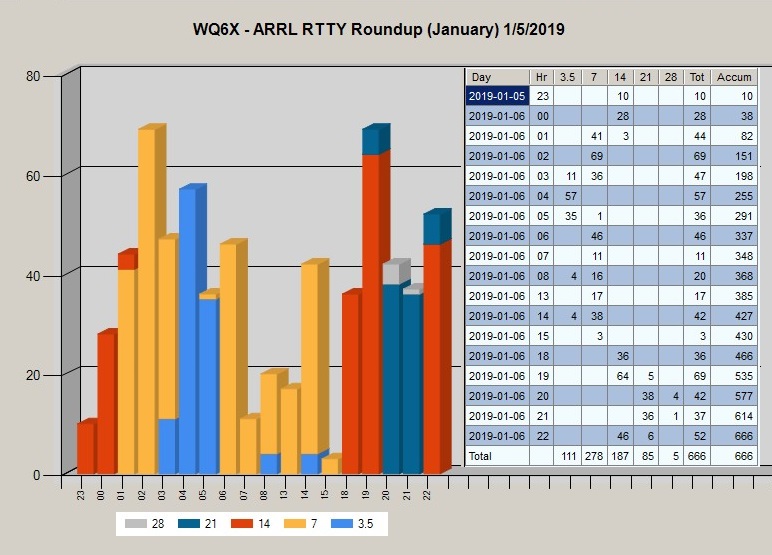
Radiosport-wise, my favorite way to start the new year is by way of the ARRL RTTY RU GiG;
run the 1st weekend of each new year.  Altho the WP2/WQ6X worldwide win (with NP2/N6GEO) is now 5 years behind us, that event, followed by our RU wins from EB section since then inspires me every year to do something unique.  For the 2018 RTTY RU GiG, WQ6X took 1st place for San Diego (SDG) section in the HP Unlimited category.
My goal for this year was to duplicate (if not exceed) that section win.

The original plan was to run the Yaesu FT-1000mp from W7AYT's QTH (in Concord) into the recently modified (again!) WQ6X Lazy 8jK Sloper using the recently acquired RigExpert Plus computer/radio interface.  Unfortunately, the "Blue Screen" (after the previous weekend's RAC contest) took the COM ports with it, making RTTY with the Yaesu radio impossible in the 2019 RTTY RU.

E l e c r a f t  K 3 / 0 access to N X 6 T
Luckily, in anticipation of Dual-OP'ing from NX6T and W7AYT, I brought along WQ6X's secret
"black bag" containing the recently acquired Elecraft K3/0, offering quality access to NX6T remotely.  Unfortunately, the K3 connection to Fallbrook's STN-2 was not responding.  After wasting the 1st 5 hours of contest time, a connection to STN-1 (a K3 + ACOM-2000a) finally came online, putting the 1st QSO in the log @22:58z.  Because we are required 6 hours of off time, the late start made that easy.

N X 6 T @ 0 0 : 0 0 z
Similar to last year, thanks to the remote controlled A/C system, the ACOM-2000A could
run comfortably @ around 990 watts.  Ironically, the shack ran cooler when running stations
one-after-the-other because the listening time (to receive the EXCHG) gives the amp just enough
time to "cool off" after sending the WQ6X exchange.  In contrast, CQ calls generate a considerable amount of heat; which is why it is advantageous to alternate between the [F1] (CQ) and the
[F3] (Tu QRZ?) keys.

Because we have not yet emerged from the depths of the bottom of the solar sunspot cycle, commencing operations @3pm (local time) pre-empted beginning with a 15 meter opening;
that had to wait until Sunday morning.

Similar to last year, the secret to 2019's RTTY RU was running frequencies, with an occasional Search & Pounce (S&P).  Because the K3 radio on the Fallbrook end of the connection is not a
dual-receive unit SO2-V was not possible, altho running as Single-OP  assisted allowed using
the spotting networks and skimmers to discover "juicy" multipliers.

Running frequencies in RTTY can be a LoT of fun; especially when it's properly synchronized with the [F-10] NOW key.  However in order for the NOW key to work, stations need to pay attention.  Many times I finish a QSO with the NOW key only to find the next station in line has already disappeared.


After all the work tweaking the WQ6X Lazy 8jK sloper it is a shame I was unable to run the RTTY
from W7AYT's QTH in the East Bay section.
Nevertheless, the antenna work was time well spent. 

The weekend after the ARRL RTTY RU is the North American QSO Party (NAQP) Cw contest. 

With the 8jK sloper in its best configuration ever, I should be able to run a dual-OP operation as WQ6X from W7AYT and as a remote op with NX6T's Multi-2 operation from Fallbrook.

Did YOU work the 2019 ARRL RTTY RU?

Is WQ6X in YOUR log?

For WQ6X NAQP Cw Notably NoT Normal

With the ARRL RTTY RU contest "safely" behind us, the 1st Cw contest of each new year is
the North American QSO Party (NAQP) Cw GiG followed by the SSB event the following weekend.
For this weekend, the goal was for my 1st dual-OP operation, running NX6T STN-1 remotely for approx. 5 hours, with the remaining time to run as WQ6X @ W7AYT'S QTH in Concord, Ca.

Friday evening, just as I was about to checkout the RRC-1258 IP connection to Fallbrook, a text message from N6KI informed me that the microwave dish across the hill providing us fiber-optic internet access was DOA; Sunday evening, the connection is still down.

The upside of all this is that WQ6X was able to operate the entire 10 hours of the 12 hour
contest; the caveat : the COM port problem (from the RTTY RU weekend) had yet to be resolved. 
The RigExpert Plus relies on a solid USB connection to route audio paths and computer CAT control to the Toshiba Windoze-7 laptop.  Luckily, using the Toshiba DynaDock offers 6 USB ports from one cable; unfortunately, not all ports are the same. 

Trying one port after another eventually identified the USB socket which brings the RigExpert
unit to life.  Magically, the RigExpert COM ports (from 3 weeks ago) magically reappeared.  There
is even a useable USB port on the back of the Plus unit, giving back the USB port taken over by the unit itself.  This port is perfect for running the wireless headphone unit; which draws very little power.  Once this problem was resolved WQ6X was ready to run Cw via the N1MM+ contest software.

Next up was to run through the MFJ 949-E tuner settings to verify the WQ6X Lazy 8jK Sloper was still functional after some rain and some heavy Contra Costa winter winds during the previous week. 
While the antenna itself was functional, the tuner settings changed dramatically.

Luckily, a close-up look at the termination resistors on each leg of the Lazy 8jK sloper showed no signs of overheating due to high-SWR or weather-induced deterioration.  The purposely twisted ladder line was also intact.

Band-by-band new settings were found.  Unfortunately, 20 & 40 meters produced so much in-shack RFI @ 100 watts the yellow keyboard stopped working (it routinely does this amidst strong RF fields).  The RigExpert plus unit lost its CAT computer connection and N1MM+ lost the ability to send CW.
Ultimately, the decision was made to use the CHA-250 vertical for 40, 20 & 15 meters and the Lazy 8jK for 160 & 80.  Using a wireless keyboard (atop the yellow one) solved the keyboard problem.
Band condx @W7AYT were marginal at best; 10 meters never happened and 15 meters folded
after only 25 QSOs in the log.  That relegated 20 meters as the QSO-volume band, producing a disappointing 76 QSOs for those 4.5 hours.

Hoping for an early 40 meter opening the switch was made at 22:45 with the 1st QSO at 23:05z.  Calling CQ and S&P'ing produced only 17 QSOs in the log.  At this point the decision was made to take over 90 minutes (of the required 2 hour break) off to do other things, while waiting for 40 meters to finally open up to the east.

Back on the air at 02:00z, disappointed by the lack of signals on 40 it was time to move down to 80 meters.  21 QSOs
in an hour is not great, but better than ZERO.  Back to 40 meters, working NO6T he made a request to QSX on 1837.  After working Al, I "setup shop" on 1828.28 and eventually added 4 more 160 QSOs to the log. 

Returning to 160 several times unfortunately yielded no results.


Back and forth between 80 & 40 added a few more QSOs to the log before mandatorily shutting down @ 05:40z.  While band conditions were disappointing it was fun to get back into the CW operating position.

Did YOU work the NAQP Cw Contest?
Is WQ6X in YOUR Log?

Friday, January 11, 2019

WQ6X RAC's one up for Canada and the Stew Perry 160 Contest

K 3 / 0  R e m o t e  O p e r a t I o n
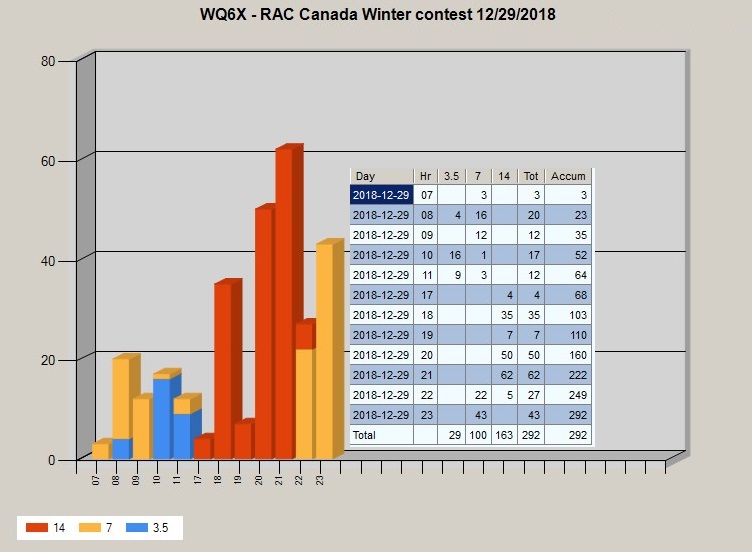
The last weekend of every year brings up the Canadian RAC Winter contest alongside the Stu Perry 160 GiG starting at 00:00z (Fri. afternoon PST) the RAC is essentially over (23:59z on Saturday) just in time for 160 meter signals to waft in from the east into Southern California.

Multiple commitments kept me busy on Friday evening, altho by 07:00z the K3/0 remote connection to NX6T in Fallbrook was up and functional.  Instead of running mixed-mode, WQ6X took the easy route by running Cw only.

The recently acquired wireless headphones brought un-cabled freedom by way of an Autek QF-1A filter to process the audio.  External audio filters provide signal boosting capabilities beyond most APF filters built-in to older HF transceivers.  While the K3/0 DSP is useful, it lacks APF capabilities only an IC-based audio filter can provide.


N 6 K I   O p e n s   S P - 1 6 0   G I G
Having only 3 operators - N6CY & WQ6X (both remote) and N6KI (onsite) - I used the weekend
as an opportunity to test run the Elecraft K3/0 with the MikroBit controller into a higher-speed internet connection.

For WQ6X, the RAC contest did not begin until just before midnight (08:00z).  At such a late hour 80 & 40 meters are wide open to Canada.  While we can work anybody in the RAC GiG, VE/VA/VO/VY stations are worth more points.  Canadian stations with an "RAC" suffix are worth 20 points making RAC stations worth "hunting for".  Because this operation was an assisted CW-only affair the Cw skimmers made it easier to find extra-point stations.  By 11:30z (3:30 AM) there were no new Canadian stations, giving me an excuse to get some sleep.


Restarting @ 17:00z found 20-meters alive with RAC contest participants.  Unfortunately, 10 & 15 meters never materialized for this contest; even 20-meters ran down by 22:00z.  Luckily, (due to the low sunspot cycle) 40 meters was found to be wide open, providing the final 65 QSOs before the contest ended @ 00:00z.

I wrapped things up, by snapshotting the pictures for this BLOG entry and producing a Cabrillo file just in time for 160 meters to open up in time for the Stew Perry Top Band Challenge.  Somewhat unique for 160 contests is the use of our GRID SQUARE as the important part of the exchange.

160 meters was slow to open @ NX6T, however when signals made their way to STN #2 (around 01:00z),  N6KI was in the chair putting QSOs into the log.  WQ6X ran the usual 8:00 - 10:30 "dinner shift" running several frequencies.  By 06:30z, N6KI was back in action until shortly after midnight, giving me a few hours sleep.

Unfortunately, an internet failure kept me off the air until around 11:00z.  Surprisingly, we had experienced an opening to JA; considering previous JA contest turnout, this was something I
was hardly expecting.  I found it useful to keep the Grid square map centered around Japan
and Southeast Asia.  Rick (N6CY) took over remotely at 13:00z allowing me to go back to bed. 
By 15:00z the band faded and the contest was over.

Did YOU work the 160 GiG or the RAC Winter contests?

Is WQ6X or NX6T in YOUR Log?