Friday, August 24, 2018

Q-Filtering for Fun and Profit - Part 2: What I've Learned So Far

OUTBOARD FILTER COMBINATIONS USED by WQ6X
In recent months, I have been experimenting w/various combinations of outboard audio filters for the FT-1000mp I operate from W7AYT's QTH in Concord.  In March of this year I wrote the original BLOG on this subject, not knowing what kind of changes I would be considering, each and every month.  ([CLICK HERE] to read the original BLOG entry.)   Recently, an original (ca. 1972) Autek QF-1 has been added to the mix of outboard filter equipment I use in contest operations; whether operated remotely from Alameda or portable @ W7AYT.  The original testing and evaluation of the QF-1
was made during my remote operation of NX6T in the recent NAQP Cw contest.  The QF-1
offered enough promise that it was transplanted to W7AYT joining the other Autek QF-1A unit.


QF-1 (Top) and QF-1A (Bottom)
Comparing the QF-1 & QF-1A filters,
it would seem that while the PEAK, NOTCH & LOWPASS capabilities are functionally similar, a close-up look at
the equipment schematic diagrams
show the circuits to be implanted
quite differently.

The original QF-1 shares a design flaw with the MFJ-752 series of filters.  Both filter designs utilize a pair of dual-500k pots (for selectivity and frequency) to control the feedback circuits for Peaking and Bandpass filtering.

Both designs suffer from a "cramped" tuning range caused by the selection
of a 500k pot value.  I am proposing a bridging resistor across each dual pot. 


Doing this will "spread" the actions of each knob more evenly "across" the dial, making the adjustment less "touchy".  How this experiment turns out I will document in Part 3 of this BLOG Series.

An interesting conundrum is that the QF-1A filters ALSO make use of dual-500k pots and yet there is no "dial-cramping" with the newer (1977) design.  Go Figure.  Operationally, the two filters are quite similar.  The 1A simply adds a dedicated notch filter allowing Peaking and Notching at the same time.

Component-wise, the QF-1 filter unit uses an LM-741 IC along with LM-747 IC's (which are dual-741 OP-amp IC's) in the filtering circuits.  The QF-1A uses LM-348 IC's which are QUAD-741 OP-amps inside one DIP package.  Comparing the two filter units, operationally I find the QF-1A does a superior job of filtering compared to the original QF-1; and of course, the QF-1A does not have
500k-pot range problems.


A not-externally noticeable advantage of the QF-1A is a pair of trim-pots inside of the unit.  Page 7 of the Autek instruction manual details a relatively simple alignment procedure to peak the performance of the QF-1A unit.  The manual ALSO says [re-]alignment should not be necessary.  In fact, however,
3 QF-1A units I have refurbished ALL were somewhat out of alignment.  Investing a mere 20 minutes per unit yielded increased output gain on all units.


FILTER COMBINATION - AUGUST 2018

 
In recent years I have made use of various combinations of external filters.
While the Autek QF-1A and MFJ 752-C are functionally similar, I find the Autek
unit to produce sharper and/or more-pronounced audio peaks than the MFJ units.

For the current configuration, I brought back the JPS NIR-12, reinstating it in the Sub-RX
audio path of the Yaesu FT-1000mp.  It is NoT well understood that the Sub-RX has nothing
in the way of IF-Shift, NOTCH or DSP.  The NIR-12 effectively provides this functionality. 
The NIR-12's DNF (Digital Notch Filter) is quite effective.

While the NIR-12 has a sharply tunable bandwidth, outputting the signal to the MFJ-752C allows taking advantage of the MFJ CWF-2 custom-installed "under the hood" replacing the MFJ's cheesy NL (noise limiter) diodes.

Bottom-line: No matter how highly-rated your receiving equipment, they can all benefit from external audio filtering.  Additionally, if you are a "knob-twiddler" like me, external filtering keeps me busy and provides the illusion that I can eliminate ANY QRM that seems to be problematic.

What about YOU?
Do YOU utilize external filters?
If NoT, WHY NoT?

Wednesday, August 22, 2018

WQ6X Wings another NAQP SSB Dual-Operation

WQ6X/6 @ W7AYT in Concord
Altho this was another last-minute WQ6X Dual-OP Operation for NX6T @ W7AYT, I found out
later that N6KI had put me on the OP-list nearly a week ago. The "burbling" internet connection
I encountered 2 weeks ago before during the NAQP Cw contest has never really been resolved;
it seems to "randomly" come and go producing 150ms dropouts throughout the contests, wasting
significant time in getting EXCH data from other stations; conversely, they copied me just fine.

On the WQ6X remote end of things, thanks to the beautiful audio of the Electro Voice EV-664 broadcast microphone into the FT-1000mp,
I didn't need the Heil-PRO headset.

For listening, I used a cheesy pair of white ear buds with fidelity matched
by the outboard audio filters.

Saturday morning before the 11am contest start I implemented an easy enhancement to the WQ6X Lazy 8JK Sloper array.

This came in the form of 280-ohm terminating resistors at the electrically "far end" of each leg in the Cobra-dipole array (4 legs); the goal being to lower the signal radiation angle, hopefully transforming the sloper into more of a DX antenna and less of an NVIS cloud warmer.


The latest filter configuration @W7AYT
Another goal was to disentangle the morass of audio cables that have haphazardly evolved during previous contest operations @ W7AYT.
For this event I ended up by cascading one of the QF-1A filters into the newly acquired (but considerably older) QF-1 filter (circa 1972) for the left ear audio from the Yaesu FT-1000mp's Main-RX. Because the MP's Sub-RX has no DSP the JPS NIR-12 Dsp unit into an old MFJ-752 does almost as good a job
as the eDSP in the 1000mp.


Afternoon OPs - New and Old
Running as a Multi-2 entry allowed us to attain B-I-C (butt in chair) for Station #2 throughout contest (except the dinner hour).  Anytime there was no onsite B-I-C, remote operators kept Station #2 active at all times.

WQ6X opened the contest remotely from Station #1, being relieved at 20:30z by the afternoon onsite operators.  W2PWS opened the contest on 20-meters with B-I-C.  Hundreds of QSOs were put in the
20-meter log and hundreds more when N6KI made the scene.


Because NAQP contests are over too early to coincide with the usual after-midnight intentional QRM, imagine my surprise during pileup running when the run frequency was invaded by one of several IDIOTs who thought it was the National Tuneup Frequency (NTF). Why is it that NTF QRM usually happens while I am trying to pick an S-3 signal out of an S-9 noise-level. Luckily the K3 has an
IF-based DNF (Digital Notch Filter); that coupled with a JPS NIR-12 on my end rendered most
of those numerous carriers all but inert.

Antennas @ W7AYT's QTH

Installing the 280-Ohm terminating resistors on each leg of the WQ6X Lazy 8JK Sloper SEEMS to have lowered the radiation-angle, as I was hoping.  After the NAQP GiG was long over, I spent time listening to JA signals as they played around in their local KJC contest.

In recent Asian contests I have considered the Northwest antenna direction to be a propagation-vortex to Japan and beyond.  This weekend suggests that problem may have well been alleviated.

Reception conditions of WWV on 20 & 25 Mhz also seem to have improved considerably with the 8JK antenna update.  Unfortunately, the A & K Indexes reminded us that S-9 noise levels could be expected, and in fact were.  On the WQ6X end of things band condx were noisily-HORRIBLE, resulting in only 6 QSOs to the log.
Bummer Dewd.


When it was all over, we ended with 781 QSOs and 120 multipliers giving us
a not insignificant score of 93.6k points.

Did YOU work the NAQP contest?
Is WQ6X in YOUR Log?

Monday, August 20, 2018

WQ6X Dual-OPs NAQP Cw (another look)

(While I wrote up the August NAQP CW contest for the WQ6X Contest Blog, I had originally intended a different write up, which was promptly misplaced.  In the spirit of completion, here is the original BLOG entry with some different yet appropriate PICs to go with it.  [CLICK HERE] to read the
original Contest BLOG post.)


It's hard to believe 7 months of 2018 is already behind us.  For WQ6X, NAQP signifies the beginning of August and the beginning of the winding down of Summer.  While the NAQP RTTY contest was held the end of July, domestically the NAQP CW/SSB contests are the focus of the month of August.

Because NAQP is only a 12 hour contest, it makes no sense to make a trip Fallbrook to join NX6T;
it [almost] isn't worth the trip to operate from W7AYT. Client commitments were light on Friday so I took the remainder of the afternoon off, arriving is Concord before 6pm; with enough daylight left
for antenna-futzing, which turned out to be unnecessary.

N6KI & WM6Y
The goal for this NAQP weekend was to assist NX6T remotely while enjoying 6+ hours of WQ6X
operator time from Concord (EB section).   Unfortunately, a shortage of live operators in the chair (B-I-C = butt in chair) for long periods relegated N6CY & WQ6X to remotely keeping NX6T "pounding them out".  Luckily, we had a busy afternoon shift with the operators who could make it.   In the end, just like 2018 FD, WQ6X had 90 minutes to put QSOs in the log.  Those 61 QSOs were a fraction of the 300+ I made running STN-1 for NX6T.


NX6T after NAQP is over
During several recent NX6T / W7AYT dual-OP weekends, I have perfected a set of Y-Split audio cables, allowing the combination of XCVR audio from NX6T and stereo (2-channel) audio from the Yaesu FT-1000mp I run from W7AYT.

In the current (but consistently changing) configuration, I enjoyed having a pair of QF-1A, back-ended
by an MFJ 752-C audio shaper for the predominantly left ear oriented sound; all that, couple that with the 1000mp's eDSP and Shift/Width facilities, and the WQ6X end of the remote connection is as filtered as it gets.

With the FT-1000mp, for S&P'ing while running a frequency (with the Main-RX), the Sub-RX is predominantly right-ear and can benefit from outboard audio processing.  The same is true for the NX6T remote audio coming in via the internet; it TOO can receive benefit from the Autek, MFJ and JPS NIR-12 filters.  The only thing these filters CAN'T "Fix" are internet dropouts; being analog filters, they are unable to process things which are not [there].

Because time was also spent experimenting with the WQ6X parallel antenna switch, considerable attention was made to reception/propagation from Northern / Southern California using the CH-250 vertical, the WQ6X Lazy 8JK Sloper, and both in parallel.  Synchronizing the radio's 2-VFO's allows "diversity reception" (as described on P.46 of the Yaesu FT-1000mp operator manual)  The use of outboard filters complements the diversity reception capability of the 1000mp considerably. 
At several points throughout the weekend, I was listening in Concord (SF East Bay) to NX6T
in Fallbrook (near Oceanside), all while S&P'ing @ W7AYT via the Sub-RX.

WQ6X Ending Screen
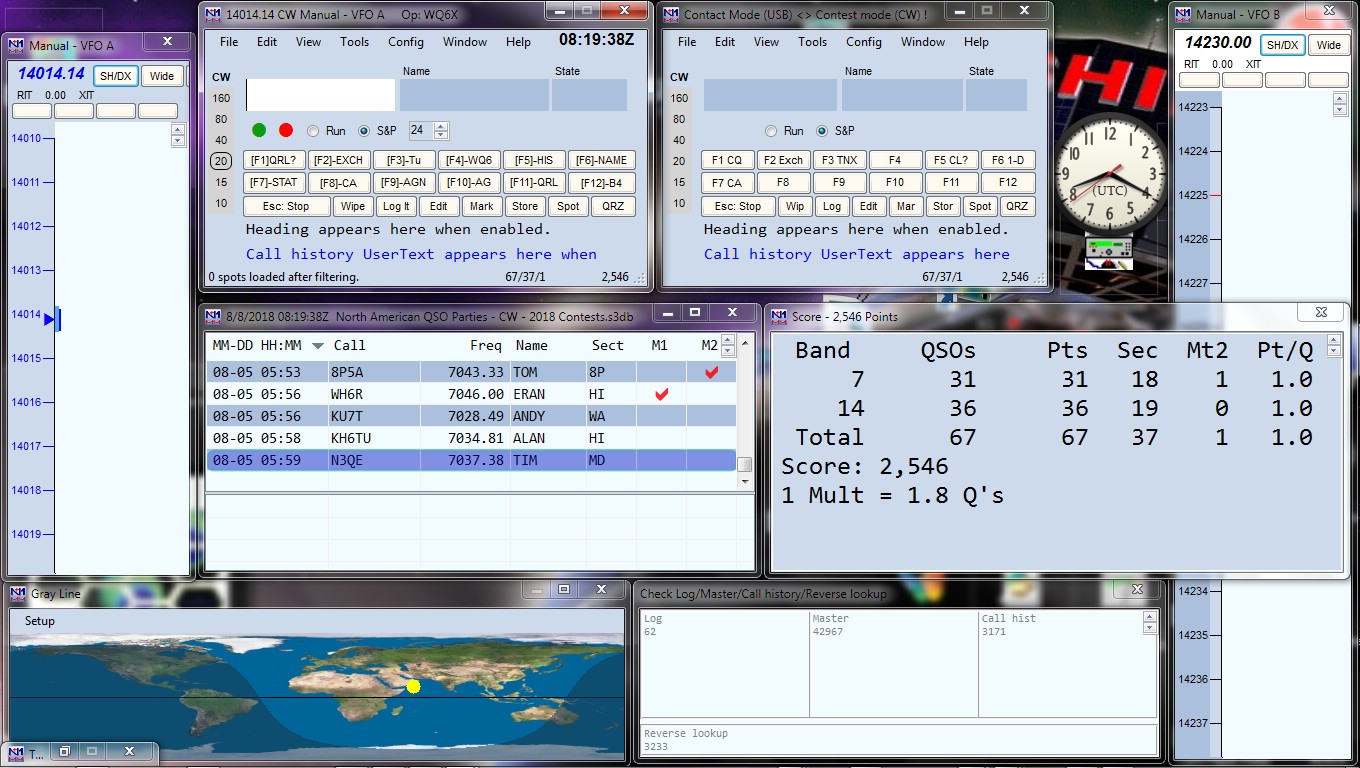
When the NAQP contest ended, WQ6X put a whopping 62 QSOs in the log from W7AYT and over 300+ QSOs in the NX6T log remotely.  The dual-OP operation allowed me to improve the audio routing as ongoing experiments are made to determine the best outboard filter combination for maximizing performance of the already AWEsome Yaesu FT-1000mp.

Did YOU work the August 2018 NAQP Cw contest?

What kind of outboard filters do YOU use?


Wednesday, August 15, 2018

WQ6X Stumbles Thru WAE Cw Contest

WQ6X Remote operation w/QF-1 & QF-1A Filters
Every radiosport event brings unique/different problems often requiring custom solutions.
For the 2018 WAE (Worked All Europe) GiG, the biggest problem came in the form of a repeating internet dropout approx. every 5 seconds. This continual outage defined the WAE contest weekend.

The Worked All Europe contest is considered by many (including myself) to be the most COMPLEX

of all radiosport events. In most contests, a regular QSO is worth 2 points. In WAE, each QSO is worth ONE point; to receive another 1-point you must send a different station a QTC message,
which is in effect a report to the 2nd station about the QSO made with the 1st station. 
For efficiency, QTC messages can be sent in sets/books of 1 to 10 to a single recipient operator.
[CLICK HERE] to read the 2018 WAE contest rules.

The 2018 WAE contest resulted in barely 10% of the 2017 score. Because of the internet dropouts, there was NO WAY I was going to reliably send 10 QTC messages (let alone 1).  Of course sending

a QTC message for every QSO effectively doubles the score. When stations would send "QTC?",
I would press the pre-configured F-10 key to send "NOQTC". It was frustrating to listen to all the
"boys and girls" sending QTC's and I couldn't - Bummer Dewd!

NX6T station during Friday nite setup
CW-wise, WAE brings us many SUPER European operators, like YQ6A who kept the code speed under 28 wpm, sending a fast 5NN and a much slower serial number; the correct way to operate.  Unfortunately, MANY European operators were trying to impress people by running 35wpm during their CQ calls.  When you combine that with QRM/QRN and internet dropouts, it often took 20+ seconds to JUST figure out the callsign.  By the time I am ready to call the station, he is now
receiving a packet of 10 QTC messages.  WQ6X ain't waiting around for that - Buh Bye!
Remember: Your callsign is your calling card, if we copy it incorrectly then YOU don't
get credit for the QSO - SLOW DOWN people.

Commitments with my Toastmaster's club prevented me from getting started until 05:30z; by then, Europe had already faded into Fallbrook oblivion.  I took the time to configure the N1MM+ software
for WAE, connected and tested the outboard audio filters and caught 8+ hours of sleep. 
The 1st WAE QSO did not make it to the log until after 15:00z.


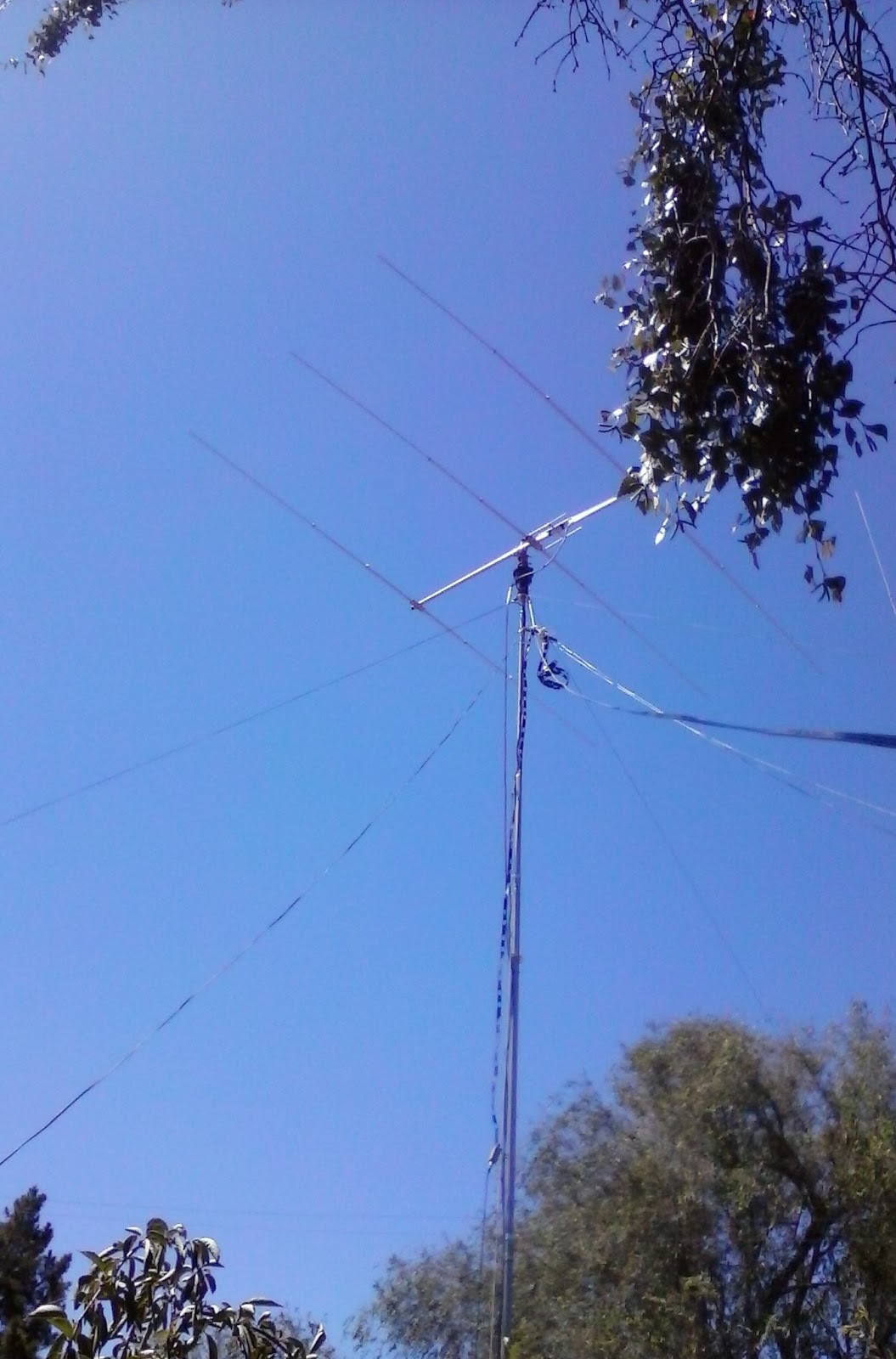
As you can see from the graph, 20-meters was the primary band for working Europe.  Running the C-31 yagi (7-el on 10, 5-el on 15 and 3-el on 20) I took a number of looks at 15 and 10 meters. 

Unfortunately, a low SFI of 67 did not contribute to an opening on those bands, at least the A-K Indexes were reasonably low; while there was plenty of static QRN, amazingly, the K3 radio's NB circuits knocked it all out.

Starting late on Friday missed an opening on 40 and 80 never materialized to Europe from NX6T's NVIS coaxial (double bazooka) inverted Vee for 80.


In radiosport, no matter what the contest result, I always learn something new technically.  
Just before the WAE contest weekend, an original Autek QF-1 filter was added to the laptop audio, effectively in parallel with the already existing QF-1A.  While each ear was routed through one of the filters, because RCForb laptop audio is effectively monaural, technically, the same audio content was being filtered in two different ways for each ear; not quite stereo Cw, but certainly effective enough to raise even weak signals above the noise.

N1MM+ Ending Screen for 2018 WAE
While the 2018 WAE Cw contest was quite a disappointment, it did allow me to work things out at
the remote access site.  I also learned how to invoke the onsite air conditioning in Fallbrook, allowing me to be self-sufficient.  Running 550 watts allowed WQ6X to be heard while keeping the NashVille shack relatively cool.  How CooL is that?

Did YOU work the WAE Cw contest?

How many QTC messages did YOU send?


Thursday, August 9, 2018

WQ6X DUAL-OPS NAQP CW CONTEST (and other things)

WQ6X running barefoot for a change
Just when I thought summer was just getting started, the end-of-July NAQP RTTY contest came
and went. ([CLICK HERE] to read about WQ6X's participation in that event.) Right behind the RTTY GiG is of course the NAQP CW event.  Wanting to run another dual-OP GiG, Friday afternoon I made my way to W7AYT's QTH for the weekend. During the weekend a goal was to investigate different receive audio filter combinations for the FT-1000mp as well as test different antenna configurations for the custom-wired WQ6X antenna phasing switch.

Every remote operation with Fallbrook (whether run from W7AYT or from unknown locations in Alameda) bring with it a unique set of problems; most recently radio to RCFOFB audio connections.  Thursday evening I remoted in to verify the internet connection & the audio; everything checked out.

On Friday evening the audio again failed to come through. 
Troubleshooting the problem brought the realization that somehow some of the audio settings in the RCFORB software had "mysteriously" been changed.  When queried, no one owned up to changing anything; or, as my mother used to say: "then "Mr. Nobody" must have done it".  Nevertheless, once the settings were reverted back to their proper settings, everything worked FB.


WQ6X Equipment setup @ W7AYT
Once the NX6T remote access was resolved, then it was time to setup the Yaesu FT-1000mp @ W7AYT's QTH.  In recent weeks I have been running the 1000mp into various combinations of outboard audio filters.  Because I also run NX6T remotely during the same contest, I have worked
out a parallel cabling arrangement between the 1000mp, a Toshiba WIN-7 laptop and a HEIL Pro headset.  The cables are routed directing the internet audio from RCFORB into the input of the
Autek QF-1A filter, along with the transceiver's Main-RX audio.

Directing the radio and laptop audio run through separate isolation transformers keeps unnecessary ground-mismatch hum out of the ears.  Other annoying artifacts can be eliminated incidentally via the PEAK/Lo-PASS filter paths of the QF-1A.  For this weekend's operation, output of the QF-1A was fed into a long-used MFJ 752-C Audio Shaper, before making its way to the HEIL headset.
 

Running NX6T as a Multi-2 operation allowed a number of different operator configurations; some remote, some live in the shack atop the hill (900' high) in Fallbrook.  At 18:00z on Saturday, N6CY
ran 20 meters remotely while I alternated between 15 and 10 meters.

Because of the surprising 10-meter opening in the NAQP RTTY contest, I was hoping for a similar opportunity for NAQP CW; nope, lengthy S&P'ing and CQ calls yielded a WHOPPING 2 QSOs for
the log.  Luckily, 160 meters (at the other end of the spectrum) produced 32 QSOs to counter-balance the statistics.

For some reason, RF was getting into the K3 on 10 meters causing the radio to power itself off during each 2nd CQ call.  Reducing the power to 80 watts was enough to resolve the problem, but not enough to add more 10-meter QSOs to the log.  The 64 QSOs on 15 meters, while not a huge number, was to me a "bonus surprise".


NN6X + N6KI + N6EEG
Throughout the afternoon WQ6X ran station #1, taking breaks to put a few QSOs into the WQ6X Concord log.

23:00z on 20 meters & 01:15z on 40 were the longest runs for WQ6X.

By 03:00z I was back running remote during the "dinner hour".

N6KI joined me again around 05:10z and
we ran dual until 05:50
when I called it quits
with NX6T.

The last 10 minutes of NAQP were focused on 40 meters for WQ6X.  I was rewarded with QSOs from 8P5, WH6 and KH6, amongst some statesiders.  While WQ6X missed the minimum goal of 100+ QSOs, I DiD manage to fulfill several other operational goals for the portable operations from W7AYT's QTH.

Included in these goals was an innovative way to make use of the WQ6X antenna switch.  This allows running the WQ6X Lazy 8JK Sloper and the CH-250 vertical, either separately or (using  switch position 3) paralleling the coax from those antennas, running the two simultaneously.  While the radiation lobe(s) of these combined antennas are probably WEIRD, a number of stations were heard with the combo that could not be brought through with the individual antennas run separately.


2-el-10 + Lazy 8JK Sloper + CH-250
Overall, the NAQP Cw weekend was a mixture of fun, frustration and WEIRDness.  In the Multi-2 classification, NX6T took 8th place for USA and North America.

While WQ6X barely made an appearance this Cw GiG,
at LEAST I took the opportunity to test antenna sharing
as well as audio sharing

In the realm of audio-sharing, this operation allowed consolidating the previous morass of different audio
cables and multiple "Y" connectors down to two cables
and one junction block.

Combining the laptop audio with audio coming from the radio allowed the possibility of streaming electronic music from Pandora while running frequencies, however occasionally the music would "beat" with the Cw making code copy difficult; which is what Pandora's PAUSE
button is for.
 
Tuning around 40-meter Cw after the contest I encountered Buddhist chanting on 7.020 Lsb.  The chanting would build to a fervor and then it would be quiet; repeating this cycle every 5 minutes or so.
HuH?  WTF?
 
Did YOU work the North American QSO Party (NAQP)?
 
Is NX6T or WQ6X in YOUR log?
 
Addendum: The original rough draft for this BLOG entry was recently discovered and written up.  [CLICK HERE] to read that entry.

Sunday, August 5, 2018

WQ6X RUNS NAQP & DMC RTTY Contests


Like many WQ6X remote operations, the July NAQP RTTY contest was a last minute setup.
Earlier that week there was an attempt to run NX6T in the NAQP contest as a remote Multi-2 operation until they discovered there is no reliable/accurate way to remotely dial back STN-1's
ACOM 2000a amplifer down to exactly 99 - 100 watts (the power limit for NAQP contests).

Enter WQ6X. On Friday evening it occured to me that running STN-1's Elecraft K3 barefoot at 55 watts would result in only a 3db reduction in the signal level; an amplifier would not be necessary.

The BiG secret to running lower power operations is directing the RF energy into gain-producing antennas , such as the C-31 and Shorty-40 yagi's at NX6T's Fallbrook location; both 31mh.

The 80-meter coaxial dipole (atop tower #2 in it's 13mh lower elevation) was enough to put 15 RTTY QSOs in the
80-meter section of the log.

While the overall operation was ad-HOC, WQ6X managed QSO #1 by 18:01z. Running the Elecraft K3 @55 watts kept the radio and the shack relatively cool; had I run the ACOM 2000a with no one onsite to turn on the shack A/C, simple heat problems woulda become BiG problems.

Thanks to the DMC RTTY contest (which began at 12:00z), putting 11 QSOs in the DMC log from 16:00z - 18:00z allowed testing of the radio facilities in Fallbrook, as well as the internet connections on both sides of the radio operation.

NX6T on Friday evening
Pre-loading N1MM's keyboard RTTY macros on Friday evening, software operation ran nearly flawlessly; there were even 1/2 dozen opportunities to effect proper use of the F-10 "NOW"
key while running a frequency.

During S&P operations another 1/2 dozen QSOs made it to the log by way
of the other station's proper use of their "NOW" key.

As I often do during RTTY & CW GiGs, run frequencies are PRECISELY chosen such that when some IDIOT calls Cq EXACTLY on my run frequency, I know
it did NoT happen by accident.

 That is also why I have the F-11 key configured to send "QRL - Pse QSY". When a station attempts to move-in on my run frequency, I press the F-11 key TWICE for each time I press F-1 to call CQ. 
In most cases the intruder gets the message and QSY's to another frequency.

While we are still near the bottom of the solar sunspot cycle, the SFI was UP high enough and long enough that 15 AND 10 meter openings were a part of the daytime operation. In fact, more QSos made it into the log on 10-meters than on 15 - GO Figure. While running 10-meters a periodic scan
of the C-31 from North to East to South America and back again put dozens of QSOs in the log.
While contest goal of 300 QSOs was JUST missed (293), considering the 55-watt power level,
I was amazed how easy it was to keep run frequencies active.

Because NAQP GiGs are 12 hour contests beginning at 18:00z and ending at 06:00z it is reasonable to expect that encountering intentional QRM probably will not be a problem; especially during a RTTY contest. Unfortunately, when I started up on 40 meters around 02:00z, I no sooner put out the first "CQ NAQP" call, when a Spanish-speaking SSB station (with no callsign ID, of course) zero-beats
the 7094.94 run frequency EXACTLY; i.e., this was no accident. While I am used to Asian SSB signals in the upper portions of the 40-meter Cw/Digital spectrum, rarely does that occur before midnight (07:00z), and certainly not in Spanish.


Events of the day allowed working the allowed 10 out of the 12 NAQP hours (the limit for Single OP operations). Altho there are fewer stations operating the final 2 hours of the contest, it is not surprising to hear "new" stations during that period; possibly OPs who got on the air at the last minute to make a few QSOs.

What about you?

Did YOU play in the NAQP and/or DMC RTTY contests?

Is WQ6X in YOUR log?

Tuesday, July 31, 2018

WQ6X SOUND PROCESSING: Maximizing the Art of Experimentation

As you may know, I love to knob-twiddle, but ONLY if pressing buttons and twiddling knobs will effect an improvement of the received signal. In the middle of the night, knob-twiddling helps alleviate operational boredom, helping to keep me awake.

A 20+ year old FT-1000mp is still contemporary
In March 2018 I published a couple of BLOG Entries detailing the many different aspects of processing RX audio from the Yaesu FT-1000mp during portable and contest operations:


Running a Yaesu FT-1000mp offers plenty of adjustable knobs useful for extracting weak signals
out of the noise. Unfortunately, most of those receive enhancement features (IF Shift/Width, NOTCH
& e-DSP) are functional ONLY with the Main-RX.  The Sub-RX is seriously lacking in interference reduction facilities, which is what makes external filter units so important.


For the 1000mp's Main-RX, I prefer to utilize outboard Autek QF-1A, JPS NIR-12 and MFJ-752 filters (in that order of usefulness). 

For the Sub-RX, because it sports no DSP auto-notch filtering, the JPS NIR-12 becomes a crucial addition.  While the bandwidth adjust controls of the NIR-12 are useful, I leave that filtering aspect to a QF-1A inserted between the XCVR and the NIR-12.

Pricewise, QF-1A's can easily be had for under $50.  JPS NIR-12's are much harder to come by and can fetch as much as $200+; altho the average price seems to be around $125.  When I bought an NIR-12 from W6SW, it had little use, which for me made it worth the $175 I paid. 
(List price was around $249.)

Based on the recommendation of Dr. Joel (W1ZR), because it is equipped with an output amplifying stage, it makes sense to put the NIR-12 AFTER the QF-1A in the FT-1000mp's Sub-RX audio line.  [CLICK HERE] to read my comments about Dr. Joel's recommendation.

This filter combination is very useful when running Multi-mode contest events such as state QSO parties, Field Day and the IARU HF championship on 40 meters.  It allows running a frequency on CW using VFO-A while using the Sub-RX to
look for SSB stations.

The Automatic Notch Filter (ANF) circuit in the NIR-12 does an excellent job of knocking out 40-meter shortwave broadcast carriers.  The bandpass filtering of the QF-1A peaks scuzzy SSB audio making it more readable.  Remember however
that being an audio-based filter, even though the carriers
are removed from the audio stream, any deleterious effects those carriers may have on the AGC circuits will still exist.

Cascading the QF-1A & NIR12 for the FT-1000mp's Sub-RX audio allows emulation of the Main-RX notch filter features.  The NIR-12 ANF is as effective as the ANF in the FT-1000mp.  The notch filter
in the QF1-A seems to be as effective as MP's manual notch filter.

Remember that the FT-1000mp Main-RX is equipped with I-F shift and width-reduction capabilities. 
While the Sub-RX is lacking in this respect, at anytime the A<-->B button allows swapping the VFO's
giving immediate access to the SHIFT/WIDTH functionality.

Technically the QF-1A is not equipped with any form of noise reduction circuitry, yet the PEAK and Bandpass filtering often result in an improved signal/noise ratio.

Although the NIR-12 IS equipped with
a Digital Noise Reduction (DNR) circuit, while it is continuously adjustable, I find the 4-position DNR switch of the Yaesu
FT-1000mp provides more effective "noise-softening" than does the NIR-12.

Additionally, altho the NIR-12 is equipped with audio bandwidth and frequency shift controls, being audio-based, their effect is not nearly as pronounced as the IF-based
SHIFT/WIDTH controls built into the Yaesu FT-1000mp's Main-RX.

In the 21st century, we have BOTH analog and digital filtering methods available for use in ALL
areas of our receiving equipment; the RF frontend, the many/various I-F stages and the front-end audio circuitry.

Surviving in contests and DX pileups require that we utilize every bit of technology available to us.  While older analog-style filters may seem primitive by today's standards, remember that they ALL utilize a primitive (originally undesirable) feature known as feedback.  Technically the DSP circuits
in today's modern radios don't utilize feedback, however the A-to-D and D-to-A conversion circuitry make extensive use of feedback.

WQ6X's FT-1000mp filter usage in May 2018
Additionally, remember that many filter techniques (such as noise-blanking and DSP noise reduction) often add their own distortion (i.e. noise) in the process.  I guess in the end, what matters is whether or not the signal I am attempting Q-5 copy on is in fact becoming more-copyable with all these filter buttons and knobs. 

In all my contest experience, while I've had mixed results with various external interference
reduction units, overall, the time, money and effort have been well worth it.  There are contest
certs in the WQ6X contest certificate binder that would certainly not be there had I not made use
of external audio shaping and filtering.

What about you?
What kind of external filtering equipment is used at YOUR QTH?

Friday, July 20, 2018

WQ6X Dual-OPs 2018 IARU Contest - Part 2 of 3: Making it all happen


In Part 1 of this BLOG series I described the every-4-year tradition of the IARU HF contest that, like the Olympics, pits the best of best operators from around the world to win the coveted Gold, Silver and Bronze medals; known as the WRTC championship competition. Around the world, contest participants endeavor to work the WRTC stations.


In 2014, the WRTC Championship was held in New England.  This allowed U.S. stations easier access to those operations.  (For the 2018 GiG, European stations will have a similar access advantage to the WRTC stations operating from Germany.)

Operating multi-OP as WQ6X from N6GEO's Brentwood QTH, we managed to work nearly
half (21) of the WRTC stations; at least according to the surprise box of QSLs received via the W6 QSL BURO.

I wrote about our multi-OP participation in that WRTC event for the July 2014 IARU WQ6X contest BLOG entry.  [CLICK HERE] to read my 2014 IARU HF Championship contest reflections.


Checking coax lines @ W7AYT
For the 2018 WRTC/IARU competition I was strongly considering hopping Amtrak to Oceanside joining up with the NX6T crew live.  Eventually however July being
a busy month kept me in the bay area, allowing me to work with clients on
Friday (before QSY'ing to W7AYT's QTH
in Concord) and afterwards on Sunday
in Alameda.

As I mentioned in Part 1, an audio problem on my laptop prevented me from running SSB audio remotely from NX6T. 

On the WQ6X end of things, while the Electro Voice 664 produced superb SSB contest audio, there was a dearth of SSB stations heard working the IARU contest from the W7AYT QTH. 

Luckily, to make up for no SSB, WQ6X put over 350 Cw QSOs into NX6T's log.  Remember: Cw Q's are worth 3 points, while Ssb Q's are worth only 2.

After my 15:00z relief at NX6T I managed to put 20-meter QSOs in WQ6X's log for a 1/2 hour before being summoned remotely back to NX6T.  Then, while running a frequency on 20-meters for 45 minutes, the day crew took over @ NX6T, allowing me to put more QSOs into WQ6X's log before snatching 3 hours of sleep.

N6KI AND KB7V
While I spent the afternoon putting QSOs into WQ6X's log, a webcam look into NX6T's operations found the Fallbrook operators running in a coordinated fashion.

In a multi-single transmitter operation, only one radio
may transmit at a time.   Additionally, switching
bands and modes require
that operations in/on that band/mode continue
for at least 10 minutes.

 
QF-1A filters & other GooDies
Typical of my involvement with NX6T operations, I run Station #1 during the 8pm
to 10:30 period (local time) allowing the other operators
to replenish their energy for one more GO of it.

When they come back I either work WQ6X QSOs and/or get some sleep until the 1:30 am wakeup call.


This year was similar but different.  While the live OPs were off having dinner, Station #2 was run remotely by other OPs allowing WQ6X more opportunities to pump up the score.  At 04:30 (9:30 PDT) I took over on Station #1, turning it over to N6KI in the chair at 06:30z giving WQ6X
another run on 40 meters and some QSOs on 80.

Tower #2: 2-el 40, Stepp-IR & Inv. VEE's

I finally got to sleep at 12:15 when less than 20 minutes later I was given the wakeup call; for some reason an hour early.  Oh well, IARU only happens once a year.

Starting off running a frequency (3531.31) put enough QSOs in the log to keep NX6T busy until the sudden 09:00z JA opening.


During that period, a BONUS came in the form of ZL3TE & VK2GR on the side - it doesn't get much better than that; add to that CM8NMN (off the back of the beam) followed by HS3ANP & 9M2PUL.

Because my WQ6X operation was listed as ASSISTED I am allowed to use
the FT-1000mp (both Main/Sub RX) to gauge propagation paths, including the path from Fallbrook to Concord.  While (I believe) the contest rules forbid WQ6X from WORKing NX6T, there is no restriction on my LISTENING to NX6T's signals to spot openings from the Southwest.

Being that I was focused more on keeping Station #1 going as much as possible, I didn't really have much time to put QSOs in WQ6X's log.  That is ok.  What time I DiD spend was
a lot of fun augmented by a GIGANTIC can
of Peanut Butter Stout.

Unfortunately, the MFJ-1026 noise canceller was nothing more than a "paper weight" during the 2018 IARU contest.

Luckily, most of the RX noise experienced
by WQ6X was mostly handled by the FT-1000mp's eDSP controls and/or the QF-1A filters; which in addition to peaking signals above the noise, also keep much of the low-level noise outside the filter skirts.


When it came time to submit the WQ6X IARU contest log, making the 6 QSOs on 20 meter SSB relegated the log to the MIXED mode category.  As it turns out, my score standing (as reported by the 3830 Scores Website) is slightly higher than had the submission been for CW alone.

There is lots more to say about the 2018 IARU contest.
For openers, aren't you just a BIT curious about who took the trophies
for WRTC 2018?  Stay tuned for Part 3.

Did YOU work the 2018 IARU HF Championship?
Is WQ6X and/or NX6T in YOUR LoG?


Tuesday, July 17, 2018

WQ6X Dual-OPs 2018 IARU Contest - Part 1: Another 4 years

[Note: The majority of the text for this BLOG Entry was written
while riding the train to Concord Friday evening, July 13th
]

While July's IARU HF Championship is an annual event, the WRTC (Olympic-style) finalists only compete every 4 years.  In 2014, the WRTC was held in New England bringing us a slew of unique K1x, W1x & N1x 1x1 callsigns.

The book Contact Sport by J.K. George was written about the 2014 championship event. 
I made a mention of this book in the 2017 BLOG write-up about last year's IARU GiG. 
[CLICK HERE] to read this BLOG entry.

For the 2018 WRTC event from Germany a series of unique "Yxx" callsigns were created, one for each of the two person teams.  They put together a special WRTC page on Facebook. [CLICK HERE] to see the WRTC Facebook page.  From NX6T in Fallbrook, we will be looking for an opening to Europe on 20 meters as soon as the contest begins; 40 [meters] will be fading away as 20 fades
in to the Northeast and then the North Northeast.

Unique to the ITU HF Championship is the sending of our ITU Zone number instead of the usual CQ Zone.  According to the CQ model, California is in Zone 3; under the ITU model, California is in Zone 6.  Luckily, on Cw the computer sends the exchange; on SSB we still have to "think it and speak it".

For WQ6X, the 2018 goal is to operate NX6T during the usual night-time and dinner-time operating time slots.  During the "in between" periods I endeavor to put WQ6X on the air from W7AYT's QTH.  With an incrementally-increasing SFI, I hope to give W7AYT's 10-meter yagi a workout; especially towards South America.


An operating goal on-the-side is  continuing experiments with different audio filter combinations; including a
pair of Autek QF-1a's, a JPS NIR-12
for the FT-1000mp's Sub-RX audio (complementing the eDSP's DNR & DNF features built-in to the Main-RX) and the beefed-up MFJ 752-B (with
it's newly added CW-1 filter).

While the QF-1A's worked superbly, the MFJ filter made almost no difference. 
Because there were so many audio cabling situations to contend with during the 24-hour contest period, I never got around to including the NIR-12 in the Sub-RX's audio line; next time I operate
from W7AYT the NIR-12 will be worked in appropriately.

Because the IARU GiG starts at 12:00z (5am) it will be up to WQ6X and N6CY to put Stations #1 & #2 (respectively) on the air.  Unfortunately, due to microphone audio problems on the laptop being used for remote access of NX6T, it looks like WQ6X will be running ONLY Cw during remote access.  Luckily there are a number of experienced SSB operators on the schedule for live operating from Fallbrook.

Hellllloooooo Radio

On the UPSIDE of things, the SFI
was a little higher as of late and the geomagnetosphere was actually
rather quiet. 

While there was noise experienced at BOTH the NX6T and W7AYT QTH's, amazingly, the DSP-based NB circuits on both the K3 and the 1000mp were able to knock most it out, creating a noticeable improvement in signal-to-noise ratio.


Running the FT-1000mp's stereo audio into a pair of Autek QF-1A filters never ceases to amaze my ears.  While the QF-1A frequency controls can be a bit "touchy" (almost too sharp), when set exactly, signals literally JUMP OUT of nothing into about Q-4 copy.  Most DSP filters can't make
anywhere NEAR that claim.

Propagation-wise, around 04:00z I turned on the FT-1000mp @ W7AYT's QTH and (using just the Lazy 8JK Sloper) was able to copy WWV signals on EVERY operating frequency: 2.5, 5, 10, 15, 20 & 25 MHZ.  While the 20 & 25 mhz signals were not S-9, the WX forecasts were quite readable.

N6KI Tuning-UP on 160
It looks like things are ready to roll for the start
of the IARU GiG starting at 12:00z starting-time.

In part 2 of this series,
I will detail how it all turned out.

Stay TUNED!

   Ron
 WQ6X