Thursday, March 30, 2017

The WPX contest that ALMOST never was: TWICE

This is the WPX contest that almost never was: TWICE!


In years past I have made the trek to NX6T (aka "NashVille") in Fallbrook in order that we could use the WQ6X call for WPX SSB & CW contests.

This year, because N6KI chose to join up with the NC6B conglomerate (in the SCV section) there did not seem to be any interest in putting together a multi-single or Multi-2 operation up on the mountain.

After a 5 second "arm twist" I agreed to run WQ6X solo.   WQ6X is a sought-after prefix in the WPX contest, almost as "rare" as when I ran as WP2/WQ6X during our RTTY RU operation in 2014 (for which we received a 1st place Dx plaque). [CLICK Here] to read the write up about that and/or

go to the WP2/WQ6X webpage.


The WQ6X "Remote Desktop"
During most of the week, the internet connection(s) to NX6T were OUT.  With the combined technical prowess of Tom & Jerry (N6KI and W6JBR), NX6T was finally remotely accessible late Thursday nite (06:20z).

 My thinking was this would give me 18 hours to resolve the conflicts with the transmit audio flow in time for the 00:00z start time. Due to what became my "weird" audio-routing solution,
I ended up getting a late start (02:00z) with more problems surfacing a half hour into the operation.

One of the advantages in operating remote is that I can "take the contest with me",
whether at the office in between client sessions or flopped on the bed in front of the
TV, flipping thru cable channel drivel.

Towers #1 (Top) & #2
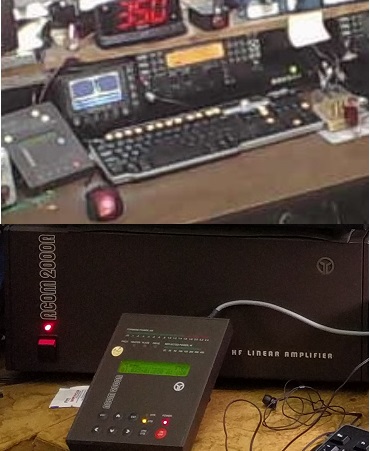
Equipment-wise I ran the usual Station #1 configuration consisting of an Elecraft K3 running into an ACOM 2000a amp dialed back to the tune of about 800 watts. 
Doing this kept the amp heat and the shack
temperature down to 40-deg c) for safety reasons.

With the antennas being used and the advantage

of being located 900-ft above sea level, 800 watts
 is more than adequate.

The "antenna farm" was the usual 13mh C-31XR tri-bander for the high bands, 2-elements on 40 and

an 80-m Inverted Vee broadside N/E - S/W.

Because operating 160 disrupts the internet connection, for obvious reasons I avoided top band for this WPX GiG.  160 only works @ NX6T when sitting in an actual operator chair.


This was an extremely frustrating weekend as I had everything going for me in this operation.

On the NashVille side I was blessed with Porque' Pig (guardian of the ACOM 2000 amplifier).  Mr. Bill was also present - for good "Luck".

Additionally, there were EASY Buttons on BOTH sides of the internet connection for added assurance.

The computers and radios @ NX6T are protected by UPS facilities so I figured nothing could go wrong. However, because a remote operation is only as good as its most crucial microwave link, that must ALSO figure into the UPS recovery plan. 

I guess they will add THAT feature NEXT week
@ the microwave site - OOOps.


Porque' Pig

Once I learned how to direct DVK recordings to the K3's voice memory areas, after recording the usual CQ, callsign and TU messages I made sure to digitize the EASY Button for play back during times when I run a frequency. [CLICK Here] to hear the EASY Button. 

Overall Saturday ran rather well altho throughout the weekend Auroral flutter made voices sound strange; sometimes resulting in 2 copies of the same signal coming at me simultaneously - very strange indeed.


I mostly ran frequencies interspersed with S&P thanks to spots on the band map. Even though there are no SSB skimmers, somehow WQ6X was manually spotted many times throughout the WPX contest.  Having a 2x1 callsign makes being spotted more worthwhile.

40 meters brought a bunch of EU and even some AF QSOs - very nice for us Left Coast operators. Surprisingly,
80-meters yielded a dozen SA stations; not bad for an inverted Vee.


On Saturday 10 meters yielded only 2 QSOs (@23:00z) even tho I called CQ throughout the day.

Because propagation was so spotty and often localized, I made extensive use of the rotor controls

in this contest. While making use of the NX6T Stepp-IR's ability to run BI-directional or 180 at a moment's notice is a useful advantage, for remote setup I am relegated to running the antenna
as Antenna-B on the K3 radio; meaning a power level of 100 watts max.


Instead, I made judicious use of the remote rotor facility. 
At times on 15 & 20 I would sweep the C-31 yagi from the North Pacific down to the South Pacific and back; amazed at the signals from "down under" which would quietly slip into the listen "window".

While signal levels were not great on the high bands, careful tuning and listening brought forth all kinds of "juicy" prefixes; which is what the WPX contest is all about.

The BiG disappointment came on Sunday (@19:20z) when a power failure occurred across the mountain at the internet microwave site with no human operators present to restore the power. I was in line to work TF3CW. For WQ6X, that power failure marked the end of the contest. The hoped-for 2nd shot at 15 & 10 meters never happened, and they were open and ready for alert Left Coasters.


An upside of this disappointment is that I learned how to program the K3's voice memories remotely, allowing me to run the contest largely with function keys.

I also made extensive use of the EASY Button ("That was Easy") when pressing F3 to send the "Thank You" message. 

Because most "foreign" stations might not understand the significance of the EASY button, I tended to use it mainly for U.S. and Canadian contacts.

Did YOU hear the easy button?
 [CLICK Here] to hear the Easy Button.


Minus the occasional random router spaz attacks, until the power failure, running NX6T remotely was almost like actually being there. Looking back, I was amazed that the internet connection was actually ready in time for contest start.

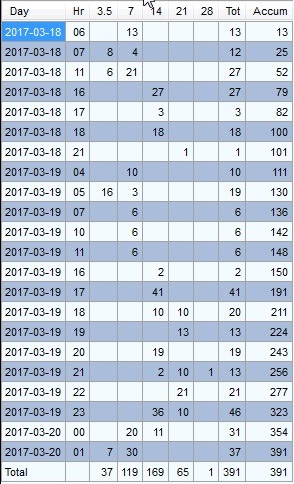
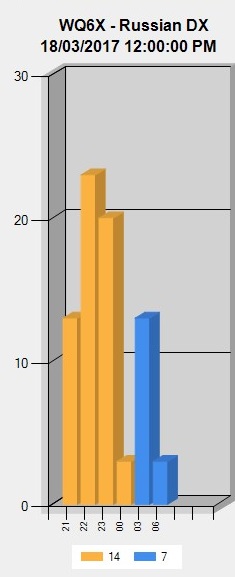
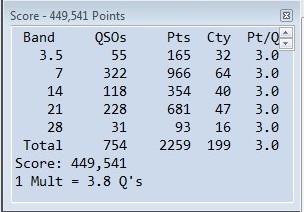
The router failure could have happened at anytime. I am thankful for having had nearly 43 hours of contest time available to me; how effectively I used those hours is shown in the statistics graph above.


Did YOU play in the WPX SSB contest?

Is WQ6X in YOUR Log?

WQ6X worked 273 unique prefixes for WPX SSB.

Is YOURS one of those 273?

Tuesday, March 21, 2017

WQ6X dual-runs Russian DX and BARTG contests

NX6T - STATION #1
For the 2nd year in a row I have found the time and wherewithal to again run the BARTG RTTY and Russian DX contests remotely from NX6T.

To read my write up on last year's event [CLICK HERE].

[CLICK HERE] to read the 2017 BARTG contest rules.

Similar to 2016, an attempt was made to work the LAQP and VAQP QSO parties.
Unlike last year, in 2017 I actually made QSOs in those parties (2 Q's with Virginia
and 3 Q's with Louisiana). Ironically, the two VA QSOs should technically win a 1st place,
being that I submitted the log as a single-band 20-meter CW entry. 

Because many state QSO parties are only 12 hour GiGs, by the time 40 meters opens to
the right-coast (for us on the left-coast), unfortunately, the QSO party is usually over.


Tower-1 (below)
Tower-2 (above)
Overall, my goal for the weekend was to recreate the spirit of last year's operation. With an 02:00z start and end time (48 hours later) the BARTG contest bracketed the Russian DX contest (with a 12:00z begin/end time),
as well as the state QSO parties.

To make things easier, I used the Elecraft K3 to drive the ACOM 2000-a amplifier to a comfortable 550 watts; on both CW and RTTY.  While the amp warmed the room considerably, it ran cool - as amplifiers go.

In order to be effective in 4 contests, somehow, SLEEP needs to occur in sufficient quantity; whether in large blocks, or hour-long swatches, when the eyes can no longer remain open.

Compared to the 2016 setup, the quality of remote operating @ NX6T has improved considerably. 

This last weekend, when the internet was happening
in Fallbrook, it was like a super highway.


Unfortunately, there were unexpected and unexplained connection failures which would

end up costing upwards of 30 minutes in lost OP time. I missed a number of brief band
openings because of that.

Typical of most contests I participate in, I made a late start - 06:17z being the 1st log entry as it took several hours to resolve some internet and then audio conflicts. However once things got started what was left of friday evening became immediately productive.


One of my goals for the BARTG RTTY contest was to utilize it as a "training ground" for improving my RTTY operating style.


When I have a radio in front of me, tuning RTTY signals "by hand" is relatively EASY; that same action

when made by way of the internet
can be tricky at best.


Something new for this contest was the inclusion of the F-10 key as a "NOW" key.  Properly designed, the NOW key allows you to invoke F3 ("TU QRZ?"), log the QSO, pop the next call

off the stack into the callsign window and invoke F2; all from one key press.

While I ran frequencies most of the time, circumstances were such that I only got to use the NOW feature twice. What makes the NOW key tricky is when the decoder deciphers what it thinks is a callsign while I am copying the exchange from the current station. Now that GARBAGE is on
the call stack and needs to be deleted before the NOW key will work properly.

Unless I just "happen" onto a properly tuned RTTY signal (as happened for 2% of contacts made),

or bandmap-click a perfectly spotted spot, I simply look for a "clear" frequency from which to
send: "CQ BARTG Test de WQ6X WQ6X Test". 

In RTTY contests, it is expected that stations will be operating above the .100 boundary in each amateur band.  The WQ6X run frequencies fit in with this:
14114.14, 21104.04, 14109.09, 14110.10, and even 21099.99.

One of my RTTY contest BEEFs is that the 14.100 beacon frequency is ALWAYS FLOODed
with RTTY stations because operators are either ignorant of the fact, or do not care, that non-RTTY amateurs rely on that NCDXF beacon.  Having a beacon does us NO good if no one can hear it due to RTTY QRM.  What?  You didn't KNOW 14.100 was a beacon frequency?  Well, NOW you Do!
Do the right thing; offer +/- 3 or more Kc to beacons and make EVERYONE happy.


In virtually EVERY contest I operate, once my callsign is heard calling [effectively] "CQ Contest", my run frequencies become fair game for intentional QRM.

Running RTTY hardly shields me from intentional QRM. Sometimes it is REAL OBVIOUS. 


I PURPOSELY choose weird (i.e. unique) run frequencies. Therefore when I see a PERFECT COPY "CQ Test..." message decode before me,
I KNOW that station's choice of frequency is no accident;

especially if I have been on that frequency for nearly an hour.


To resolve this, whether the mode is CW or RTTY, I always have a specific N1MM+ function key defined that allows me to essentially send "QRL / QSY" each time the key is pressed. If that does not work, I type QSYLID into the callsign field and press F5 as needed until the IDIOT finally vacates.

During the Russian DX contest, at one point while calling CQ, at 22:30z a station came on frequency just below my run frequency (14025.75), first tuning up and then sending a series of continuous dits, for what turned out to be over an hour. After 30 minutes I vacated the frequency for other pursuits, finding the dits singing away over 1/2 hour later when I checked back. Amazing. While CQ'ing on 7018.18 I was greeted with what sounded like a "data cranker" machine. 

The polar flutter made it sound like a toilet flushing.

Auroral influenced signal flutter was all over 20 meters. At 17:00z the flutter was so pronounced it put a weird flutter on "G" stations (England) and made a W5 station sound like it was coming from EU. This is good reason for sending your callsign THREE TIMES. 
The demodulator may garble
one of them, but the other two will confirm each other.

One of the things I like about the BARTG contest is its adherence to what I call the

multiplier/call-area rule.  Taken from the BARTG rules web page, it reads:
 

"Stations in areas that count as multipliers whose callsign does not reflects the correct area must append the area after their call. E.G. W1XXX/4. Penalty will be the log becomes CHECKLOG"


Amidst the BARTG RTTY pandemonium I found time to play in the Russian DX contest.

While it is a multi-mode contest, when I am running remotely, I prefer sending serial numbers by way of CW; pressing a key is easier than configuring transmit audio signals over the internet and using my
own voice (voice keyers are no good
for Serial #'s).


Propagation-wise, 10 & 15 meters were virtually a no-show on Saturday, even though I put out numerous "CQ Test"

calls throughout the day. 

On Sunday, pointing the C-31 yagi to 240-degrees yielded KH6CJJ on 28084.84; what turned out to be the ONLY 10 meter contact.
At least I can now say that I played 10 meters. 
Did YOU play 10 meters?

When 10 meters could deliver no more, the switch was made to 15 meters just in time for an extensive JA opening, while also working persistent U.S. stations off the end of the C-31 yagi.

As usual, because my preoccupation was with the BARTG RTTY contest, I did not make my way down into the CW band for the Russian DX contest until 21:30z (2:30 PDT). I had JUST run out of EU
stations to work on RTTY; knowing the band was wide-open
dropping down to CW to pick them up made sense to me.

Eventually I settled in on several run frequencies including 14007.07, 14026.26 & 14036.36, before transitioning down to 40-meters at 03:00z Unlike RTTY, on 40-meter CW I spent most of the time S&P'ing, instead of frequency running. The worth in EU multipliers is inestimable.


While I didn't spend nearly enough time on CW, the Russian DX contest helped reinforce my recognition of the fact that we are at the bottom of sunspot cycle 24. That means considerably earlier 40-meter openings to EU; even from the San Diego area. 

In looking at the log, I am confused by the fact that there are no 80 meter QSOs made in the Russian DX contest. While not a GREAT antenna, the 80-m inverted vee @ NX6T has been known to work EU, and in particular, those countries bordering the Atlantic like EA, CR, CT, DR, and all their variants. 

I guess I can't think of EVERYTHING.


In the midst off BARTG and the Russian DX GiGs, I put in several
CW listens for and VA or LA stations calling for their QSO party.

The LAQP ended at 02:00z (Saturday evening for me). Unfortunately, by the time I made it to 40-meters the QSO party had JUST ended. This is yet ANOTHER reason QSO parties should have extended ending times.

At least the VAQP had another 12 hour slot on Sunday allowing me to take the number of log entries from ONE to TWO. Ironically, according to 3830Scores.com, that may be enough to qualify for a 1st place in the 20-meter CW category.


This is once again proof of why you should ALWAYS submit your log
after dabbling in a radio contest. 

If I am capable of setting up that contest in N1MM+, then the LEAST I can do is submit the resultant log when it is all over. Time-wise, less than 10 minutes
is needed to make it all happen.

To sum it all up, this was a typical last minute radiosport contest operation. While the radio equipment performed flawlessly (no amplifier faults), sudden internet "collapses" made this a tricky operation. 

If I seemed to "disappear" on you, and then come back suddenly, it was NOT because I was improperly running SO2R, it is because something I could not control (an internet outage) suddenly made the scene . 
While I probably won't receive any awards (except the 2-QSO 1st place in the VAQP), this weekend gave my operating skills a REAL workout.


Did YOU operate in the BARTG RTTY or Russian DX contest on CW?

If so, is WQ6X in YOUR Log?

------------------------------------------------------------------------------------------------------------------------------
June 16th Update:
Today I received a 1st place certificate for the VAQP.
This is again the reason to ALWAYS submit a log - no matter how small the score.


Sunday, March 12, 2017

NX6T eeks out a Win for 2017 SA-10 Contest

STATION #1


Last year, in conjunction with N6KI as a team
Dennis and I took NX6T to our first 1st place worldwide
in the South American SA-10 contest, hosted by
Radio CLUB La Rioja.


To read last year's contest write up [Click Here].


The rules for this contest are simple and straight forward... http://www.sa10m.com.ar/cqsa10m_rules.html


Hoping to reprise the 2016 win, as I did last year I ran NX6T remotely.  For 2017, at the last minute, the NX6T operation became Single-OP assisted.


http://www.3830scores.com/editionscores.php?arg=tUaLz8gfqvN

In 2017, from the beginning this operation was plagued with failures. For various reasons,
both stations #1 & #2 "mysteriously" shutdown, virtually right after I finished setting up N1MM+.
"Did *I* do that?"  Hehehehehe

While the two events are not related, the full restart of equipment was not back in operation until near 18:00z. Without access to a receiver, I have no way of knowing whether or not I missed a 10-meter opening in that period.

ACOM 2000-a

I ran Station #1 - an Elecraft K3 into
an ACOM-2000a amp at 1050 watts.

Because this was a single band contest
I chose to use a 13mh C-31 yagi instead of the 15mh Stepp-IR on tower #2.

The C-31 is much easier to "sweep" over a designated geographical area as I look for signals to all of a sudden jump above the noise.


The Elecraft was front-ended using the RCForb internet software.
The RCForb screen layout is not all that different than the K-3 itself.

RC-FORB software representation


The contest opened working nothing but Argentinian stations.
While CX9AU eventually broke that streak, overall this GiG was largely an Argentinian contest.
Considering that they are the contest host, I guess this makes sense.
Brazilians made up the rest of NX6T's log.

Near the end of the 10-meter opening for the west coast, I put out a CQ call on 28028.28,
snagging 3 QSOs I might not have made otherwise, as those stations were not running frequencies.


While I easily worked everything
I could hear, most callsigns never made it all the way to San Diego,
even though they are on the log list. 


Space weather plagued the signal quality throughout the contest period.

Unlike the previous weekend's successful use of the K-3 DSP-NR,
for the SA-10 contest it seemed to
make things worse not better.


The C-31 yagi (at 13mh) did all that it could do.  Unfortunately, the propagation path to South America did not materialize anywhere near the degree we experienced it in our 2016 operation.

However, in looking at the scores submitted to 3830Scores.Com, it would seem that QSO rates were in serious decline - worldwide. I only heard one east coast USA station and saw 2
others on the band map -but did
not actually hear them.

However, in the end, 10-meters faded out at 00:00z - never to return.


SA-10 Contest Ending Screen


My biggest BEEF with the SA-10 contest is the starting time. 
We Left Coaster's would prefer that the SA-10 contest begin
at 15:00z - 16:00z, giving BOTH the Northern and Southern hemispheres access to each other from the beginning of

the contest event.

Then, on Sunday we will be able to END the contest with open bands.  The way it is now, when 10-meters closes at the end

of the day Saturday, the SA-10 contest is OVER for me. 
Bummer dewd.


 Did YOU work the South American 10-meter contest?


If so, how many 4 point QSOs are in YOUR Log?


Wednesday, March 8, 2017

OPs at NX6T come together for 2017 DX SSB Contest

 
STNs #1 & #2 (remote)
During 2017, the San Diego Contest Club has put almost NO ACTUAL BODIES in the contest chairs (except for NAQP SSB). Instead, many of the contest operations have been run remotely by NX6T operators who could not (for whatever reason) make it up the mountain to "NashVille" in Fallbrook, 900' above sea level, looking towards San Diego.

This year alone I have remotely run the RTTY RU, NAQP RTTY, WPX RTTY, ARRL Dx CW contest and NCQP (N. Carolina QSO party). This contest marked the FIRST time I actually operated an SSB contest in which I used the headset mic over the internet, in addition to playing .WAV files by way of the WINTEST function keys.

For the 2017 ARRL Dx contest that all changed when N6KI assembled a group of classic NX6T operators along with N6NC & WQ6X running remotely. Normally in SSB contests when I am on the mountain I tend to run things during the dinner hour (8:00 to 10:30 pm local time) as well as 1:30 to 8:00 am in the night hours.


Then as needed I fill in on day shifts with a shortage of operators. For this event there was no shortage of daytime operators so I worked with clients at my office in Alameda and caught up on sleep during this period.


This ARRL Dx contest was littered with space weather caused outnesses throughout the weekend. 40-meters was our best band and it opened quite early. Along with an 03:00z opening to EA5 & CT1 on 80 meters, it is clear to me that we are nearing the bottom of sunspot cycle 24.

Both evenings gave us IMMENSE JA pileups. Around 04:30z Saturday evening, with a LoT of careful listening I managed to put a dozen EU multipliers in the log even though most of the signals were about S-2 in Fallbrook. Evidently they had no trouble hearing me; most calls resulted in an immediate response.


Equipment-wise, we ran 3 Elecraft K-3 radios into a pair of ACOM 2000a amplifiers. 

Antenna-wise, for the high bands we made use of a C-31 yagi and a 3 element Stepp-IR. 2 elements on 40 and an inverted Vee (broadside NE/SW) for 75 meters was all we needed.

I think the 75-meter vee was more omni-directional than not, which gave us the near-360-ness of a vertical but with more-or-less horizontal polarization; which may explain having very little noise to contend with on 75 during this contest.


At other times, 80/75 can be one NOISY NIGHTMARE; which is why we have a LooP antenna available to us.  It is also during times like this that the MFJ-1026 and ANC-4 phasing noise cancellers
can make all the difference. 

While they require a lot of careful tweaking during the heat of competition, when they work, they are amazing. 
Of course radios like the K3 have DSP noise reduction circuits,  however with weak SSB signals, they often cause signal distortion, which is worse than the noise itself - GO figure

I did not work 40-SSB during the 10:00z - 13:00z period so I can't vouch for the intentional QRM level there. However on 75 meters I was constantly plagued by carriers and tuner-uppers. Around 13:10z while looking for JA's on 75 meters I again encountered the Chinese military station M8JF calling for Russian RIS9 on 3772.84 - wassup with that? The shortwave spectrum is HUGE! Why MUST they use our limited amount of spectrum, when they could easily operate BELOW 3.500 or ABOVE 4.000 - BOTH areas RARELY USED anymore.


After-contest Space WX report
During every contest operation each operator runs into one or more difficulties; some of them based on the time of day or the space weather A/K indexes at that moment in time.

For N6NC and myself, the biggest problem was internet latency. 

During our operation, over time, the router signal quality would degrade, requiring a reset.


Router resets take ALL remote connections offline for 3 - 5 minutes; in the heat of competition,
a time that FEELS like Eternity. If you were waiting to work me on my run frequency and I suddenly disappeared, it was NoT because I was running SO2-R irresponsibly, it's because the internet connection flaked out. Rumors have it that a NEW router is on its way to Fallbrook - I can't wait.

Score-wise, NX6T took 15th place worldwide, 9th place for USA and 2nd place for W6/Left Coast. Sunday brought a resurgence of 10 & 15 meters; 15 eventually surpassing 20. 
Like working the S-2 Europeans on 40, making 75 meters happen required a lot of FOCUS and Patience; with QSOs being made in batches and then long periods of "silence". 

JA Band Plan
To work JA's on 75 meters you need to understand the band plan they are subject to. What politicians or bureaucrats came up with THIS idiotic idea?!! 
What do they do with the GAPs in between
band segments?  Who gets to use them? 
If NO one, wassup with THAT?!

Just like in the CW Dx contest (a couple of weekends back), numerous stateside stations absolutely HAD

to work NX6T. 

On SSB its easy to let them know that we are working DX only, and they should be too. On CW it's too complicated to explain that so I would simply send
them a contest exchange (to satisfy their need for one) and then use Ctrl-W to wipe their callsign from the
entry window.


When it was all over, NX6T was designated the winner for the ARRL Southwest Division.

Did YOU play in the ARRL Dx SSB contest?

For Dx stations, is NX6T in YOUR Log?


Monday, February 27, 2017

WQ6X joins the 2017 NAQP RTTY action

The North American QSO party contests are unique events in that they do not allow high power entries.  All stations must run 100 watts or less; putting more importance on the antenna and receiving systems.

Last month I participated in the CW & SSB NAQP events running my FT-1000mp portable from W7AYT.  A couple of weekends back I ran the WPX RTTY contest remotely from NX6T in Fallbrook putting a 550 watt signal on the air.

For NAQP RTTY this weekend I setup another remote operation from NX6T.  Because NAQP
max power is 100 watts and RTTY is considered
a full-duty cycle mode which can put a lot of strain on most radios, setting the k3 output power down to 4 watts and driving the ACOM 2000a amplifier to ~ 99 watts seemed to solve that problem; until the IP-remote control of the amplifier failed.

Without amplifier control I bypassed the amp and set the power to ~ 60 watts.   Unfortunately I forgot
to up the power for 80 meters and made the 1st 9 QSOs running only 4 watts - Oops.  Nevertheless calling CQ on 3575.75, I received calls from: N0NI, NV9L, VE7FO, K9GWS, N7MDS & WB6JJJ - go figure.  When I jumped the power to 62 watts several receiver front-ends probably received quite a BLAST.


(Left) 2-EL on 40 & 80-m Inv Vee
(Right) C-31 Yagi --- both @ 13mh
While I setup NX6T's station #1 the night before, before the 10 am contest start someone errantly removed the C-31 from the antenna switch.  Because the ACOM 2000a kept faulting on high SWR,
I set about discovering what the problem really was.  Because single-OPs are only allowed to operate 10 out of the 12 contest hours, this became my first off hour. Suddenly, the antenna problem was resolved and WQ6X fired-up on 21104.04.


The last several contest weekends have happened amidst poor space weather conditions.  This weekend, while the predictions were more favorable, for NAQP 10 meters was non-existent with 20 & 15 being a toss-up for best band.  Outside of one VK5 station on 20 (who called me off the back of the C-31 yagi), there were no QSOs outside of U.S. and Canada; no Central/South America, no EU and no JA - HuH?

The DX-Map spotting facility spotted WQ6X being heard in Japan
and yet there was no one there to work me - Bummer Dewd!

WQ6X spotted by 7L4IOU
During NAQP we exchange Name and QTH. We do NOT send signal reports so the 40% of reports I received that had a "599" in it were wasting time and bandwidth. When the fast QSB hits, sending additional data that is not only NoT needed, it then preempts proper receipt of name or QTH when the signal fades at the end; which necessitates unnecessary repeats.


On the plus side, I liked the creative use of names such as: BIGFRANK, HILLTOP, DOYLE, CJ & JERZY (who was actually in NY).


Because this was a remote operation I chose to run frequencies 99% of the time.  Unfortunately, many stations would call me OFF FREQUENCY and then get mad when I told them to tune me in rather than using RIT (which is not possible to do using the RCForb software to run the K3).

So, instead of getting MAD at me or calling me LAZY (as one station did), the REAL solution is to BE ON FREQUENCY WHEN YOU CALL ME - HELLO!.......

If you can read my message saying your are off frequency, then synch your VFOs before calling me.  If you cannot read that message then you ARE off frequency and need to tune me in.  My message to these idiots is: "What part about being on frequency before making a radio transmission do you NOT understand?"


During the last hour while running on 3575.75

at 04:30z I got preempted by the RN6 CW traffic net so I setup camp on 3592.92.  Unfortunately, stations seemed to have trouble finding me after that so I made the final 3 QSOs on 7.100.

To wrap the weekend, on Sunday while capturing the NAQP log, I remembered the North Carolina QSO party (NAQP) was also happening so I spent the final hour of the NCQP picking off a dozen NC stations on 20 and then 40 meters.   I was amazed that I could even be heard on 40 at 00:30z.


Did you play in the NAQP RTTY contest?

Is WQ6X in YOUR log?

Monday, February 20, 2017

WQ6X works the ARRL Dx Test remotely on CW

Station #1 @ NX6T
This weekend found WQ6X running another ARRL Dx contest remotely from the NX6T station in Fallbrook
(aka "NashVille").

Last year I ran the station remotely from the Gold Strike casino hotel

with relatively horrible internet access. 
This weekend, thanks to a super internet connection I had very
few latency problems.

When the internet router would inevitably degrade, I ran a local reset program, waited about 4 minutes and voila! I was back in business.


Altho space weather predictions were horrible, not only were QSO rates quite decent, this weekend even produced a pair of 10 meter openings on Saturday and Sunday. 
On Friday evening Fallbrook was plagued with a lot of atmospheric noise which was leveled off by the K3 radio's noise reduction circuits. 
Normally I don't like the K3's DSP noise reduction, however this weekend it made the difference.


WQ6X working KH6 on 10 meters

Despite reports that we are 2 - 3 years away from the bottom of the sunspot cycle, instinct tells me we are less
than a year away; something we will not know for sure until around 2021,
or thereabouts.

During declining sunspot cycle periods, 40 meter DX opportunities take on the profile that we encountered on 20 meters several years ago.

With a good directional antenna, 40 meter DX opportunities during sunspot
cycle lows are utterly AWEsome.


WQ6X spotted on 15 meters

This manifested in my being able to run pileups with stations deep into Europe early in the evening on 40 meters.

Even Western Europe made its way to the west coast on 80 meters Saturday evening. While I was unable to work 160 (it bombs out the internet router)
I have heard many favorable west coast reports on 160 propagation.


The station setup included an Elecraft K3 front-ending an ACOM 2000a amplifier dialed back to
550 watts into an 80-meter inverted Vee and 2 elements on 40.


For the high bands I mainly used a C-31 yagi. Also available was a Stepp-IR attached to antenna #2 on the K3 although to use it I had to run barefoot. Running 100 watts on the Stepp-IR sometimes allowed me to make a quick QSO w/o having to wait for the C-31 to rotate around.


Stepp-IR + 2-el 40 (above)
C-31 Yagi (below)
This contest brought a NUMBER of questionable operating practices to light. While I don't normally "name names", I feel compelled to identify the violators in these cases; especially because they should know better.

Lets begin with stations operating OUT OF BAND.
At 08:42z I copied K3LR calling CQ with a run frequency that ZERO-beat was EXACTLY 3499.70. Later at 09:25z

I copied K1ZM with a run frequency that ZERO-beat EXACTLY at 6999.89. Lest you conclude that the
Elecraft K3 was off calibration; think again.

I verified these out of band signals with ANOTHER radio. So unless Elecraft has design flaws with their equipment, these stations were CLEARLY out of band.

This is yet another reason why we should avoid the bottom 2 - 3 khz of each radio band.


Next up is stations taking over frequencies ALREADY OCCUPIED. This entire weekend I counted less than a handful of times I heard a station ask "QRL?" before taking over a frequency. At 00:08z

on 21049.49 (a frequency I had been using for over an hour) KH7Q jumped on top of me calling CQ.
I sent "QRL QSY" a 1/2 dozen times and was ignored. When I sent "QSY LID" 3 times he went away.

Later at 11:00z on 7037.37 (having been there for nearly an hour) 7J7AAI attempted to take over the frequency less than 200hz below me. He was S-9 on my end and I assume so was I on his end. 

I put up with him for over 20 minutes when he then shifted right on top of me and said "QRL QSY". Huh? My reply to him was "QSY LID" after which he disappeared.

What ARE these people NOT thinking?


Finally during the last hour of the contest I was running the frequency 21049.49. 20 minutes in K6RR asked QRL? I replied QRL QSY several times and was ignored. So, we BOTH shared the frequency with him desperately calling CQ, making about 5 QSOs during that 40 minutes while I not only made 50 QSOs, I also added several new countries to the log including a T88 and 5T0 (which came in by long path).

Either K6RR could not hear me (unlikely) or he obstinately remained on my run frequency.
Had he moved up 1.5kc (which was clear) he could have worked several dozen stations after they were done with me. Instead, I grabbed all the QSOs he SHOULD have had. 

Being stubborn is NoT the way to succeed in radiosport.

Near the end of the final hour BA4TB proceeded to tune up EXACTLY on top of me (obliterating other stations) and then give me a call. Normally I ignore stations that do that however he was so loud I worked him to get him out of the way so I could work the stations he would have otherwise obliterated.


WQ6X run frequency rates
Speaking of getting stations out of the way, another amazing situation is that over TWO DOZEN stateside stations called me looking for contest QSOs. Rather than try to explain to them that they can't work me, I simply sent "5NN CA", let them send their exchange and then did not log their callsign.
I take it that these stations DID NOT READ THE RULES.
How can you expect to get anywhere when you don't read the contest rules?

Another weird situation was WH6ASW on 21054.47 at 23:03z with a weird sounding signal. 1.6 khz above him was a raspy sounding spurious note on his signal. I hope his radio didn't blow up. 


Around that time I noticed a weird Doppler-type shift between my left and right ear in the headphones. Several marginal signals seemed to shift back and forth between the ears; and no, it wasn't anything I was smoking.


QRM-wise, in addition to what I mentioned above I encountered the usual intentional QRM after 09:00z on 40 meters. Typically of this time period much of the QRM was RTTY based. Other QRM was SSB-based. While we DO share the CW spectrum with SSB in region 1,

this was clearly intentional as the station(s) would shift their VFO
while speaking to be annoying.

Additionally, stations would simply send strings of dits on top of me as

I attempted to copy weak calling stations.  Additionally, because the 2-element yagi was often pointed toward Asia, the Russian "M" beacon came through loud and clear on 7.040, however during
this contest the other Russian beacons could not be heard.

Overall, this was an enjoyable ARRL DX contest. While I probably

won't win any awards, I certainly contributed to my DXCC total for
solo operations from San Diego county.


Did YOU work the ARRL DX contest?


Is WQ6X in YOUR DX station log?