Sunday, May 19, 2013

Sometimes just showing up accomplishes the Goal....


In the past I have pitched a case for just showing up and operating a radiosport contest,
regardless of
whether or not you feel you  can win a participation award.

When I enter a radiosport competition, my focus is on making QSOs per the
contest criteria. 
It's only after the contest is over that I look at the award possibility.

In many contests you can work contacts on multiple bands and then submit your log as a single-band entry.  I did this with last month's JIDX contest.  Operating as W6J, I noticed that the 65 QSOs on 40 meters constituted the biggest band.  While I submitted the entire log (to keep the log checking BoTs happy), I submitted the W6J log as a 40-meter low-power entry.
____________
 
Once I submit a log to the contest organizers, I can then forget about it until one day I get a surprise e-mail from the contest committee with a certificate attached, or I find a thin envelope waiting for me at my P.O. box.  The above two awards are cases in point.  On the left is a "1st time entry" award for my 140 point entry to last years Tennessee QSO party.  On the right is an award from the ARI contest rating me at 12th place (in the U.S.) for submitting a 2 QSO log.

There is no reason why you can't do the same thing.  All it takes is first consulting the contest calendar to find a competition to play in.  The contest calendar I find most useful is the WA7BNM website.  Next, determine which logging software is best for this contest.  
While I mostly use the N1MM logger, WINTEST is also workable, as is WriteLog.
Fire up the software and start contacting stations in the contest.

When the contest is done, make a Cabrillo log file and send in your contest entry.  While you're at it, post your contest summary results on the 3830 reflector website to let everyone know how you did - good or not so good.  
While waiting for the results (which can take up to a year) find more contests to engage in and do things all over again.  Before you know it your callsign will be in dozens of contest databases and
the accolades will start coming your way.


Thursday, April 18, 2013

WQ6X Operates as W6J in the 2013 JIDX Cw Contest

This last weekend found me operating the JIDX Cw contest again as W6J from a portable location
in Concord, Ca. (in the SF East Bay).  (Last year W6J operated portable from Monterey on the
beach - with a horribly mismatched antenna.)


As you can see, I ran the Yaesu FT-900 for the first part of the contest, switching over to the ICOM 7000 later in the contest. The antenna was my trusty Butternut HF2-V vertical with a bevy of tuned radials; it even tuned on 160 - altho there was no discernible activity. The MFJ 752-C and JPS NIR-12 noise filters made all the difference for JIDX. 

While JIDX has become one of my favorite contests, it is also consistently a disappointment in terms of the lower than expected participation from the Japanese themselves.   Most of the time it seemed like there were more stateside stations Calling CQ JA, than JA stations calling CQ JIDX. 
Eventually, I became one of those statesiders calling CQ JA.


The JIDX contest opened with a rapidly declining solar flux and a K-Index of 3.  
Just when it seemed like the K-Index was itself on a decline, a CME hit the ionosphere sending
it back to 3, taking the receive noise-level even higher.  15m and 10 m stayed open here on the west coast until after 05:00z on April 14.  Unfortunately, aside from a couple of loud kilowatt JA stations,
the rest of the signals were from Oceania and the South Pacific.

JA activity on 80 & 20 were quite a disappointment.  Not surprising, no JA signals were heard on 160.  Three years ago (JIDX 2010) 160 had lots of activity; memorable because the Centurion amplifier arced over on 160 (during receive no less) at 10:30z.

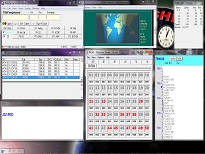
Despite my disappointments, the 2013 JIDX contest did give me an opportunity to test-run the latest release of the Prefecture Tracker by WQ6X Software.  You can see the mini version of the software
in the 2nd picture (above).  This year I expect to release Version 5 of the Prefecture tracker with its considerably more detailed screen, as shown below.

The software can input a Cabrillo .LOG file to produce the stat screen data below.
Notice that we now have the name of each prefecture in the box.  An upcoming screen will be designed around a map of Japan with call areas and prefecture #'s - for complete after-contest documentation.

Do you know of ANYONE who managed to work ALL prefectures in a JIDX contest?  
I've been close every year, but never made it.

Did you play in the JIDX contest?
If so, how did it turn out?

Curiously,
    Ron
   WQ6X
 

Monday, April 1, 2013

WQ6X Operates WPX-SSB Solo for 2013

Here are pictures from this weekend's WPX solo operation I put together on the spacious dining table at N6GEO's cabin in Twain Harte. Equipment included an ICOM 7000 with a Yaesu 
FT-900 as backup radio (its auto tuner was GREAT 
for the phased sloping Cobras) driving an SB-200 amplifier to 850w P.E.P
Work-related scheduling problems dictated that I operate WPX SSB solo this year. 
A lengthy business meeting delayed my arrival in Twain Harte to 00:15z where I put together a fully operational station in 2.5 hours on the dinning table in N6GEO's cabin. 
While there was still daylight I hoisted a pair of phased S-Style dipoles (Cobras) as a Sloping-V at about 55-feet high to compliment the OCFD dipole at 65 feet. 
The disappointing news this contest was of course the crummy solar flux, and unfortunate A-Index of 27 and K-Index of 4 (if you look closely at the 4th photo you can see the space weather forecasts to the right of the Greyline display).
While I amassed a total of 402 QSOs (for a 175k+ score) the goal of 600 Q's was derailed by the skewed propagation, thanks to geomagnetic noise induced by this weekend's solar activity.  The log-submission reports I've read from other operators confirm the fact that the noise problem was world wide.
This year, for the 1st time, I heard multi-op QSO totals over 6,000 and one beyond 7,000.

Amazingly, 75 meters was quite productive on Friday evening. D4C (Cape Verde) and a plethora of South American stations made the band worth the time spent.  I enjoy 75 meters for WPX contests because I can take a more informal ragchew attitude.  
In the spirit of ragchewing I brought the Electro-Voice 664 microphone in to compliment the Heil headset.

WPX is a contest where lengthy callsigns can become the most sought after.  
On that basis, I was disappointed by the lack of JA stations with their multitude of juicy prefix multipliers.  I was pleased by the multitude of unique prefixes from abroad as well as local ones such as WI9WI and WI0WA.

Did you play WPX?  
If so what callsign did YOU use?

Curiously,
    Ron
  WQ6X

Tuesday, March 19, 2013

WQ6X Survives the BARTG RTTY Contest

Despite a massive solar CME event and having to spend most of Sunday doing client work, I managed some operating time in the BARTG RTTY contest.  This was my first entry into this British Amateur Radio Teledata Group sponsored contest.
A CME event hit planet dirtball sometime late Sunday morning, rendering 20, 15 & 10 meters all but useless.  I put out numerous 5 minute CQ BARTG calls with no response.  At first I thought it was equipment problems or that my little hamstick antenna fell out of the tree; both ruled out.  Then, out of nowhere I would hear (and work) a station half way across the country, sounding as loud as I would expect - go figure.
Nevertheless, I found this contest to be a LOT of fun.
The exchange for this contest is a signal report (always 599) followed by a Serial # and rounded out by sending the UTC time of day.  Using N1MM with the MMTTY RTTY overlay made entering data into the log nothing more than clicking on the proper data in the receive window, which was then transferred to the next data entry box in the log window.  When its all in synch, it works great; when I got out of synch it would result in a momentary confusion.
I have enjoyed RTTY contests so much this year that I recently mused that the November Sweepstakes should have a RTTY event on the weekend BETWEEN the Cw and SSB events, or maybe during an "off" weekend in October or December  Yes, in November it would be in competition with the JIDX SSB event, but die-hard contesters (like me) would find a way to make BOTH events happen.
What are your views on this?  
If an SS-RTTY event were proposed, would you join in the fun?

Curiously,
   Ron
 WQ6X

Saturday, March 9, 2013

ARRL DxPhone - DiD it REALLY Happen?


Last weekend's Dx contest turned out to be a disappointment world wide.
The solar flux was low, the A-Index hovered near 27 and the K-Index was 3-4.  
For me, combine that with a setup using only a pair of hamsticks, in location full of streetlight RFI and you have the worst ARRL Dx contest I've ever experienced.

Touching base with several contest participants in California confirms that the conditions were down worldwide.  This year, work-related events kept me from joining the crew at NX6T in Fallbrook.  In comparison to their Step_IR's @70' my hamsticks probably rated worse than a mobile whip.
Nevertheless, there were some exotic stations operating during the contest.  
Who is the TX8W station I heard?  Even N1MM didn't know who that was.

Did you catch  TX5K on Clipperton?
They are scheduled to leave tomorrow at 11am.
My hamsticks have yet to get thru.
I've heard them on 40, 30, 20, 17, 15 & 12.
On 30 meters I hear them easily  but they always seem to be calling for EU only (on BOTH Cw & RTTY) so my window of opportunities do me no good.  Oh well maybe next Dx-pedition. 


According to my calendar, this weekend sports the Wisconsin and Idaho QSO parties.
Look for me to make a few QSOs in each and submit a log - which is now easy to do in QSO parties.  Who knows, you might get a certificate like I did from the Hawaiian QSO Party for making a WHOPPING 2 QSOs.
====================> <====================       


Sunday, February 24, 2013

WQ6X does the NAQP RTTY Contest

This weekend found me playing in the NAQP RTTY Contest.

This was another ad-hoc operation running the ICOM 7000 into a pair of hamsticks 5mh.
I was amazed to be able to work all areas of the U.S. & Canada, as well as KH6 & JA from that pair of rods.  90 QSOs may not seem like a lot, but using only those rods, it is fantastic.
While I've been getting more involved in RTTY contests in the last 6 mos., the NAQP RTTY GiG is a first for me.  Originally, because there were a couple of state QSO parties happening as well, I considered playing both.
Instead I decided to just play RTTY alone - it was more than enough to keep track of.
Although this was a RTTY contest, I encountered many of the same problems encountered in SSB & Cw contests:
  • Listening is the key to successful contesting.  Pausing 1/2 second before calling another CQ is hardly good operating technique.  Sometimes it takes me 1 second or more to send a reply.  So my reply occurs simultaneously with your next CQ, keeping us BOTH out of synch and NO qsos are made.  Likewise waiting 10 seconds between CQs leads S&P operators to believe that you disappeared.
  • When you start a QSO - FINISH IT.  Many times, a station will send my callsign and an exchange and then momentarily not hear me (or I get walked on by an inconsiderate operator)Rather than ask me for a repeat they move on to another callsign (sometimes the guy who walked all over me).  Now, I don't know if I am in his log or not.  Yes we are in a hurry, however courtesy is a BiG part of ethical operating.  Slow down and complete EACH Qso before moving onto the next.
  • With RTTY contests we have an interesting situation.  We operate at the higher end of the "Cw" portions of the band that are also shared by other services, such as BEACONS.  This weekend I sometimes had difficulty hearing the beacons on 14.100 because they were being QRM'd by contest RTTY stations - K6TU being an obvious offender who should know better.  These beacons exist to assist us in making propagation determinations.  The LEAST we can do is give them a bit of room to provide their signals QRM free; otherwise, what good are they? 
I am finding RTTY contests to be as enjoyable as Cw GiGs.  
I look forward to further events.  Having YOUR callsign in my log will be good for all of us.
When are you going to come and play RTTY with me?

  Ron
 WQ6X

Wednesday, February 20, 2013

WQ6X in the 2013 ARRL DX Cw Contest


This last weekend found me operating the ARRL Dx Cw contest from the SF bay area instead of Fallbrook.  I quickly setup the HF2-v vertical in its usual umbrella stand with a dozen radials, guyed with four thin ropes.  Because the Yaesu FT-900 sports an auto-tuner, I chose to use it instead of the ICOM 7000 (which would require me to setup the MFJ tuner and figure out all the settings).
The solar flux of 100 notwithstanding, 15 meters was quite a disappointment this contest; 10 meters wasn't much better - 40, 20 & 80 (in that order) were the best bands.

This year, I was frustrated by a number of Dx operator anomolies:
  • Stations would ask me to repeat my NR ("number) when they in fact wanted my state ("CA").  Rather than try to explain the difference (this was a Cw contest) I just went along.  Nevertheless, the confusion was unsettling.
  • Some stations (notably PY & P40 for example) had their receive filter settings skewed considerably.  Their signal would be 59+20 yet they couldn't hear me.  Tuning around sometimes found that if I positioned my carrier considerably BELOW their operating frequency they could hear me; so it turned out the problem was not my mere 100 watts.
  • As usual, some stations don't listen.  Waiting 1/2 second between CQs is NOT listening; especially if your receive passband (as described above) is not properly set. If stations would listen properly they wouldn't be calling as many CQs.
Nevertheless, I managed 211 QSOs in 39 countries (all continents).

New ones included: T88, J35, 6Y2 & XE7
Notable repeats included: C6, CR2, CR3, CQ8, EA8, NH2, V31, VP5 & ZF2.

Notably absent were Asian countries (other than China & Japan) and down under (VK & ZL).  The lack of Oceania was not due to poor antenna performance.  When the signals were there they were often S9-plus.  Signal presence from South America was quite good for this contest.  Even the African signals (what few there I could hear) were quite strong.  Northern Europe made quite a presence on Sunday altho southern European signals were noticeably lacking during this event.
I did mostly search and pounce (S&P) altho when I did call CQ, I was rewarded with a reply from CR3A (Madeira).
While this was not necessarily a memorable contest event I did find it enjoyable.
If the currently rising solar flux (114 today) holds for the DX phone contest, we should have some interesting fun.

  Ron
WQ6X

Sunday, February 17, 2013

K6M DOES IT AGAIN!


Yesterday, the CQP website published the final results of the 2012 CQP event.
Our 2nd K6M event from Modoc County garnered George (N6GEO) and I a 1st place finish from Modoc and a 2nd place finish overall (for low power) in California - not bad for our error-riddled ad-hoc setup in the middle of nowhere.
Last night I updated the WQ6X 2012 CQP page for last October's operation.  While there were moments when we wanted to say "screw it!", we forged ahead and ended up with a mighty fine showing; even though we can (and will) do better.  With proper planning (and no antenna failures) there is no reason why we can't surpass the 1,000 Qso mark.


This is the county line coming into Modoc. This is the approach road to our site.
Luckily it wasn't raining like 2010.
This is a rear view of our operation. The view from this location is AWEsome!

Thursday, February 14, 2013

WQ6X in the 2013 WPX RTTY Contest

This last weekend found me teamed up with N6GEO at his QTH in Brentwood (Northern California).  Despite a minimal antenna system (a 6BTV Vertical and a TH-3 jr - 8Mh) and running only 100 watts, we did amazingly well operating as a Multi-Two; we make a good Multi-2 team; as demonstrated by our last 3 CQP activities.
George put his newly acquired Flex 1000 to incredible use picking off QSOs with ease, thanks to the 1000's SDR design.  On my end, despite intermittent computer control with the ICOM 7000, I made things happen - working nearly half of the contacts using more primitive methods.  Several times in the contest I was able to hold and run a frequency for nearly an hour.  I have no problem doing that on c.w., but having never done that before in a RTTY contest was an exciting challenge; especially with an occasional filter "drift" in the MMTTY software.

We ended up with 699 Contacts with 285 Prefixes for an estimated score of 367,080 points, which will get whittled down for every logging mistake we made. 
Overall, not bad for an ad-hoc, two radio setup.

To George and I, what was significant about our success in the RTTY contest is that we FINALLY got to test-drive the antenna triplexer unit George built last year to use on the beam for CQP in Modoc (which as you may remember never made it: See my 2012 CQP page).

A Triplexer allows up to 3 radios to concurrently share a single tri-band antenna.  Because we use bandpass filters on each band, we had very little interaction between the two radios, except when the SDR-1000 went to 80-meters - the BUZZ was fierce!

WQ6X at his ad-hoc setup

While this looks tall - it was only 8 mh

This is the screen from the WQ6X 1/2 of things
Check out that FLEX SDR-1000 Screen!  Two monitors really helps. 

It turns out that we took 1st place for the W6 call area, even though the LCR (Log Checking Robot) DINGED us for almost 89k points due to logging errors.  OUCH!