Tuesday, March 21, 2023

WQ6X Works a Wonderfully WEIRD Dx Contest

While the Weird Prefix contest weekend is nearly 3 weeks away, the Dx contest weekend qualified
as the Weird Dx Contest weekend.  Originally, NX6T was slated to run low power from our Ramona remote location.  On Thursday evening we received authorization to run multi-OP high power (HP) from the WA6TQT superstation QTH in Anza.  This turned out to be a blessing as well as a curse,
the problem being intermittent access to the Anza location.  It turned out, Friday evening many remote ops (such as WQ6X) could turn on the radio remotely, however turning the knobs had no effect. 
The net-effect of this was that my 2am to 6am shift (on 40/80/160 meters) never happened.

Instead of remote operating after midnight, I managed to put several dozen contacts in the WQ6X
log and catch up on needed sleep.  A trip to my Alameda office on Saturday allowed me to run an hour for NX6T by way of the K3/0 Mini on my desk there, proof that remote access had been completely restored to the Anza QTH.
While we've been enjoying moderate a moderate Solar Flux Index (SFI) all week, Wed/Thurs
brought us what turned out to be a short-term solar storm which fortunately (more-or-less) ended
in time for the 00:00z (4pm PST) contest commencement.  Nevertheless, most of the HF spectrum
was littered with random atmospheric (shot-style) noise.  Fortunately, the FT-2000's DNR (Digital Noise Reduction) circuitry was able to clip the spike tops off the noise, reducing (what I call) noise-fatigue, while running the audio thru (what I call) Stereo Ssb enhancement made it more readable.

When it was all over, it would seem that NX6T took 16th-place overall, 10th-place for USA and 1st-place for Southwest Division and Riverside County.  WQ6X (running low power) took 70th-place overall, 59th-place for USA, 2nd-place for PAC division and 1st-place for EB (East Bay) section.

DiD YOU work the ARRL Dx Ssb contest.

Is NX6T or WQ6X in YOUR LoG?

Tuesday, February 28, 2023

WQ6X Runs a 1st-time QRP Weird Prefix (WPX) RTTY Contest

Throughout the year 2023, I have been finding excuses to run radiosport contests at QRP power - RTTY contests in particular.  The January RTTY RU run with QRP power was a resounding success.  Because the WPX GiGs are truly world-wide events I took the opportunity to explore the world-wide aspects of running QRP power (<5-watts).

The newly acquired MFJ 949 IntelliTuner has made running QRP power much easier than running
a manual MFJ tuner last year.  The built-in wattmeter facility in the 949 gives a precise power output reading for the FT-2000 transceiver.  It turns out that altho the FT-2000 indicates we are running
5-watts, in fact the output power is closer to only 3-watts.

Also discovered this contest weekend is the fact that the 3-element 10-meter Long John yagi
is tunable by the MFJ-949 on 15-meters as a rotatable dipole.  While there is no gain from this approach, there IS directionality.  At other times, the yagi makes for a LOW-Noise receive
antenna, almost as good as a Beverage - AWEsome.

The BiG challenge for this year's WPX RTTY contest was of course Space-WX disturbances. 
During the 2022 event, while there were ALSO Space-WX disturbances, the SFI was a mere 117, compared to this year's SFI of a whopping 215.  As a result, upper-band conditions were not nearly
as bad as the A-Index and K-Index would have us to believe.

While every Weird Prefix contest has some weird things happening, this year (as you can see above) involved some unknown station attempting to EXTORT AB0RC into sending him money for some reason.  The jamming station went on and on for nearly a half-hour with his threat - WEIRD.

Because things are sometimes so weird, I have defined N1MM's Function Key 12 (FK-12) to send "WEIRD - WEIRD - WEIRD".  A typical weird thing is when a calling station frantically calls in (obliterating the other stations), I send him an exchange, and he promptly disappears. 
Some stations did this 3-times over the course of a half-hour - HuH?  (WEIRD!)

The REAL interesting statistic is looking to the Reverse Beacon Network (RBN) to determine where the WQ6X signal is being heard world-wide.   The problem with RBN reporting is that while our signal is being heard by SDR receivers in QTH's like EA8 (Canary Islands), if there are no HUMANS running a radio there, it simply becomes a tease that leaves me frustrated and wanting.

When it was all over, comparing the online score board to the QRP entries submitted to the 3830 scores website, I have NO idea what place the WQ6X QRP score actually took.  I get to wait for at least the preliminary scores to be published by the CQ contest team.

DiD YOU participate in the 48-hour WPX RTTY radiosport contest?

Is WQ6X in YOUR LoG?


WQ6X Zig-Zags thru another XE-RTTY Contest


Becoming a fan of RTTY contests, the XE-RTTY contest has become an annual enjoyment. 
While I've been running a number of radiosport events (such as the RTTY RU) with QRP power,
the XE-RTTY GiG has no QRP-category, encouraging me to run Low Power (LP) - 99.5 watts. 

This year, my BiG question was: WHERE were all the XE stations?  Less than a dozen XE callsigns were heard in the SF bay area.  Less than a handful of different Mexican states actually ended up in the log.  Was the XE turnout actually that low or was it just the effect of the Concord receive-vortex, missing all the XE signals?

In recent months I have also been turning on the access to the contest online score board. 
It's actually a kick to see WQ6X move up and down in the standings.  Running low power,
WQ6X typically places at around 25th-place.  An interesting feature of the scoreboard is the
ability to track QSOs, Multipliers and total score on an hourly basis.


Typical of radiosport weekends this year,
10-meters has been THE band; at least, in the daytime.  Next up has been 40-meters, altho for the XE-RTTY GiG, turnout on 40-meters was actually quite a disappointment.  

For some reason, this year, 20-meters has been a "non-producer" overall; especially in recent RTTY contests, where 20-meters used to be THE RTTY band.

While there is a pair of Autek QF-1A
filters installed in the receive audio line, unfortunately, they are of no use to RTTY operations as the RigExpert PLUS unit intercepts the audio BEFORE the filters
"see" the data. 


I am proposing an experiment wherein the RiGExpert audio is intercepted and routed THRU the pair QF-1A filters BEFORE being re-directed into the computer's sound card facility.  This will open up the possibility for TRUE stereo RTTY - similar to the way we run Stereo-Cw and Stereo-Ssb.

DiD YOU work the XE RTTY contest this year?

Is WQ6X in YOUR LoG?

WQ6X Wanders through a Weird dual-Contest Weekend

For 2023, the final contest weekend in January brought disparate pair of radiosport events:
The CQ-160 Cw contest and the Winter Field Day (WFD).  While K6PO and N6KI ran the
CQ-160 contest from Station-2 at the WA6TQT Super Station, there was some down time
on Friday/Saturday evenings and after midnight on both days, giving WQ6X the opportunity
to make another 160-meter QRP run from the Anza station.

During Saturday and Sunday in the daytime, WQ6X ran QRP-Cw in the Winter Field Day
(WFD) event; mostly on 10-meters, but a handful of contacts on each of the lower bands.
As it turns out the WFD would not LoG properly in the version of N1MM+ in use @W7AYT
(running a "broken" WIN-7 has rev-locked N1MM+).

For the WFD event, the new MFJ IntelliTuner beautifully tuned ALL the antennas at the W7AYT
site giving a more accurate 5.0-watt indication than the FT-2000's power level display.  When the transceiver indicates 5-watts output, in fact, the power-level (shown by the tuner's wattmeter) is between 2.5 ==> 3.0 watts.


There really isn't a lot to say about the CQ 160 contest other than the fact that running QRP
power into a full-size Tri-Square array found many operators reporting that it sounded like I was running an amplifier.  Once the scores were posted to the 3830 Scores website, it would seem
that WQ6X took 6th-place overall, 5th-place for USA and 1st-place west of the Mississippi - NoT
too shabby for just ad-libbing it from the 1st-QSO.

DiD YOU work the Winter Field Day or CQ 160 contest?

Is WQ6X in YOUR LoG/

Aug-30 NEWSFLASH:  
The CQ magazine contest write-up ([CLICK HERE] to read it) paraphrased a quote from the logfile entry SOAPBOX (a good reason to ALWAYS write a SoapBox entry for EVERY contest entry).


Friday, January 27, 2023

BLAST from the PAST: QRP Reconsidered

In most "BLAST from the PAST" blog entries, that particular BLOG focus spans a timeframe as much as 10+ years.  It turns out slipping into QRP operations a weekend at a time (beginning in October),
I realized that a LoT of focus/attention has been put on QRP contest operations; in all honesty to create triple-OP operations, upping the overall contest ToTaL for 2022.  It doesn't matter how we
GoT to QRP running, what matters is that we HAVE discovered the World of QRP and find it to
be substantially different, yet equally challenging than I contemplated before October of last year.

Putting the phrase "QRP" into the WQ6X Blog search engine, a LoT of Blog entries came up.

Chronologically we have the following Blog entries:
  • [X] -1- WQ6X Triple-OP's yet another California QSO Party
  • [X] -2- WQ6X Successfully Operates a 1st-time triple-OP Sweepstakes
  • [X] -3- WQ6X works another dual-OP CQ WW Contest
  • [X] -4- Some Thots on dual-OP'ing as QRP
  • [X] -5- Triple-Thots about Triple-OP'ing the Ten-Meter Contest
  • [X] -6- WQ6X reprises K6T for a 10-Meter triple-OP Operation
  • [X] -7- WQ6X Wangles another Wonderfully ad-HOC Radiosport Weekend
  • [X] -8- WQ6X Dual-OP's another ARRL RTTY Roundup (RU) Contest.
  • [X] -9- QRP Reconsidered
  • [X] -10- WQ6X Runs a 1st-ever NAQP QRP dual-OP Contest
  • [X] -11- WQ6X dual-OPs a 1st NAQP Ssb GiG
Each of the above documented events provided a slightly different way to experience the QRP approach.  As I said in the QRP reconsidered BLOG, successful operations happen ideally when
we run from a great QTH (high in elevation and relatively RFI-noise free), a super antenna system
(the WA6TQT location sports stacked Yagi's, and phased-vertical arrays), and run frequencies with plenty of QRM-free bandwidth on either side.

The main objective of this BLOG entry is to provide a simple landing page to accompany
my Saturday presentation on QRP for the Amateur Radio Club of Alameda (ARCA). 
As club president, I am often called upon to give presentations on various topics, often
radiosport contest related.  This talk will eventually be posted on YouTube.  When that
happens, I will post a link to that video, here, in this BLOG entry.

Do YOU ever run QRP operations?

What has YOUR Experience been like?

Wednesday, January 25, 2023

WQ6X dual-OPs a 1st NAQP Ssb GiG

This weekend brought us a truly unique Ssb North American QSO Party (NAQP) radiosport contest experience.  During the last several months, while I have run many radiosport GiGs at QRP power 
(5-watts), I have specifically avoided Ssb contests, due to the mistaken belief that [somehow] QRP Ssb signals will [somehow] be unintelligible to most potential-calling stations.  This weekend laid to rest any misgivings I have had about successfully running an Ssb contest with only 5-watts.

For the NX6T-end of the dual-OP operation, N7NR (Dave) organized everything, with the hope of
gaining unique team-leader experience.  Dave certainly found himself "knee-deep" in organizational challenges as BOTH K3-radios at the WA6TQT superstation developed audio problems on Thursday.  Thanks to adroit coordination between N7NR and N6KI, both radios were remedied in time for a final remote checkout on Friday evening.  For reasons too complex to fathom, we ran the DXLOG contesting software on STN-1 and the WINTEST program on STN-2.

Thanks to having access to stacked Yagi's for the high bands, callers from all over USA and Canada said we were LOUD.  I double checked the 95-watt power level and confirmed that the software to run the Expert 1.5k amplifier was not active.  When I took over STN-1 during the 4pm-to-8pm operating shift, both stations at NX6T (running as Multi-2) had already put more than 1200 Ssb contacts in the log.  During my 4-hour shift I added nearly 400 more contacts to that total.

On the QRP-side of things, running Ssb was tricky, for all the reasons I mentioned in the previous NAQP QRP blog entry.  In addition to all those points, because running Ssb involves P.E.P. (Peak Envelop Power), setting the power level to not exceed QRP restrictions required a judicious use of
the wattmeter on the MFJ-993B tuner, along with increased settings on the mic gain and the speech processor built-in to the FT-2000 transceiver.  While the Electro Voice 664 microphone is wonderful for casual conversation, during Ssb contests, I prefer the Heil PRO-set microphone, which is designed more for contest "punch" than it is for ragchewing (the EV-664 once again became a mic stand).

When the 12-hour contest finally wrapped up at 06:00z (10pm PST), after all the score submissions,
it would seem that BOTH WQ6X and NX6T took 1st-place for California.  NX6T managed an incredible 3rd-place finish overall.  (Note: According to the May/June issue of the NCJ Contest Journal, WQ6X took 3rd-place overall for the Single-OP assisted QRP category - wOw! - NoT BaD considering I was just screwing around for a few hours)

More important, WQ6X demonstrated once again that QRP is ACTUALLY a viable operating mode.

DiD YOU participate in the January NAQP Ssb contest?

Is WQ6X or NX6T in YOUR Log?

Thursday, January 19, 2023

WQ6X Runs a 1st-ever NAQP QRP dual-OP Contest

As I mentioned in the recent Blog "QRP Reconsidered", since October 2022 I have been giving
QRP radiosport further consideration.  For Cw, running QRP turns out to be a "no-Brainer". 
The 2023 NAQP Cw GiG gave me the perfect opportunity to further explore the QRP angle.

Operating the NAQP was quite a juggling act.  From 1pm to 5pm, I was obligated to participate in
a series of Zoom presentations.  Running separate computers, it was possible to run Zoom under Windoze-11 and run the N1MM+ software under an ancient version of Windoze-7.  Fortunately,
running QRP, there was insufficient RF floating around the shack to cause any router disruptions.

Space-WX wise, Solar Cycle 25 has been on a HUGE upswing since the new year began.
While some geomagnetic disturbances hit earth Saturday afternoon, for California, the only
real problem from this was 10 & 15 meters closing down abnormally early (for such a high SFI).
It would seem that the bigger cause of lack of activity had everything to do with stations calling
it quits earlier than I would have expected.  Because my 2-hour off time (as WQ6X) was spent
running the 6-to-8 pm shift on STN-2 for NX6T, WQ6X ran the contest down to the last minute,
with reasonably good band conditions, yet poor turnout overall.  A CME occurred on Monday
and finally left its mark on the Space-WX on Tuesday evening.

The weekend was also the 2nd time the newly installed MFJ-993B IntelliTuner was run under radiosport conditions.  While 10-meters was THE band, it was discovered by accident that the
10-meter 3-element Long John yagi will tune up beautifully on 15-meters - evidently acting as
a rotatable dipole (a rotatable ANYTHING at this location is a blessing).

When it was all over, it would seem that NX6T took a resounding 1st-place for California and WQ6X managed a QRP 1st-place for the left coast - NoT bad for just screwing around and randomly trying things.

DiD YOU play in the NAQP Cw contest?

How DiD things turn out for you?


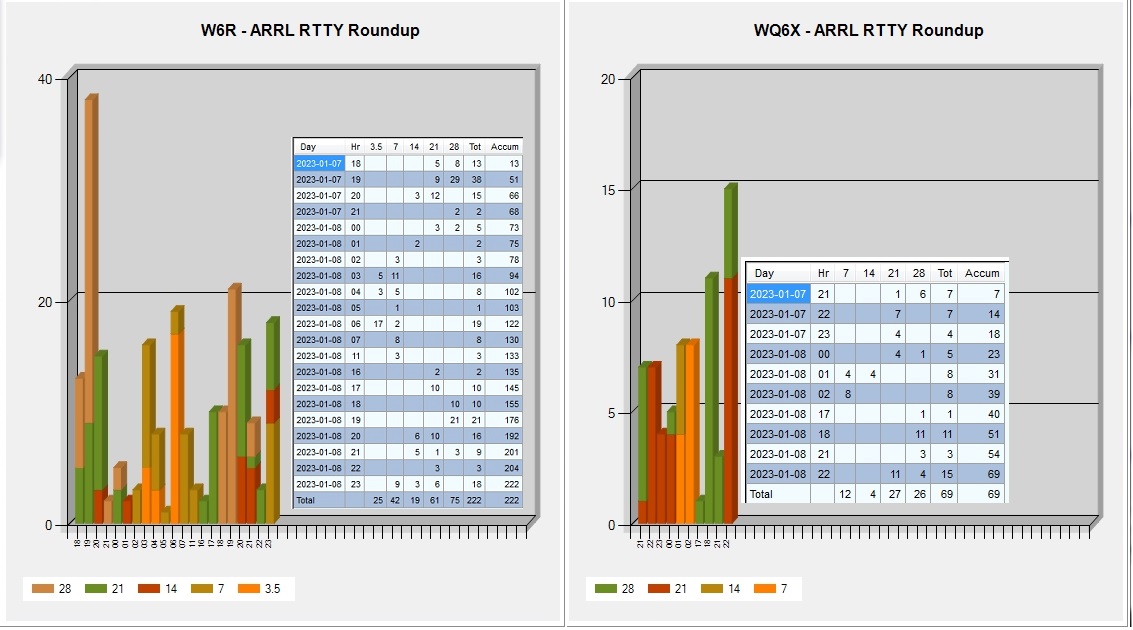
WQ6X Dual-OP's another ARRL RTTY Roundup (RU) Contest.

With 2022 now long behind us, looking into the radiosport possibilities for 2023, I rewound the timeline back to October 1st and my favorite operating GiG, the California QSO Party (CQP),
wherein I accomplished a triple-OP operation, putting in operating hours at NX6T, running K6Q
as a low power operation from Contra Costa County and finding the wherewithal to slip in some
OP-time running WQ6X in QRP mode.  The CQP results are now on the website: NX6T took a resounding 1st-place as a Multi-OP, K6Q took a resounding 1st-place for Contra Costa and WQ6X
set a new county record operating as a QRP operation.

One of the radiosport goals for this year is to replicate the different operating-styles that worked
well in 2022, in a context befitting 2023.  The 1st radiosport GiG of the year (the RTTY RU) created
a framework from which capitalize on dual-OP'ing as LP and QRP for a given event.  For this contest weekend, a new addition was made to the portable setup at W7AYT's QTH in Concord. 

A new MFJ-993B IntelliTuner relegated the manually operated MFJ-949E VersaTuner to
"Top-shelf status".  Anticipating future remote access to the Concord QTH, the MFJ-993B is
one of the many steps towards that goal.  Thursday evening was spent taking the tuner through
all bands (160 to 10 meters), giving it the opportunity to memorize settings for each band-mode
(Cw, RTTY & Ssb).  

Friday evening, after rerouting the coax cables properly, another trip through the bands ensured
that the IntelliTuner would be primed and ready to tune the myriad of different antennas at W7AYT:
an 8JK-style Cobra dipole array, a CH-250 vertical and a Hygain 3-element 10-meter "Long John" yagi.  Additionally, one of the Cobra dipoles can be redirected as a noise antenna for the MFJ-1026 noise canceller also inline between the FT-2000 and the MFJ tuner.

While the MFJ-993B tuner certainly accomplished what I set out to accomplish, it also provided
an unexpected surprise.  While running RTTY on 28088.88, I inadvertently typed in 21088.88 and began calling CQ.  After a delay caused by a short flurry of relay clatter, the MFJ-993B continued on.  After making a handful of 15-meter contacts, it occurred to me that the 993B had tuned the 10-meter yagi on 15-meters, I guess turning it into a rotatable dipole.  Not only was it directional, the noise-floor (compared to the 8JK cobras) was nearly ZERO - as it turns out, the Long John yagi makes for a very LOW-noise receiving antenna on 15-meters.

In previous RTTY-RU contests with N6GEO (George), the W6R has been used, so as NoT to favor WQ6X or N6GEO.  In honor of that, for this year's roundup GiG, the choice was made to reprise the W6R callsign (the "R" in W6R representing RTTY) allowing WQ6X to run as a QRP station, banking on callsign recognition to make up for a weaker signal than people are used to hearing from WQ6X.

As in recent contests, operations began on 10-meters, switching between running as W6R (LP) and WQ6X (QRP) working down to 15 and then 20 and 40 meters, before calling it quits for the evening
on 80-meters (RTTY contests are purposely NoT run on 160 meters).

Near the end, I took advantage of WQ6X's low QSO count spending about 90 minutes calling 
"CQ RU Test" on 10, 15 & 20 meters.  Because a 5-watt signal lacks presence, keeping a run frequency meant moving around a lot, looking for the RBN receivers to put WQ6X back on the frequency list.

With 69 QRP QSOs in the WQ6X and [hopefully] a new record set for East Bay (EB) section,
the last 70-minutes of the RTTY RU was spent running as W6R running frequencies and S&P'ing. 
The decision was made to move back down to 40-meters during the last 30-minutes of the contest.  Doing this put another half-dozen multipliers in the 40-meter register.

DiD YOU work the 2023 RTTY RU Contest?

Is W6R or WQ6X in YOUR LoG?

Friday, January 13, 2023

QRP Reconsidered


Until the 4th quarter of 2022, I rarely gave the idea of running radiosport as QRP much
consideration.  Triple-OP'ing the California QSO Party in October opened up the world of
running QRP.  Being a domestic contest, CQP creates the perfect environment to do so.

When OM2VL ended up in the 40-meter Cw log at 05:32z, I knew we were onto something. 
The "Real" tests came during the Cw Sweepstakes and CQ W.W. Cw GiGs.  Successfully
running the ARRL 10-meter contest and the Stew Perry SP-160 GiG as QRP convinced
me that QRP operations, properly run can be quite an interesting challenge.

It could be said that successful QRP operations rely heavily on the following factors:
  • Great QTH (geographical location)
  • A super-efficient antenna system
  • CLEAR Run frequencies.
For the Stew Perry 160-GiG in December, WQ6X experienced all 3-factors. 
Running from WA6TQT's superstation (atop the mountain in Anza, California) offered
a GREAT QTH and 2/3rds of a 3-square vertical array.  Judicious operating created numerous
clear run frequencies.  During this GiG, running a "snappy" CQ frequency, room was actually
made for those runs. 

In 30 to 48-hour contests, during the final hours, the high-profile stations are desperate to add callsigns like WQ6X (QRP) to their logs; hence calls from stations like: OM2VL, PJ2T, ZF1CW
and KH6LC.  For the 2023 RTTY RU contest, I took advantage of WQ6X's low QSO count by spending about 90 minutes calling "CQ RU Test" on 10, 15 & 20 meters.  Because a 5-watt QRP signal lacks presence, keeping a run frequency meant moving around a lot, looking for the RBN receivers to frequently put WQ6X back on the frequency list.

With 69 QRP QSOs in the log, it would seem that WQ6X set a new record set for East Bay (EB) section in the RTTY RU - confirming that the number of QSOs made in a contest event is relative
to the power level being run for that operation.  This was first experienced during WQ6X's QRP run
in the California QSO Party (CQP).  While the QSO total was nothing compared to what was achieved using Low Power (LP), relative to previous QRP operations, the CQP QRP operation was enough to set a record for Contra Costa County.

Based on the above experiences, I am encouraged to run more radiosport events using QRP power.

What about YOU?  Have YOU ever run QRP power in a radiosport contest?

How did it turn out?