Monday, July 19, 2021

NX6T Survives 1st-time IARU Contest from Anza

With NX6T operations from Nashville now a distant chain of memories, we focus our attention and channel our energies forward from our new (I hope) home hosted by WA6TQT in Anza.  The location (known as Radio Ranch) is so strikingly different from Nashville.  I hear somewhat loud stations in Anza that were not even faint-whispers in Nashville.

After the IARU GiG was over, Dennis (N6KI) regaled me with a summary of our past IARU performance.  While we've always posted a 1st-place for San Diego (SDG) section, our USA
and WorldWide standings have been "middle of the list", at best.  The Factors attributing to this mediocrity included the operators available, man-made noise (QRN) to the Northeast (at only 900'
ASL we were physically close to the electronic noise curtain).  

Other factors contributing to our middle-performance include marginal (at best) antennas for
80/160 (a pair of coaxial-Bazooka Inverted Vee's) and sharing internet access via a microwave
link, as well as a bunch of other factors I cannot now remember.

In contrast, our use of Radio Ranch offers antennas already 2800' ASL.  The multi-acre land parcel
is largely away from interference-generating electronics.  Antenna-wise, multiple towers sporting stacked Yagi's for the high bands and stacked Stepp-IR's for 40 meters, the low bands were
covered by way of 4-Square (80-m) and 3-Square (160m) antennas.

Thanks to a set of Green Huron (GH) antenna control boxes, pointing and phasing the various antenna arrays is AMAZINGLY powerful.  Another factor in our favor is the now ever-increasing
solar flux index (approx 77 for IARU weekend).

One of the things I like about the IARU GiG is that it's multi-mode (a sort of Multi-Band 10-meter contest).  This year, every shift I ran, I spent a not-insignificant amount of time running frequencies
on Ssb; 40/75 meters, particular.  While the K3 (on the Anza end) sports a DVK for voice keying, recording it remotely from my end appends a "PSSHT!" sound before playing the recording;
I am assuming that spritz originate at my end as none of the operators experience that - the
story of my remote operation radiosport life.

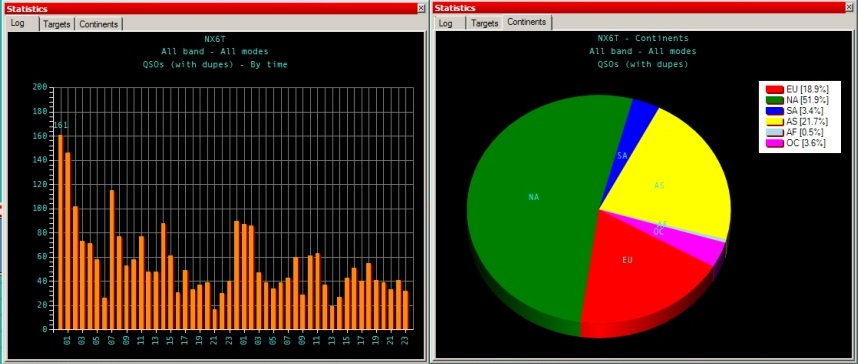
It is interesting to use the RBN network stats as a tool for "backward looking" after a given event.  Screen capturing those RBN stats and saving them for "next year" will be an eye-opener, one or
more years from now.  Looking at the end of contest RBN stats for 2021, I was astounded by the variety of NX6T spots; something we saw only a fraction of in Nashville.

Last year I wrote a couple of interesting pieces on the IARU contest:

  • [X] - A BLAST from the PAST look at IARU
  • [X] - A write up about the 2020 event

With this years RBN spots, the BLOG entries for this time next year will give us all kinds of (meaningless) comparison data.

As more and more European operators submitted their logs. our 6th place standing slipped quietly down 13 points; at least JUST in the Top-20.

DiD YOU participate in the 2021 IARU HF Championship?

Is NX6T in BOTH your Ssb and Cw Logs?


WQ6X Barely makes Marconi Cw GiG Memorable

This was one of those off-beat mixed-back radiosport weekend, as the DL-DX RTTY shared
24 hours with the Marconi Memorial Cw Contest (colloquially known as MMC).  During the 2020
DL-DX+Marconi weekend, I ran Both contests as NX6T, while squeaking a pair of QSOs into the WQ6X Concord Log.

This year, with Nashville now history, running RTTY from WA6TQT in Anza has not yet been facilitated.  At least I was allowed to run the Marconi GiG at 100 watts.  For the DL-DX GiG, the FT-1000mp ran flawless RTTY, 'cept only 2 signals were heard at the Concord location - GO Figure.

While I truly MISS the Nashville operation for many reasons, the Anza station more than doubles the ASL and gives me access to stacked yagi's for the high bands and stacked 3-element Stepp-IR's for 40, as well as a 4-Square and 3-Square directional antenna system for 80 & 160 meters respectively.

Remote operating, while wonderful, also has it's caveats.  Once in awhile, dropped bits to/from the Elecraft K3/0 may cause the receive audio to DOUBLE in amplitude, waking me up from my sound snoozing.  It's a weird thing to hear my voice thru the K3/0 monitor (via the internet), however if I am ALSO listening to the NX6T signal live with my FT-1000mp in Concord, I am amazed at how "slow" that 0.5-sec internet latency actually is.


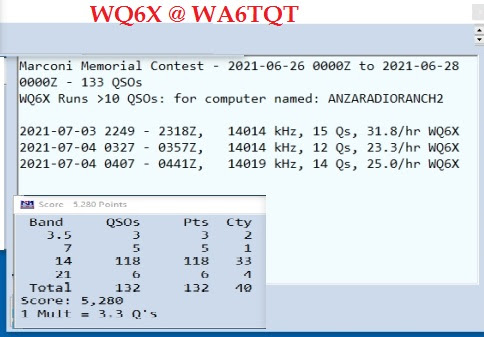
When it was Finally ALL Over, 132 hard-earned QSOs closed-out the log.
As the SFI Index ebbs and flows in the high 70's (and beyond) we experiencing a revisit
to the 20-meters of years ago, when 20 would be open virtually all night.


Anytime I feel Down after a radiosport GiG, I have discovered that color BAR Graph screens help put it all into perspective. 

Revisiting the Hour / Band breakdown allows me to reevaluate the high and not-so-high points during my operating time.

DiD YOU play around in the MARCONI & DL-DX GiG?


Is (by miracle of miracles) WQ6X in YOUR Log?


WQ6X RAC's a Dual-OP Operation for Canada Day 2021

Sometimes I get so backed-up with running actual radiosport contest events, that finding time to write it all up (with pictures, screen shots and internet links) becomes a challenge and unavoidably Blog writing takes a secondary priority in the overall scheme of things.  In July, the timing of Canada Day adds to the complexity of things.  We're used to most contest events being held on a weekend; Canada Day is July 1st, with the event beginning at 00:00z (which is 5pm the day before on the left coast).

This year, July 1st was on a Thursday; as such, the radiosport event began at 5pm on Wednesday in California (8pm on the east coast).  Putting a call in to the NX6T team informed me that a Multi-single event was planned running as NO6T from Station 2 at the Radio Ranch in Anza (San Bernardino area of So. California).

These stats give us a breakdown of what made this year's RAC GiG different than those we've run before.

Looking closely, 658 QSOs made on
20-meters is no surprise when the stats show that 17 out of the 24 hours we had an operator on 20. 

Because  we are largely a group of Cw operators, it is no surprise that 56% of the QSOs were on Cw, leaving 44% for Ssb; missing many Ssb multipliers.

 A BiG disappointment for me was the poor turnout on 160 meters.  All too often 160 becomes a Cw only band when in fact 160-Ssb is just a HoT.

With only 24 hours to play and a decent number of operators to run Ssb and Cw, my short operating time-blocks also gave me time to run the RAC contest as WQ6X from Concord.


Like other contest weekends, the RAC GiG gave yet another opportunity to (if you will) "force
a band opening" on 10-meters.  WQ6X called CQ on 10-meters with only 7th call area SDR receivers allegedly "hearing" us.  Then, out of nowhere a pair of Canadian stations come down the 3-el Long John's 33-degree azimuth pipeline to the N. Northeast; that's what the rotor control box is for - finding that "corridor".

When it was all over it would seem that NO6T took 3rd place to RAC stations (VA3RAC & VE1RAC); hardly a fair comparison.  If WE had had an RAC call we would have worked TWICE their individual scores.  Nevertheless, we took 1st place above every non-Canadian entry; which is worth something.

WQ6X took no awards for this event.  More importantly, I gained the opportunity to test run the current K3/0 connection to WA6TQT (Radio Ranch), paving the way for running the DL-DX RTTY contest the following weekend.

DiD YOU play in the Canada Day RAC Contest?
How many RAC stations DiD YOU work?
Is NO6T in YOUR LoG?

NEWSFLASH - THIS JUST IN:
It LooKs like WQ6X took 1st-place for California (W6);
not bad for just screwing around at the last minute.


Sunday, July 18, 2021

WQ6X Floats a 3rd Field Day (FD) from Aeolian Yacht Harbor

Just prior to this Blog being written up, I received the sad news that the XYL of our club member (and former president) Bruce Gillis passed away after a protracted illness.  We will miss her spirit. 
A condolence board was created.  [CLICK HERE] to read that.

Radio Amateur's Field Day is a strange thing - it seems to be nearly a year off and then alluva
sudden it's June 1st and FD is only a handful of weeks away.  This year was no exception.  While
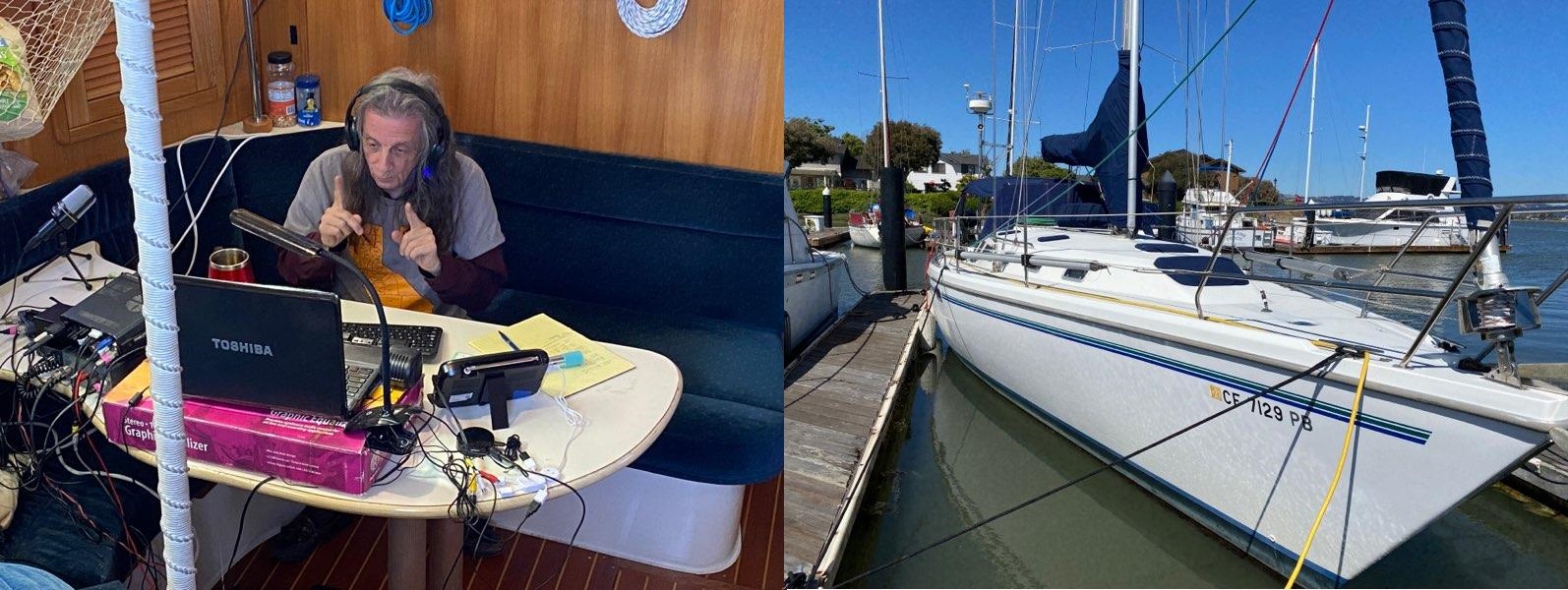
I miss doing Field Day from Mt. Abel, my 2nd favorite location is on WB6RUC's 42' sailboat that he docks in Alameda's Aeolian Yacht Harbor, JUST for the FD event itself.

Last year, I ran FD all alone from the yacht harbor, while other Amateur Radio Club of Alameda (ARCA) members made QSOs from their home QTH.  This year, another ARCA club member (KC2YOT** Roger) also moored his boat at the yacht harbor, so I didn't feel so quite alone. 
In the evening, with the radios turned down, the only sound to break the stillness of lapping
waves is the occasional vehicle driving across the bridge to/from Bay Farm Island.

As the Solar Flux begins its first of dozens of Up-Peak, each peak is often inevitably accompanied by a seemingly "sudden" downturn, repeating itself approximately 24 days later.  It is not unusual to be in the middle of a wide-open band, only to have "the bottom fall out"; actually, it's the TOP - solar BELCHes can transform a signal-reflecting ionosphere into a signal sucking sponge in a matter
of minutes.

Tuesday evening we were enjoying some AWEsome propagation worldwide on 20 (and even) 40 meters.  By noon on Wednesday, the SFI was back to where it had recently been - Ho Hum. 
By the time Field Day weekend happened, the only real GooD thing we could say is how quiet the geomagnetosphere was.  Unfortunately, what noise we were spared was compounded by the the electrical junk-noise from the corral of boats surround ours, even tho we were docked at the end of the pier - device RFI travels amazingly far.

Operator-wise, we were considerably short-handed this year (altho several club members visited the Aeolian wharf).  Roger (KC2YOT**) was our CW-only operator this year, making QSOs (as I recall) on 40, 20 & 15 meters in the daytime and 40-meters in the evening.  Zachary (W6AKE)  accounted for our VHF presence.  He e-mailed be a .JPG of his hand-logged logsheet.  After FD was over, I created a special N1MM environment and hand-typed the QSOs in, allowing us to include a Cabrillo file for those QSOs as part of the log submission.

During Field Day I LOVE operating as many bands and modes as I can.  This year certainly gave me the opportunity.  I ran the ICOM 7000 through a classic DENTRON JR. Monitor to the Butternut HF-2V vertical, which was tunable all the way down to 160 and up to 15 meters.  Onboard there is already a Sloper antenna from atop the mast down to a rear-boat insulated coax block.  Down below this wire connects to an SC auto tuner.  A manual coax switch allowed for instantaneous selection of the best antenna for EACH Qso.

The 337 QSOs doesn't include the dozen+ callers who kept repeat calling on each band.  If they had read the rules (the whut?) they would know they could work me only once per band-mode.  Because most repeat-callers were on SSB, I told them to look for me on CW on the half-hour.  You mean that Morse code thing?  Isn't that obsolete?  FD Cw QSOs are worth 2 Points while Ssb QSOs are worth only 1 point - you tell me.  

Now, my detractors will probably want to say I cheated; I looked it up in the FD rules - there is NO Rule declaring that EASY Buttons are disallowed in ANY ARRL radiosport contest.  

You've heard me say "When in Doubt CHEAT! (but within the rules)".  EASY Buttons are certainly within the rules, and even the Spirit of the rules.

The problem with REAL EASY Buttons is that they can either break, or the batteries can run down.  I solved this dilemma by developing a WINDOZE APP giving me all
the power and advantages of the desk-side button.


Last I checked, the essence of Field Day is to try out NEW Equipment, NEW Configurations, DIFFERENT operating locations & MORE Operating Modes.  "New" equipment often means old add-on equipment which still has use under emergency conditions; which is what Field Day is attempting to simulate.  Being radio-ready aboard a sailboat has all kinds of not so obvious advantages. 
Sounds like I should write a BLOG on JUST that topic - Stay Tuned Folks....


Meanwhile back on the boat...   my plan of operation was largely dictated by tracking the Solar-WX (as you saw above) in conjunction with massive amounts of calling CQ multiple-times per hour, noting the RBN Spots.  We brought a Internet HoT-Spot onboard the boat giving me access to all kinds of information, from which to boil it all down in a statistical-pot, creating magical powers enabling me
to know which band and mode I should be using at any moment in time - N  O  T.

In that I have a number of radio projects in various stages of needing to be completed, I've been delaying my BLOG-writing responsibility, leaving me with less to say about this year's event, compared to [2020] and [2019].  What that REALLY says is that for 2021, I've taken all that I have learned from the 2 previous FD operations at the Aeolian Yacht Harbor, enabling a near-flawless K6QLF operation, without loss of life/limb, radio/tuner, masts/antennas, sailboats or batteries.

Next year may well bring another nautical surprise.  Thoughts are already formulating in that direction.  DiD YOU participate in the 2021 Radio Amateur's Field Day? 
Is K6QLF in YOUR LoG?

** P.S. I JUST got word that Roger KC2YOT has been transformed in the K6QLF tradition
           into W6QLF - may his Left Foot survive the transition.


Monday, June 21, 2021

WQ6X'S All Asia Dual-OP is All Over the Place

I always know when we are getting close to Field Day, because the weekend prior brings us the
All Asia DX Cw contest.  I wrote about this last year.  ([CLICK HERE] to read about it.)  Propagation
to Asia was AWEsome in ANZA, in comparison to the dearth signals heard at the Concord location.

Because this was an Asian contest, it would make sense to check-in on the ~7.039 Russian military beacon frequency, determining Asian propagation paths.  Unfortunately, similar to the 2019 All Asia contest GiG, only the "M" beacon could be heard; the "F" and "K" beacons were noticeably AWOL.  Unfortunately, no beacons were hearable from the Concord location.

During virtually every DX-style contest I operate, intentional QRM on 40-meters (beginning around 09:00z to 10:00z) is an unfortunately reality.  For the All Asia Cw GiG this made the form of something I encountered back in May's CQ WPX contest; altho THIS time it involved THREE
Chinese stations, not just one.  The CQ calls went something like this:

  • CQ FUCKIN VIRUS Test - BY1CY (10:51z) - reported Age was: 11.
  • CQ FUCKIN VIRUS Test - BD7JNA (10:59z) - reported Age was: 63.
  • CQ FUCKIN VIRUS Test - BH3ERS (11:15z) - No QSO made.

The station(s) were not responding to callers, altho before the morning was over I managed to log
a QSO with BY1CY and Sunday we bagged BD7JNA, while BH3ERS never made it to the NX6T log.  Additionally, a new kind of "Woodpecker" plagued 40-meters around 10:16z.  While I didn't go looking for it, instinct tells me the Woodpecker was "parked" just below the 40-meter band (somewhere around 6.850 Mhz).  Although I have a "Moscow Muffler" hooked up in Concord, it does no GooD
in Anza unless I can insert it in between the Elecraft K3 and the amplifier - Bummer Dewd!

While I TRULY Do miss running from Nashville, the advantages of the Anza station are NUMEROUS.  Throughout the weekend, while running locally as WQ6X, I also paid attention to our competitor K3EST's operation.  It seemed that there were better and earlier openings in Anza than here in
the bay area.

Pointing the 3-el 10-m Long John yagi towards Asia and calling CQ yielded only KH7M. 15-meters was also a no-show, altho NX6T certainly found a couple of openings. Receive signal levels at the Concord location seem to constitute a signal vortex, wherein it would seem that other stations
hear me better than I hear them; altho the stations I DiD hear were quite strong.

In the week prior to the contest event, I spent time upgrading the WQ6X Beacon Tracker software
(to make propagation tracking easier) and created an [EASY BUTTON] Windoze APP, to help with "morale" - it's fun to hear "THAT Was Easy" when things go well.


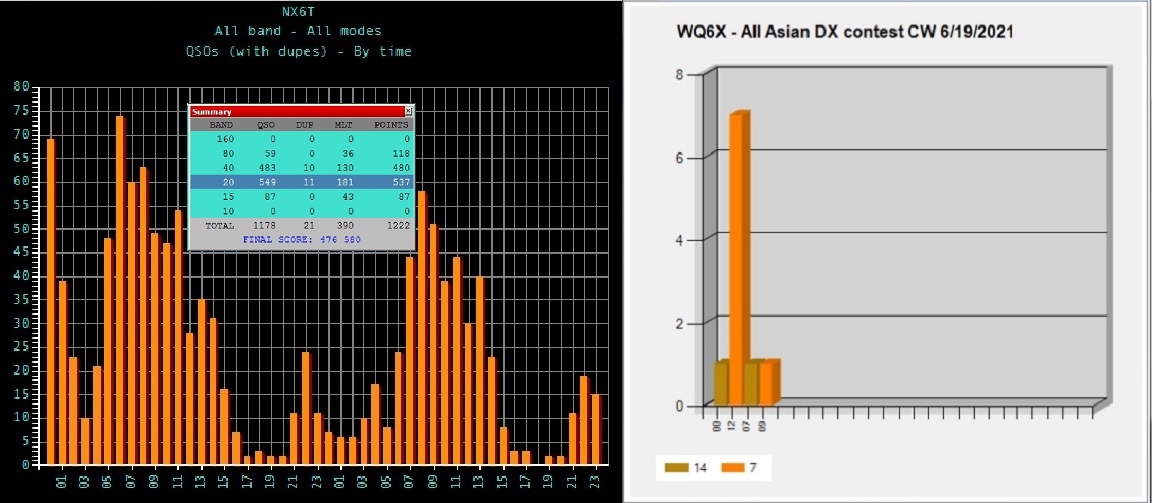
The All  Asia contest is ALL about working new countries and unique prefixes; both of which were well done with the NX6T operation.  For
WQ6X, I made so FEW QSOs, that nearly everyone was a MULT
in some way.

While there were LoTs of Asian prefixes active during the 2021 contest,
I was disappointed to not see some of the more EXOTIC Asian prefixes
(like we see in the CQ WPX Cw contest).

Space WX forecasts were ALL OVER the place; some periods great and some periods loaded with noise and QSB.  Nevertheless, we are CLEARLY in the early stages of Solar Cycle 25.

With All Asia behind us, it is now time to focus on the upcoming weekend's Field Day event from the sailboat in Alameda's Aeolian yacht harbor,
just like I've done for the last 2 years.  The 1st weekend in September
will bring us the All Asia Ssb contest - for some reason, they don't do RTTY.


When it was all over, it would seem that NX6T took 1st place for the Multi-Single transmitter category.

DiD YOU work the All Asia Cw contest?

How many Asian countries and prefixes are in YOUR LoG?


Wednesday, June 16, 2021

WQ6X Drags Thru another DRCG RTTY Contest

A couple of weeks ago I wrote about a [so-called] off weekend radiosport-wise.  (Click [HERE])
It was hoped that this weekend wouldn't fit that pattern.  With the DRCG RTTY contest and the WWSA (South American) contest, I had high hopes; especially since last year running as NX6T , N6ERD and WQ6X took 2nd place as a Multi-OP operation in the RTTY GiG, running under 600
watts at all times.

With NX6T no longer and the ANZA location not yet setup to run RTTY, I chose to run the best

Single-OP operation I can from W7AYT's QTH in Concord.  The SFI and A/K Indexes were all
over the place.  One minute the bands were jumping and the next minute calling CQ for 30 minutes yielded 1 QSO.  The RBN Stats indicated WQ6X was being heard all over, and yet, there were no manned stations hearing those CQ Calls.  If a station calls CQ and there's no operator around to hear, Does it still count as a CQ?

Only 1 QSO was made on 80 RTTY, during the 1/2 hour (combined time) spent futilely calling "CQ DRCG Test".  

An equal amount of time was spent on Saturday afternoon futilely calling "CQ DRCG Test" on 10 & 15 meters.  Both bands were clearly open and yet there were no girls and boys to play with.


As you can see, the SFI was all over the place.  On Monday and Tuesday the SFI oscillated between 69 & 81, before settling in at 77, just in time for even worse conditions as we see by midnight on Tuesday (local time).

Also in the WA7BNM Contest Calendar was the WWSA contest (otherwise known as the GACW Contest), focusing mainly on stations in South America.  

The 1st QSO with a Loud LW2DOD on 40-meters offered hope; unfortunately, aside from WH6R (Zone 31), only AC6ZM (Zone 4) and K6DBF (Zone 3) made it to the log.  Bummer Dewd. 


When NoT calling CQ for the DRCG RTTY GiG, I was engaging in the futile effort of calling
"CQ GACW Test".  Even MORE than last weekend, I was wandering around the shack mumbling
(to no one in particular) "Where IS Everybody?!"

Working those two events took the WQ6X radiosport participation count to 66 different events thus far for 2021.  While it is doubtful I will ever surpass last year's 142 GiG Events, I get a kick out of playing around in so many different contests and QSO parties.

While there was a dearth of radiosport activity, the off-hours gave me the opportunity to save and organize the memory system in BOTH the ICOM-7000 and the Yaesu FT-1000mp.  Aside from the usual benefits, organizing the memories makes way for the opportunity to do further study of the Russian Military Beacon phenomenon.  I have written about this in the past; the last being in May 2020 when I asked "Wassup with those Russian Military Beacons?".

What about YOU?  DiD YOU play around in the DRCG or GACW Contests?

THEN WHY DiDN'T YOU CALL ME???


Tuesday, June 8, 2021

External Audio Filtering: Maximizing the Art of Experimentation (Part-2)

80 to 100 years ago, virtually all radio amateurs home-brewed their equipment; overall, the circuits were relatively simple.  While QRM/QRN was always an issue, band crowding was actually nothing compared to our congested bands of the 21-st century.  In those days, 20-50 watt (max.) transmitters were most common; kilowatt amplifiers were rarely encountered.  Today, 1.5kw amplifiers are heard everywhere at all times of the day.

In today's whirrrrl'd, most transceivers use micro-minature SLIC's (Surface Level Integrated Circuits) and are not easily serviceable by the average home-brew amateur.  Linear amplifiers and antennas
are large enough that we can still have a hand in their design and upkeep.  We can also add external audio and I-F filtering to most radios allowing us to improve their performance somewhat.

I've written extensively on the subject of various approaches to audio filtering for survival in the 21st century.  Many of those Blogs have links to earlier Blog entries written on variations of this subject.  Several Blogs that come to mind include:

  • [X] - (Apr. 2021) - WQ6X Wanders thru an Experimental Contest Weekend
  • [X] - (Nov 2020) - More Lessons Learned From Listening to the DR.
  • [X] - (Aug 2020) - Learning the Art of Leveraging Dual Receive:
                               Yet Another Look (w/Links to the Past)
  • [X] - (Dec 2019) - Analog or Digital - Which shall we choose?

To combat interference issues, receivers became increasingly complex.  NoT only were they more difficult to build, accurate alignment required test equipment that was usually way out of the reach of most amateurs.  Companies like Heathkit, KnightKit, Eico and Viking (among others) bridged the gap by offering kits with units requiring alignment already pre-built and aligned.  By the 1960's, 80% of the equipment was commercially made, turning us into [so-called] "appliance operators".

Over the years, I have amassed quite a collection of external audio filters and switch boxes, including:

  • 4 Autek QF-1A's (2 in Alameda and 2 in Concord) - one for each ear, creating a "Stereo" effect.
  • 2 MFJ-752's - a MFJ-752c (L-Ear) and a modified MFJ-752b (R-Ear) with a CWF-1 filter in place of the kludgy noise-limiting diodes.
  • An MFJ-751 used in Alameda as a balancing-unit between the two Autek QF-1A filters.
  • An MFJ-784 Super DSP for Left-channel audio processing in Concord.
  • A JPS NIR-12 DSP unit for Right-channel audio processing in Concord. 
  • A Radio Shaft DSP-40 audio DSP unit (under evaluation in Alameda).
  • A Radio Shaft 15-band per channel Equalizer (32-2059) for use in audio
    experiments at the Alameda location.
  • A pair of Radio Shaft 4-IN/1-OUT COMPOSITE AV SELECTOR SWITCH
    boxes (15-313) - one in Alameda and one in Concord.


ROCKVILLE 4-Device (8-Channel) Audio Mixer
Because my WQ6X portable operation at W7AYT utilizes 3 different transceivers and several audio filters, a ROCKVILLE audio mixer has been installed making it easy to blend the audio from each radio into a series of different filter configurations.  The downside of this is very low output levels from the mixer.  This problem was remedied by installing a 2-watt stereo amplifier board inside the mixer and routing the amplifier output to an 1/8" stereo plug matching the Radio Shaft 4-device AV-selector box.

Each of these devices have separate grounding considerations, making it quite a challenge to keep ground loops out of the audio.  Having a multi-band equalizer between the mixer and the AV-switch box would be one way to accomplish this.  Prices for another Radio Shaft 32-2059 15-channel equalizer unit are only around $40 on eBay.  This may well become an addition to the Concord location in the future.


RADIO SHAFT 32-2059 15-CHANNEL EQUALIZER
Audio equalizers are an excellent way to tailor receive audio in most amateur stations. 
The above equalizer has also been used to tailor the transmit audio of the old Kenwood
TS-450 transceiver and the current ICOM-7000.  Because the Yaesu FT-1000mp and the
K3/0 Mini transceivers have their own menu-adjustable transmit audio equalization circuits,
I use the Radio Shaft equalizer to process only stereo receive audio.

With the 32-2059 equalizer 60-cycle hum  and high frequency "hiss" can be rolled off. 
Additionally, specific audio frequencies can be enhanced for improved Ssb and/or Cw reception.  However it should be pointed out that like the ROCKVILLE mixer, equalizers often lack sufficient amplification output to drive speakers, altho headphones usually work fine.


STEREO-Cw - Center-channel Audio
In addition to Stereo-Cw, another (even older) idea is what has been called the stereo
"Center Channel".  This is created by running the (-) leads from each speaker into a
   THIRD speaker, positioning it electrically "between" the Left and Right channels.


STEREO-Cw - Center-channel Filtering
For some time, I have been experimenting with a variation on the center-channel approach, substituting an MFJ-751filter in place of the center channel speaker.  To make this work properly,
it was necessary to electrically isolate the two QF-1A units.  The MFJ-751 input/output is inserted between the shield conductor of the Left QF-1A and the shield conductor of the Right QF-1A.  It just so happened that the units are sitting on a wooden platform; wood being a good indoor insulator. 


The WORLD of MFJ-752 Signal Enhancer II analog filters
Having completely forgotten about the Autek filter line, I began making use of external audio filters by way of the MFJ-752 (models B & C).  When the FT-1000mp made the scene, the one noticeable lack was audio processing for the sub receiver - the MP's eDSP works ONLY with the Main RX.  

Remembering an MFJ CWF-2 was languishing in the junk box, the circuit board was removed and retrofitted to fit inside the MFJ-752b unit.  If you look real close at the photo you will see that the NL positions of the On/Off/NL switch were sacrificed to provide 180-hz and 80hz Cw filtering.  Today, the 752C is used to process SSB audio for the Main RX (Left Channel), leaving the 752B to process SSB/Cw audio for the Sub RX (Right Channel).

Late in the audio filter game w/the
setup in Concord, I happened onto a $9.99 MFJ-751 Signal Enhancer;  predecessor to 752 Signal Enhancer II.  

While technically, they are descendants  the filtering capabilities of the 752 relegated the 751 to the back of the used equipment shelf in Alameda.  

As described above, a legitimate
(albeit unusual) use for the MFJ-751
was found as an "arbitrator" unit between a pair of Autek QF-1A filters.


The WORLD of AUTEK QF-1A Analog Filters
Coexistent with happening onto the idea of Stereo-Cw, I also happened onto a pair of Autek QF-1A filters (I now have 4; 2 in Concord and 2 in Alameda).  I was about to order the individual components to replicate the circuit in the original 1977 article on the subject when it occurred to me that the individual QF-1A filters would offer an even better idea: Variable Frequency Stereo-Cw.

Having variable frequency filters allows the shifting to left/right channel frequency cutoff points. 
That way, if a particular set of filter parameters become too monotonous, they are immediately/easily shifted into something different.  A variety in listening-experience contributes considerably to fatigue-reduction.

Occasionally, one encounters a QF-1A with an after-market pilot lamp added as you can see in the above pair.  The power transformer in those Autek units is so hefty, that I have been contemplating removing the power cord on the 2nd QF-1A and running a power pole connection to the unit with
the modification.  Another possibility would be to power each of the MFJ-752 units from a power
pole connection to the two Autek QF-1A's.


FRONT-ENDing and REAR-ending the AUDIO PATH
Having an array of filters is nice, but ONLY if that array is properly in-Fed and out-Fed. 
Switch boxes do that nicely.  I found the small box (on the right) on e-Bay a couple of years ago. 
I shoulda bought 3 or 4 because when I put in an order to the Korean vendor last year I received the information that for now they are not shipping to the USA.  As a replacement, I settled on a Radio Shaft AV Selector box (15-313).  The AV box has the advantage of switching an additional YELLOW wire at each switch position.

WRAPPING IT ALL UP
As you can see, I love to play with external switches and filters.  For the most part, even the best of amateur transceivers can benefit from the addition of external filters.  Many operators sold off their old filters when they bought the new radios, giving me the opportunity to snap them up for an average of $35 per unit.

Do YOU make use of external filtering units.

What has been YOUR Experience?


There is No Such Thing as an Off Radiosport Weekend

This last weekend had little to offer radiosport-wise.  I listened around the bands and was ready
for the eclectic TISZA_CDX Cw contest.  Unfortunately, (typical with contests of this type) nothing
was heard.  There was also the Kentucky QSO Party.  Also typical for such events, very few KY stations participated in their own QSO party. Nevertheless, I submitted a 4-QSO Log and posted
an entry on the 3830 Scores Website.  My last KYQP GiG was in 2019 and I made even
LESS QSOs than this year.

Having only 12 hours for an East coast-based party all but precludes contacts on 80 & 160 meters from the Waste Coast.  I wish they would either LENGTHEN the event hours on Saturday or give us
a 2nd opportunity on Sunday; as many state QSO parties do.  I managed a WHOPPING 4-QSOs;
3 on 20-m Cw and Ssb and one on 40-Cw.  While there was a run of the SEANET GiG, just like
2019, there was hardly anyone heard to make it worth setting up a log in N1MM.

The Boats on the Air (BOTA) GiG offered us the promise of working a sailboat tooling around Angel Island (in the S.F. north bay)  from 1 to 4 pm Saturday afternoon.  They published the frequencies (7.115 Cw, 14.325 Ssb and 18.100 FT8) but not what callsign(s) would be on the air.  Having rewired the antenna sharing switch for the CH-250 vertical, we gave a listen with Dennis's (W7AYT) Yaesu FT-450 and my Yaesu FT-1000mp.  Nothing was heard on 40-Cw, a faint whisper was heard on 14.325 and some (undecodable @W7AYT) FT8 signals were heard on 18.100.  On 20-meters,
if they WERE on 14.325, their signals were probably skipping over the Concord location.

This was also Museum Ships Weekend as well.  WQ6X managed communications w/the USS Midway (stationed in San Diego) and the USS Iowa (anchored in San Pedro - near L.A.).

Throughout the weekend there were experiments that didn't make it.  The JPS NIR-12 external DSP runs extremely HOT - there are no ventilation holes to keep the pair of TMS320C26 DSP chips cool, leaving them HoT to the touch and the filter cover extremely warm.

In the past I tried running a pair of fans (from a defunct laptop cooler).  They worked well enough
and unfortunately put a motorboat (or airplane engine) sound in the right channel audio line (where the NIR-12 is inserted).  Thinking it was a fault of the fan-pair, I tried a junk box fan with the same results.

It is possible the problem is created by using the NIR-12's power line (tapping it from lugs on the power switch).  I guess the next test should be to power the fans directly from the 30 amp SAMLEX 1235M power supply - the NIR-12 is powered by its own Wall wart.

On the software side of things a new Version (4.82) of the WQ6X Beacon Tracker went into Alpha
test on Monday to evaluate the new Active Beacon Frequency screen, offering a look at not only the selected beacon frequency; also included are an indication of what bands the other 4 active beacons are transmitting on.

Even though a given weekend shows little to no contest activity, there are ALWAYS things to be done to improve your operating experience for the next weekend there IS radiosport activity.  I wrote about this exactly a year ago (June 8th, 2020).  Click [HERE] to read all about that.

What do YOU spend your time with during slow-radiosport weekends?


Wednesday, June 2, 2021

WQ6X Wings another Weird dual-OP in CQ WPX Contest

Last weekend being an off period in radiosport contests (Fallbrook operations have now ended) coincidentally, I spent the weekend tearing down and then rebuilding the WQ6X portable setup in
Concord.  While it allowed me to dual-OP contests, with so many different devices cascaded together the ground-loops were rampant.  Thanks to proper re-cabling, those loops should largely be gone.  What better than the WPX contest to test run the operation; which is what this Memorial Day weekend was largely about.

With the Solar Flux Index (SFI) jumping around from 74 to 87, the Space-WX was all over the place as well.  Every couple of hours in the daytime, I made a CQ WPX call on ten meters.  The RBN Spots were from all over the country and yet, almost no actual operators were there to make QSOs which actually shoulda been a no-brainer.

It turns out stations heard me much more LOUDLY than I can hear them in the receive signal vortex of this QTH in Concord.  Unfortunately, I was asked to repeat my number about 85% of the time - wOw!

For NX6T, because we had plenty of operators, I took the 2am - 5am shift on Saturday and the 5am
to 8am shift on Sunday.  The intentional 40-meter QRM for this contest came on Saturday morning (11:00z) in the form of a weird chiming sound on 7040.40, reminiscent of the opening chime from classic/old SWBC stations.

In the end, NX6T made well over 2,600 QSOs and WQ6X made a WHOPPING 8.8% of those QSOs.  Noticeably absent during my operating shift were stations on 80 & 160; the JA count on 40 meters was also not what I was used to from years past.  

Compared to the old Nashville location  the ANZA location @WA6TQT is incredibly more quiet (noise-wise), and the stacked array antennas for 40m thru 10m and the 4-Square and 3-Square for 80 & 160 are a noticeably wonderful improvement.  While I already miss the spirit of Nashville, I am excited by the new prospects from a higher mountain in Anza.

Something noticeably lacking this year was the plethora of REALLY WEIRD prefixes; those reserved specifically in other countries for the WPX contest itself.  While there was plenty of activity overall, having more bizarre "Weird" prefixes makes things more fun.

While not a super score, according to the 3830 website NX6T's 7.1 million points garnered 14th place worldwide, 5th place for USA/NA and 1st place for the left coast (W6 & W7); not bad for a motley bunch of operators.

Did YOU work the CQ WPX (Weird Prefix) Contest?

Is NX6T or WQ6X in YOUR LoG?