Saturday, May 11, 2019

WHY I Do Radiosport - PT. 4 - Portable Preparedness

In preparation for the 4th installment of the "WHY I Do Radiosport" series I reflected back to my letter to the ARRL editor that was published back in May of 2017.  Here is the reprint of that letter along with a few thoughts to go along with it.

A long time ago, I had all number of excuses as to why
I was not able to engage in radiosport activities, including no "home QTH", poor antennas, inadequate radio equipment and no convenient place to setup that equipment even if I DiD have it.

In 2000, not only did I switch callsigns (from KX6H to WQ6X) I took a more pro-active approach to radiosport activities, beginning by guest-OP'ing with the crew @ the W6ML CQP operations from Mammoth lakes (MONO county).  ([CLICK HERE] to read about WQ6X's CQP involvement from 2000 and beyond.

As you can see from the CQP website, beginning in 2004 (when W6KC returned to solo CQP activities) I began running portable operations from newly-built houses in OJAI (Ventura County), allowing me to run CQP and SS (Sweepstakes) events from the SB (Santa Barbara) ARRL section.

Because I love camping and trying out different styles of portable operating, I did not allow not having a home QTH to keep me off the air during key radiosport events.

A major reason I do radiosport is to take advantage of my creative genius and find unique ways to make temporary operations work towards actually winning certificates and plaques.


2 0 1 2  A. A. Ssb (left) --- 2 0 1 3  A.A. Cw (right)
Eventually, some newer state-of-the-art radios were added to my repertoire however I was still lacking quality locations to operate from.  One solution was to operate the All Asian DX Contest from the W6SW campsite atop Mt. Abel (48 mi. N/E of LAX @ 8200' above sea level).  In Sept 2012 I made a special trip to the mountain to run AA-Ssb.  In 2013, I arrived at the W6SW mountain site a week in advance to run the AA-Cw, playing around with antenna configurations in time for the 2013-FD event.

N A Q P  J A N 2012  C w
When my Biofeedback practice brought me back to the SF bay area in 2010, trips to OJAI were no longer convenient and needed a replacement.  One solution was to house sit for people who were
ok with WQ6X operations from back patios and/or using the ever-cool Coleman Insta-tent.

N A Q P  C w (from Phoenix Lodge) & N A Q P Ssb (from N 6 G E O)
Hotel rooms (from above the ground floor) provided many operating operations.  The N6GEO QTH in Brentwood provided me many opportunities to run Single-OP or join up with George to effect some sort of Multi-2 event.

W Q 6 X Running HQP from M t.  D i a b l o
In 2011, WQ6X ran the Hawaiian QSP party from Mt. Diablo in the SF bay area.  While not as high up as Mt. Able, it did offer an easy access to the "Pacific Pond" (which is where the Hawaiian islands are located).

During 2012 & 2013 I operated HQP from the Phoenix Lodge 2nd floor - not very high, but high enough to score a 2nd place from W6-land.

As you can see, these events are ALL different; different contests, from different locations, for different reasons.  One of the reasons I do radiosport the way I do is that I am never bored; each location has its merits and its challenges.  While most portable events don't yield certificates and awards, the ones that DO win make it even more satisfying and keep me excited for the next set
of GiGs.

In 2017 WQ6X participated in 82 radiosport events; 2018 yielded a total of 74.  My 2019 goal is to surpass BOTH those years.  It's not even mid-May and there are already 43 events reported to the 3830 Scores website for WQ6X operations.

Have you ever run radiosport events from portable / field day-like settings?
How did it turn out?
Is WQ6X, N6GEO or NX6T in any of YOUR logs?

Tuesday, May 7, 2019

WQ6X Wangles & Wrangles Stereo-Cw for yet another Cinco-de-Contest Weekend

L o o K  M a, no  w i r e s - Oh, the JoY of wireless headphones
While I have run nearly a dozen Cinco-de-Contest weekends over the years, looking back,
this is the first time to ever make use of an Elecraft K3/0 for remoting in.

When the operating schedule was initially drawn up, Dennis (N6KI) had me slated to run most of Saturday.  What ACTUALLY happened was more operators signed on the last minute requiring my "expertise" to run the cinco-GiGs only in the beginning (6 to 9 am, PDT time) and then to frantically finish the search for New England stations on Sunday and that "other" station in Delaware, altho
none were actually heard.

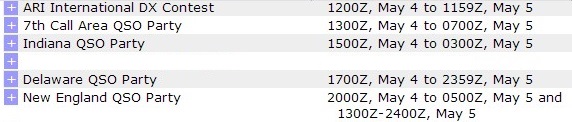
In summary, preparations were made for the following radiosport GiGs:
  1. 12:00z - ARI Dx Contest
  2. 13:00z - 7QP QSO Party
  3. 15:00z - INQP QSO Party
  4. 17:00z - DEQP QSO Party
  5. 20:00z - NEQP QSO Party
I arrived Friday to first spend some time re-cabling both installations @W7AYT; the 10-meter yagi now has a switch position, waiting patiently for the solar-flux (SFI) to bring the high-bands back to
real life.

In recent visits to W7AYT the WQ6X Lazy 8JK Sloper was an in-shack RFI producer on 40 meters; allegedly the band it was tune-focused for. 

Of course the main recipient of that RF
was the RIGEXPERT PLUS that interfaces the computer to the radio - 2 of the 3 COM ports just disappear - "dematerialize". 

Restarting N1MM+ reactivates the com-port "Sniff" routine, resurrecting them once again (appropriate for the just-passed Easter weekend).

Connecting a piece of leftover yellow Butternut radial wire between the grounding wing-nuts of the FT-1000mp and the MFJ-949E tuner resolved the RFI problem on 40 - Nicely.  Unfortunately, it only succeeded in shifting the RFI problem to the next harmonic - 20 meters. 


Now, instead of bombing the computer interface, the errant rf corrupts the N1MM+ address space, resulting in a "software crash" message.  Restarting N1MM+, the remaining 20-meter time was spent using the CH-250 vertical and the Cobra sloper wire to finish the NEQP contest on Sunday.

This contest weekend space-WX condx. switched from a miserable SFI of 66 and a K-Index of 3 to an all-of-a-sudden SFI rise to 74.  While the K-Index dropped numerically, operationally the atmospheric noise was enough to distort communication in the SF bay area, while internet burbling put holes in Cw signals requiring additional repeats during access to NX6T.

When not hassling rf & noise problems in the shack, my attention was freed up to spend more
time learning to leverage the "Art" of stereo-Cw in a multi-contest environment.
You may recall that I have written about Stereo Cw before:
  1. [x] Stereo-CW - it's EASIER than You Think
  2. [x] Some Further Thoughts regarding Stereo CW
Clever audio cabling allowed switching the outboard audio filters to between the FT-1000mp and
the NX6T internet access.  For handling noise, the FT-1000mp's NB circuits were all but worthless, altho the MP's audio DSP helped considerably (for the Main-RX).  For the Sub-RX, the JPS NIR-12 and Autek QF-1A accomplished essentially the same thing.

With the noise more-or-less under control, my attention turned to reducing adjacent audio-QRM by way of proper balance (at that moment) between the two QF-1A's/my ears.  In the above pic, notice that the left channel utilizes the high-Q Peak filter, while the right channel utilizes the more vague lower-Q HP (High Pass) filter setting.

Adjusting the Frequency knobs of both units, signals can be "moved around" inside my listening experience, to a better "position" where the signal is more readily copyable.   Making this work is
an "Art", requiring LoTs of patient practice.

Stereo Cw makes frequency running more effective.  I can either peak a desired signal by using
the radio's CLAR control, tuning it to maximum peak in the audio filters and/or adjust one of the
audio frequency knobs to effectively do the same thing.  When Searching & Pouncing (S&P'ing),
with the two QF-1A's, properly set, when I tune "through" a signal it shifts from one ear to the other, depending on whether I am tuning up or down in frequency.

With all this as a foundation, I attempted to make all the QSO parties happen, one way or another; with a variety of (but not unexpected) results.  Being on the West Coast, it's not surprising that 7QP was WQ6X's best performing event; then again at NX6T, NEQP was the main focus.

Other than 7QP the station turnout for NEQP, DEQP & INQP was quite a disappointment.  INQP produced only 1 QSO and DEQP produced two QSOs on different band, but with the same station.  While propagation conditions were far from ideal, this is EVEN MORE reason for stations to participate in their own QSO party; last weekend, Florida stations were out en-masse'; especially the rover stations.

Ending the QSO Party action at 03:00z (as with INQP) hardly gives us an opportunity for West Coast stations to experience QSO opportunities.  NEQP wasn't much better, ending at 05:00z, but at LEAST we get a 2nd run from 13:00z to 24:00z on Sunday.  While I would prefer a 7QP continuation on Sunday, at least running until 07:00z gives us QSO opportunities on40, 80 & 160.

While WQ6X did not take a 1st place in this year's 7QP QSO party,
all indications are that a 3rd-place was achieved.

A major disappointment was a lack of 7QP 160 meter activity.  Conditions on 160 were actually ideal.  Both the CH-250 vertical and the Lazy 8JK Sloper tuned 160 nicely.

Also lacking in activity was 10 meters; not because the band wasn't open, but
because everyone was listening for CQ's and no one (except WQ6X) was actually transmitting.

You may remember last June I wrote a series of BLOG entries detailing my beefs with various kinds of contest activities.  ([CLICK HERE] to read that series.)
A major BEEF this weekend were the DOZENS of stations hearing my "CQ 7QP" or "CQ NEQP" blindly calling me from outside of those areas?  Question: do you know who I am looking for when I call for 7QP/NEQP stations?  If you DON'T know, then FIND OUT BEFORE CALLING.  If you DO know that I am looking ONLY for 7th-area and 1st-area stations then why are you (W0,  KB5, or K4 stations) calling me.  Remember: Listen BE-4 you transmit.  If you don't know what I am doing then DON'T call me.

Like wise, if you are a station operating from the seventh call area and don't have a "7" in your callsign, either sign with a /7 (ex: WQ6X/7) or sign your call with the appropriate county designator
(ex: WQ6X/ORDES or WQ6X/WAKNG, etc.)

As for the ARI contest, too many things conspired against that happening for WQ6X - next year.

Did YOU operate in the Cinco-de-Contests?
Is WQ6X or NX6T in YOUR LoG?

NEWSFLASH - 4-23-2020
Just received this week was a plaque for our 1ST PLACE finish in the NEQP.

Friday, May 3, 2019

WHY I Do Radiosport - PT. 3 - Learning Technology Improvement


Many people (radio amateurs & "civilians") often ask why I spend so much time engaging in radiosport.  This series of posts in the WQ6X Contest BLOG is an attempt to answer that question.
Click [HERE] for Part 1 and [HERE] for Part 2.

The 3rd installment in this series is about taking the understanding of our equipment and antennas
to the next level.  Over the years, the main transceiver in my operation(s) have grown in ability from
a Kenwood TS-50 & loaded TS-450s to an ICOM 7000 & Yaesu FT-900 and then to a Yaesu FT-920, eventually "trading up" to the current Yaesu FT-1000mp (with the IC-7000 as backup radio).

Despite the radio upgrades,  WQ6X operations have kept the same audio filters; either an MFJ-752 + JPS  NIR-12 combo (in past years) to the more recent Autek QF1-A and JPS NIR-12 combinations. 

It might surprise you that I go to the trouble of adding external filtering to radios (like the FT-1000mp & ICOM-7000) that already have their own DSP filtering.  In truth, no DSP or interference filtering is a panacea. 

It has been said that we don't get something for nothing. Example: many noise blanking circuits either add their own distortion (at high[er] signal levels) or make the receiver more susceptible to "AGC-pumping" in the vicinity of STRONG signals.


When the Collins 75-A4 was introduced, the noise blanking circuitry sampled the noise-blanking signal OUTSIDE the amateur bands (usually BELOW the Cw band segments); doing it this way reduces the likelihood of strong signals keying the noise blanker.

In recent months, I have added an Elecraft K3/0 to lineup allowing more effective remote of the facilities @ NX6T.  While K3 radios (in Fallbrook) have built-in IF-based DSP, no DSP is perfect.  Sometimes the K3's NB and/or DNR circuits seem to have no effect.  Other times - WoW - the
effect is DRAMATIC.  Nevertheless, the K3/0 audio is fed into one or more QF-1A filters.

Whether or not I make even a single QSO in a radiosport event, the GiGs offer the opportunity to learn the intricacies of the equipment configurations.  Listening to signals under QRM-ridden or QRM-free conditions allows experimenting with the built-in DSP and external audio-filter combinations.


In particular, the Autek QF-1A filter
can produce subtle (yet powerful) audio peaking; rivaling if not exceeding the APF knobs found on radios like the Kenwood TS-930 / TS-940.

I am always amazed how well the
QF-1A can boost a signal right out of
the noise or above other signals inside
the audio passband.


While the FT-1000mp possesses an audio-based "contour" control and DNF (Digital Notch Filter), those features work ONLY with the Main-RX, not the Sub-RX.  Inserting the QF-1A / NIR-12 pair in the sub-audio line offers up DNR & DNF functionally equivalent to those features present with the Main-RX.  Learning to leverage the entirety of these controls is what radiosport is all about.
And then, it's practice, practice, practice.

When I discovered the world of "Stereo Cw", these filter combinations took on new possibilities.  (CLICK [HERE] & [HERE] to read about that.  With an understanding of stereo-Cw, "playing around" with the various filter combinations & settings has transformed my radiosport operating enjoyment, and as a result, made a considerable improvement in scores WQ6X submits to the contest committees.

Put simply - a MAJOR reason I do radiosport, is because, for me, it's just FUN.

What about YOU?
Why do YOU do radiosport?

Wednesday, May 1, 2019

WHY I Do Radiosport - PT. 2 - Emergency Preparedness

The previous BLOG entry in this series gave me a chance to genuflect on the last 10+ years of radiosport activities.  In Part 2 of this series I want to share some further details from what was written up in Part 1.

Some radio amateurs spend their operating time engaged in emergency preparedness while deriding the time spent by other amateurs who spend time engaging in radiosport competitions.  Evidently it does not occur to them that radiosport operators are often more effective at getting the message through than anyone else; we "rehearse" doing so, nearly every weekend.

Because I often ran radiosport events from portable locations such as hotel rooms, these activities gave me a considerable amount experience in quick-setup an easy takedown of radio equipment and makeshift antenna configurations.

One of the more frustrating portable antenna designs was the 2010 WQ6X Classic Hamstick dipole.  Against a flat wall it had limited azimuth coverage but produced an amazingly low-angle signal.

Also in 2010 WQ6X ran a loaded Kenwood TS-450s from a number of hotel locations into the Hamstick dipole and an MFJ "Apartment" antenna.

While the TS-450s tuner can match/load nearly any antenna (it once produced a mobile QSO w/JA on 17-m Cw using a 2-m magmount) without an elaborate counterpoise system there was always nasty RF floating around the room.

Altho wonderful, cascading MFJ-7523C and JPS NIR-12 audio filters make operations more effective.


While the NIR-12 now runs in the RX-B audio line on my current Yaesu FT-1000mp, the MFJ-752's have been relegated to the "research lab", replaced by a pair of more capable Autek QF-1 filters.  Having a built-in audio-based DSP built-in to the transceiver (RX-A) and the external NIR-12 audio DSP (RX-B) gives the radio contest power of DSP-based transceivers costing $3K, and, with greater flexibility.

As equipment and antennas have improved considerably since 2011, each step of the way has taught me new approaches towards improving operating efficiency.  Should a "disaster" strike, having operators like WQ6X in your EOC (Emergency Operations Center) will help get the message
through - every time - because that's what we do.

How do YOU leverage your radiosport operating skills?

WQ6X prepares for Cinco-de-Contest Weekend - Pt. 2

I no sooner published the original BLOG entry about preparing for Cinco-de-Contest when I discovered more pictures from past 5-contest weekends in May.   In 2014, after securing a 1st-place (worldwide) win w/N6GEO in the RTTY RU, I enjoyed a number of multi-OP events w/the crew @ NX6T culminating in a 1st-place win for the NEQP QSO Party.

What I learned from 2014 I applied to a WQ6X SOAB portable operation from W7AYT's QTH to secure a 1st-place for W6-land (California).   While I managed a 1st-place plaque for 2016-7QP,
for 2017 the competition evidently wised-UP, leaving WQ6X with a 3rd-place certification; not too
bad, when I consider the limited antenna configuration in use @W7AYT at that time.

Also in 2017, WQ6X accomplished as a Single-OP something not possible @NX6T - finally taking a 1st-place in the Italian ARI contest.  Understand that the score I amassed in that event was HARDLY a BiG one; however it was greater than anyone in USA who submitted a legitimate LoG.

Additionally in 2017 was a 1st-place win in the INQP contest, with a whopping 8 QSOs for 804 points.  Ironically, in 2018 as a multi-OP with NX6T, we also took a 1st-place - with 8 QSOs resulting in 804 points.

What we learn from this is to ALWAYS submit a contest LoG, no matter how pitiful your score may seem.  If no other logs are submitted in your operating category, you win by default.


You may recall one of my operating mantra's: "When in Doubt: CHEAT! (but within the rules) ".  Because the concept is so easily mis-understood, I wrote a separate BLOG entry about it.  ([CLICK HERE] to read this BLOG Entry.)

As you can see, at NX6T we rely on unique operating aids to make for larger radiosport scores.  NYE Viking Kilowatt+ tuners give us
a more perfect match to the 160 & 80 meter double-bazooka inverted Vee's.

MR. Bill and the [EASY] button are also utilized, if for no other purpose than to give station operators more luck. 

Then again, I remember that Thomas Jefferson once said, "I am a great believer in luck; and I find, the harder I work the more luck I have.

Hard work becoming a success is no accident.

In radiosport, submitting a winning score is also no accident.  To give me a better chance of winning
a given even (or set of events), in advance of the contest weekend I read the rules of each contest, update the contest logging software, check the space weather forecasts and review previous year
log and BLOG submissions.

What about YOU?

What do YOU do to prepare for radiosport events?

Tuesday, April 30, 2019

WQ6X prepares for another Cinco-de-Contest Weekend

If you've been following the WQ6X contest BLOG you are probably aware that I enjoy the many "flavors" of radio sport operations; including (but not limited to) Cw, RTTY, Ssb, low power, high power, DX contests, state/area QSO Parties, Sweepstakes and multi-OP events, including Field Day and various special events such as the SEQP and International Lighthouse GiG.

The first contest weekend of May offers up a variety of 5 radiosport events; 4 state QSO parties and the Italian ARI Dx contest.  In preparation for the 2019 Cinco-de-Contest weekend, I decided to review past involvement in these contest GiGs.  Documented in the WQ6X Contest BLOG are the following CQ de Contests:
  1. 2018 - Dual-OP as NX6T and WQ6X
  2. 2017 - WQ6X Survives another 5-contest Weekend
  3. 2016 - WQ6X runs 5 contests simultaneously
  4. 2014 - WQ6X joins Team NX6T for a 4-Contest Weekend
I first found about the May GiGs back in 2010, when as a newcomer to Team NX6T Dennis (N6KI) suggested that we tackle all 5 GiGs, somehow  integrating all the QSO party logs into one operation.

Because the ARI contest is first on the list for the weekend, we turned the yagi to 30-degrees hoping for a good Italian turnout.  Had we correctly read the rules, we would have realized that in the ARI contest, anyone can work anyone, altho Italian stations are worth more points per contact.  After turning away 50+ non-Italian stations we reread the rules realizing our mistake: we futilely attempted to woo lost QSOs into the log.

Over the years, practice makes perfect as demonstrated by NX6T's 2018 1st-place 7QP win. 
I was a part of that mult-OP operation, interlaced with a WQ6X operation from W7AYT.


Over the years, WQ6X made forays to Fallbrook, joining the various OPs who also like to play in State QSO Parties.  Those operations resulted in a number of NEQP Multi-OP 1st-place plaques.

In 2016, running the FT-1000mp from W7AYT's QTH into an early incarnation of the WQ6X Lazy 8JK Sloper, stupendously, WQ6X walked away with the 7QP 1st-Place Single-OP plaque. I was just "screwing around", but evidently was on the right frequencies at the right time, making it all work.

 Rereading the above referenced BLOG entries is giving me a number of operating improvements allowing WQ6X to run another Dual-OP GiG, similar to 2018.

As we often say in my Alameda Tongue Twisters Toastmaster's club, "We're not Perfect - we're always getting better"


The way to better ourselves in Radiosport is to revisit our previous operations and study the soapbox comments of contest competitors.  Remember: "He/She who does not learn from the past is doomed to repeat it".  What about YOU?  Do you review Your previous contest operations?
What do You learn from YOUR past?

WHY I Do Radiosport - PT. 1 - Operating Skill Improvement

This is the 1st in a new WQ6X Contest BLOG series.
Having passed the 225-mark in posts to the WQ6X contest BLOG, in looking back over the
6 1/2 years of BLOG-Entry writing I give pause to consider why I play in radiosport events. 


During some event GiGs when things go wrong, if you were the [proverbial] "fly on the wall", you might watch me nearly tear-my-hair out, when equipment/internet failures set in and/or when other operators do things that are incredibly STUPID.  I became so incensed by these IDIOTs I began a BLOG series entitled: "The Role of Respect in Radiosport".  ([CLICK HERE] to read that)

Those frustrating periods aside, radiosport is one of the best things that has ever "happened" to me; getting a ham license at age 14 of course tops that.  It is through radiosport that I have been exposed to all different kinds of enhanced technology; not only in the radio world itself, but in the world of computer performance, software design, travelling and even writing, BLOGs like this.

As I became more interested in the idea that I might actually win section awards and division plaques in various radiosport events, I was inspired to leverage my love for software design into tools and accessories that can enhance my radiosport operations; be they fixed, portable or internet-remote. 

When I learn a new computer language or design technique, I leverage that knowledge into some piece of software that I can use in MY life.  As a semi-PRO Blackjack player, that is how the "Boris
for Blackjack" (BorisBJ21.Com) simulation software came about; since 1992, the software has evolved dramatically.

WQ6X Software" was created as an adjunct to radiosport activity.  For example, when I discovered the value of tracking the NCDXF propagation beacons, an APP was developed to assist that action.  Finding free space on the APP screen made it possible to also track space weather data as well.

Because the JIDX (Japanese International Dx) Contest is in my top-10 list, another software APP came about in the form of  the "WQ6X Prefecture Tracker" for inputting a JIDX LoG file to sort the prefectures worked on each band.  Using this data, I am now able to make an application to the JARL for a number of JA-related awards; a daunting challenge with or without the software.
If YOU possess software development talent, I encourage you to devise custom software for improving your own radiosport abilities.

Success with the JIDX tracker prompted me to write the "WQ6X CQP Tracker" for tracking CA counties worked - leveraging the underlying software platform .DLL's.  Because radiosport relies on the visual experience (similar to playing Blackjack), it became clear that I needed a screen capture application for snapping, documenting and organizing Blackjack/Radiosport activity. 

Taking things one step further, it became clear that a SnapShot application would be beneficial to my Introspection Therapy / Neurofeedback practice. I devised a separate design moniker aptly named "NeuroLogik Solutions" for producing this wide-reaching software APP.  Having a license to my own software designs, I have since embedded the SnapShot camera into most of the Boris & WQ6X software designs (as you can see with the above Beacon Tracker").
([CLICK HERE] to obtain your own copy of SnapShot Version 3.5.)

Several years ago, I wrote a custom Excel spreadsheet for tracking the various "flavors" of radiosport activity I engage in every year.  Producing graphs from those years brought me an astonishing look at WQ6X's operational breakdown.

Because I don't have an official "home QTH" running radiosport from portable locations has been my ticket to being on the air, sometimes under the most adverse of operating conditions.  For me, it has often been Field Day (FD) over a dozen times a year.

In recent years I have put together a semi-permanent operation from W7AYT's QTH in Concord California, in the East Bay (EB) ARRL section.  The Concord location alone has introduced me to a new bunch of operating challenges.  While I yearn for a conflict-free weekend, there is something to be said about encountering operating difficulties and then finding a unique solution to those maladies.

How about YOU?

Why do YOU do radiosport?
I would enjoy hearing YOUR Ideas.

Monday, April 29, 2019

WQ6X does April RTTY & Oranges

W Q 6 X operating from Alameda + Stat Screen Collage

The last weekend in April is relatively quiet, radiosport-wise.  For this last weekend there were
3 radiosport competitions which I deemed worthy of further investigation:
  1. [?] - SP-DX RTTY Contest
  2. [?] - Helvetia Contest
  3. [?] - The FL QSO Party (FQP)


For this weekend, the Helvetia contest was another no-show disappointment @NX6T in Fallbrook.  Last year (2018), evidently I was off doing other things as there is no evidence of any WQ6X radiosport activity in the above events.  In 2017 while WQ6X worked both the Helvetia and
SP-DX contests for the 1st time, they were on different weekends in April.

Also on this weekend Japanese amateurs were holding their own regional contest (similar to
the Russian's  domestic GiG the weekend before).  This populated the bandmap with 100's of unworkable JA stations (many of the signals being S9+  on 40 meters and S3 - S5 on 80).  One way of solving this "problem" is by changing the TELNET settings, taking the unworkable JA calls
out of the band map.  Then again, leaving them IN the bandmap makes it easier to avoid that area
of the Cw spectrum while tuning around.

W Q 6 X  running  N X 6 T's  STN-1  in  Fallbrook  remotely
To guarantee QSOs in the LoG, the decision was made to run high power (990 watts) into the C-31 yagi (for the high bands), a 2-el Shorty-40 and a 13mh inverted Vee for 80.   FQP doesn't run 80-meters, leaving the Vee for the SP-DX Rtty.

While FQP began at 16:00z, because the main focus was RTTY, switching over to Cw didn't happen until 22;30z on 20 meters; altho earlier a periodic look at 10 & 15 meters yielded no Florida stations - Bummer Dewd!

Anticipating working Asian station on RTTY (each contact worth 10 points),
I turned to the Russian Letter Beacons (7.039 Mhz) for an idea of how propagation to Asia might turn out.

As it turns out, the resultant predictions turned out to be relatively accurate.  Pointing the antenna to 320-degrees yielded scores of JA & UA0 stations.  A number of surprise calls came from stations like: 9M2, 8N3, YB7, YC4, BA5, BH6 & HL5; the last contact in the log being with DU1/N6NPX.

From this last weekend I have 2 radiosport beefs; one from FQP and one from the RTTY contest.  There were MANY non-4 stations operating from Florida this year.  While that is nice, unless I asked them SPECIFICALLY, I had NO WAY of knowing they are in Florida.  There are 2 solutions to this dilemma; signing /4 is an obvious one.  An even better solution is to add the 3-char county abbv. to your callsign, as the rover stations do, making our job easier and putting MORE QSOs in their logs.  For example: if WQ6X were to run from Miami-Dade, the CQ would look like: CQ FQP WQ6X/DAD WQ6X/DAD.  BTW, most RTTY contests would REQUIRE WQ6X to sign /4 ; i.e. WQ6X/4.

In RTTY contests one of my BEEFS
is stations who jump on my frequency EXACTLY, as if they didn't know I was there.  In a Cw contest, being NEAR
my run frequency is understandable.

EXACTness (down to 1hz) is
NO ACCIDENT. SPECIFIC run frequencies are purposely chosen
(such as 14085.85 or 7047.47) . 
Getting PERFECT copy on the RTTY decoding, I know the offending station HEARD ME FIRST before they decided to attempt grabbing the frequency.


This weekend offered up an opportunity to give another test to the rerouted audio cables to the Autek QF-1A
and MFJ-751 analog audio filters.

Because these filters occur on the remote side of the connection, they are no good for Rtty decoding; luckily
the Elecraft K3's Shift/Width/DSP circuits handle most
of the required filtering.  However, for Cw, this filter combination is outstanding.  Properly adjusted, the resultant "Stereo-Cw" effect is an unbeatable combination.  ([CLICK HERE] to read the recent
BLOG I wrote on this useful filter side-effect.)

When adjacent channel RTTY stations move in, with this filter combination, the RTTY audio of the nearby stations is attenuated considerably, saving my ears (and sanity)
at the very least.

Overall, this was a successful contest weekend.  While I managed to S&P a few multipliers into the RTTY log, the secret to this weekend was to find
quiet frequencies to run.

In contest events like the FQP, being an out-of-state station, running frequencies is not necessary.
Thanks to Stereo-Cw concept coupled with the Elecraft K3/0's R-I-T control, each station to work is easily "moved" into the audio passband for near-perfect copy that even the K3's DSP can't do any better.


Did YOU work the SP-DX RTTY contest and Florida QSO Party?

Is WQ6X in YOUR LoG?

Wednesday, April 24, 2019

Some Further Thoughts regarding Stereo CW


           It has been quite some time since I originally shared my discovery of Stereo Cw. 
               ([CLICK HERE] to read the original article.

You don't need a dual-watch or dual-receive radio to transform your stereo headphones into an incredible operating experience.  With Stereo Cw you DO need to be ready for signals to be shifting around "inside your head" as you tune THROUGH a signal or use the R-I-T control to "position" the signal "in your head"; or, if you prefer, "between your ears".

Properly centered, tuning the R-I-T +/- 150 cycles can "position" a signal in the upper-left of my hearing or the upper-right.  With the R-I-T = 0, the signal "appears" to be "in front" of me.  At first
this takes some getting used to; then, later, you wonder how you ever ran a radio contest without it.


In the original article I detailed the Stereo Cw circuit and then suggested that we can simulate
that circuit by way of two outboard filters properly offset from each other.  For my portable setup at W7AYT's QTH I use a pair of Autek QF-1A audio filters; one for each ear. 

To enhance my operations from Alameda, I recently implemented a filter combination; an Autek
QF-1A for the left ear and an MFJ-751 for the right side.  Separate splitter cables separate the
input audio towards each outboard unit and recombine it back into a stereo cable plugged into
a wireless headset transmitter.

In the above picture, notice the QF-1A setting (for the left ear) is for HP (High Pass), while the MFJ-751 setting (for the right ear) is for LP (Low Pass).  Tuning a signal from high-pitch to low
causes the signal to "move" from the left-side of my experience, to more towards the right-side.  Likewise, tuning a signal from low-pitch to high causes it to shift from my right-side, "thru my head" and eventually to the left; continue tuning to a higher pitch and the signal will seem to move to the "upper left" of my experience.  (Reverse the Ears to Reverse the Direction-flow.)

An additional advantage to using Autek QF-1A (or MFJ-752) outboard filters comes from the auxiliary notch filter those units have; the MFJ-751 possesses no such additional filter.  This secondary [notch] filter can notch-reduce a signal in the passband for that ear.  Use of these external filters takes the concept of an APF (Audio Peak Filter) circuit to the next level. 

Combine these filters with a transceiver's existing DSP configuration - either audio-based (as with the Yaesu FT-1000mp) or IF-based (as found with the Elecraft K3 and K3/0) - resulting in a double-whammy against all manner of complex
noise and QRM.


Combining analog and digital technologies allows co-leveraging BOTH methods to alleviate
a single/combined source of QRM & QRN.  Realize that every attempt at filtering audio may itself introduce its own "artifact" (QRM).  For example, "pushing" the QF-1A filter to its limit may introduce "ringing", requiring that the filter intensity be "backed off" a little.

With external audio filters adjusted similar to the above-mentioned setup, running pileups becomes considerably more DO-able; different signals with different offsets are experienced either in the left-side, right-side or "middle" of the listener's "Experience".

Stereo CW is an incredible augmentation to radiosport signal copying. 
While it does nothing to boost the transmitted signal, it makes once-difficult copy copyable. 
Regardless the quality of the transmitted signal, if "I can't hear 'em, I can't work 'em".

What about You?  What do YOU do to make signals more readable?