Thursday, July 12, 2018

WQ6X Dabbles in Marconi Memorial & DL-DX RTTY Contest


In between the Canada Day (the RAC contest) and the IARU HF Championship is a pair of international contests; one Cw (the Marconi Memorial Contest) and one RTTY (the DL-DX RTTY GiG).  In years past, the Marconi GiG has shown a not-insignificant amount of activity, while the
DL-DX GiG was relatively quiet.

For 2018, exactly the reverse was true.  During the Marconi Cw GiG, I needed to get out an electron microscope to see station spot entries on the N1MM+ bandmap.  Not knowing that in advance, I went to great lengths Friday evening to configure the software and the hardware interfaces in preparation for a 11:00z DL-DX starting time.

Friday evening the contest weekend opened allegedly with the Venezuelan Independence Day contest; I say allegedly because I never once heard any YV (or equivalent) callsigns on during
the 24 hours of that event.

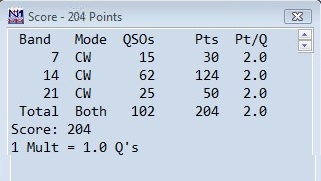
WQ6X's Marconi Memorial contest involvement began @ 21:24 w/90 minutes on 20 meters.

When the band became noticeably quiet, the switch was made to 40 meters @ 03:15z.  After only 2 QSOs and nearly 90 mins of CQ's and S&P's, another switch was made, this time
to 80 meters. 


Amazingly, NO ONE was heard playing MMC on 80.  At 06:15z two more QSOs hit the log. 
Out of frustration I got some sleep.  A 40 meter band sweep at 10:00z followed by numerous
CQ MMC calls yielded no new QSOs.  Message received - time to put the Marconi Memorial
contest to bed followed by WQ6X the operator, in that same bed.


During off periods of
the MMC contest,  the K3 radio was switched to AFSK to run the DX-DL RTTY contest.

Contest time began at 23:17z with S&P'ing around 20 meters.


Eventually, settling in on 14096.96 WQ6X ran stations for over 90 minutes. 
At 01:30z, when the QSOs thinned out, I made it down to 40 meters, eventually setting up operations on 7058.58.  Periodically, looking on 80 meters yielded no RTTY signals.  Then at 03:00z the first3 80-meter QSOs made it to the log.  The rest of the evening was spent frantically calling CQ on 80 & 40, with an occasional station worked via a bandmap spot.

While I would have preferred more stations participating in the DL-DX RTTY GiG, the even BIGGER disappointment was that I NEVER worked a SINGLE DF/DJ/DK/DM or DL station; the stations which were actually WORTH something.

Did YOU work any German RTTY stations?

What about stations in the Marconi Memorial Contest?
How many QSOs are in YOUR Log?

Newsflash (09-03-2018) WQ6X took 5th place for USA

Sunday, July 8, 2018

WQ6X Says: Happy Birthday Canada!


In 2017 I participated in my first RAC Canada Day event, taking 1st place for California. I also participated in the RAC Winter contest for the first time, although we don't yet know the outcome
of that event. Having resolved station #1's audio problems, I was open to running the RAC GiG

on Cw this time around hoping to at least double last year's score.


For 2018, to make things easier, the amplifier was set to 1350 watts and the antennas pointed more-or-less North to North-east; altho doing a "periodic sweep" from Northwest to Northeast brought many weak Canadian signals into the C-31 yagi.

I was pleasantly overwhelmed by the actual number of VE8, VE9, VY1 & VO stations on
the air this weekend. Where are these stations during Sweepstakes and the IARU GiGs?

 Station #1 @ NX6T (an Elecraft K3 into an
ACOM 2000a was run at about 1350 watts).
Available antennas included a C-31 Yagi and
2-el Shorty 40, plus inverted Vees for 80 and 160.  All antennas 13mh.

While NX6T's antenna tower #2 was useful for the low bands (2-el 40 and 80/160 inv. V's), it was by way of "relentless searching" using the C-31 yagi that stations as far away as VE8, VE9, VY1 and VO2 could be worked.
At 13mh, it possesses all the characteristics of the Stepp-IR
yagi @ 27mh on tower 2.

Rotating an antenna remotely involves some guesswork, but overall allows picking out weak signals and/or at odd reflection angles that might not be heard otherwise. 


Running 1350 watts I KNEW WQ6X would be heard "everywhere" in Canada, whether or not I could hear callers from each of those areas in return. 

Additionally, tuning around on 160
& 10 meters for QSOs that others missed took the QSO count above
400; not bad considering last year's QSO total was only 159.

The QSO counts on 40 & 20 were not really surprising.   The amazing thing was experiencing a dual-opening to Canada on 15 meters.


While 80 meters yielded only 32 QSOs, when you consider the antenna was nothing more than a coaxial-dipole formed into an inverted V, the signal was amazingly strong.  Unfortunately, because the antenna broadsided Northeast (and not Northwest), a lot of the weak signals (mentioned earlier) could not be heard on 80.


As the contest progressed, poor air conditioning required I run the last 3 hours at about 550 watts.
For the most part I don't think anyone really noticed the 5db difference.

When it was all over WQ6X amassed nearly 75K points.  Last year's 1st place for California was made with only 13K points.  Thus far, (according to the 3830 Scores website), WQ6X will EASILY take yet another 1st place for California (3rd place for USA).

Did YOU play in the RAC Canada Day contest?
How many Canadian QSOs ended up in YOUR log?

Thursday, July 5, 2018

WQ6X 2018 FIELD DAY - a dual-OP Solution

WQ6X @ W6SW STN-2 in 2013 (660 20-m CW QSOs)
Field Day is a unique event for U.S.
and Canadian radio amateurs.
A not-insignificant number of licensed amateurs credit Field Day as being their first real exposure to amateur radio.
A not-insignificant number of those people found their way into electronic engineering for their career, as a result of exposure to/through the radio hobby.

Amateur radio has always been a hobby for me, not a career. Nevertheless, this hobby shares a tight relationship with my work as a Bio/Neuro feedback therapist and software developer.


While I've run a few solo Field Day events, since 1985 I've nearly always run with the San Andreas Fault Line Survivors (W6SW) or occasionally with N6GEO; altho for 2017 I ran solo as WQ6X from W7AYT's QTH in the East Bay (EB) ARRL Section. For 2018, three Field Day ideas (running with W6SW or N6GEO and working from W7AYT's QTH) all failed to materialize.
 

Wanting to be a part of something available to the public, I joined up with the Amateur Radio Club of Alameda (ARCA) from 8am until they shutdown at 5pm (00:00z) using their K6QLF callsign. Because Field Day is all about participation, this year again found me assisting with antenna raising as well
as problem troubleshooting when a bad coax barrel connector nearly sidelined Station #2 (a Yaesu FT-897), which I eventually used to put 21 SSB QSOs in the 20 meter log.


South end of G5RV support


Prior to that, running an FT-817 (5 watts) at Station #1, I managed to make a pre-FD ragchew QSO on 40 meters using (horror of horrors) a hand key. (In all honesty, my "fist" was sore for several days afterward.) Luckily by the time Field Day started they had put in an electronic keyer.
Sending manually with the keyer, I put 14 CW QSOs in the 40 meter log.

A third station put K6QLF on the air with digital modes demonstrating the different modes we use in ham radio for visitors. Outside the center a VHF setup allowed me to work an FD station halfway down state on 2-meters - it THRILLED the kids on the other end.


While we had our share of equipment problems, we also had some fortunate events. 
A visit from the new Section Communications Manager (SCM) for East Bay (EB) section was a pleasant surprise (as well as worth 100 FD points).  The last time that happened for me was the visit from the N6VI, the then Southwest Division vice director in 2014 atop Mt. Abel during W6SW's usual FD setup.  It is visits like this which encourage more publically-viewable activities such as Field Day. 
I ran a November Sweepstakes from Carpinteria state beach one year; the only thing missing
being a visit from the Santa Barbara section manager.


After spending the day with the ARCA group, I hooked up to a secure high-speed internet connection, hoping
to run WQ6X remotely from NX6T.  Unfortunately, another audio problem with station #1 kept me off the air

all evening. 

Sunday morning just after 9am

(16:00z) because I was still connected
to Fallbrook, suddenly I heard receive audio waft in from the RCForb software.
I was in business for 96 minutes.

To make sure I was heard everywhere, I ran the station at 1350 watts, suffering the 1.0 power multiplier. Nevertheless, that was an intensely FUN 96 minutes.


The amazing thing was being able to work 20 meters, then 15 meters, then back to 20 meters.
The final 20 minutes put 15 QSOs in the log for 40 meters. While WQ6X will take no awards,
it was certainly a successful exercise in catching a brief 15-meter MUF before it disappeared.
Asking for a 10-meter opening was too much too early. Next year, an increasing SFI should
help resolve that problem.

Did you work Radio Amateur's Field Day?

What tales do YOU have to tell?


Friday, June 29, 2018

The Role of Respect in Radiosport - Part 4

This is the 4th installment of the WQ6X contest BEEFs BLOG.
You may recall:
  1. Part 1 was a potpourri of BEEFs; a Beefy Potpourri.
  2. Part 2 brought us a look at the technology side of 40-meter QRM. 
    This included an encounter with an Indonesian Witch Doctor.  I KiD you NoT.
  3. Part 3 was another potpourri opening with a look at CW on steroids
    and ending with a look at stations who GIVE UP.
Part 4 is largely about the world of SO2-R operators who haven't a clue.
However first, let's begin Part 4 with a look at operators who waste everybody's
time by sending large amounts of unnecessary exchange data.


BEEF #16 - CW STATIONS WHO SEND 599+ EXCHANGE EVERYTIME I ASK FOR ONLY A SPECIFIC PIECE OF INFORMATION
One of the BiGGesT wastes of time in radiosport contests is sending unnecessary information.
A not insignificant number of contests have us send "599" followed by an additional piece of information; typically, a Serial #. To be in compliance with contest rules, I send a "599" for
every contact (but only once per QSO).

Under N1MM+ I define Function Key F6 to send "UR NR?" and F7 to send "NR 1234".
Sending a minimal amount of information is very important when the receiving end is
experiencing medium-fading.

When I send "NR?" and you send "599 1234", what usually happens is I hear the 599 VERY LOUD just in time for the signal to fade when you send me the number. This causes me to ask for a repeat AGAIN and AGAIN; whereas, if you JUST sent "1234", I would get it the first time and we can then BOTH move on. Is that so difficult for people to understand? It MUST be because most people
make this most fundamental of radiosport mistakes. WAKE UP PEOPLE!


BEEF #17 - STATIONS WHO DON'T WAIT AT LEAST 1.5 SECONDS BETWEEN RUN QSOS LISTENING FOR CALLERS BEFORE MAKING ANOTHER CALL
When I run a frequency during a contest, after EACH QSO I take a 2 second pause, listening
for other callers. Doing this prevents me from having to make a lengthy CQ call when there are stations ready and waiting to make a QSO.

When I am calling a run station, IMMEDIATELY after he concludes his QSO I press F4 to send my call. Often when the rig is back in receive, he is in the middle of calling CQ (we both transmitted at
the same time). I call him the second time and comes right back to me.

HuH? If you had waited JUST 2 seconds you would have heard me calling you and there would
be no need to call another CQ until AFTER we make our QSO. The bottom line is PATIENCE.
Getting ANXIOUS actually slows things down rather than improving operating efficiency.


BEEF #18 - SO2-R OPERATORS WHO DO SUCH A POOR JOB RUNNING THINGS THAT "BOTH" FREQUENCIES END UP WAITING
While I have mixed feelings about running SO2-R in contests (as long they are in their own separate category I don't mind them), my BIGGEST problem with SO2-R are the operators who THINK they are SO2R-Aces, when in fact, they are just beginners.
 

Nothing is MORE annoying than hearing an S-9 "CQ contest" call and not only does he not come back to me, he responds to no one else either. After sending "WQ6X" 3 separate times, if there is
no response, I send "QRL?" 3 separate times. If there is STILL no response, I press F1 to call CQ
and the frequency is mine; unless of course NOW the Idiot wakes up and blindly calls CQ without
first listening to see whether or not the frequency is in use (a violation of FCC rules which require
we listen BEFORE transmitting).

When that happens I intersperse [F1] CQ calls with [F9] QRL QSY messages. 

What if the reason they were delayed was because of an equipment glitch? TOO BAD.
If you're having equipment problems, then fix them off the air; not at our expense.


BEEF #19 - SO2-I - SINGLE-OP TOO IDIOTIC
A variation of the above complaint is the Dingle-Dork (usually during his state's QSO party)
running a CW frequency (VFO-A) and an SSB frequency (VFO-B) - (in many contest events
this is forbidden).

I remember one day waiting "in line" to work a QSO party station on CW. After each QSO he would ask: "SSB? QSX 14222.22". Next thing WE discover he was now using VFO-B to make a ragchew-style QSO party contact, leaving US stranded on the Cw frequency with the line getting longer.
(I was listening to the SSB frequency with the FT-1000mp's Sub-RX).

After no replies to my 3 "QRL?" queries, I started calling CQ for HIS QSO party signing as "WQ6X/CA". When he blindly came back on frequency I pressed the [F9] key, letting him know the frequency was now in use. The amazing thing is, he actually yielded the frequency over to me - I can at LEAST credit him for that.  Nevertheless, I registered a complaint with the QSO party sponsor.

What is even MORE amazing is that I managed 5 QSOs from his state in that original pileup which included some of his state-buddies; ALL of which he could have worked for QSO point credit had he JUST stuck to running CW (Cw QSOs are worth more points than Ssb).


BEEF #20 SO2R-NL - SINGLE-OP 2-RADIOS - NOT LISTENING
Similar to BEEF #17 is the SO2-R IDIOT with an S9+ signal who calls CQ TEST with
a 1-second pause in between each call.

Realize it takes me at least TWO seconds to press the [F4] key sending my callsign. It's clear
that this operator is simply keeping this frequency busy (which is against most contest rules).
My solution?: QRLx3 and then I just "MUSCLE" in on the frequency and call CQ. When he complains the frequency is in use, I say "no it isn't - I called you 5 times and you didn't respond. If my signal is so loud that I am QRM'ing you then why did you NoT respond to my call?"


SOME LAST MINUTE THOUGHTS
wOw!  What began as a single Top-10 contest beef BLOG entry has become a 4-part Top-20 BLOG series.  Instinct tells me that before the summer is behind us I will have enough material for a 5th
(and possibly 6th) BLOG entry in this series.

What are YOUR Beefs in Radio sport? 
e-Mail your ideas to me and I can include them in Part 5 or 6.


Thursday, June 28, 2018

The Role of Respect in Radiosport - Part 3

This is the 3rd installment of the WQ6X contest BEEFs BLOG.
You may recall:
  1. Part 1 was a potpourri of BEEFs; a Beefy Potpourri.
  2. Part 2 brought us a look at the technology side of 40-meter QRM. 
    This included an encounter with an Indonesian Witch Doctor.
    I KiD you NoT.
Part 3 is another potpourri, but of a radically different kind.
Let's begin Part 3 with a look at CW on STEROIDS.


BEEF #11 - CW STATIONS WHO RUN CONTESTS AT 35+ WPM
Sending code so FAST that no one can understand it is NoT (I repeat, NoT) CooL. 
Every CW contest there are a handful of stations who like to call CQ contest at 35+ WPM;
one guy was clocked at least 38 WPM! This is complete NONSENSE. The guy at 38+ called
and called and no one came back to him; probably because they could not decipher his callsign.
I put QRSPSE in the callsign field and pressed F5 after every call he made until he got the
message. Eventually he slowed down to about 30 WPM allowing me to give him a QSO,
followed by 8 more contacts.

Remember this: your CALLSIGN advertises that you are "open for business". If we can't copy your call then we can't work you; or, we will enter your callsign incorrectly in the log.  Either way, you don't get the QSO. I NEVER run faster than 25WPM and immediately slow down when a significantly slower station calls. What about you?


BEEF #12 - STATIONS WHO SEND WQ6? AND THEN WORK SOMEONE COMPLETELY DIFFERENT; EX: KB1XYZ
HuH? Why did you give up on me and work someone else?
When I get a partial callsign I keep with that station until a QSO is made.
I will keep sending "WQ6?" again and again until all the other IDIOTS shut up and let me
finish the current QSO.  It's really THAT simple.
When I send "WQ6?", if you don't have a WQ6 in your call then SHUT UP!!! OK? 
It's really as simple as that.


BEEF #13 - STATIONS WITH CHOPPY ENGLISH
This is another variation of the previous BEEF. Your callsign is your trademark.
If we can't understand you, your call will never make it to the log correctly. Now, I AM impressed by
non-English speaking operators who make an attempt at using English during Radiosport contests. However, saying your callsign correctly and intelligibly is SO important that you should practice
it OVER-and-OVER again BEFORE the contest. 

Recording your rehearsed-voice in a .WAV or .MP3 file allows you to play it  through your transmit audio over and over again.  If necessary, have someone ELSE (whose voice is similar to yours) say your callsign and YOU record him/her.

In years past I have made .WAV files such as "November Xray SIX Tango - SIX Tango"
or "Whiskey Quebec SIX Xray - SIX X-ray".


BEEF #14 - STATIONS WHO GIVE UP
When stations are weak or fade out in the middle of sending a number, I am forced to ask for a repeat. When I ask: "NR?" I want ONLY your number, NOT "599 + Number".   If signal fading is significantly choppy, when you ALSO send the signal report again (which I did NOT ask for),
then what we get is this: "5 9 9 - 1 2 @ & 4". Is that 1234? or 124? or?
I will continue to send "NR?" until I get your number. I am a patient operator and you should be too.
Don't give up on me after 3 INCORRECT responses to my "NR?" request; learn to do it the right way and I will get everything on the FIRST repeat. To make things easier on my end, when running N1MM+ I define function key [F6] to send "NR?" and [F7] to send "NR 1234" when sending
YOU my number.


BEEF #15- MULTIPLE STATIONS WHO GIVE UP
Consider the following scenario.  I call CQ contest on a run frequency and have 7 stations all respond to the CQ call.  I select one of those stations to work and spend about 10 seconds making contact with this station as we both send our exchanges.  At the end of the QSO, I press F3 to send "TU WQ6X" waiting for the next caller, only to be met with SILENCE.

HuH?  WTF?  Where did EVERYBODY go?  Why would you call me and then disappear? 
Do you mean to tell me you can't wait 10 - 15 seconds to make a QSO with me.
I make another CQ call and this time 5 stations call me.  I spend 10 - 15 seconds making that
contact and press F3 ("TU WQ6X") and AGAIN everybody disappears.  Are there REALLY that
many unworked stations that you can't wait your turn for the next QSO?  Am I missing something?


SOME FINAL THOUGHTS
What all the above BEEFs have in common is that the people I described were all not paying
attention and/or have no clue about what to do in a radiosport event.  This is why the first step towards  participation in any competition is to read the rules THOROUGHLY - find out specifically what the rules allow and what they don't; otherwise not only do you waste YOUR time, you waste
the time of the stations you incorrectly attempt to contact, as well as other stations legitimately
waiting their turn.

What is the first step you take before a radiosport event?
There is a 4th Part to this series.  [CLICK HERE] to read that.

Tuesday, June 26, 2018

For WQ6X - All Asian is All Over the Place

One of the things I like about radiosport is its seeming predictability.
Every event has some sort of repeating time-frame; usually the same weekend of a given month.

WQ6X equipment configuration @ W7AYT

In years passed, I have consistently run some contests (such as JIDX & WPX) from NX6T's station
in Fallbrook; other GiGs (like the November Sweepstakes) from W7AYT's QTH in the ARRL East
Bay section.  Other contests (such as the ARRL Dx GiG) have been run mostly remotely. 
Where I called in remotely from has varied widely; from Las Vegas and Laughlin
Nevada to hotel stops along Highway 101in California.

While all different, these events at least have a semblance of repeatable, predictability. 
Then, 2018 made the scene.  Thus far this year, contest GiGs I shoulda run onsite (@NX6T)
ended up being run remotely while other GiGs normally run elsewhere ended up as ad-HOC operations from W7AYT.

WQ6X remotely running the dinner shift @ NX6T

For the 2018 All Asian Cw GiG, the original plan was to join the NX6T crew LIVE from Fallbrook,
while taking time out to attend a wedding, also in Fallbrook.  Last minute client changes in Alameda sidelined the trip to Fallbrook.  Instead, I spent the weekend @W7AYT's QTH in Concord; the idea being to help put Asian QSOs in NX6T's log (WQ6X made nearly 300 QSOs out of the 900+ total).
In the [so-called] off hours look for Asian signals arriving in Concord.

One of the biggest frustrations in this Asian event was the dozens of non-Asian calling stations to
my CQ calls.  Because the F/B-ratio on a 2-element 40-meter yagi is not all that spectacular, NX6T was quite loud in the Southeast.

Surprisingly however, I received numerous calls on 20-meters from stations all over Europe,
even though Europe is geographically to the Northeast while Asia is to the Northwest.  Sending "ASIAONLY" usually sent most non-Asian callers on their way.  For those stations that persisted
I sent "599 55", ignoring whatever they sent in return.  Pressing Ctrl-W wiped any remnants from
the log.

N6CY (Rick) & N6KI (Dennis)

Due to a shortage of available Cw operators, Rick (N6CY), Dennis (N6KI) and WQ6X all did double (and even triple) duty.  Our dedicated cooperative effort made all the difference.

While running extra duty shortened
my operating time as WQ6X, it was well worth it.

Sometimes we seem to make even more contacts when under the pressure of an operator shortage.


Antennas @ W7AYT

As it turns out, a number of GooD openings to Asia made their way to Fallbrook.  Unfortunately, less than a dozen Asian signals made it too the made it to the FT-1000mp front-end.

Using the upgraded WQ6X Lazy 8JK Sloper and a Comet CH-250 vertical; sometimes individually and sometimes
in parallel.

There were so few Asian stations heard that I am beginning to think that W7AYT's QTH has a charged RF barrier-shield blocking signals from the northwest.

In the past, attempts to run All Asian and JIDX contests from this location have been frustrating operations, at best.  Then again, openings to the southeast (even tho blocked by trees) seem quite good from this location.


While this year's All Asian
GiG was full of frustrations, there
were a number positive surprises.
Because signals from the middle east are so rare in Fallbrook, for this contest
I pointed the Yagi's due North during greyline periods.

At one point, manually tuning around
20-meters I happened onto a Very
LOUD station tuning up.  Once finished the station identified as: 4X70A. 


An immediate call to him put 4X70A into the log.  Within 30 seconds there were 50+ North American stations calling.  I got lucky on that one.

When it was all over, it looks as if NX6T took 1st place worldwide for the high power Multi-OP
Single-Transmitter category; at least according to the 3830 Scores website it would seem that way.
[CLICK HERE] to see the 3830 results.

JUNE 9th 2018 Follow-UP:
I received an e-mail from N6KI (Dennis) with the following certificate attached:


I guess the Three Stooges aren't so stoogie after all!


Thursday, June 14, 2018

The Role of Respect in Radiosport - Part 2

I opened the first installment of this contesting series with the following quote:
"In radiosport, indeed during ALL on-the-air activities, in my mind, it goes w/o saying that respect for others should be an over-arching trait representing our on-air decorum."
Unfortunately, because ham radio operators are people too, they sometimes say/do some rather WEIRD things on the air; especially during radiosport contest events.  This 4-part BLOG entry series gives me an opportunity to air out the dirty laundry often lurking at the depths of [often] worldwide competitions.

In the first BLOG of this series we had BEEFS #1 --> #5.
[CLICK HERE] to read Part I of this series.

In this issue we will continue with BEEFS #6 --> #10, beginning with a pesky little
"creature" known as the WooDPecker.


BEEF #6 -  OVER THE HORIZON (OTH) RADAR - WOODPECKER 2.0
In the EARLY 1980's the shortwave spectrum was PLAGUED by the Russian Over-the-Horizon radar. It's FAVORITE operating frequency was 13.856 mhz (or thereabouts) - right below the 20-meter CW allocation; although the radar pulses could be heard WELL-ABOVE 14.350. This radar was dubbed "the Woodpecker" because of its pulses which had a woodpecker-like sound.

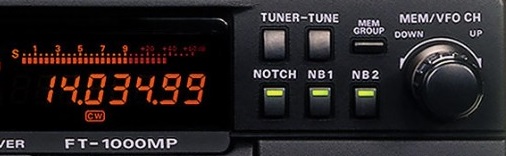
A.E.A. Corporation immediately released what they called the "Moscow Muffler"; in an attempt to combat this menace. Since then, virtually every amateur transceiver is equipped with an NB-1 noise blanker, and sometimes an NB-2; although depending on who you ask, those blankers are effective only 1/2 the time and sometimes introduce their own artifact, in the form of circuit/audio distortion.

With the demise of the Soviet Union, the Woodpecker all but disappeared. However now, in the last 2-years, a new Woodpecker has built a nest on 6.995 mhz or thereabouts. WTF is THAT all about? What Dingle Dorks decided that it is a GooD Thing to park a megawatt radar transmission right next door to the 40-meter CW band? If you're going to INTERFERE with broadcasts, I would think the illegal PIRATE Radio stations (clustered around 6.555 Mhz) would be fair game; not amateur CW.
Am I missing something?


BEEF #7 -  DATA CRANKERS IN CW CONTESTS & RTTY QRM IN SSB CONTESTS
Because I operate the night shift during most radiosport GiGs, that puts me on 40 meters
much of the time. The 40-meter amateur band is shared with a number of different radio services. Unfortunately, I have gotten used to data cranking on my CW run frequencies and RTTY during SSB contests. I NEVER hear the data crankers or RTTY in the SSB segments EXCEPT during radiosport contests - wassup with that?


BEEF #8 - STATIONS WHO WON'T ID ON A REGULAR BASIS
Many stations (whether simply DX or running a contest frequency) simply REFUSE to ID.
When I run a frequency, I program Function Key [F3] to send "TU WQ6X", opening it up for
the next caller. Sending "QRZ?" (w/o a callsign takes just as long to send as a callsign.
What is so difficult to understand about that?


BEEF #9 - CALLING CQ TEST ON CW WITH A SINGLE CALLSIGN ID FOR EACH CALL
When running a frequency, sending your callsign advertises yourself as being open for communication. If we log your callsign incorrectly, then YOU get Dinged for the QSO.
Imagine the following: "CQ TEST WQ6X". If there is quick fading or the noise-level is significant,
one or more letters of the WQ6X call can be obliterated. Sending the call TWICE (or maybe even
3 times) "CQ TEST WQ6X WQ6X" gives us a chance to catch it on the repeat. Otherwise, we have
to wait around for another "CQ TEST WQ6X" call, only to have it obliterated as well.
Bottom-line?  Keep your CQ calls Informative, yet Quick.


BEEF #10 - OTHER FORMS OF INTENTIONAL QRM
As I said above intentional QRM on the 40 meter band happens nearly all 40-meter CW contests; everything from someone playing a voice recording repeating "F - U" over and over again, to this happening during the 2017 WPX-CW contest:
 
Stations were dutifully lining up to put WQ6X in their log until 10:47z when a Loud HOWLING noise appeared, followed by an Ssb-audio CW calling "CQ WPX de YC9WSQ". 
This went on intermittently yet continuously. The QRM got so loud that I moved to 7027.27 to escape the cacophony.
Then at 12:53z YC9WSQ was now at it again on 7.027 with that HOWL seeming LOUDER than ever. This station never worked anybody so it was clearly nothing
more than harassment; or, the guy was under the influence of one of the doctor's concoctions.
After the contest, I looked up his callsign on QRZ.Com and found this WEIRD picture. Which one is the operator? The guy on the right or the witch doctor on the left? 
(Note: As of November 2020, the YC9WSQ callsign can no longer be found using QRZ.Com.  However doing an internet search on the call, I was directed to YB9URM wherein use of this call was more-or-less explained, altho I STILL don't understand it.)

As you can see, a lot WEIRD things happen during radiosport GiGs; especially during the Weird Prefix Contest.   My BEEFS get even beefier in the 3rd installment of this BLOG series coming soon to the WQ6X.BlogSpot.Com.  [CLICK HERE] to read Part 3.


The Role of Respect in Radiosport - Part 1

In radiosport, indeed during ALL on-the-air activities,
in my mind, it goes w/o saying that respect for others should be an over-arching trait representing our on-air decorum.   Unfortunately, the desire for a "perfect whirrrrl'd" is FAR from perfect.

This Blog entry began as a Top-10 list of BEEFS
I have with radiosport operations and operators.

The list quickly grew way beyond the 10, relegating
this BLOG to become a 4 part BLOG series; this entry being part 1. 

Normally with Blog entries I go to great lengths ensuring there is some sort of aesthetic beauty in what is written.


Because this is a blatant list of beefs, I am just going to list them without fanfare and share my thoughts about each one, as well as a few relevant pictures as well. 
To make things more meaningful, I used poetic license
in the choice of visual images.


BTW, the opening picture is a PERFECT example of one of my radiosport BEEFs. 
([CLICK HERE] to read the BLOG entry this picture 1st appeared in.)


BEEF #1 - STATIONS CALLING ME WAY OFF FREQUENCY
On CW, operators running radios with 2.0+ Khz I-F's often tune WAY OFF my run frequency. 
They seem to think because they can hear me, I should also be able to hear their 20 - 50 watt
signal into a mis-matched dipole.

When I run the FT-1000mp I can immediately switch-in the clarifier knob and tune them in.
However, if I am running remote, I have NO ACCESS to an R-i-T control; the RCForb software
cannot invoke that Elecraft K3 feature.

A work-around to this problem is to synch VFO-A & VFO-B and put the radio in SPLIT mode; listening on VFO-A and transmitting on VFO-B.  The CORRECT answer is for calling stations
to call with no more than a 1000hz offset. Do you think you can do that?


BEEF #2 - STATIONS THAT SHOW UP OUT OF NOWHERE,
ZERO-BEAT THE RUN FREQUENCY AND CALL CQ
This is ESPECIALLY noticeable when running RTTY contests.
Out of NOWHERE an S-9+ station opens up with "CQ TEST"
with PERFECT RTTY copy, meaning the station is EXACTLY
on the run frequency; it was NO accident.

A special N1MM+ Function Key (FKey-9) allows me to repeatedly
send "QRL / QSY" until they get the message and move on.
Amazingly some don't; XE2 stations in particular.  I-F notch filters
are the RTTY operator's answer to IDIOTS like this.

Now you know why I purposely choose frequencies like 14084.84.


BEEF #3 - STATIONS WORKING ME IN A CONTEST WHO
CALL ME AGAIN 7 MINUTES LATER


HuH? He JUST worked me? Did he log the previous contact incorrectly?
Should I work him again to be sure he's in the log?
I have done that only to have them call me a THIRD time 20
minutes later. I guess they don't hear too many contest stations.

Then again, I guess their attitude is that making DUP QSOs is
better than falling asleep at the radio.


BEEF #4 - STATIONS WHO WORK ME AND THEN ATTEMPT QSOS WITH MY CALLING STATIONS ON MY RUN FREQUENCY
HuH?  WTF is THIS all about?  Go find your OWN run frequency, or S&P (Search and Pounce) elsewhere.  What are these operators NoT thinking?  When a station does this, I press function
key [F5] (their callsign) followed by [F9] ("QRL QSY") followed IMMEDIATELY by the [F1] key
("CQ Contest").  After that they usually LEAVE.


BEEF #5 -  STATIONS WHO WORK ME THEN MOVE DOWN 200HZ AND CALL CQ CONTEST
A variation on the BRUTE operator (described above) is the IDIOT who makes sure to work me FIRST, then moves down 200hz (but still within the reaches of the Yaesu's 500 & 250 hz filters)
to call their OWN CQ Contest.  HuH?  WTF is THAT all about?

I have consistently noticed that they usually don't make any QSOs from those calls
(because my signal is drowning them out).  Eventually, they find a new frequency.

The solution to THESE Idiots is SIMPLE - I move down 200hz and press [F9] again and
again until they MOVE.   Then it's back to the run frequency and back to the contest.

That's it for this 1st installment, Radiosport fans.
[CLICK HERE] to read Part II of this series.


Sunday, June 3, 2018

Beacon Tracking saves WQ6X from drowning in 2018 SEA NET


Radiosport-wise, the 1st weekend
in June is usually very quiet.
Thinking I may have missed something,
I took a gander thru WA7BNM's Contest Calendar for June.

All I came across was
the SEA net contest.
([CLICK HERE] to read the
rules for this contest GiG.)

Altho the event started at 12:00z,
there was NO WAY I was ready to
get up THAT early; in fact, the WQ6X starting time was more like 23:00z
(mid afternoon PDT).

Originally, the contest was not a part of WQ6X's N1MM installation, I downloaded the SEAnet.UDC (User Defined Contest) file and imported it into the N1MM+ software on the WQ6X laptop, as well as Station #1 @ NX6T. It lists itself as the SEAnet RTTY contest and yet sets the operating modes as CW+SSB - GO Figure.

To make a BORing long story short, bottom line: the 2018 SEAnet contest was - from the WQ6X perspective - a NO SHOW. Devising custom CQ macros for this contest, I auto-CQ'd from the NX6T station for what seemed like hours. The only comebacks were stateside idiots who sent me 5NN and their state CODE (ex: AL & NM), to which I pressed the F3 key (TU QRZ?) and then used Ctrl-W to WIPE the QSO rather than log it.

What is frustrating about this weekend is that there were JA's & VK's (amongst others) who QUALIFIED to be in the contest but in fact were not. HuH?! This is the beef I have with stateside contests - operators don't play in their own contests. Somehow I thought this weekend would be different; and, it wasn't.

Now I coulda moped around about how I got screwed, however instead, I used this weekend to learn
a LoT MoRe about the radio beacons which populate the amateur bands; some you may know about, and some you may have never heard of before.

To open this discussion, I invite you to consider a set of beacon stations that have been around
(in one form or other) since the 1930's; none other than WWV, WWVH & CHU Canada.

When I purchase a transceiver (such as
my Yaesu FT-1000mp or its FT-920 & FT-900 predecessors) or a shortwave receiver (such as the current Tecsun PL-600), one of the immediate things
I do is to load up the 1st 10 frequency memories with the WWV/WWVH/CHU frequencies (leaving #10 available). 

A couple of weeks ago at W7AYT's QTH during a non solar storm weekend, in the evening I was able to copy ALL of the WWV/WWVH frequencies: 2.5, 5.0, 10.0, 15.0, 20.0 & 25.0 Mhz., as well as CHU
on 7.850. Scrolling thru the time stations gives me a sense of what
the LUF & MUF frequencies are at that time of day.

As a backup reference, several more memory allocations allow listening to various commercial
RTTY stations in the 7.5 and 8.5 Mhz frequency ranges as well as the Pirate Radio Spectrum
(6.500 - 7.000 Mhz) giving an indication of the propagation on those frequency segments.

Manually scrolling or invoking a channel scan gives me a good overview of the shortwave spectrum.
At W7AYT I use the CH-250 vertical to check band openings, BECAUSE it is a vertical, and because the FT-1000mp has a dozen+ auto tuner memories set to match the vertical.  Within 5 minutes I can get a quick look at overall propagation.   In addition to 100+ frequency memories, the thing I like most about the 1000mp is it's antenna tuner and dual receive capability.

Russian "Letter" Beacons
I often bitch about military incursions into our amateur bands  (such as the Chinese military M8JF calling the Russian RIS9 on 3772.84 @13:00z).

Then again, an upside to their activities is that inadvertently they give us LoTs of propagation information from North
and North-Central Asia.

I often hear the 40-meter letter
beacons (7.039 Mhz) nearly every
day after around 07:00z. Depending
on where I am listening from (NX6T, W7AYT or N6GEO) one or more beacons will drift through.


This weekend, only the "M" beacon (Magadan) was heard at NX6T.
I've covered the lower frequency beacon offerings first because they are not well known
to amateurs and shortwave listeners. More familiar are the 18 NCDXF beacons stationed
strategically around the globe.

I devised the WQ6X Beacon Tracker to help determine which beacon
I am hearing at any given moment. While this is not necessarily a new idea, combining
it with a Space WX sub-window and the ability to capture screen pictures IS unique.

3-EL Stepp-IR + 2-el Shorty-40
 

One of the useful functions of the NCDXF beacons is that they can give us an indication of whether or not a band is actually open and to where.


Throughout this weekend
I set the Stepp-IR yagi (atop Tower #2) to BI-Directional, pointing it in various directions to listen for several 3 minute periods as each beacon went through its 20 meter transmissions.


Considering that this weekend seemed to have a dearth of Oceania/Asia stations, I was surprised
to hear the W6WX, KH6RS, VK6RBP, JA2IGY & VR2B beacons, altho ZL6B never made it to Fallbrook. While it didn't count for the SEAnet contest, signals from YV5B (Venezuela) were heard throughout the night and even on 15 meters Sunday afternoon along with LU4AA in Argentina
(altho the rest of the band seemed dead).

It is BECAUSE I could copy KH6RS, VK6RBP & JA2IGY that I spent as much time calling
"CQ SEA Test" as I did. While it effectively accomplished nothing, it DiD get me into listen
and evaluation mode; something I sometimes don't do enough of.

Do YOU ever make use of the various propagation beacons on the shortwave bands?

How many beacons have YOU heard?