Thursday, June 1, 2017

2017 Weird Prefix Contest is weirder than ever

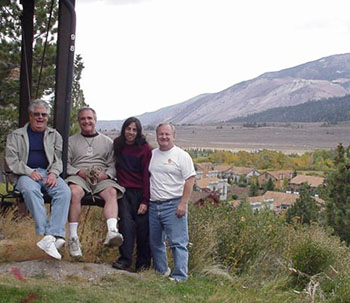
DL3YM & N6KI @ 23:55z be-4 WPX
In the last year, contest-wise, work commitments have largely kept me in the SF bay area.
However during the last 7 years I have made the drive (or hopped on Amtrak to Oceanside) to play live in a Multi-2 approach to WPX CW contest @ NX6T ("NashVille") in Fallbrook, north of San Diego.
(For the SSB WPX contest in March I ran single-OP as WQ6X but remotely from the NX6T station.)

For the Memorial day weekend, instead of another 10+ hour drive to "NashVille" I enjoyed another leisurely Amtrak ride allowing me to finish writing recent contest BLOG entry material along with internet research in preparation for the WPX contest event.

This year we were blessed with another top-notch CW operator - DL3YM, joining us before
heading onto a business conference in downtown Los Angeles. It was W6JBR who picked me up
at the Oceanside Amtrak station Friday afternoon and DL3YM who delivered me back there Sunday evening before taking I-5 to L.A. Thank you both.


This year we again ran as a Multi-2 station using three Elecraft K3 radios.  Stations 2 & 3 are interlocked, allowing only one station to transmit at a time.  When the OP at STN-3 finds a new station to work, a hand gesture to the STN-2 OP instructs him to standby
while STN-3 makes the QSO.

With 3 radios in action, the 2017 WPX CW contest was hardly a disappoint-ment; unless you factor in the NASTY space weather.  (More on that later).

With the proliferation of more and more unique callsign prefixes, it seems that the CQ WPX
(aka Weird Prefix) contest gets weirder with each event.  The WPX contest seem to bring out the WEIRDEST callsigns, which is why we call it the Weird Prefix Contest.

I believe the WEIRDEST callsign of ALL-TIME was present in this contest; namely: VC3C2C. 
Some of my favorites from this GiG include: AG1RL & JA2GAL, DF0WRTC, 8J1ITU, XE2X, WA0WWW & WI0WA, OE8TED, DS2FAG, 9A/E77DX, TI8/AA8HH, 7K1MAG/2, E51DWC,
5W1SA, ZL40BQD, AB5ZA/7 & CT9/R7KW, YC9FAR, 7N3WRE & VE3NRG.


Being physically present in Fallbrook,
as always we used my WQ6X callsign, making us the only WQ6 station in the entire contest and more sought after.

The San Diego contest club station was its usual organized clutter, except that one of the ACOM 2000 amplifiers was replace by an EXPERT 2kL linear amplifier.
This amp uses a set of 4 fans that are actually noisier than the ACOM units.

NX6T's Highly organized connect cabling setup
While the EXPERT amp performed reasonably well, RFI in the shack occasionally impacted the remote interface to the amplifier. 

Maybe the RFI had something to do
with the precise [sic] cabling behind the scenes (some changes were made
in the past week); but I'm getting
ahead of myself.

We were also PLAGUED with horrible space weather throughout the weekend. How come solar storms never hit mid-week, and "only" during contest weekends?

WQ6X waiting for 10-meters to open
Again, I'm getting ahead of things in this BLOG entry.
Being a 48 hour marathon, the WPX contest offers
multiple opportunities for operations on each band.

Because of RFI issues clobbering the internet router,
we were unable to run 160 meters.  Considering the
noise levels it makes me wonder if we missed out.  Checking the 383Scores log submissions, it would
seem that North American stations had little success
on 160; whereas the exact opposite was the case
for Europe.

Due to the continual decline of Solar Cycle 24, 10 meters becomes less of a factor, while 40 & 80 meters bring us increasing contest activity; probably to the dismay of
non-contest CW ragchew operators.

Surprisingly I was able to use the crowbar method and
put several dozen 10-meters QSOs in the log; and again,
I am getting ahead of myself.


Virtually every CW contest I engage in brings out new sources of intentional QRM. Most of my fellow Fallbrook operators don't notice it because the QRM happens usually on 40-meters after 08:00z - 09:00z while they are sound asleep. We nightshift people are the ones who get bombarded by careless and antagonistic radio operations. This contest was no different.

NX6T in the "wee hours"
Saturday morning around 09:55z while running a frequency on 7012.12 all of a sudden some very funky sounding CW showed up on the run frequency.

In the past, this weird CW has been attributed to E. Russia altho I haven't heard this CW style in a couple of years.

Being that the antenna was pointed more-or-less @345-degrees, UA9/UA0 is a possibility. I moved to 7013.13
to get away from the weirdness. 

YC9SWQ from QRZ.Com
Everything was fine until malicious SSB QRM showed up around 10:20z, prompting me to move back to 7012.12,
which was now quiet.

Stations were dutifully lining up to put WQ6X in their log until 10:47 when a Loud HOWLING noise appeared followed by
an Ssb-audio CW calling "CQ WPX de YC9SWQ.

This went on intermittently yet continuously.
The QRM got so loud that I moved to 7.027.27 to escape
the cacophony. Then at 12:53z YC9SWQ was now at it
again on 7.027 with that HOWL seeming LOUDer than ever. This station never worked anybody so it was clearly nothing more than harassment; or the guy was under the influence
of one of the witch doctor's concoctions.

After the contest, I looked up his callsign on QRZ.Com and found this WEIRD picture. Which one was the operator?
The guy on the right or the witch doctor on the left?


When I figured out that this was harassment, it was time to make the move to 7.025.25. Unfortunately, by 13:18z the illegal Indonesian SSB stations moved in on me.

Sometimes it seems that you can't win, you can't lose and you can't even QUIT the game.

Because we rely heavily on the JA prefixes to up the multiplier count I usually turn the 2-el 40-meter yagi Northwest, at the risk of encountering the illegal Indonesian SSB crap, or one of the Russian military beacons stations on 7.039.57.

While I normally hear 2 or 3 beacons every CW contest, this weekend, only the "M" beacon could
be heard; probably because the others were below the threshold of the nearly-S9 QRN levels on
40 meters produced by the weekend's solar storm.

K4RB fresh @ 8am (15:00z)
While I managed to operate straight-thru from 2am to noon (local time) on Saturday, doing that two days in
a row was not possible.

Luckily my relief came as it often does @ 8am Sunday morning when K4RB takes over for 4 - 6 hours, just in time for the "day shift" operators to take over until around 00:00z when sleeping OPs (like me) finally wander back into the shack.

I took the opportunity to make a brief YouTube video Saturday afternoon, only to discover that despite holding the cellphone "correctly", there was enough tilt that the GPS-circuit thought I was holding the phone sideways.

A Toastmaster's compatriot has offered up some video-editing help to turn everything 90-degrees, for eventually putting the video online. Stay Tuned.


Weekend Space WX Data
The BiG story regarding the 2017 WPX CW contest is the MAJOR solar storm that hit around 06:00z on Sunday morning (approx. 10pm local time).

This produced near S9 noise levels on both 40 & 80 meters, while 20 meters seemed relatively free of that atmospheric noise.


Altho no one else seems to have reported it, I noticed high noise levels nearly 24 hours before the reported storms. Unfortunately, the K3's noise blanker accomplished virtually nothing to take the
tops off the noise and the DSP noise reduction circuits altered signal readability more than it
actually removed any noise. 


In retrospect I should have brought
my MFJ 1026 noise canceling signal enhancer or scrounged the JPS ANC-4 unit languishing in a box somewhere in
the NX6T shack.

Those units can often phase null noise sources. Under the right conditions, units like the MFJ-1026 and the ANC-4 can make a DRAMATIC difference in signal readability without the side
effects of DSP circuit artifact.


When it comes time to submit logs, 3830 Scores and BLOG entries, it's easy to say, "don't worry, I'll doit when I get around to it".  This weekend I found a round TUIT in the shack, so there was no excuse for us not to take care of business quickly after the contest.

We can thank N6KI for that. Results-wise, according to the 38330Scores website, the WQ6X WPX operation took 17th place worldwide, 5th place for North America and 1st place for W6; not bad for a motley crew of 6 aging OPs.

WQ6X (foreground) & DL3YM

Because we had several operators drop out just before the contest, having Andy (DL3YM) join us probably added 25% to our QSO total. Andy and I dual-OP'd the dinner hour on Friday evening and then he joined me again Saturday morning which helped keep me awake until noon, when Dennis (N6KI) rolled out of bed so I could roll INTO bed.

During recent contest weekends 10 meters has been a no-show with 15-meters not being much better. Nevertheless, if everyone is listening and no one is calling CQ, an open 10-meters can
often sound DEAD.  Even under seemingly poor CONDX., there is often a 10-meter opening
to South America.

For this weekend I made 59 QSOs on 10 meters and we put over 500 QSOs in the log on 15 meters. 20 meters was,
as they say, the "money band" with over 1700 QSOs.

40 meters gave us nearly 800 QSOs and 80 meters over 150; all despite the S-9 noise levels.

Imagine what we could have done had there
been no solar storm
this weekend.

Statistics-wise it is very clear that while we had a STRONG rate at the beginning of the contest, however (probably due
to the oncoming solar storms) that rate steadily declined all the way to the end of the contest.

Friday evening before the dinner hour
I sat in as a 3rd operator to work multipliers on 20 meters while N6KI
ran a frequency.

Otherwise, most of the time we lacked a 3rd operator. In exchange we had the benefit of N6CY running station #2 remotely Friday evening while I ran station #1. Saturday evening K6AM
remoted in during the dinner hour and beyond, adding some nice mults to the log.

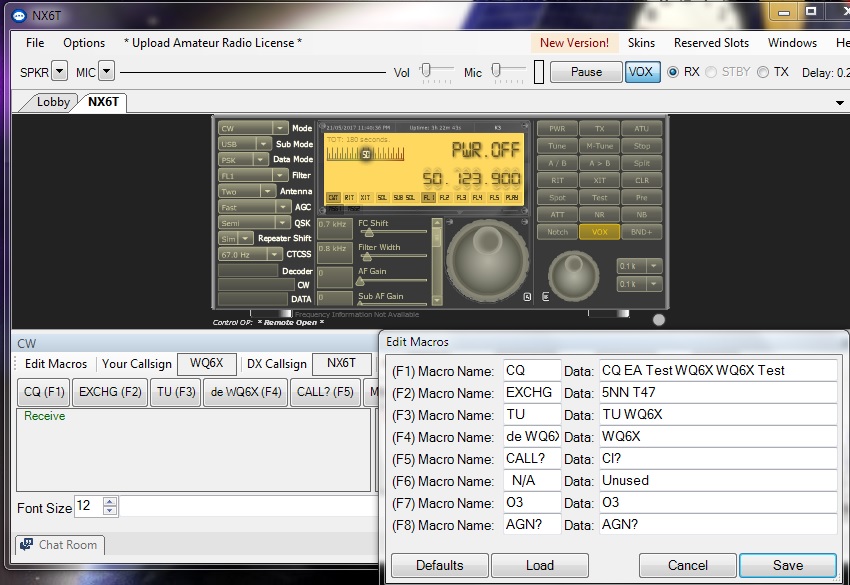
When it was all over, this is what the final WINTEST screen looked like.


Before wrapping this BLOG entry allow me to make a few specific comments about contest
operating WPX in general.


  1. Be patient and DON'T GIVE UP SO EASILY!
    Because I run frequencies a lot I frequently encounter situations where several
    stations are calling me at the same time; often making it difficult to pick out a callsign. 
    I finally work one of those stations and call "QRZ?" only to find that ALL of the other callers have DISSAPEARED?  Huh?  Where are you going?  All you had to do was wait around 10 seconds and you would be next up.  Were you able to find another station and secure a QSO in 10 seconds?  I don't think so!
  2. I program the F6 WINTEST key to send JUST the QSO number w/o the 5NN.  When I ask NR?, do NOT waste time by sending 5NN + NR.  With horrible space WX like this weekend, the QSB-fading is often so fast that by the time you have sent me the unnecessary additional 5NN your signal has faded into the noise and I have to send "NR?" again.  Numerous times 3 or more repeats were necessary, all of which could have been avoided by the station sending JUST the number when asked.
  3. Stations who work CW at greater than 30 Wpm WASTE EVERYBODY's TIME! 
    We are NoT impressed by you sending CW @35wpm which nobody can understand. 
    Because the prefixes are often unique in WPX, it is important that you SLOW DOWN
    when you send your Callsign AND when you send the QSO #.  If I mis-read your callsign
    and enter it in the log incorrectly then YOU will get DINGED by the Log Checking Robot
    (LCR) because YOUR callsign does not show up in my log.
    In many cases I had to manually send "QRS".  If I can't understand you then I will
    NoT log you.  Likewise, when a station calls me at 20wpm or less, do you know
    what I do? - I SLOW DOWN to match the caller's speed.  Doing so is a show
    of respect and a guarantee that we make the QSO.
    Typically I run at 24 - 25 wpm.
    WINTEST allows me to set up the CW macros to speed up and slow down
    during the transmission such as:
    F1: CQ +++TEST--- WQ6X WQ6X +++TEST---
    -or-
    F2: W6XYZ +++5NN--- 1234
    -or-
    F3: ++TU-- WQ6X
  4. Before you start CQ'ing on a frequency or even asking "QRL?", LISTEN FIRST. 
    If you start transmitting while I am attempting to copy a weak signal, if I don't respond
    to your needless "QRL?" message, because you are not listening first, you will
    assume the frequency is now yours.  If I DO take the time so send to you "QRL!" then
    I have to follow that up with asking the calling station to repeat their exchange - a
    COMPLETE WAST of TIME.
    Bottom line?: LISTEN FIRST BEFORE TRANSMITTING!
  5. When I am attempting to pick out a callsign and I send something like "JA2?" if your
    callsign is something like "IK6xxx" I DO NOT want to hear from you.  I often work the
    1st station I start to hear, NoT the station who is the loudest.  So if you are LOUDer
    than the station I am attempting to work, you COVER UP that station requiring me
    to send "JA2?" again and again until YOU SHUT UP and let the JA2 station complete
    their QSO with me.  If you violate this enough times I will simply IGNORE you and
    you will NEVER end up in the WQ6X log.
  6. If you are a station running SO2R, then do it responsibly.  Calling CQ with a 1-second
    gap between calls is simply your way of HOGGING a frequency, not of actually working anyone.  With a 1 second gap, there is not enough time for me or anyone else to press
    F4 sending the callsign.  If you are S-9 and I know I am too... when I call you, if there is
    no one else on that frequency to give you a QSO then WORK ME.  If the reason you
    don't come back to me is because you are busy on another frequency - that is UNACCEPTABLE.  If I call you THREE TIMES and you do not respond to me or anyone
    else, I will then send "QRL?" 3 times.  If I still hear nothing then the frequency is MINE
    and I will call CQ.  If you now come back and immediately start calling CQ (without
    listening first) then you are QRM'ing a busy frequency which is a VIOLATION of FCC
    rules.  If you can't keep two frequencies going w/o delay then SO2R is NoT for you - so
    turn off VFO-B or the other radio.
    In a recent QSO party, a station would make a CW QSO and then solicit that station
    to QSO on SSB, often leaving the rest of us stranded for 20+ seconds - NoT ACCEPTABLE. 
    I reported this station to the contest organizer as a violation of contest ethics.
What is all the above saying?  It is reminding us that more important than ANYTHING in
radiosport is that we should operate with kindness, courtesy, respect and efficiency. 
When stations consistently violate proper contest decorum, after the contest is over
I send an e-mail to the contest host naming callsigns of the violators.
Have you ever been disqualified (DQ'd) from a contest? 
Maybe that's why.

Did YOU play in the 2017 WPX CW contest?

Is WQ6X in YOUR Log?

Friday, May 26, 2017

Sometimes just showing up... Part II


[In May of 2013 I wrote a Blog entry suggesting the importance of showing up to radiosport events and submitting a log, no matter how small or seemingly insignificant. [CLICK Here] to read the original write-up.  Additionally, in August 2015 I wrote a BLOG on the importance of documenting contest activity. [CLICK Here] to read that write-up.]  
Here are some further thoughts on these topics.


It's no secret that I love radiosport; aka amateur radio contesting. Outside of my research and work with Introspection Therapy, amateur radio (and radiosport in particular) occupies much of my time.

Back in the olden days I "played around" in the usual bunch of contests: ARRL Dx, CQ WPX & DX contests, November Sweepstakes and of course Field Day. While I knew about the many other kinds of contests (such as the many European contests and the state QSO parties in the USA), I rarely joined in.


W6ML Crew - 1st Place (2001)
After the Y2K hoopla settled down in 2000, I got serious about contesting.
During Field Day 2000 operating with the W6SW crew atop Mt. Abel, Jim (W6KC) proposed that it was time to put together a "serious" multi-multi CQP expedition at Mammoth Lakes (Mono county).

From 2000 - 2003 we operated
as W6ML accomplishing a series
of 1st place wins.  As the sunspot cycle made its inevitable decline, W6KC switched over to running single-OP events from Mammoth taking many awards; I began portable operations
at a multi-million dollar house under construction at the time in Ojai.

Winning a couple of CQP certificates from Ventura county during 2004 - 2007 got me interested in contesting all over again.  One of the reasons I put together the WQ6X.Info website was to document contest activity, as well as other things of interest in amateur radio.

In late 2009 a chance encounter with N6GEO at a class reunion brought us together again and our dual-OP contest activities began. Documenting our activities was one of the reasons I began this
contest BLOG in the first place. A special CQP web section on the WQ6X.Info website documents
all my CQP activities.

If you look through the BLOG entries I've written you will notice that I have dabbled in all different kinds of contests.

I rely heavily on the WA7BNM contest calendar to see what is up and coming.

Many contests are single mode affairs. Other contests (like state QSO parties) give you a choice to run CW, SSB or mixed mode. In the last couple of years
I have received certificates by submitting a CW only entry.  


Then again, in other contests I have scored a winning entry by running mixed-mode when most of the competition wasn't; doing this netted Dennis N6KI & WQ6X a win running mixed-mode as NX6T in the South American SA-10 10-meter contest.

When I get interested in a contest I often go to the contest sponsor's website to look up the results of the last 3 years, giving me an idea of where the greatest and the least competition is.

Case in point: for the November Sweepstakes I thought there would be more competition in the "assisted" categories so I avoided them.

As it turns out the competition in the unassisted category has been way more fierce. Operating in the assisted category has resulted in several section wins and
even a Pacific Division plaque.

During contest operations I find opportunities to keep side-notes (on a note pad next to my operating position), and, thanks to a screen capture utility I wrote called SNAP-Shot!, I take pictures of the computer screens behind running the contest. 


Finally, after leveraging a given equipment installation for a given contest event (or events),
I do several things:

  • I use the notes and screen shots to produce a BLOG Entry for the WQ6X Contest Blog
  • I make a score submission to the 3830 Scores website.
    [CLICK Here] to see the list of WQ6X's 3830Score submissions.
  • I submit the log to the contest host, no matter how FEW QSOs are in the log.  I have submitted 1, 2 & 3 QSO contest logs many times and frequently receive personal thank you notes from contest organizers.  Submitting every log actually makes the log checking process faster and more accurate.


Doing the above has resulted in several surprise plaque
and certificate awards showing up at my P.O. Box.

These awards are the final acknowledgement of a job well done; from making the actual QSOs to doing the follow-up work afterwards.

In the beginning I NEVER submitted contest logs, for many reasons; missing out on several awards. Now, no matter what I ALWAYS submit a log.

What callsign to use can be a contributing factor towards
a winning contest event. For many events (such as the California QSO Party - CQP) I have been known to reserve a 1x1 callsign; such as W6C, W6E, W6K, W6R, K6A, K6M, K6S & K6T. 


This allows the callsign to stand out, altho the downside is that some operators get confused by the short callsign and ask for a repeat on it. I once reserved N6K and set about a confusion between me and Dennis, N6KI - I'll never do THAT again!

For other contests, I am finding that my own WQ6X callsign is often more recognizable, making
it the preferred choice in contests like November Sweepstakes, CQ WPX, the NAQP GiGs and
most of the state QSO parties (except CQP).

A MAJOR reason I engage in radiosport is my desire to maximize equipment utilization. 
In other words, in an ideal scenario I endeavor to try out new ideas; either to improve
signal/noise ratio, setup better contest screen layouts, or unique antenna configurations.

One of the newer ideas I have been toying with is to improve the "backend" of the FT-1000mp's secondary receiver. 

While the 1000mp sports a WONderful eDSP facility, it only processes audio from the MAIN receiver (Rcvr-A),
leaving Rcvr-B unprocessed.

Rcvr-B audio by default comes through the right channel and is easily routed through the JPS NIR-12, back to the right side of the headphones. 


I recently wrote this up in a Blog on leveraging dual receive. {CLICK HERE] to read this write-up.

There are many reasons to show up for a radiosport event.

When did YOU last engage in a radiosport event?

Which contests are YOUR Favorite?

Monday, May 22, 2017

KING of SPAIN Contest teaches VALUABLE lesson

Stations 1, 2 & 3 @ NX6T in Fallbrook

Due to previous entries in the King of Spain (k-o-S) CW contest I am on the contest committee's mailing list, receiving a reminder of the upcoming 2017 K-o-S event about a week ago.
However as usual, I made last minute arrangements to run the contest remotely as
WQ6X from NX6T ("NashVille") in Fallbrook, California.

A number of operational goals were accomplished this weekend, the main thing being a test-drive
of a new air conditioning approach for use in the shack during unattended remote operations.
You may recall that a couple of contests back Station #1's laptop overheated and shutdown
creating a vicious circle making it impossible to continue operations that weekend; and this
was with the amplifier on, but in STBY mode. KW amplifiers generate almost as much
room heat sitting there doing nothing as they do during FULL keydown.

For this weekend, operations began at 100-watts, quickly escalating to 500, 750 and
finally 1.1kw; all with no laptop shutdown - Hurrah!


Space WX wise, things were quite horrible. Opening the weekend,
the K-Index was 4.

Although I made many forays onto 15 meters and was even spotted across the U.S., no contest QSOs were to be had.

80 meters was quite noisy and produced no contest QSOs even though I was spotted by skimmers in VE3 and W9.


That left 20 meters (with less than 20 QSOs), with the majority being made on 40-meters. After the contest was over it was a no-brainer to submit this year's K-o-S log as a Single-OP 40-meter entry.

Every contest operation I am a part of (be it live or remote) is visited by a number of operating anomalies. While some things tend to occur repeatedly, nearly every event brings something new.  This weekend's "something new" came
in the form of a "beeping beacon" sound on 7022.53 at 00:15z. It disappeared for a couple of hours (or was not hearable due to shifting propagation and/or solar storms) reappearing at 04:13z, but much weaker.

Fortunately the Indonesian illegal SSB operations in
the 7.015 - 7.025 region never materialized in Fallbrook; probably having more to do with the 2-el yagi pointing at Spain (~35-degrees) and not Asia (~330-degrees).  

Unfortunately, at 22:57z I was "heckled" by an IDIOT who would immediately send "N-I-L" after every CQ call I made on 14015.15.  Eventually he became even MORE Bored than when he found me and sauntered off to harass someone else.  Just in case, I took refuge on 40-meters,

Throughout the evening a phase-shit rushing sound could be heard ~7.029. Either this was a "professional" jammer, or more likely, some idiot amateur screwing around again (I've heard
this same cacophony during the last 3 contest weekends).

After midnight, hoping to catch some Asians (or at least JA's) playing in the K-o-S contest, I

pointed the yagi to 325-degrees. All I heard were the "M" & "D" Russian military beacons on
7.039, altho the "D" beacon was much weaker this weekend than the last two.


Windoze Device Mangler


This contest weekend, the lesson to be learned
is: CHECK EVERYTHING OUT.

While setting up N1MM+ on Friday evening, checking
the contest rules and finding out about the space weather problems, the one thing I neglected to check was whether or not N1MM+ could actually key the radio.

The RCForb remote access software was able to tune the radio and N1MM+ was able to CAT control the radio just fine. To keep the shack cool, I chose not to turn on the amplifier until actual contest starting time (12:00z).

Rolling out of bed and firing up a pot of coffee,
I fired up VNC Viewer and prepared to test-send
the radio - NOTHING! HuH?


After a number of experimental tests I concluded that the Winkeyer unit (which lives on the COM4 port) was not responding. Bringing up the Windoze XP Device Mangler showed that the comm port was not in the system. Rebooting the computer did NoT bring it back. Now what?


RCForb CW Macros

Remembering that in the WPX-SSB contest I used RCForb to access the 4 voice keyer memories of the K3 radio, it seemed logical that I should be able to accomplish something similar for CW.

That something similar came in the form of defining a set of Function Key macros under RCForb, running the contest by function keys and switching screens to N1MM+ to log the actual contacts.


At first I thought I was relegated to
JUST running S&P (Search & Pounce).

Eventually with a little practice I was able to actually run several frequencies, altho to stations on the other end I probably came off as a novice contester; which I was when it comes to this kind

of ad-HOC approach to operating.


Nevertheless, WQ6X's 1-kw signal was heard well enough (esp. on 40 meters) to be spotted by many skimmer stations, near and far. Many times I would make a single "CQ EA Test" call and receive a "WQ6X spotted" message within 10 seconds. AmaZing!

Because I had enough to deal with, I chose to forgo running SO2-V (Single-OP 2-VFO's) in this contest. To make things easier I found a chart on the EA contest webpage detailing all the
Spanish provinces and their abbreviation codes.


After running a frequency for awhile produced nothing new I would check other bands and/or S&P.

It was at this time I happened onto

a TEASE Spanish station (EA6NB)
who was calling CQ DX and was specifically NoT in the contest.


HuH? Whut? A Spaniard disrespecting the King by NOT playing in the King of Spain contest? HOORORS! If *I* can play in the King of Spain contest, so can they.

Did YOU play in the King of Spain contest?

Is WQ6X in YOUR Log?


Monday, May 15, 2017

WQ6X operations: the Weekend of BEACONS and RTTY


WQ6X remote operation of NX6T

In a way, I could say.... this was a weekend of Beacons and RTTY;
the beacons belonging to the
Russian military and the RTTY
aspect of it all being the VOLTA
RTTY Dx contest that happens
every May.

Mother's Day weekend is usually
slow radio contest wise, but as a BioFeedback therapist, it was a busy one; making it a challenge to some-how fit radiosport into the schedule.


Luckily, because this was a remote operation I didn't have to make the drive to Fallbrook,
or even to W7AYT in Concord.  Rather than having to deal with excess traffic en route to
a contest operation, the [so-called] traffic jams I had to look out for were internet related. 
Luckily, this weekend offered up near perfect internet access speeds. 
Internet latency was not an issue for this operation.

Performance-wise there were no hardware failures during the weekend.
This is rare because there is almost always something that can go wrong.
The only difficulties encountered were software based. 
The radio and antennas work perfectly.

Tower-2: 2-elements on 40 & Tower-1: C-31 Yagi

Due to potential heat generation problems, for RTTY, I ran the Elecraft K3 @ 62 Watts,

upping it to a full 100 watts for CW operations. The antennas were the usual C-31 Yagi
for the higher bands and a 2-element yagi on 40-meters; both approx. 13mh high.


Space WX wise, all the numbers were down; the A-Index, the K-Index, and unfortunately an SFI = 69. 

While I contend we are at the bottom
of solar cycle 24, those "in the know" say the bottom won't be for up to 2 years. 2 Years?  REALLY? 
You mean it gets WORSE?


Unfortunately 10 meters was another no-show and 15 meters produced only 1 QSO. Had there been another 6 - 12 hours of contest time I might have had another shot at 15, altho 10 meters was destined to continue its D-O-A status. Yeah I know - Woulda, Shoulda, Coulda.

For this weekend there were 4 publicized worldwide events:


  1. The VOLTA RTTY Contest 
  2. The CQ-M Contest
  3. The Arkansas QSO Party (ARQP)
  4. The brand new Jakarta (SSB) Contest


As I happened onto them (mostly by way of the WA7BNM Contest Calendar), I published links to that contest's relevant web page on my personal Facebilk (er, Facebook) timeline.

I often use my FB timeline as a sort of public book mark system for things that
I am currently involved with, or working
on long-term.

Being a "slow" contest weekend gave me the opportunity to test drive various RTTY techniques.

Normally when I operate RTTY via NX6T remotely, for simplicity I tend to just RUN frequencies
(unless the internet latency is HORRIBLE!).


Because I STILL can't figure out how to run the R.I.T. thing remotely via RCForb, when stations

call-in WAY OFF frequency, I press the F-11 key (pre-defined with: "UR OFF FREQ - Tune me in")

followed by the F-3 key ("TU de WQ6X QRZ?"). While most stations get it and zero-beat the run frequency, some stations would remain confused and quietly disappear.

A solution needed to be found.

 
For this contest weekend, to obtain the equivalent of R.I.T., VFOs A & B were first synced. Putting
the radio in "SPLIT" mode allowed tuning around the VFO-B frequency using VFO-A. Diddling a BiG tuning knob instead of a little (by comparison) R.I.T. knob is far more preferable.
 
Then again, two unique situations arose:
  • The frequency recorded in the N1MM+ log file is the RECEIVE frequency (which varies); not the static Transmit frequency. (Time to submit a software change request to the N1MM design team.)
  • There is no immediate Reset/Clear button (as there usually is with most R.I.T. facilities). Returning to the RUN frequency is either done by turning the tuning knob manually, or,
    by swapping VFOs and copying VFO-A ==> VFO-B; burdensome, yet effective.


A recurring theme this weekend was FLDIGI (the RTTY demodulator being used) locking up.
When in a hurry, it's easy to accidentally invoke 2 copies of FLDIGI, which together, can SWAMP
the CPU, effectively shutting out the rest of the XP-based computer Station #1 is run on.

Several times after "settling in" on a run frequency, 2 copies of FLDIGI attempting to decipher complex RTTY patterns would eventually lock-out the VNC viewer, effectively preventing me
from terminating the extra FLDIGI copy or invoking a Windoze restart.

At times like this, the only solution is to web-remote to a control panel allowing me to effectively
"cold boot" that Toshiba laptop. During the 5 - 7 minutes waiting for VNC Viewer to come back
alive gave me a breather to refresh the coffee mug.


Unfortunately, this happened several times while mid-QSO on a run frequency effectively stranding" that calling station.

The amazing things is that most of the time I came back to a still open run frequency, enabling me to continue from where I was so abruptly displaced from.

Now that I understand this problem is caused by dual-FLDIGI(s), I ensure
that there are never 2 copies running simultaneously before starting a RUN frequency.

Running frequencies have become FUN again; nothing worse than busily running a frequency,
only to have it suddenly come to a Halt - WHAM!


A unique feature available when running RTTY contests is to make use of the "Call Stack".
The call stack is maintained by the interface screen back-ending the RTTY demodulator.
When there are legitimate calls on the callstack, pressing the F-10 key (defined as:
F10 NOW,{TX}{ENTER} ! TU {LOGTHENGRAB} NoW {F5}{F2}{RX}) sends a "TU"
message to the current QSO, logs that contact, grabs the next station from the
callstack,  sends "NoW" to that station followed by the Exchange (by way of F2).
All of that happens, simply by pressing F-10 - technology is AmaZing!

Additionally, I would get calls from stations who (to me) were CLEARLY DUPES.
To solve THIS problem I designated function key F-12
(pre-defined as: F12 QSO-B4,! QSO-B4{WIPE} - QRZ? WQ6X).

These callers thought I was a NEW station because either they originally logged me incorrectly, OR, their current encounter of my signal was garbled and presented by the demodulator as some other callsign.  In the event that F-12 doesn't accomplish its intended function, then I just work the station; dupes don't cost anything more than removal from the log after the contest is over.

With contest exchanges made in RTTY, some people try to be "creative" in how they send the data. Several contests back, one station attempted to have his callsign stand out by putting it in parenthesis; Ex.: (WQ6X) unfortunately, this transfers the call AND the parenthesis to the
callsign window requiring ME to manually remove the parens.  The CORRECT way to
accomplish the above is: ( WQ6X ) - the callsign is still isolated and the parens are left behind.

This weekend a station sent me the QSO number with a "#" attached: "#017".
This time the # became part of the QSO-Nr. Either sending it as NR 017, OR, as # 017
will isolate the numeric portion from the non-numeric part.

I had another station send me # 101, which I mouse-clicked into the data entry window. He then changed it to #102" which required a manual change. Rather then wait 3 seconds for me to correct HIS mistake and press F3, by the time I made the change and was about to press F3, he sent me the exchange (which I had already since corrected) yet again, requiring me to now wait 7+ seconds before I could move on. While it is important to be quick, impatience can actually triple the unnecessary down time. Pay attention people.


Originally, I said this weekend was about RTTY and Beacons. Friday evening as
I was scoping the bands to ascertain propagation conditions I encountered the usual 2am appearance of the Russian military beacons that center around 7.039.75 MHz.

Some weekends I cannot hear them; often they are actually WEAKER
from W7AYT's QTH than from NX6T.
This weekend, 3 of the beacons were most certainly heard ("M", "D" & "F") and possibly the "A" or "K" beacons, altho they were mostly noise-obscured.


The "F" code speed is so fast that I often heard it as "S". The "D" beacon uses slower CW and
the "M" beacon was using much SLOWer code. This beacon would often operate intermittently;
it would ID several times and then after what seemed like a random time-pause ID again.
The "F" and "D" beacons use the same 2-second pause between IDs.

For worldwide regions 1 & 3 the 7.040 frequency marks the beginning of the 41-meter SSB segment; which is also shared worldwide with CW and RTTY operations. For this weekend's VOLTA RTTY event, the operating window seemed to be approx. 7.037 to about 7.052. I spent a considerable amount of time on 7.045.45 and 7.043.43. Above 7.052 were LoTs of CW stations ragchewing throughout the weekend (how DARE they), until about 09:00z when the Asian SSB stations
start drifting in.


For some reason, at NX6T there seems to be an RFI carrier consistently on 7.041.
Going below 7.040 subjected me to the beacons and more CW. Going above 7.052
and above put me in competition with SSB stations; often WAY stronger than the CW or RTTY.
Taking refuge at 7.046.46 found me contending with some IDIOT sending random PSK-31 (packet) signals EXACTLY after every CQ.  Either the propagation changed or the child finally went to bed.


Earlier in the evening I encountered something
I rarely hear: a CW and RTTY station conversing with one another. Once I tuned in the RTTY, the CW note was perfectly audible in the passband.

It was a brief QSO between two friends who happened onto the same frequency spectrum around the same time. While contests don't allow cross-mode contacts, for ragchewing, just about anything goes. Around this time, I heard a station call "CQ MARAC". I have NO idea who/what "MARAC" is.

Somehow around 06:00z I found a noticeable break in the RTTY activity and switched N1MM over to the CQ-M log to work CW. For a moment there, I ALMOST forgot what to do.


Over the course of 1 hour I managed to put a WHOPPing 10 QSOs in the log, beginning with I2VXJ, who called me out of the blue. Throughout the evening, European stations made their way into the RTTY log; it was fitting that should happen on CW as well. While the log isn't much, I WILL send
it in to the contest committee, just as I do for all contest activities. What's the point of engaging
in radiosport, if I don't submit a log afterwards?
 
While this weekend's radiosport activity won no awards, it DiD offer me the opportunity to learn new operating techniques. While the FLDIGI problem disrupted things in the beginning, once resolved the operation settled down quite nicely. My only wish is that both contests had been 30-36 hour affairs
not just 24.

Unfortunately, by the time I had things going smoothly, the ARQP was already over; another QSO party that should last MORE than JUST 12 hours. Because the Jakarta contest was SSB only, running it remotely made no sense, Possibly next year it will be on the operations list.

Did you play around in the CQ-M or VOLTA RTTY contests?

Is WQ6X in YOUR log?


CONTEST UPDATE:
Recently, I received a 1st placed certificate for my 24-point 40-meter log submission in the CQ-M contest; proof once again that we should ALWAYS submit a log, no matter how pathetic the score may seem.


Thursday, May 11, 2017

LEARNING the ART of LEVERAGING DUAL RECEIVE


While most amateur transceivers support dual VFO's (A & B), only the top-tier radios support dual-receive (sometimes called Dual-Watch). Additionally, only the top-end of the top-tier radios provide
the capability of dual-receive on different bands. The Kenwood TS-950SDX, Ten Tec Orion II,
Elecraft K3 and Yaesu FT-1000mp Mk-V & FTDX-5000mp are major players in the top-end.


I personally chose a fully-filtered Yaesu FT-1000mp for my dual-receive efforts.

The Secondary (or "sub") receiver is easily invoked by way of a Blue [DUAL] button perfectly located to the right
of the tuning knob.

Using the "`" key (top-left on the keyboard under the ESC key) in the N1MM+ logging software makes it easy to enable and disable the SUB receiver.


A caveat of dual-receive is that the VFO B receiver section (sometimes called the SUB receiver) is usually not as well filtered as the Main RX.

With the FT-1000mp, the 2nd receiver
is only dual conversion; whereas the
Main RX is a triple conversion deign.

Then again, the SUB-Rx is less
prone to signal "images".

While both receivers have independent AGC systems, the Shift/Width/Notch
and eDSP circuits are functional
ONLY with the Main RX.


Originally when I decided to relegate the FT-1000mp to main radio duty, I retired the
JPS NIR-12 and MFJ 752-C outboard DSP/FILTER units.

Now that I have brought dual-receive (SO2V) into WQ6X contest activities, these outboard audio conditioners have been given renewed purpose.

These units are now cascaded to 
process the Sub-RX audio (for VFO-B) effectively providing DSP-like audio processing for BOTH sides of my head.

After considerable operating time,
you will get a proper feel for what kind
of outboard DSP filtering is right for you.

Sometimes you WANT a more wide-open sub-receiver in order to look for other stations.

Then when you find one, if needed you can SWAP VFO's to actually work the station and then
Swap them back.  If you are running SO2-V in N1MM+, you don't need to swap VFO's; pressing
keys from data entry window "B", puts the radio in SPLIT mode before making the transmission
and then returns the radio to "normal" operation - a very CLEVER way of doing things.


The 1000mp is equipped with AF Gain controls for BOTH the MAIN/SUB receivers allowing me to customize the audio balance between both ears.

Additionally, thanks to the AF-REV button on the 1000mp, I am able to swap VFO A / B audio between left and right ears.

As you can see, the transceiver's menu system allows me to declare how the sound is ACTUALLY split up between the Left/Right channel of the headphones. 

I prefer to use the Stereo-1 setting which splits the audio between left and right ears, but with only 80% isolation; not 100%, as experienced with the Stereo-2 setting.


Because the FT-1000mp was designed specifically for dual-receive, putting the 752-C and NIR-12 in the right channel audio line to process the SUB-Rx is not a difficult undertaking.

It was only recently (during the 7QP/NEQP contest weekend) that I first tested this configuration using RCA-style audio patch cords.

[CLICK HERE] to read more about that setup.

For a more permanent setting I will make a set of custom audio cables directing the output to yet another device - a Radio Shack stereo equalizer.

The equalizer's 10 settings per channel will provide final "shaping" of the frequency response for each ear individually.


Once you have your Ears sorted
out, now what do you do with it?
The possibilities are numerous.

Sometimes while operating I might

want to check the WWV space
weather forecast(s) (at :18 & :45
minutes past the hour).

In the 1000mp, I have ALL of the WWV & CHU frequencies memo'd, in order,
so they are easy to bring up.


Because the sub-receiver is intended for in band reception, the WWV signal strength will be seriously attenuated; however from my usual operating location WWV is always S9+ on one or more of the memo'd frequencies.   Normally, WWV is presented to my right ear.
For SO2-V purposes, the AF-REV button allows flopping the two ears.


If I am on 20, 15 or 10 meters,
I sometimes want to make a listen
to the NCDXF beacon for that band.

On 10 meters, the entire 28.200 - 28.300 frequency range is LOADED with numerous propagation beacons.

The SUB-Rx is a PERFECT candidate for listening to beacons while running

a frequency or S&P'ing under VFO-A.

Another use for Dual receive in a single-mode contest is that it allows me to S&P with the right ear, while running a frequency in the left ear.


In multi-mode contests (such as QSO Parties and Field Day) with two VFO's I can easily run
a CW frequency on VFO-A while using VFO-B to search and pounce SSB contacts.

Now, all this takes practice, like learning to walk and chew bubble gum. Work your way up to full blown operation by spending hours practicing JUST RECEIVING with a VFO for each ear.


Testing the MFJ 752-C & JPS NIR-12 together

The N1MM+ logging software has done an incredible job of implementing Single-OP 2-VFO (SO2-V).

N1MM's design is such that EACH sub-window in the software can be moved anywhere you choose.

When I run SO2-V I tend to use an N1MM+ configuration something

akin to the picture below.


Notice that EACH VFO has a Data Entry Window and a Bandmap.  Many operators prefer to get rid
of the bandmap for Radio A as they are running a frequency there and not S&P'ing from that VFO.
I actually PREFER to keep Bandmap-A on the screen as it allows me to be on the constant lookout for 3rd-party stations moving in on what was previously a "Clear" RUN frequency.


Some people tell me they easily get too confused so dual-receive and SO2-V is just not for them.
That sometimes happens to me when running a frequency with a lineup of stations waiting to work me. Bottom line: if I get TOO confused, I switch out the sub receiver and regain my sanity by
focusing ONLY on running the frequency with VFO-A. Practice makes perfect.


In a mixed mode contest (such as a state QSO party, the 10-meter contest or Field Day) Receiver
A & B can be leveraged into working BOTH modes; the "primary" mode being in the left ear.

In the 2016 SA-10 10 meter contest, I was running a frequency on 14.045 using VFO-A, while tuning around for SSB contacts up frequency using VFO-B. The end result was a 1st place (world-wide) finish using MIXED mode.


There are more things to be said about Single-OP 2 VFO's in contesting.
When I was operating as WP2/WQ6X from Radio Reef on St. Croix, at one point I was

running a frequency on SSB with VFO-A, while S&P'ing random stations on CW using VFO-B. 
MFJ 752-C & JPS NIR-12 in Actual Operation

The possibilities are quite varied when using DUAL VFO's, however it takes PRACTICE to make
it all operate smoothly. Equipment glitches on top of that can make things completely chaotic.

If at ANY time you find yourself out of synch with the two receivers or feeling FRANTIC, turn off
the sub receiver, re-focus and re-connect with the original RUN Frequency under VFO-A.

Things can degenerate dramatically if you don't know what you're doing.

Dual Receive can be a WONDERFUL tool, if you use it properly.

Use it properly, don't let it use you to Lose.


Wednesday, May 10, 2017

WQ6X Survives another 5-contest Weekend


Cinco de Mayo set the stage for Seis de Mayo; another contest weekend, this time offering up 4 state QSO parties (7QP, NEQP, INQP & DEQP) all front-ended by the Italian ARI Dx contest.

Several weekends ago running multiple QSO parties (MIQP, NDQP, ONQP) required separate record entries in the N1MM contest log database using a coordinated manual switching
between them.


For this weekend's events, the designers of N1MM/+ offered us a special designator: IN7QPNE.
This entry allows logging INQP, 7QP & NEQP contests using one log. Because all county entries
include the state code, it is relatively easy to sort out each contest's QSOs.

The QSO party organizers for these three GiGs have taken it one step further, allowing entrants
to send in the combined contest log and having their Log Checking Robot (LCR) software select
out the QSOs appropriate to their particular QSO Party.


In addition to running 5 contest GiGs,
I took the opportunity to test-drive
a number of unique hardware configurations, beginning with a customized antenna switch box.

This enabled the 2nd antenna (Antenna B) to be switched in as a receiving antenna (RX-Ant), as antenna B on
the FT-1000mp, or in parallel with
Antenna A. 


Antenna A was a Comet CH-250 generic Vertical on a flagpole mast. Evidently the mast has slipped
a few feet in height since its original installation, with a side-effect that (according to the MFJ-259 analyzer) it is longer properly/natively resonant on 7.0 Mhz.


While the FT-1000mp can tune just about anything,
that doesn't necessarily alter the resonant characteristics
of the antenna itself. Antenna B was a Sloppy-Sloper Cobra dipole. It neither qualifies as a dipole or an inverted Vee, being nearer to a sloper than anything else;
hence a "Sloppy Sloper".

Because the 1000mp's auto-tuner is a top performing design, most of the time it was able to tune either antenna separately or in combination; sometimes by tuning a single antenna first, bringing the tuner memories more in range
for then tuning both together.

Having the switch box easily accessible at the
operating position allowed rapid operator switching between Antenna A / B / BOTH, keeping an eye on the S-meter and my ears on the audio level. Because signal levels were often horrible, the eDSP played a big role in copying the weak ones; altho a few got away nonetheless.


Despite the favorable Space-WX predictions, remember that predictions are just THAT; the real world is usually much WORSE.

For this weekend, poor signal levels plagued the operation throughout, making SSB copy quite difficult at
best in many cases.

Keeping an active hand on the coax switch allowed quick-switching the antennas looking for the correct
position for each individual signal.


With the front-end in good order, throughout the weekend I spent time working with the audio signals for both receivers (VFO-A & VFO-B).

While the FT-1000mp is equipped with an AWEsome eDSP facility, it works ONLY with the MAIN-Rx (VFO-A).

With only a 2.4khz filter in the SUB-Rx (VFO-B), it is literally wide-open (by comparison to VFO-A).


In one sense, for S & P operations it is a good idea to run somewhat more wide-open.
However being able to "shape" the audio when needed can make all the difference.
By way of an integrated set of audio splitter cables I was able to "insert" an old MFJ
752-C "Signal Enhancer" in the SUB-Rx audio path destined for the right ear. 

After the contest I inserted a JPS NIR-12 DSP unit between the 752-C and the right ear, giving two kinds of signal processing on the SUB-Rx. Because I love to knob-twiddle during contests (relieving boredom during the slow periods), with these units sitting atop the transceiver, I am once again
a happy twiddler.


For SO2-V (Single-OP 2 VFO's) operation the audio mix settings are such that both RX's appear in both ears, with the MAIN-Rx more pronounced in the left ear and the SUB-Rx more pronounced in the right.

Additionally the Heil PRO headset
sports a phasing toggle switch as well.
As a result, the 752-C's controls often caused the SUB-Rx's signal to "shift" more toward the left ear; or should
I say, away from the right ear.

Operating-wise this was a typical cinco-de-contest: 2 events with win possibilities (7QP & NEQP)
and 3 ho-hummers (INQP, DEQP & the Italian ARI Dx Contest).

My 1st encounter with the ARI contest was back in 2011 running dual-OP with N6KI.
We misread the rules from which it seemed that we were turning away more
stations than we were working - OOOPS! That year we heard HUNDREDs of ARI contest
signals.  Since then, from the bay area I only hear a dozen or so stations and manage to
barely work HALF of them.  Regardless of the QSO count, I ALWAYS submit a log.

For the 2017 ARI contest I heard but a few callers and ended up working only 2.
While I saw 20-meter RTTY spots for the ARI GiG, I heard virtually none of them.
I copied II3W briefly but was unable to maintain consistent copy long enough to
effect a 2-way QSO - Bummer Dewd!

WQ6X made numerous "CQ ARI Test" calls on CW but with no response.
Because of marginal antenna height @ W7AYT, it is almost a miracle hearing (much less
working) European stations from Contra Costa county; even by way of the N-E polar path.


From time to time I put out a call for
7QP and was even spotted many
times throughout the weekend.

This year DEQP put a WHOPPing 2 QSOs in the WQ6X DEQP contest log.

It would seem to me that when there is
a propagation path to New England,
it should also include Delaware.


Therefore, my not hearing Delaware stations was more a LACK OF PARTICIPATION than
an indictment of my equipment layout, antenna configuration, propagation or operating skill.
It's not easy to enjoy a competitive activity when the other side of the competition fails to join in.

For INQP I have the same complaint; a whole 8 QSOs made it into the WQ6X INQP log.
Plenty of W9 stations (with decent signals) were heard, yet virtually NONE were operating from Indiana; much less participating in the INQP. We WANT to play in YOUR QSO party, but cannot
do so if there are no target (in this case Indiana) stations available to work.


For me, the main focus for this contest weekend was the 7QP Gig (in an attempt to reprise last year's 1st-place win) followed by the NEQP QSO party.

Because I am used to running the NEQP Gig with the NX6T crew (making use of K3 radios, ACOM 2000 amplifiers and yagi's @ 70'),
NEQP from the East Bay is quite a "culture shock"; this year producing only 34 QSOs on CW & SSB; the DEQP only delivered up 2.

What surprised me the MOST about NEQP was the not-insignificant number of stations engaged in self-spotting. While technically not a violation of the NEQP rules, virtually ALL other radiosport contests FORBID spotting oneself; even having "a friend" spot you is considered tacky.


Another beef I have with NEQP is the number on non-1 callsigns not indicating /1 or a signing
with a county designator (Ex: WQ6X/1 -or- WQ6X/MERNH). On SSB, one BOZO (N1CC) led
us to believe he was a legitimate W1 station when in fact he was in Texas.
While he only operated 7QP this year, his callsign confused a LoT of stations.
To reduce confusion he should have signed N1CC/5 or N1CC/TX
(when calling CQ for 7QP I signed as WQ6X/Ca).

Instead he berated many stations (myself included) for needing what he called "elmer assistance" because he did not sign indicating Texas (he even wrote up his berating us in the N1CC 3830Scores.Com submission). Eventually he called for the 7th area only.

A proper call would have ALWAYS included "CQ 7QP - this is N1CC in Texas QRZ"
or "CQ 7th call area - this is N1CC in Texas QRZ"; something like that.


The 7QP QSO party was again overall a top-notch operation.
With only 18 hours to make it all happen, everything needs to go right, @ 6AM as well as
the ending at midnight. While there were several county-line operations (and even a couple of
state-line operations), I completely missed out on the tri-county operations (if there were any).

Based on the 3830Scores.Com filings for the 7QP contest, it would seem that WQ6X took a 2nd place, to none other than N1CC - AmaZing! At least thanks to Pandora there was continuous electronic music in the background; altho occasionally the music and CW got confused together.


Did YOU work any of the state QSO parties or the ARI DX contest?

Is WQ6X in YOUR Log?
-------------------------------------------------------------------------------------------

Addendum for June 7th
Thanks to more sophisticated log checking, thus far WQ6X has
received two operating award certificates; for 7QP and INQP.
The INQP award is proof that it pays to ALWAYS submit a log.