Wednesday, November 16, 2016

TRIO-Ops @ NX6T take 2nd place for JIDX SSB

Human Insights Group business brought me to So. California, allowing me to first rendezvous with the NX6T group at "NashVille" in Fallbrook (900' up) for the 2016 JIDX SSB contest.  In both phone & CW JIDX contests, NX6T has won several 1st place world-wide plaques; several of which I have been a part of.

For the 2016 JIDX Cw contest, I ran single-op from W7AYT's QTH (SF bay area), submitting the log as a 1st-place 40-meter single-band entry, because upper band condx. were so poor.


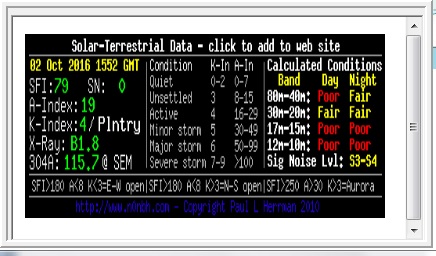
During this November event, the space WX numbers continued to be horrible extending from the last 3 weeks; surprising for such a low SFI.

For NX6T, 10 meters never materialized.  The only thing I saw on the DX Map were propagation paths to Oceania & South America, with no opening to Asia (or even North America).


N6KI (Left) and KK6NON
While I caught up on my sleep before the night shift, N6KI (Dennis) began operations on 40 meters promptly at 07:00z,  Thanks to an early Asia opening, Dennis managed nearly 120 QSOs before rousting me out of bed for my operating stint at 1:30 am (09:30z).

Until 40 meters faded out at 14:00z I made 160 QSOs on 40 interspersed with a handful on 80 meters.
20 meters never materialized until around 22:00z when Levi KK6NON made the scene to work a bunch of them. 


C-31 Yagi + MAG-loop antenna for 80/160
Between Levi running frequencies and Dennis working stray JA stations, 119 QSOs made it into the log on 15 meters.  During their operation I made a short YouTube video (View here) in addition to taking pics of the overall operation.
After 15 meters closed, 20 meters never materialized to Asia as the MUF dropped towards 40 meters.  N6KI took over at 06:30z finding a JA opening shortly after 07:00z,   When I took over at 09:30z only another 20 QSOs had found their way to the log.

Taking the final shift I added another 70 QSOs to the log, including another handful on 75 meters.  We were down to 2 prefectures left to make a prefecture sweep: #29 (Fukui) & #47 (Okinawa).  In the last 90 minutes I was surprised by calls from three Okinawa stations; a JS6, and a JR6 followed by another JS6 station.   Lacking any plentiful JA9 stations, prefecture #29 never materialized - maybe next year.


In addition to poor 75-meter propagation, I believe one of main reasons for poor JA turnout on 75 meters has to do with the IDIOTIC band plan JA amateurs must put up with.

While we were ahead of the QSO count from last year's contest for the 1st half of the event, lacking sufficient band opening time on 15 meters resulted in 150 QSOs less than the 2015 event. Our 2016 score was about 60% of last year's 1st-place plaque winning event.

When it was all over K3EST+N6RO produced over 1,000 QSOs for a definitive 1st place, giving us 2nd place significantly ahead of our usual nemesis the dual-op HG7T.

While we had high hopes for another 1st place, we had not counted on the gang @ N6RO to run multi-op; in years past K3EST had been running SOAB.
Nevertheless, NX6T's gang of 3 made an amazing showing, considering the atmospheric conditions available to us.

QRM-wise, 40 meters produced a number of intentional-QRM sources, including a "data cranker" on 7.152 at 11:18z Saturday followed by a continuous RTTY source on 7.171.71 at 13:00z.

I noticed that occasionally the RTTY would stop; ostensibly to "listen".  Moving down to 7170.70 solved that problem.  While looking for JA's on 75 meters I again encountered the Chinese military station M8JF calling for Russian RIS9 on 3777.84 at 13:33z.  on 40 meters, the Russian M & K beacons were in full force on 7.040, altho luckily we were not plagued by any OTH radar signals.

Stations #2 & #3

At 11:18z Sunday morning while calling CQ JIDX on 3749.49 I was bombarded with RTTY QRM that came and went.

It came back at 11:25z disappearing at 11:30z just in time to be informed by a weak station that a traffic net was about to start on 3.750 and would I please QSY.

I stopped transmitting to listen and never heard any traffic net stations so I am not sure what that was all about.


I abandoned 75 meters and headed back to 7152.52.
At 12:45z the intentional QRM again materialized so I slid down to 7151.51 to finish the contest,
just shy of 500 QSOs for 48k points.


Did YOU work the JIDX SSB contest?

How many Japanese prefectures are in YOUR log?

Monday, November 7, 2016

WQ6X wins another Cw Sweepstakes 1st place from EB section

This year I made another arrangement with W7AYT (Dennis) to setup the FT-1000mp from his home QTH in Concord California - East Bay (EB) section.

Because the location already sports a Comet CH-250 vertical, I no longer have to bring my old and battered HF2-V vertical to the site.  However I always bring one of the trusty Cobra dipoles and hang it as a semi inverted Vee from a tree branch about 8mh - it ain't much but works surprisingly well.


With assistance from Dennis, we retrofitted the spare bedroom by moving in a large dinning room table outfitted with a piece of wood to hold the 35" TV used as a station monitor.  The Toshiba laptop was configured to use the monitor for most of the N1MM+ windows, relegating the laptop itself as a secondary screen for things like the score statistics, greyline and Telnet windows.


Other than 10 meters being DOA and 160 meters sporting no W6/W7 stations, space weather conditions were a bit of an improvement over last weekend's CQ W.W. SSB contest.  Nevertheless, 15 meters was largely a disappointment and 80 meters not much better.


My goal of attaining a SWEEP (running single-OP) has yet to materialize.
This weekend found WQ6X lacking QSOs with NE, RI, DE, WV, EWA, GTA and MB
I heard a GTA station calling another station and saw alleged spots for RI, WV & MB, however the suspicious side of me felt someone was just messing with me.  Many stations DiD claim a Clean Sweep, so I guess those stations were on the air somewhere.

Main screen layout
This contest allowed me to give the SO2V (Single-OP 2 VFO's) method a real go.  For me, the trick to running SO2V is to make it work WITHOUT stranding callers on my run frequency while I get lost in whatever VFO-B is presenting me.

From time to time I would get so confused that the only answer was to turn off VFO-B, paying attention to the pile of stations calling me on the run frequency.  Overall, thanks to dual-receive the FT-1000mp handles
SO2V superbly.


Additionally, because of the way the radio was elevated on the operating table, it ran a full 100 watts w/o even being warm to the touch; proof that you get what you pay for.

This year, Sweepstakes CW started during daylight savings time and ended in standard time.  Normally SS begins at 13:00 local time (PST), but during daylight time the contest begins at 14:00 local time.  During the hour preceding the contest while running
a number of last minute station tests, I heard a couple of stations not only calling CQ SS but making QSOs.

At first I thought my clock was wrong; then I realized those operator's brains were wrong.  After making his 3rd "QSO"
I informed one operator that we still had 45 minutes before
contest start; to which his was reply was essentially "OOOOOPPPPSSSS".

This year, some of the rarer sections were made early in the 1st hour, starting with VY1AAA (Northern Territories) as QSO #1.
During the weekend my CQ calls were rewarded with some nice sections as VI (KP2M running QRP), PR, QC, AK, WY, ONN, ONS, MAR & SC.  Why is there always a shortage of SC & WV stations in CW Sweepstakes when there are plenty to be had in Field Day, NAQP and the 10 meter contest?

Comet CH-250 Vertical
This year, one of my major complaints were stations that were CLEARLY running SO2R or SO2V and doing a POOR job of it.  When a station is calling CQ and is 599 but does not reply to callers or has a 1-second delay between CQ calls, that too me is unacceptable behavior.  Stations would not answer many callers and then would suddenly "show up" to work everybody waiting.

Why should we have to wait because you are BUSY on another frequency?  That is ethically unfair to those stations spending time to work you.  If you can't manage two frequencies without making us wait then you should not be running SO2V/SO2R.

My solution to this "problem" is to make 3 calls to the station.  If I hear no reply then I send "QRL?" twice. 
If still no reply, then I press F1 (CQ SS) and the frequency is now mine.  If the station then comes back, I press F11 to send "QRL QSY". 
When they complain (as they often do) I let them know that the frequency was SILENT so I took it over.

Remember this folks, our frequency allocations are a SHARED RESOURCE, you have no right to any particular frequency at any moment in time except if you are ACTUALLY using it.  It is for this reason that we also have to put up with intentional QRM during contests; most specifically on 40 meters. 

During contests, typically around 06:00z on 40 meters I am greeted with belches, VFO swoops, bursts of RTTY data (below 7.025) and of course the Russian "M" and "K" beacons on 7039.  This year the only "joker" I heard was on 7022.23 sending strings of continuous dits followed by a warbling/drifting carrier wave.  Because the signal was only S-4 in the background I thought it was cute more than an annoyance.  I didn't notice the Russian beacons until early Monday morning, surrounded by Region 1 SSB stations.
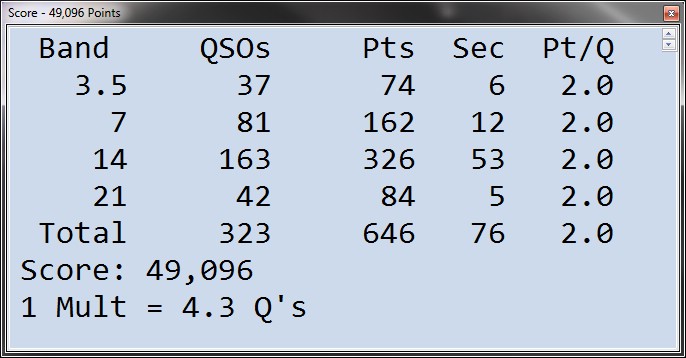
SS-2016 Final Results
Another complaint I have are stations (usually running high power) who just JUMP on a frequency w/o 1st inquiring "QRL?".  If they had LISTENED FIRST, they would have heard me calling CQ.

I can count on ONE HAND this weekend the number of stations I actually heard inquire "QRL?" before taking over a new frequency; something I do every time. 
No wonder non-contesters HATE us.

Any BULLY can push people around and get their way.  The ethical challenge is to treat people fairly en route to a winning operation.  If you can't muster that then maybe you should take up a different hobby like playing hand grenade tossing with your friends.


Laptop auxiliary screen
Another beef I have is with operators who feel the need to send CW at 35 WPM, requiring us to ask them to REPEAT their exchange several times; which of course pisses them off - too bad.

I had one 30 WPM operator ask ME to QRS.  It could not have been because of me making keying mistakes - N1MM was sending the code for me. 
How about this - if you want ME to QRS then you should take the initiative and QRS FIRST.

When I come upon an operator sending at a slower speed (say 17 to 20 WPM), I make my call to that station at THEIR speed.  It's the courteous thing to do.

Remember what Sweepstakes is: a simulated traffic handling event.  Successful traffic handling is about ACCURACY FIRST, speed comes ONLY when conditions allow it.  To illustrate that point the Sweepstakes page on the WQ6X.Info website has a picture of the ARRL Radiogram; which is what the Sweepstakes contest is modeled after.

Checking in with the 3830Scores website, it would seem that I didn't take Pacific Division however I may well have accomplished a 1st place for East bay section.  When I operate from W7AYT, not being blessed with kilowatts and 70' towers I like to play Sweepstakes as an assisted station because I need all the help I can get.


Did YOU play in this year's CW Sweepstakes?

Did you manage a Clean Sweep?

Is WQ6X in YOUR Log?


August 30, 2017 - This just in:

Thursday, November 3, 2016

WQ6X operates the CQ W.W. Contest that BARELY happened


For the CQ W.W. SSB contest in 2015 a number of fluke circumstances found me operating solo as WQ6X from the San Diego Contest Club station (NX6T in "NashVille") after stopping in Orange county to pickup a loaded FT-1000mp (formerly owned by N6VR and used to run SO2R in the November Sweepstakes from Santa Barbara section).  Unfortunately, during the drive back to the bay area after that contest my 99 Mercury Cougar blew the engine (after 166k miles), replaced later that week with a Honda Accord.


This year (like last year) there were not enough operators to put together a multi-Single operation from NashVille so N6KI opted to run N6XT remotely and I came up with the [sic] brilliant idea of setting up the Yaesu FT-1000mp on the 6th floor of a hotel in the SF bay area (location to remain a secret).

While I was not able to hang wires out the window, I have run contests during years past from 2nd & 3rd story hotel rooms using an MFJ apartment antenna with reasonable results.  Because I could not find the extendable whip for the MFJ antenna, as I have done in years past, a 75-meter hamstick took the place of the whip.

When the 00:00z contest start happened I quickly scanned the bands finding 10 & 15 meters quiet with a 20-meter opening to South America.  During the 1st contest hour the MFJ antenna analyzer helped me to ready the apartment antenna for contest operation.
Unfortunately, by the time 01:00z came around 20 meters at my location was DEAD; even stateside signals could not be heard.


Switching to 40 meters I heard very little except for a few broadcast carriers above 7200 khz.  On 75 meters all I heard were a few ragchews and the usual evening west coast traffic nets.  While it is true that space weather conditions presented a rather bleak situation, I was expecting to at least hear dozens of stations on from the U.S. and Canada.

Instead, I heard virtually nothing, leading me to wonder whether or not something was amiss with the the 1000-mp; something I know to not be the case.

After several listening sessions throughout the evening I shut things down at 07:00z (midnite local time) hoping to find everything renewed on Saturday morning.


Saturday turned out to not be much better.  At 19:44z PJ2T in Zone 9 was the 1st QSO.  The remainder of the hour brought about two Zone 8 stations and another in Zone 9.  CX2DK and CV7S were worked the next hour and that was it.  As it turned out, when 10 meters was done for the day, so was I.  Not knowing that, approximately every hour I would scan the bands looking for a fluke callsign to jump through.  Throughout the afternoon, I could hear only a handful of stateside stations.  Unfortunately, none of them could hear me.

On Saturday evening 20, 40 & 80 produced virtually no signals, even though I could hear WWV on 2.5, 5.0 and 10.0 at various points; and even WWVH in the background on 5.0mhz.  Calling it quits, I turned the radio on at 9:30 Sunday morning.  Eventually 10 meters opened back up.  While I could hear central and South America the callsigns were DUPs from Saturday.  It wasn't until 22:00z that I managed to work PV2P, CA4CBK and XE1B; which as it turned out wrapped the contest for me.


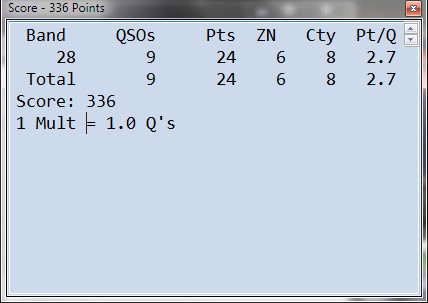
 This was TRULY the most dismal CQ W.W. contest I've ever operated it.  In viewing the 3830Scores.com contest submissions, it is clear that conditions and signal-levels were down, however contest results reported by other W6 stations certainly showed more than 9 QSOs in their logs.

Altho not much to get excited about I made a 10-meter submission to the the 3830 Scores Website.


A view of Mt. Diablo from the hotel


 Hopefully, the CW version of this event will be more productive.
In the meantime, look for WQ6X in the CW November Sweepstakes.

Did you work the CQ W.W. contest?

What were the signal levels like at YOUR QTH?

Sunday, October 9, 2016

WQ6X Reprises W6K from Tuolumne County for CQP 2016

For CQP, during the last 6 years, I have teamed up with N6GEO for various operations;
3 expeditions to Modoc county, a boat operation on the Sacramento River, an operation from
Contra Costa County setting a county record (2014), and our 1st operation
from his Twain Harte
cabin in 2015 as W6E, during the CQP 50 Gold Rush event.

This year George had vacation plans leaving for New Orleans on October 1st, so he offered up his cabin for another WQ6X expedition.
 

In preparation for us running as 
a Multi-2 operation I had already reserved the W6K callsign; a call
I have used during the November Sweepstakes in years past.


No sooner had N6GEO offered up his cabin, I received an e-mail from the contest committee pointing out that Mariposa and Madera counties had no planned operations and would I be up to operating from one of those counties.

I wrote back explaining that I had a cushy cabin waiting for me and asked
if they could find me a place to operate from one of those counties. I never heard back from my query so Twain Harte it was.


A drive was made to the Twain Harte cabin on Thursday, Sept. 29th giving 1-1/2 days to settle in and throw up a couple of wire antennas in the 70' trees. As in past expeditions at this cabin (All Asian & Field Day), I operated from the huge dining room table.

For several weeks the WQ6X CQP 2016 web page (http://WQ6X.Info/CQP/CQP2016) underwent nearly daily updates as the pieces of CQP-51 all came together. 
Since the contest is now over, the page has been finalized.


W6K CQP Operating position


The W6K operation offered up an opportunity for trying out a number of equipment configurations.

The first thing I did was to put the radio and external filters more at eye-level.  

This was accomplished thanks to some scrap lumber found at the construction site for a new cabin on the property. 


Antenna-wise the tall trees on the property were PERFECT for running an OCFD (dipole) broadside north/south and a Cobra dipole as a 1/2-wave sloper broadside to W4 & W5 land (but with a wide beamwidth).  To make things easy the FT-1000mp was run barefoot, leaving the amplifiers in storage back in the SF bay area.

1/2 wave Cobra Sloper

In most cases I worked
everyone I could hear. I
mproving the receive side of things was a better investment. 

Instead of power,
I
relied heavily on the radio's multiple filters
and
DSP gadgets to pull the weak ones in. 
Because the choice was made to run as an assisted station, having spotting access made up a little bit for lack of power, when it came time to search and pounce (S&P). Then again, because I ran frequencies so much of the time, internet access was not as
helpful as it could have been if this had  been an out-of-state operation. 
 

CQP 2016 HORRIBLE Space WX
As you can see the space weather forecasts were horrible. 

In some respects, maybe I should've run 400 watts; easy to say after the fact.

It remains a mystery as to whether or not W6K was  ever spotted on one of the DX reflectors.  

From time to time a flood of stations would show up, however I couldn't be sure if they randomly found W6K or if they had assistance.


While the space weather forecasts were HORRIBLE, the nearby hills attenuating signals were tempered by an overall very low background noise and very little RFI from nearby cabins.

Every year there is supposed to be a trial event on the evening before CQP from 02:00z - 02:30z (for CW)
and 02:30z to 03:00z (for SSB).


In years past I usually am still in station setup mode. However this year because all day Friday was available
to set things up, I was ready to go at 02:00z only to find virtually no one on during the exercise.


After working two stations, the only reply to the "CQP Test" call on 7032.32 was someone who would send "N-U-T-S" in the pause between CQ calls; I guess he was even more bored than I was. 

On SSB the only station heard was KK6NON (one of the SSB operators from NX6T). After a brief QSO
we gave it up allowing me to switch over to final log preparation with N1MM+ software in order to be
ready for 9am Saturday.


At the 9am start, 10 meters had not yet opened, and 15 meters was
barely alive resulting in the decision to call CQ on 14049.49 CW. 

An hour later found W6K on 40-meter SSB working a handful of
stations before turning to 15 meters for a bunch of CW & SSB QSOs. 
By noon W6K had returned to 20 meters; 1st on SSB, then back to
CW for a couple of hours, before running a frequency on 15 meters (21055.55). 


W6K's 2016 CQP Band Plan
Around 22:40z 10 meters rewarded W6K with a handful of QSOs so it could at least be said that there was operation
on 10 meters.  
When 10 quickly fell apart a switch was made back to 20 meters (14057.57) running the frequency until the band fell apart (at 00:00z).  This gave a good excuse to finally make a presence on 40 meters (7.047.47). CW & SSB kept me busy until 02:00z when the time came to bring 80/75 into the mix; alternating SSB & CW until 06:30z.


WQ6X  on CW

After working the majority of available stations on 80, a chance look at 160 meters found it was possible to tune the Cobra on top band; not a great SWR, but low enough to be heard. Stations worked included a handful of locals as well as Modoc county and Montana - not bad for off the back of the sloper.

After 80-meters finally ran out (transl. everyone went to bed) it was time to call it quits at 07:30z. 
With some good sleep, the OP chair 
was back in action by 16:00z (9am); 24 hours after CQP had started.
The final 6 hours of CQP are always a mixed bag. Sunday is an "off the air" day for some operators and an
"on
the air" day for others. 

For W6K, Sunday turned out to be largely a CW operation on 15 & 20 meters until 21:40z when the switch 
was made to 40-meters to run a frequency (7231.31), up to the end of the contest.
In retrospect the switch to 40 meters should've happened earlier, but 3-point 
CW QSOs are just too lucrative to pass up for only 2-pointers on 40 SSB.

QRM-wise, other than the guy sending "N-U-T-S"
on 40 CW Friday evening, there was very little intentional QRM on the band compared 
to what is usually encountered during many CW contest segments. Some "data churning" (7.050.94) was encountered at 00:33z but it seemed to be in its own world; and everyone seemed to work around it.


By contest start the CQP county map eventually listed several stations from Tuolumne County altho I only managed to
work the multi-OP N6G station Saturday evening. 
In the single-OP category I think I bested all the other Tuolumne stations. 
Based on log submissions to the 3830 Scores website, it would seem that I have taken 1st place in the Single-OP assisted expedition category.

The BiG disappointment in this year's CQP was in working only 50 out 
of the 58 multipliers. George and I have never made a multiplier sweep, but we HAVE made it to 56 out of 58 - I guess there is only so much a single-OP can do in 24 hours of operating time. For me the notable misses were AK, DE, ND, NE & SC. The "difficult" VE provinces were easy, whereas VE2 & VE4 were not to be heard in Twain Harte.

While I missed running as a Multi-2 (N6GEO and I make a good team), having the cabin to myself allowed for lots
of relaxation before and 
after the CQP GiG.  Overall, the event was a LoT of fun; despite the poor space WX.

Did YOU play in CQP 51?

Is W6K in YOUR Log?

Monday, September 26, 2016

WQ6X Survives the 2016 CQ WW RTTY Contest

WQ6X looking bewildered.

While enthusiasm is usually a good thing, sometimes the real world shows up and challenges that enthusiasm.

In amateur radio Radiosport, sometimes it seems as if solar disturbances and weird equipment anomalies go hand in hand.

Then again it could be that I am just a bit overly paranoid.


CH-250 Vertical @ W7AYT

For the 2016 CQ WW RTTY contest I made arrangements to operate solo from W7AYT's QTH in Concord California (Zone 3 in the ARRL East Bay section), bringing in a Yaesu FT-1000mp and an 8mh Cobra sloper to augment the Comet CH-250 vertical already installed at the location.
The FT-1000mp sports a robust antenna switching facility allowing me to select the best of the two antennas for a given signal; altho I could not get the Cobra sloper to tune on 40 meters.

My plan was to attempt SO2V using the West Mountain Radio Plug-N-Play device I modified to work with the FT-1000mp.  Unfortunately the modified unit did not work as planned starting a series of frustrations.

Throughout Friday stations could copy me nicely but My end of the equation was having difficulty properly decoding stations calling me; evidently from the decoder circuitry being overloaded and therefore unable to decipher.

Auxiliary Screen

Because there is a 33" monitor next to the operating position I configured the laptop to run split screen with the RTTY engine, Greyline display and contest stats on the auxiliary laptop screen, relegating the main logging functions to the larger TV monitor.

40 meters on Friday evening was quite a disappointment with very poor signals from Asia.


While the A/K indexes were numerically quite low, space WX reports labelled the band conditions as poor.  The truth was somewhere in the middle.  Band-wise, 15 meters was a huge disappointment, while 10 meters netted only K3EST (20 miles from me) via groundwave.


At 5am Saturday (12 hours into the contest) with great difficulty I had managed a WHOPPing 15 QSOs in the RTTY log.
After some sleep I gave a call to W6JBR for some encouragement
and ideas toward solving the RTTY performance problem.

Numerous cable configurations were tried altho in the end it seemed as if I was back where I started from.  The final solution came from rebooting the laptop a second time, after which things seemed to settle in.

Accompanying the CQ WW contest were the Texas (TXQP) and Maine (MEQP) QSO parties.  En route to solving the RTTY problem I took time off to make 19 QSOs in the log for TXQP, adding 6 more Sunday morning.

For MEQP I managed to work W1WMU on SSB and then CW;
enough to submit a 2 QSO log.  In some respects working the QSO parties allowed me to accomplish something while mulling over the digital audio problems.


TXQP Summary Stats


By the time I had RTTY under control on Saturday 15 meters was gone and 20 meters was winding down.

Saturday evening found me band-bouncing between 80 & 40 meters,
S & P'ing and running frequencies.


40 meters was PACKED all the way down to 7.033.  Amusingly, I heard a number of CW ragchews in between strong RTTY stations, progressing just fine as if the RTTY wasn't even there; proof non-contest activities can survive, even in a crowded band segment.

Fortunately, the usual intentional QRM on 40 meters Sat./Sun. mornings never materialized.  I guess intentional QRM idiots haven't figured out how to QRM Rtty effectively; so they don't even start.

Ironically, during CW contests I often encounter intentional QRM with the QRM'ers using, none other than, RTTY
to do the job.

It is amazing how close RTTY stations can be interspersed/squeezed together.  Using a combination of the 1000mp's eDSP contour control and  the shift/width controls I was able to tailor the receive passband more precisely using the 2.4 khz filter setting than using the 500 hz filter alone.

Altho I brought along an outboard MFJ 752-C audio filter, I never found time to configure it in the audio line.  The Yaesu's eDSP contour & DNR options turned out to be more than enough.

To maximize QSOs I continuously switched between the vertical & the Cobra sloper looking for the best signal and/or noise characteristics.  Much of the time the sloper produced more man-made noise than the vertical, whereas the vertical often produced more background atmospheric noise than the sloper - GO figure.  Amazingly,
EA9LZ (Zone 33) was worked using the sloper, not the low-angle vertical.

For me, this year's CQ WW DX RTTY contest was more like an NAQP contest than a DX contest; even though I did manage to Work All Continents (WAC).

N1MM Main Screen
The final irony for my participation in this RTTY contest is that by the time it was over the entire RTTY interface (the West Mountain Plug-N-Play unit) had been bypassed.  The receive audio was brought in directly from the 1000mp's AF out jack.

The XMIT audio was directly routed to the mic input, by way of the TV monitor's headphone jack; which also provided ground-loop isolation between the laptop and the radio itself.


Power-wise, throughout the RTTY contest I ran the radio at near full power (approx. 95 watts).  Because of heat considerations most radios (including the hallowed Elecraft K3) must run RTTY at about 50% - 60% of the radio's rated power output.  Because of the excellent ventilation designed into the Yaesu FT-1000mp, by putting the radio above the table with an exposed underside, the radio never once got warm. 

Most people sell their Yaesu's to purchase Elecraft K3's; as did the previous owner of my radio. 
With minor exceptions, I rate the 1000mp WAY OVER the K3; and I have used a dozen different K3's.  To me, K3's are all alike.  I have yet to see two FT-1000mp's that looked/felt exactly alike. 
The MP's have more character.

All last minute ad-HOC radio operations  I am part of present unique challenges; this weekend's difficulties being RTTY based.  Because I was not engaged in "serious" competition this weekend I insured 6 - 8 hours of sleep both nights, altho I got up at 5am both mornings to catch "early birds".

Look for me @ NX6T for this year's CQ WW SSB,
followed by WQ6X solo from W7AYT's QTH for the CW GiG.

Did YOU work the 2016 CQ WW RTTY contest?

How many countries/zones are in YOUR Log?

Is WQ6X one of them?

Sunday, September 4, 2016

WQ6X joins crew @ NX6T for All Asian SSB

WQ6X running JA stations on 20 meters
For this year's All Asian SSB contest,
I scheduled a business trip to Orange county wrapping things up Friday morning in order that I make the drive to "NashVille" in Fallbrook, California
to join up with the crew @ NX6T.

Because it was labor day weekend we had a shortage of operators, altho we had visits from Tu (AA6TU) a very new ham and Fabio (IZ4AFW) who joined me at 4am on Sunday morning to finish off the night shift as the sun came up.


I have been disappointed in years past by the poor participation of Asian stations (except JA's) in their own contest.  This year things were even worse as the A-index hovered near 40 and the K-index ranged from 4 to 6.  We worked virtually NO stations in the middle east this year, altho we did see
DX spots for those stations; unfortunately from other middle east stations.

Antenna tower #2 - 24mh

For this year's contest NX6T ran as a multi-single operation with Elecraft K3 radios (Stations 1 & 2) and a Kenwood TS-590 (station 3) into a pair of ACOM 2000a amplifiers putting the RF into a C-31 yagi, a STEPP-IR yagi, 2 elements on
40 and inverted VEEs for 160 and 80 meters.

Friday afternoon, 15 meters was good for only an hour
with a few QSOs added Saturday and ONE (count'em) one
15 meter QSO all Sunday afternoon and nothing else. 
10 meters was a complete no-show @ NX6T for this
contest - Bummer Dewd!


Making up the crew for this GiG included N6KI, WQ6X, KK6NON, N6EEG, N6CY (Remote), W2PWS, WB6NBU
and our visitor from Italy Fabio IZ4AFW.  It turns out that IZ4AFW and WQ6X have made QSOs in several contests, starting with the CQ WW RTTY contest back in 2013, so
I received a QSL card directly; as well as an eyeball QSO
this weekend.


AA6TU test-driving the OP chair
Fabio - IZ4AFW


For A-A 2016, the good news is that 40 meters opened early this year (06:00z).  The BaD news is
80 meters opened up late (11:00z) Saturday morning and virtually no QSOs on 80 Sunday morning, except for a couple of multipliers picked up by Fabio on 80 while I ran what was left of 40. 
Saturday nite, there were NO QSOs made after the dinner hour was over (05:30z) until I
came into the shack at 09:00z.  160 and 10 meters were a complete no-show this year. 

This weekend, on top of all we put up with, we were plagued with NON Asian stations wanting to work us.  Several dozen stateside stations evidently had trouble understanding what "Asia only" means; same thing Sunday morning when I was called by VK4 & VK2 stations (from Australia).

 
Station #2 - the Run station


Because I had the antennas pointed to the northwest, those southwest stations were barely S-2.  At one point Saturday morning on 40 meters an XE1 station (Very LOUD) kept calling me and wouldn't go away until I gave him a 2
minute QSO.

QRM-wise, 40 meters was FULL of surprises.  While running a frequency around 09:00z I discovered that 7.145.45 was the national tuneup frequency and a
place for several hams to test their microphones
("Helllllllo!  Helllllllo!"). 

I was also plagued with someone whistling and playing music, and at 4am I was treated to the long version of "Taps" (trumpet) to wake me up, along with bursts of
RTTY signals every 6 minutes (on 7.134).


N6KI, IZ4AFW & N6EEG
Sunday morning (13:16z) shortly after I setup operations on 3.777.77 I was surprised by CW signals saying: "M8JF RIS9", repeating every 15 seconds or so.  Googling these callsigns I discovered that M8JF is the Chinese army and RIS9 is used by the Russian navy. 

What the HELL are they doing playing military exercises in our 75 meter phone band?  Don't they have their OWN frequencies?

Overall this was a very frustrating contest event.  Things were soothed somewhat by the appearance of several "rare" stations, such as XX9 (Macao) VR2 (Hong Kong) and JT1 (Mongolia). 

There were a lot of spots for rare middle eastern countries.  Unfortunately, their signals never made
it to our antennas - Bummer Dewd!


We ended the contest with 660 QSOs and 164k points for what looks like 3rd place world and 1st place for North America, according to the 3830 Scores website.

Checking in with other California stations, N6KI found they were going through much the same frustration we were.  How did things turn out for you?


To fill in the dead air time, I noticed that the Colorado QSO party (COQP) and the Tennessee QSO party (TNQP) events were also happening this weekend.  Unfortunately, typical of state QSO parties (other than the BiG ones like CQP, 7QP and NEQP) these two QSO party events were severely lacking in participation in their own contest event.

Colorado QSO Party (COQP)
Tennessee QSO Party (TNQP)


That didn't stop me from submitting a log for both QSO parties, despite only a handful of QSOs in each log.  Surprisingly, the Tennessee guys were unsure of how I should log their counties - in
CQP we never have that confusion.  Oh well.  Who knows, I might earn a certificate anyway, as
I did for previous TNQP contests.
NX6T after the contest


Did you play in the All Asian SSB contest?


How many Asian prefixes ended up in YOUR Log?


------------------------------------------------------------------------------------------------------------------------------
June 2017 UPDATE:
NX6T took 1st place for North America in this contest.
Excellent job guys!