Monday, September 26, 2016

WQ6X Survives the 2016 CQ WW RTTY Contest

WQ6X looking bewildered.

While enthusiasm is usually a good thing, sometimes the real world shows up and challenges that enthusiasm.

In amateur radio Radiosport, sometimes it seems as if solar disturbances and weird equipment anomalies go hand in hand.

Then again it could be that I am just a bit overly paranoid.


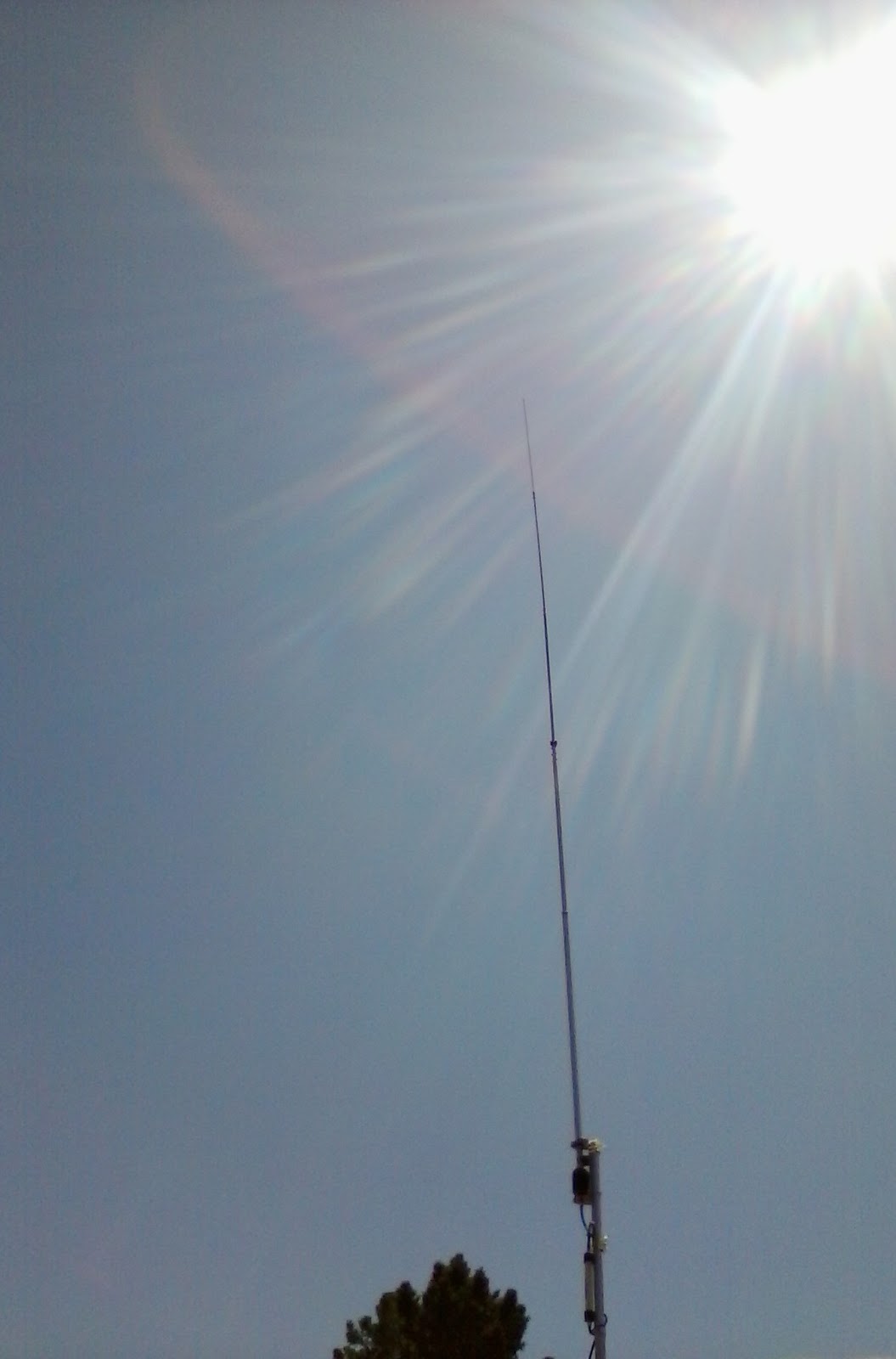
CH-250 Vertical @ W7AYT

For the 2016 CQ WW RTTY contest I made arrangements to operate solo from W7AYT's QTH in Concord California (Zone 3 in the ARRL East Bay section), bringing in a Yaesu FT-1000mp and an 8mh Cobra sloper to augment the Comet CH-250 vertical already installed at the location.
The FT-1000mp sports a robust antenna switching facility allowing me to select the best of the two antennas for a given signal; altho I could not get the Cobra sloper to tune on 40 meters.

My plan was to attempt SO2V using the West Mountain Radio Plug-N-Play device I modified to work with the FT-1000mp.  Unfortunately the modified unit did not work as planned starting a series of frustrations.

Throughout Friday stations could copy me nicely but My end of the equation was having difficulty properly decoding stations calling me; evidently from the decoder circuitry being overloaded and therefore unable to decipher.

Auxiliary Screen

Because there is a 33" monitor next to the operating position I configured the laptop to run split screen with the RTTY engine, Greyline display and contest stats on the auxiliary laptop screen, relegating the main logging functions to the larger TV monitor.

40 meters on Friday evening was quite a disappointment with very poor signals from Asia.


While the A/K indexes were numerically quite low, space WX reports labelled the band conditions as poor.  The truth was somewhere in the middle.  Band-wise, 15 meters was a huge disappointment, while 10 meters netted only K3EST (20 miles from me) via groundwave.


At 5am Saturday (12 hours into the contest) with great difficulty I had managed a WHOPPing 15 QSOs in the RTTY log.
After some sleep I gave a call to W6JBR for some encouragement
and ideas toward solving the RTTY performance problem.

Numerous cable configurations were tried altho in the end it seemed as if I was back where I started from.  The final solution came from rebooting the laptop a second time, after which things seemed to settle in.

Accompanying the CQ WW contest were the Texas (TXQP) and Maine (MEQP) QSO parties.  En route to solving the RTTY problem I took time off to make 19 QSOs in the log for TXQP, adding 6 more Sunday morning.

For MEQP I managed to work W1WMU on SSB and then CW;
enough to submit a 2 QSO log.  In some respects working the QSO parties allowed me to accomplish something while mulling over the digital audio problems.


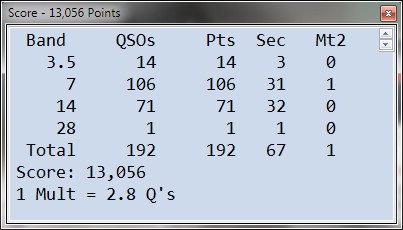
TXQP Summary Stats


By the time I had RTTY under control on Saturday 15 meters was gone and 20 meters was winding down.

Saturday evening found me band-bouncing between 80 & 40 meters,
S & P'ing and running frequencies.


40 meters was PACKED all the way down to 7.033.  Amusingly, I heard a number of CW ragchews in between strong RTTY stations, progressing just fine as if the RTTY wasn't even there; proof non-contest activities can survive, even in a crowded band segment.

Fortunately, the usual intentional QRM on 40 meters Sat./Sun. mornings never materialized.  I guess intentional QRM idiots haven't figured out how to QRM Rtty effectively; so they don't even start.

Ironically, during CW contests I often encounter intentional QRM with the QRM'ers using, none other than, RTTY
to do the job.

It is amazing how close RTTY stations can be interspersed/squeezed together.  Using a combination of the 1000mp's eDSP contour control and  the shift/width controls I was able to tailor the receive passband more precisely using the 2.4 khz filter setting than using the 500 hz filter alone.

Altho I brought along an outboard MFJ 752-C audio filter, I never found time to configure it in the audio line.  The Yaesu's eDSP contour & DNR options turned out to be more than enough.

To maximize QSOs I continuously switched between the vertical & the Cobra sloper looking for the best signal and/or noise characteristics.  Much of the time the sloper produced more man-made noise than the vertical, whereas the vertical often produced more background atmospheric noise than the sloper - GO figure.  Amazingly,
EA9LZ (Zone 33) was worked using the sloper, not the low-angle vertical.

For me, this year's CQ WW DX RTTY contest was more like an NAQP contest than a DX contest; even though I did manage to Work All Continents (WAC).

N1MM Main Screen
The final irony for my participation in this RTTY contest is that by the time it was over the entire RTTY interface (the West Mountain Plug-N-Play unit) had been bypassed.  The receive audio was brought in directly from the 1000mp's AF out jack.

The XMIT audio was directly routed to the mic input, by way of the TV monitor's headphone jack; which also provided ground-loop isolation between the laptop and the radio itself.


Power-wise, throughout the RTTY contest I ran the radio at near full power (approx. 95 watts).  Because of heat considerations most radios (including the hallowed Elecraft K3) must run RTTY at about 50% - 60% of the radio's rated power output.  Because of the excellent ventilation designed into the Yaesu FT-1000mp, by putting the radio above the table with an exposed underside, the radio never once got warm. 

Most people sell their Yaesu's to purchase Elecraft K3's; as did the previous owner of my radio. 
With minor exceptions, I rate the 1000mp WAY OVER the K3; and I have used a dozen different K3's.  To me, K3's are all alike.  I have yet to see two FT-1000mp's that looked/felt exactly alike. 
The MP's have more character.

All last minute ad-HOC radio operations  I am part of present unique challenges; this weekend's difficulties being RTTY based.  Because I was not engaged in "serious" competition this weekend I insured 6 - 8 hours of sleep both nights, altho I got up at 5am both mornings to catch "early birds".

Look for me @ NX6T for this year's CQ WW SSB,
followed by WQ6X solo from W7AYT's QTH for the CW GiG.

Did YOU work the 2016 CQ WW RTTY contest?

How many countries/zones are in YOUR Log?

Is WQ6X one of them?

Sunday, September 4, 2016

WQ6X joins crew @ NX6T for All Asian SSB

WQ6X running JA stations on 20 meters
For this year's All Asian SSB contest,
I scheduled a business trip to Orange county wrapping things up Friday morning in order that I make the drive to "NashVille" in Fallbrook, California
to join up with the crew @ NX6T.

Because it was labor day weekend we had a shortage of operators, altho we had visits from Tu (AA6TU) a very new ham and Fabio (IZ4AFW) who joined me at 4am on Sunday morning to finish off the night shift as the sun came up.


I have been disappointed in years past by the poor participation of Asian stations (except JA's) in their own contest.  This year things were even worse as the A-index hovered near 40 and the K-index ranged from 4 to 6.  We worked virtually NO stations in the middle east this year, altho we did see
DX spots for those stations; unfortunately from other middle east stations.

Antenna tower #2 - 24mh

For this year's contest NX6T ran as a multi-single operation with Elecraft K3 radios (Stations 1 & 2) and a Kenwood TS-590 (station 3) into a pair of ACOM 2000a amplifiers putting the RF into a C-31 yagi, a STEPP-IR yagi, 2 elements on
40 and inverted VEEs for 160 and 80 meters.

Friday afternoon, 15 meters was good for only an hour
with a few QSOs added Saturday and ONE (count'em) one
15 meter QSO all Sunday afternoon and nothing else. 
10 meters was a complete no-show @ NX6T for this
contest - Bummer Dewd!


Making up the crew for this GiG included N6KI, WQ6X, KK6NON, N6EEG, N6CY (Remote), W2PWS, WB6NBU
and our visitor from Italy Fabio IZ4AFW.  It turns out that IZ4AFW and WQ6X have made QSOs in several contests, starting with the CQ WW RTTY contest back in 2013, so
I received a QSL card directly; as well as an eyeball QSO
this weekend.


AA6TU test-driving the OP chair
Fabio - IZ4AFW


For A-A 2016, the good news is that 40 meters opened early this year (06:00z).  The BaD news is
80 meters opened up late (11:00z) Saturday morning and virtually no QSOs on 80 Sunday morning, except for a couple of multipliers picked up by Fabio on 80 while I ran what was left of 40. 
Saturday nite, there were NO QSOs made after the dinner hour was over (05:30z) until I
came into the shack at 09:00z.  160 and 10 meters were a complete no-show this year. 

This weekend, on top of all we put up with, we were plagued with NON Asian stations wanting to work us.  Several dozen stateside stations evidently had trouble understanding what "Asia only" means; same thing Sunday morning when I was called by VK4 & VK2 stations (from Australia).

 
Station #2 - the Run station


Because I had the antennas pointed to the northwest, those southwest stations were barely S-2.  At one point Saturday morning on 40 meters an XE1 station (Very LOUD) kept calling me and wouldn't go away until I gave him a 2
minute QSO.

QRM-wise, 40 meters was FULL of surprises.  While running a frequency around 09:00z I discovered that 7.145.45 was the national tuneup frequency and a
place for several hams to test their microphones
("Helllllllo!  Helllllllo!"). 

I was also plagued with someone whistling and playing music, and at 4am I was treated to the long version of "Taps" (trumpet) to wake me up, along with bursts of
RTTY signals every 6 minutes (on 7.134).


N6KI, IZ4AFW & N6EEG
Sunday morning (13:16z) shortly after I setup operations on 3.777.77 I was surprised by CW signals saying: "M8JF RIS9", repeating every 15 seconds or so.  Googling these callsigns I discovered that M8JF is the Chinese army and RIS9 is used by the Russian navy. 

What the HELL are they doing playing military exercises in our 75 meter phone band?  Don't they have their OWN frequencies?

Overall this was a very frustrating contest event.  Things were soothed somewhat by the appearance of several "rare" stations, such as XX9 (Macao) VR2 (Hong Kong) and JT1 (Mongolia). 

There were a lot of spots for rare middle eastern countries.  Unfortunately, their signals never made
it to our antennas - Bummer Dewd!


We ended the contest with 660 QSOs and 164k points for what looks like 3rd place world and 1st place for North America, according to the 3830 Scores website.

Checking in with other California stations, N6KI found they were going through much the same frustration we were.  How did things turn out for you?


To fill in the dead air time, I noticed that the Colorado QSO party (COQP) and the Tennessee QSO party (TNQP) events were also happening this weekend.  Unfortunately, typical of state QSO parties (other than the BiG ones like CQP, 7QP and NEQP) these two QSO party events were severely lacking in participation in their own contest event.

Colorado QSO Party (COQP)
Tennessee QSO Party (TNQP)


That didn't stop me from submitting a log for both QSO parties, despite only a handful of QSOs in each log.  Surprisingly, the Tennessee guys were unsure of how I should log their counties - in
CQP we never have that confusion.  Oh well.  Who knows, I might earn a certificate anyway, as
I did for previous TNQP contests.
NX6T after the contest


Did you play in the All Asian SSB contest?


How many Asian prefixes ended up in YOUR Log?


------------------------------------------------------------------------------------------------------------------------------
June 2017 UPDATE:
NX6T took 1st place for North America in this contest.
Excellent job guys!
 

Monday, August 22, 2016

WQ6X Survives the summertime NAQP SSB contest


WQ6X @ W7AYT
Thanks to horrible space weather afflictions, the weekend's NAQP SSB contest was a considerable disappointment.

Business requirements kept me in the bay area prevented me from joining the NX6T crew in NashVille.  In all honesty, they had so many [now] veteran operators that I doubt that my contribution would have much improved what turned out to be an incredible 3rd place Multi-2 score; beat only by KD4D & NV9L.
 
Comet CH-250 Vertical

Agreeing to be on one of the SCCC (Southern California Contest Club) single-OP teams I again setup operation from W7AYT's QTH (Concord, Ca.) on Friday evening giving me ample time to configure the N1MM logging software for voice-keying.  Unfortunately, I could never manage to get the audio link to work properly, so I did the unthinkable and used my own voice FULL time.

I ran the Yaesu FT-1000mp into a CH-250 vertical (already at W7AYT's QTH) and a hastily raised sloping Cobra dipole - 10mh at the apex.  The FT-1000mp supports two separate antennas (A & B) making it easy to rapidly switch between the two looking for the best signal level.

Overall, the sloper seemed to be the better antenna for 20 meters and the CH-250 vertical produced stronger signals and (surprisingly) lower noise-levels on 40.   Having both antennas available allowed for QSOs on 80 meters.


QSOs by Hour

While the CH-250 was miraculously able to tune on 160, I was unable to raise any of the stations
I heard there.

Space weather wise, conditions were HORRIBLE.  From Concord, 10 & 15 meter activity was non-existent.  Hoping that band conditions would improve, I chose to not begin operations until 19:45z.  While signal levels had improved a little, I could see that it was going to be a slow go. 

By 00:00z (1/2 way into the contest) I accomplished a WHOPPing 26 QSOs.  As you can see things didn't begin to pickup until 02:00z.


A disadvantage of starting nearly 2 hours into the contest is that after 04:00z one-by-one the single OP stations run out their 10 hours and QRT.  Because most of the remaining multi-OP stations have already been worked it takes a combination of CQ's and S&P's to add a handful of QSOs to the log.

While this contest is overall a lot of fun due to the personal exchange (Name and QTH) this particular event was one of the most frustrating NAQP contests
I've ever engaged in.


I submitted the NAQP score to the 3830 website and even made a short video showcasing the operation at W7AYT's QTH.


FT-1000mp + Electro Voice 664 Mic


Did You operate the NAQP SSB contest?

Is WQ6X in YOUR log?

Friday, August 19, 2016

WQ6X dabbles in WAE-CW 2016


NX6T - Station #1


For this year's WAE (Worked All Europe) contest I had to make a decision whether to drive to NashVille (in Fallbrook) to operate the NX6T station, operate portable from W7AYT in Northern California with only a vertical antenna, or, operate
NX6T remotely.


As it turns out, the rock band GAMMA+ was playing at Club Fox in Redwood City on Saturday night so I compromised and got a room for two nights at the Comfort Inn in Redwood City to see the show,
while running the NashVille station remotely as WQ6X.


C-31 Yagi - 12mh
Operating from the East coast or Midwest gives operators there a significant advantage in working Europe.  Operating from NX6T's QTH had the advantage over Northern California of a C-31 yagi on the high bands
and a 2-element 40 meter Yagi.

Because propagation was poor on 80/160/10 I heard no signals on any of those bands, making this operation a 20-15-40 meter affair; not surprisingly with most of the action on 20 meters.

40 meters on Friday evening was a tough go. 
It seemed as though I was weaker into Europe than
I thought I should have been.  On Saturday morning
I discovered why - the K3's power level had been dialed down to 25 watts (probably for station testing) and I neglected to check power levels before starting.  It could've been worse - dialed back to 5 watts. 
(Maybe I shoulda run as QRP).

Running the K3 @ 95 watts made all the difference.  Unfortunately, 40 meters was nearly a no-show on Saturday evening, so I largely missed out.

The WAE contest is unique in that you have the opportunity to send/receive "QTC" (traffic) messages for extra points.  Because I was running remotely using "canned" function keys, making QTC work with N1MM was way over my head for the weekend so I replied "no QTC" to traffic requests; probably disappointing a lot of EU stations.

One of my goals in working the WAE contest was to put the WQ6X callsign in as many EU logs as possible for callsign recognition in future contests.  WAE also put a guaranteed 34 countries on my solo DXCC list from NashVille.

Countries worked in WAE
Being a CW contest, I further developed my SO2V operating skills; thanks to the dual-receive capability
of the FT-1000mp.

Operating remotely, internet latency was a BiG problem Friday evening
and somewhat less of a problem on Saturday afternoon.  By Sunday, things had settled down.  I could no longer blame internet latency for my poor performance; by then it was all about operating skill.

Being a remote operation I relied heavily on internet spots via the N1MM bandmap.  Unfortunately, many of the spots were significantly off frequency requiring "manual" tuning in order to make contact - not always easy to
do remotely.

Additionally, many of the spotted callsigns were surprisingly incorrect (despite being spotted by a skimmer), requiring me to actually LISTEN before blindly calling the station.  Then again, because
I ran frequencies much of the time I was helped along by a number of East coast skimmer radios adding WQ6X to the network.  I submitted a contest score report to the 3830 Scores website.

WQ6X remote view of NX6T
Did you work the WAE contest?

Is WQ6X in YOUR Log?

Monday, August 8, 2016

WQ6X Joins SCCC Team #1 for NAQP CW

WQ6X operating position
Comet CH-250 Vertical

The CW/SSB NAQP 12 hour contests happen twice a year: January and August.  (RTTY variations of NAQP happen in February and July).

For the August 2016 NAQP gig, I joined SCCC (Southern California Contest Club) team #1, again operating portable from W7AYT's QTH in Concord (East Bay ARRL section).

While the location sports only a vertical antenna, for ease of setup the location can't be beat.  Dennis' other contribution to my operation was some EXCELLENT homebrew food Saturday evening.

For this NAQP event my main goal was to learn/perfect the art of SO2V (Single OP, 2 VFOs) encouraged by a VE3 writeup on the subject.  Reading all about SO2V is one thing; making it actually work is a completely different contesting challenge than what I am used to.

Luckily, the FT-1000mp and N1MM software are integrally integrated.  The N1MM keyboard layout to make SO2V work was well thought out; using keys on both sides of the alpha key structure.  My only beef with N1MM is that during program startup the ENTRY window for VFO-B is hidden behind the window for VFO A - even if you save window positions before shutting down the software.


In implementing SO2V, a number of times I got frustrated and manually swapped VFO A & B to quickly make the contact so as not to confuse the station on the other end.  Eventually I got the feel for SO2V and it became more "fluid".  Practice (and not giving up) breeds more precision.  It will be interesting to see if I can repeat the SO2V experience in 2 weeks for the NAQP SSB contest.


Space weather wise band conditions above 15 mhz were rather bleak at the W7AYT QTH; altho it seems that most W6 stations shared a similar experience.  I only worked one W6 station above 15 mhz (on 10 meter CW).

Other W6 stations suggested that 15 meters possessed sudden propagation shifts allowing them to work other countries.  In retrospect I should have checked 15 meters more often.


Country wise, the only entity I worked was NP2X (Virgin Islands) on 40 meters.


20 meters became the predominate daytime band followed by40 meters during the evening. Although I made a number of 40-meter run attempts throughout the afternoon, they yielded merely a handful of QSOs.  Considering that I had run out of 20-meter stations at that moment I guess the switch to 40 meters at those times were warranted.


Surprisingly, altho I ran the Yaesu into a roof-mounted Comet CH-250 vertical, the noise level at W7AYT's QTH was quite low - no need for the 1000 MP's DSP noise reduction facilities.

Unfortunately, signal levels were ALSO way down.  Whether that was due to the use of a (no-gain) vertical or the poor propagation conditions has yet to be determined.  Nevertheless I managed to work virtually every station I heard.


As a part of SCCC Team #1, I operated in conjunction with a lot of "heavyweight" operators.  Out of the 6 members of Team #1 while my score was at the bottom of the heap, the bottom line is that I did the best I knew how with the setup I had available to me and improved my operating skills considerably this weekend, making it a worthwhile endeavor for all concerned.

Because NAQP requires a minimum of 2 hours off time for single-OP stations, part of the contest strategy must include when to start and when to take the mandatory 30+ minute (minimum) breaks.  I took a risk and began operations at 19:00z (12 pm local) - one hour into the contest.  Due to poor band condx I found two other off time opportunities, for lunch while ostensibly "waiting" for space WX condx to improve; which it eventually did.


On 40 meters, while I did hear the Russian "K" beacon (on 7.039), there was not the usual intentional QRM I am used to on 40; no belches, no VFO swoops and no bursts of RTTY out of the blue.


Unfortunately, this contest's 80 meter activity was quite a disappointment.  While I was able to work up into Washington, east to Colorado and Kansas and into Southern California, the actual number of stations on 80 meters was very small.


The CH-250 does not natively work 160 and I did not bring a manual line tuner so working top band did not happen in this contest.


In retrospect while the QSO count in this summer's NAQP contest was much less than I am used to, the upside is that there were no equipment failures.


The WQ6X callsign made yet another contest appearance for 2016; becoming one of my more contest-active years.


Before I forget, the WEIRDEST thing about this NAQP-CW was working a DOZEN people with the name MILT; most of them in AZ.  Before this event, I RARELY see the name Milt in NAQP.  Wassup with Milt?

Did you play in the NAQP CW contest?

Is WQ6X in Your log?

Thursday, July 28, 2016

WQ6X & N6GEO Work 2016 Field Day from Tuolumne County

Station #1 - manned by WQ6X

FD 2016 is only the 2nd time in 31 years that I have not joined the San Andreas Faultline Survivors for Field Day on Mt. Able (in Southern Kern county 55 mi. N/W of Los Angeles).  For 2016, client commitments before and after FD made a drive from the SF bay area (300+ miles each way) impractical  when you consider that I pretty much single-highhandedly put together a campsite and 20 meter CW station along with assisting in the near dozen antennas the group hangs from trees.

During Field Day weekend, N6GEO is usually in England on business for Livermore Lawrence lab.  Because this year was an N6GEO exception I simply loaded up the Honda Accord with the FT-1000mp and it's outboard accessories and made the drive to George's QTH in Brentwood (SF East Bay) where we loaded up his monster truck and made the 3 hour drive to his cabin in Twain Harte;
the same cabin we ran the CQP contest last October as W6E.

I almost brought a Coleman InstaTent to setup outdoors, but was too lazy to stuff it into the back seat of the Honda (Insta Tents are "insta" because the pole structure is built right in.  The trade off is that the unit is HUGE compared to the camping tent I usually pack with it.)
As it turns out, George became our "outdoor operator".


In recent years I have registered the
1x1 callsign "K6F" (Kilowatt Six Foxtrot)
for W6SW's GOTA station.

Having already registered that call in anticipation of my participation with the Faultline Survivors, K6F became the callsign utilized by N6GEO and WQ6X and the Faultline Survivors used KJ6UVQ for their GOTA station as
they did last year.


Because we arrived Thursday , technically we were not allowed to do any station setup or put up any "new" antennas until Friday morning.  However, because we essentially operated out of a "home QTH" (albeit a cabin vacation home) the rules did not prohibit us from adding extra radials to an already existing military-style vertical (front-ended by an SGC-250 external auto-tuner).
While were at it we gave the other antennas (a 6-BTV vertical, an OCD Dipole and a homebrew
3-element 6-meter yagi) a thorough inspection with an MFJ-259 antenna analyzer.

N6GEO running Station #2
Friday morning found us laying out guy lines for a 36' pneumatic mast with a TH-3 jr at the top.  We couldn't find the time to run rotor cables for the yagi, so we used the infamous "Armstrong method" to rotate the antenna.

Then again, most of the time the yagi was pointing north to northeast, favoring where the most signals come from.  Having two multi-band verticals available allowed us communication in other directions; including Hawaii (KH6) and Puerto Rico (KP4).
Attempts to convince our friends from "down under" to look for our callsign produced no DX QSOs.

I brought along the usual pair of Cobra dipoles I bring for every field day to make a multi-band 8JK array or the infamous WQ6 multi-band  8JK sloper.  Because the already-resident antennas were more than adequate, we chose not to go to the hassle of making 1 - 4 additional antenna line shoots.


TH-3 jr 12mh
Friday afternoon gave us plenty of time to organize the cabin for a dual station operation; me running the FT-1000mp on the BiG wooden dining room table and George first on the desk in the living room, quickly changed at the last minute to run his Elecraft K2 from an umbrella covered table on the outside patio.  The weather was perfect for outdoor operation.  I was almost envious of his outdoor setup until 8pm (local time) when the sun set and it got a little cold.

Power-wise we ran a Honda generator the entire operating period with a specially chosen AC-line RF filter to keep line noise out of the radios.  Because we ran bandpass filters on each band we were also able to pretty much keep out of each others radio except for the direct 2nd harmonic from 40 meter CW to 20 meter CW (or 80 CW to 40 CW) and an occasional SSB harmonic from 7.155mhz to 14.310, encountered when searching and pouncing on the upper end of 20 meters.


Military vertical EXUDING RF

One of my FD goals for 2016 was to include some form
of digital communications - in my case RTTY; because RTTY is FUN.  Additionally, like CW contacts, digital contacts are all worth 2 points; whether you run RTTY, PSK-31 or even JT-65.  Unfortunately, by the time FD came around I had not worked out a keying-relay cable
for the FT-1000mp.

Luckily, N6GEO is an accomplished RTTY & PSK operator.  George's trusty Elecraft K2 put 13 RTTY & PSK contacts in the K6F log along with a 7 SSB QSO presence on 50 Mhz, thanks to a homebrew 3 element 6-meter yagi.

George also gave us a brief presence on 160 meters; not bad considering the vertical was tuned for 80 meters with no 160 meter loading coil.  (It is amazing what antenna tuners can do.)


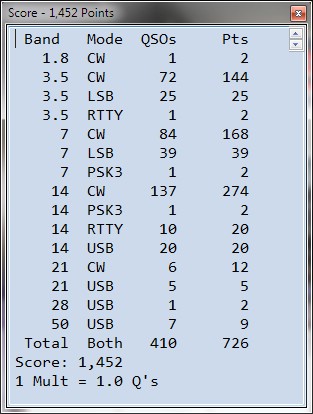
As you can see from the Summary Stats there was not much activity for us on 10 or 15 meters.  In fact, N6GEO made more sideband contacts on 6 meters than on 15.  In a way this is not surprising when you consider that the low-angle reflection possibilities were largely inhibited by shallow hills not far from the Twain Harte QTH.


As George and I are both CW operators it is not surprising that 20-CW was the most productive band mode this year.  At W6SW, typically I am the 20-CW operator for the group, so I felt right at home at K6F.
We both made quite a presence on 80/40 CW.


My biggest beef during this year's FD was stations just JUMPing on frequencies to call CQ w/o listening first and/or asking "QRL?" before assuming that a frequency is available.  When you consider that Field Day encourages novice/beginner operators (as well as station visitors who
barely know what amateur radio is) control operators at each station should take extra
responsibility to insure that their operation is as QRM-free (to other stations) as possible.

Bananas & Negra Modelo
not JUST for breakfast anymore
Amazingly, the usual intentional 40-meter QRM I have come to expect in contests after 05:00z did not materialize this year; no belching, no VFO swishes, no stray RTTY.  Unfortunately the nightly South American SSB idiots on 7.018 were out in force which gave us a reason to operate on/around 7.033.  Then again, because of our foothill location we did not hear any of the Russian 'letter" beacons on 7.039.

While I am used to running Field Day for the entire 24 hours, this year I gave it up at 08:45z (1:45am).  K6F was back on the air at 15:00z (8am).   Because we had worked most of all stations we could hear, we managed only 50 QSOs between us for the last 3 hours of the contest. 

With an extra 1 or 2 operators we could have made an even greater presence of the higher bands as well as modes like RTTY and Packet.  George and I have the same feeling concerning our CQP operations; especially from Twain Harte.


Next year look for me to rejoin the W6SW team and drag N6GEO along.
There is a rumor that friends from VK and/or ZL land will be visiting California for next years event.

While I truly missed playing with the Fault Line survivors this year, their FD report indicates that they survived without me and we survived “roughing it” at the Twain Harte cabin.

Did YOU operate Field Day 2016?

Is K6F in YOUR log?

Monday, July 18, 2016

WQ6X takes 2nd place for So. Ca. in NAQP RTTY

Station #1 @ NX6T

This was a last minute remote operation at "NashVille" (@NX6T) from a "secret location" in the SF east bay. 


This past week with assistance from the techs at West Mountain Radio, I built a one transistor relay driver
enabling the FT-1000mp
RTTY-able.

Plug-N-Play be-4 final mod.


The goal was to operate RTTY from a location in the SF east bay.  Unfortunately, at the chosen operating location, signal levels were almost non-existent, making remote operation my only option for this weekend.


Luckily, with last minute assistance from W6JBR
and N6KI to debug internet problems, I managed to accomplish remote access to the Fallbrook station;
altho in the early contest hours internet latency was HORRIBLE.


WQ6X operating position


As a result, I took a gamble and used the 20:00z - 22:00z period as my "off time", waiting for the internet latency
to settle down (which it eventually did).   Luckily, the Giants .vs. Padres game was on TV while I ran
the contest.  (Unfortunately, the Giants lost.)

Taking the mandated 2 hour early off-time allowed me
to work the contest up to the 06:00z ending time, along with the remaining single-OP & multi-OP stations.


An upside to this remote operation was virtually no background noise to deal with, altho because of the K-Index of 3, I noticed a funny echo on a few signals; especially those coming in from Europe.

C-31XR Yagi

The station consisted of an externally fan-cooled Elecraft K3 (running 59 watts) into a C-31XR yagi for the high bands, 2-elements on 40 and an inverted "V" for 80 meters.

Because it is not easy to manually tune in some RTTY signals remotely (when no spotting-assistance is allowed),
rather than S&P, I chose to run frequencies having stations come to me.

Unfortunately, this created a new problem when stations would call considerably off frequency such that FLDIGI could not demodulate their text, no matter how LOUD
they were.  Because using RIT remotely (with poor internet latency) to tune stations in is not possible, I resolved this by allocating N1MM's F-11 key to send the message: "You are off frequency - tune me in", followed by F8 ("AGN? AGN?"), or F3 ("TU QRZ").


2-el on 40 + Stepp-IR
My thinking is that if you are copying me correctly when you receive the message you will make sure that your Xmit/Rcv frequencies are the same when you call me.  Most stations got the message and then called me on frequency.

Amazingly, I actually had one station COMPLAIN because I would not (meaning I COULD not) tune him in - CHILL OUT DEWD!  With poor internet latency, my trying to tune YOU in will actually slow things down for everyone else waiting to work me.  If you want a QSO, it is YOUR responsibility to BE ON FREQUENCY, not mine.
A big disappointment was when I couldn't complete a
20 meter QSO with an IK4 station because the internet froze and I could not send him an exchange via N1MM's function keys.  By the time I was back in normal operation, either the IK4 was gone or so were the signals from Europe.  If I seemed to "disappear" on you, the reason was probably poor internet latency, not because I was ignoring you.
 

One of my beefs in this contest had to do with stations sending unnecessary information; most specifically "599".  Because there are no signal reports required in NAQP (a ridiculous piece of
data to send during a contest anyway) sending "599" once or twice is not only confusing, but when signals are low, by the time you get to sending the NEEDED information the signal drops out.
In MOST cases, stations that sent a signal report faded out afterwards requiring me
to request a repeat of their exchange once or twice.

QSO/hr per band

QRM is always something to be dealt with during radio contests, however in RTTY contests when it is EXACTLY on my frequency, I know it is no accident.  For this event, I chose specific operating frequencies (14087.87, 21086.86, 14094.94, 7086.86, 3586.86 & 7082.82) on the premise that if you start CQ'ing EXACTLY on my run frequency it MUST be intentional.

It also amazes me when a station calls me (along with other stations), only to then immediately call
CQ on my run frequency if I work another station first.  WTF is THAT all about?!

Sparse activity on 80 meters was a HUGE Bummer (only 10 QSOs),  along with no signals heard on
10 meters at the Fallbrook location; altho other Southern California stations listed 10 meter
QSOs in their 3830 score website submission.

Nevertheless it was a FUN contest allowing me to work a number of W6 friends. 
While I didn't make a GREAT showing in the contest, according to my 3830 Scores website submission, it would appear that I DiD make it to 2nd place (behind W6TK in
Santa Barbara) amongst all the Southern California submissions.

NAQP Ending screen

When you consider that the rest of the Southern California stations had the advantage of
working from their home QTH (with no internet latency problems to contend with), it is surprising
that I scored higher than they did.  Next year look for me to run NAQP RTTY using the FT-1000mp with the West Mountain Plug-N-Play unit adapted to key the radio.

Did YOU work the NAQP RTTY contest?

Is WQ6X in YOUR log?