Monday, September 7, 2015

NX6T Survives horrible Space WX during 2015 A.A. Dx Contest


For this year's All Asian phone contest I arrived a day early allowing me to catch up on sleep
as we had a severe shortage of operators. Between N6KI, myself and our newest op KK6NON,
we managed to put over 1,040 QSOs in the log.  While we slightly beat last year's 1,010 QSO total, we were lacking in multipliers, resulting in nearly 60K points less than the 2014 event at NX6T.
(For the record, amazingly, I did not operate last year's 2014 AA phone contest.)

Altho I keep having doubts, it seems clear that solar cycle 24 is clearly on its way out. 
Unfortunately, low solar activity does not mean low incidences of Geo-magnetic storms;
case in point being this weekend's All Asian contest.  During the previous 2 weeks, dirtball
earth has been inundated by solar storms of varying degrees.  The A/K indexes have been
quite high, with many high band blackouts and significantly increased low band noise levels.

My hopes for a reduction in space weather severity this weekend never happened. 
While the bands were not as noisy as expected, 80 & 10 meters never materialized for us. 
Lack of 80 meter activity amazed me because Thursday nite I was able to copy WWVH (Hawaii)
on 2.5 mhz with an S-7 signal level using a Tecsun PL-600 shortwave radio with a whip antenna.

Additionally, because 15 meters never opened on Friday afternoon/evening we turned to 20 meters making up for the lack, producing a WHOPPING 27 QSOs in the first three hours (last year we worked over 100).

WQ6X running 40-meters

My bitches aside, we experienced a short but WONderful opening to the middle east.  In a sense I over-focused on that opening, not realizing I was missing out on a run of JA's (the C-31 antenna sports a relatively narrow beam width).

Then again, Japan is so plentiful we take the attitude that most of them will be worked before the contest is over.  Therefore, we don't normally obsess over them.   Saturday evening didn't bring us a middle east
opening so I guess my decision was vindicated.

In one respect, with the weird layout of Japan's 75 meter phone band allocations it is no wonder that amateurs there spend little time working non-JA stations. 
This same problem will be with us during
November's JIDX SSB contest.


The NX6T radio shack.

Typical with 40 meter contest activities we ran into
our share of weird QRM; from "helllllloooo" testing of microphones and belching, along with one of the "yeah, yeah" boys, vfo swishes, and, for nearly 2 hours, bursts
of RTTY-type data every 6 minutes.  I must confess a curiosity over what purpose data-bursts on 7.178.78
mhz could be; especially during an Asian contest.

While we encountered a lot of pulse-type noise,
I was disappointed in the K3's handling of it.
The NB circuits, while effective, gave rise to IF distortion anytime a relatively strong station was nearby - a major beef I have with the DSP-style NB circuits - so I ended
up mostly working without it.

Here is where an NIR-4 or MFJ 626 noise canceller
unit could be real useful.


80 meters never happened for us so noise-reduction was not a problem and the Loop antenna was not needed.  Asians contests don't do SSB on 160 giving us no reason to check things there.


Running as a multi-single operation, we used a pair
of Elecraft K3 radios on one band (one for running frequencies and one for S&P'ing on the same band) into
an ACOM 2000 amplifier.  We used a 3rd K3 radio for finding multipliers on another band; however, with the
poor turnout this was largely unnecessary.

C-31 Yagi @45'
Antenna-wise we put C-31 and 3-el. Stepp-IR yagis on the high bands and a 2-el beam on 40 meters.

While we had an 80-meter inverted V at 70', with the poor band condx it was useless.

For Sunday we lowered the Stepp-IR to about 45',
which for Asia is a much better height to create a LOUDER presence.  Unfortunately, on Sunday it
didn't help to bring 15 & 10 meters alive.


As it turns out, in Asian contests by the time Sunday afternoon rolls around, most of the Asian
stations are either sleeping or on the trains headed to work - confirming my beef that not enough Asian stations participate in their own contests.  The average operator age on Sunday is well over
60 - I.E. RETIRED!.

Locally, the 8am to 2pm time period has no Asian activity, allowing me to spend time working
stations as WQ6X in the Colorado QSO party (COQP) on Saturday and the Tennessee QSO
party (TNQP) on Sunday.

Because it is so easy to submit logs by e-mail and post scores on the 3830 Scores website,
the QSO party log submissions were finished before leaving Fallbrook on Sunday evening.
N6KI & KK6NON

As Sunday afternoon was so slow, N6KI spent time mentoring KK6NON on the fine art of understanding
Asian voice communication attempts.
We operators who natively speak English should realize that for many Asian operators understanding much beyond callsigns, "QRZ?" "QRX" and "stand-by IDIOT!"
is about all they can manage to figure out.

I quickly learned that many stations do not understand
the phrase "we've worked before".
If I knew they were already in the log, I would allow them to give me their exchange and then (without logging the dupe) move on to the next contact.

One of our biggest problems was the number of U.S. stations calling us, evidently not aware that this was an Asia only contest.  I would remind them that they should point their antennas northwest and work REAL Dx.

For Asian stations, did you put NX6T in your log?
For you non-Asian stations, how many Asian prefixes did YOU work?

Sunday, August 16, 2015

Is there Value in Documenting Contest Activity?

N9RV's Op-Ed piece in the March/April 2015 issue of the  National Contest Journal (NCJ) touched on the importance of documenting our contest activities, as well as learning from other scores posted to 3830Scores.Com and looking up old RBN (Reverse Beacon Network) charts.

WQ6X operating as W1AW/6


This WQ6X Contest Blog is in line with the above points.
I sent Patrick an e-mail detailing how I go about documenting my contest activities.  It occurred to me that others might like to see this and will have their own thoughts for inclusion to this discussion.


Here is what I wrote to N9RV
Your editorial comments in March/April NCJ got me to thinking about all the contests I have participated in since approximately 1970.  Other than a few things which stand out in each event, you are correct in saying that we remember the events but not many of the details of each event.

Because digital-cams and video are so cheaply plentiful, I make it a point to take as many pics and shoot as many video clips as time can be made for.  Because I have the http://wq6x.info/ website I can document some of the more important events such as my expedition with N6GEO on
St. Croix as
WP2/WQ6X in the 2014 RTTY RU (we  took 1st place LP worldwide); or, our last 5 successive CQP events: http://WQ6X.Info/CQP.

When I post a log to 3830 I usually write a paragraph or two - not only for everyone else, but for me a year from now.  I also write a rather detailed soapbox entry, cuz ya' never know when the person writing up the contest will want to quote a soapbox entry, as happened in reference to WP2/WQ6X in the 2014 RTTY RU results write-up. (Documented on my /WP2 web page.)

Since January 2013 I have been maintaining a contest blog wherein I can post thoughts, URL links, videos & pictures from each contest event a few days after it is over.  You can see the blog at: http://WQ6X.Blogspot.Com.  In fact, I even posted the contents of this letter as a Blog Entry.

Facebook is also a great place to post information.  I announce most upcoming contest GiGs so friends and family know where I am on any given contest weekend.  It also allows hams on FB to keep up with my activities and the world of contesting in general.  People often don't know a contest or event is happening (such as the International Lighthouse event this weekend) until they see my Facebook announcement.
You can find my Facebook page at:
https://www.facebook.com/ron.fitch.69
W1AW/6 Stepp-IR + 2-el 40
I would like to encourage YOU to start your own contest reporting Blog here on BlogSpot.Com. 
It's free. 
Who knows, your unique form of reporting might make a difference in operational improvements for a wanna be contester, or even a well seasoned Multi-Multi operation.


Once your Blog beginning is ready, PLEASE send me a link to it.  I will link to it from this Blog and will be happy to post something positive to it.

Until then - 73's - CU around the bands and in your Blog.

  Ron
 WQ6X

Monday, July 6, 2015

WQ6X joins NX6T in All Asian CW with a 1st place for North America

WQ6X running a pileup on 20 Meters
Last year I submitted a single-band 40-meter log for my All Asian CW activity in Alameda rather than making the drive to Fallbrook to join up with NX6T.  While I took 1st place for single-band 40, the atmospheric noise was HORRIBLE making me wish I had been a part of NX6T's 1st place North America multi-single entry.

For this year's All Asian Cw contest I took the Amtrak San Joaquin & Surfliner trains to Oceanside arriving Friday at 11:00 a.m.. After a several hour catch up nap I was ready for the 5pm (00:00z) contest start.

In All Asian the exchange is 599 and Age (YLs send "00").
While the mean-age was 60+ plus, there were two operators reporting 17 and one sending 88.
This year it seemed like there were more YL (00) participants than in years past - excellent!
HS0ZIA worked stations as young as 14 and as old as 92 - wOw!


We had a shortage of operators for this event.
N6KI, N6CY and myself made 90% of the QSOs.
Sunday afternoon N6EEG & N6ERD joined us, although their biggest contribution was a Quad copter with a camera for tower and location inspection as you can see in the photo.


For this year's All Asian contest we were just coming off a solar flare event that created many different forms of geomagnetic storms.  This created all kinds of weird propagation effects, the weirdest being hearing Europe in the evening on 15 meters (that should happen in the morning)  and hearing Asia in the morning on 15; something that shouldn't happen until after noon.


QSO wise 20 & 15 meters were our big bands with both giving over 500 QSOs.  At 241 Q's 40 meters was next; altho we contacted more Asians on 40 in the WPX contest 3 weeks prior - again validating my complaint that not enough Asians play in their own contest.
With only one marginal opening we manged only 122 QSOs on 10-meters.
There was virtually no A.A. activity on 80 meters giving me a mere 3 QSOs between both nights.
160?  DEAD!

N6CY S&P'ing 20-Meters @ 5am
 As usual there was the intentional QRM on 40-meters.  However for this event the QRMers also made the scene on 20 meters.  On top of that, what continues to amaze me is how a station will work me (I've been running a pileup on that frequency for nearly 2 hours) and then immediately shift frequency +/- 0.5kc to start calling CQ - HuH?  WTF!


While we technically ran as a multi-single operation, we used 3 transmitters to do so.  In All Asian, you can run  an extra transmitter on a different band to ONLY work multipliers.

Additionally, because we use a lock-out system, we are able to use two radios on the band being run at the time.  The run operator works a pileup using radio #2, while another operator uses the band map to S & P unique QSOs on that same band using radio #3.


Station #2 @ end of night shift

While it can get a bit tricky at times doing this, overall we were able to make it all happen seamlessly, thanks to the networking facility in WinTest that allows all 3 stations to interact with the same log.

Results wise, it would seem that NX6T took 1st place for North America and 4th place worldwide.
I.e. fewer operators turned in a better score this year and ended up with the same results; which suggests that the competition is getting stronger.


I DiD notice that what made the difference in many scores were the amount of 160/80/10 meter contacts (worth more points each).  HS0ZIA managed 560 QSOs on 10 meters and yet complained of poor propagation - go figure.  We had one 10 meter opening that quickly disappeared giving us a mere 122 Qs for that band.


Oh well.... All Asian phone comes up in September.
It will be interesting to see what the solar/propagation conditions will be like.


Did YOU play in the All Asian CW contest?
If so, how did it turn out?

Monday, June 1, 2015

WQ6X @ Fallbrook unleashes new contesting tools


For this year's WPX Cw contest I took the Amtrak San Joaquin & Surfliner trains to Oceanside on Thursday to be ready for a 5pm (00:00z) WPX contest start on Friday.   As I type this blog, I am sitting in the Surfliner's Business Class heading to LAX Union Station and points North.

In years past we have used the WQ6X callsign because WQ6 seems more unique than the NX6 in NX6T.  This year, it may be that the WQ6X callsign worked against us.
First off we heard no other NX6 callsigns.  Atop that, the appearance this year of WQ7X and WQ5K confused matters considerably - especially for Asian contesters; making callsign repeats a necessity.

We ran the usual three K-3 radios into a pair of ACOM-2000 amplifiers. Radio #3 was tied into Radio #2 with a lockout on each radio allowing only one to transmit at a time.  Radio #2 would run a frequency on a given band while the operator on Radio #3 traverses the bandmap to search for more multipliers or otherwise important stations.

Other than a handful of audio & control cable malfunctions, hardware-wise this weekend progressed rather smoothly.  Of course, having  Mr. Bill and the EASY Button at our disposal always makes a significant difference.

Solar-wise, the SFI was down to a low of 92.  Having a low A-Index of 5 does little good if the K-Index continues to hover around 2+ the entire time.  The low solar activity turned most of 10-meters into a worthless graveyard.
92 QSOs over 30 hours of potential band openings give us a theoretical average of 3 QSOs per each hour spent on 10 meters -pretty pathetic.

One of things I like about the NX6T operations in Fallbrook is that we are able to leverage the radio and computer technologies to their fullest capabilities.  In recent months this has included the use of remote operating.  For wpx this weekend, K6AM ran 20 meters remotely Saturday morning, putting over 100 QSOs in the log.  Early Sunday morning, N6CY put in an hour remotely on 80 meters, picking up where I had left off on 80 after a brief stint on 160.  This allowed me to spend time running a pileup on 40 meters.
Rick's remote operation complimented his 6+ hours in the chair Saturday evening.


WQ6X & N6CY during the dinner hour
 In every blog entry I make comments about the weird goings-on during the 09:00z - 13:00z time period on 40 meters.  With a low SFI the opportunity always exists for funky shit to happen.  This contest was no exception. In addition to the plethora of intentional jammers & S. American SSB stations (at the bottom of the CW band) we had a lengthy visit from a "woodpecker" radar station along with 3 Russian beacon stations on 7.039:
"F" (**-*), "K" (-*-) and "M" (- -).


Luckily I tend to operate below 7.039, making the beacon stations an annoyance more than anything else.  With the radar, I could make it "go away" by turning the yagi towards Northeast (instead of West / Northwest), which gives us an idea of what direction it originates from.
Run #1 and Run #2 stations at 3am


I had a brief CW "pounder" Sunday morning who qualified as one of the numerous 40 meter jammers.  Don't people have anything else better to do?  An unintentional jamming occurred in the form of the 2nd harmonic from our 80 meter operation on station #1 doubling up onto 40 meters - a small price to pay in order
to have 2 run stations.


An increasingly problematic problem this year came in the form of a station working us to get the QSO points/multiplier and then moving off frequency 0.5 Kc to call CQ on top of us.  WTF are people NOT thinking?  My solution is to send QRL again and again until the idiot leaves.  Last I checked, the 1st station on a given frequency has "rights" to that frequency.  If there is no "room" for you to call CQ, that is the breaks;  either switch to a different band or continue to search & pounce (S&P).
Is this REALLY that difficult to understand?

While there were indeed a LoT of weird prefixes on this year, I was disappointed that there
were not more than there were.  In the warm-up period (approx. 2 hours before the contest)
there seemed to be more exotic prefixes on 20 meters than during the contest itself. 
Hmmmm....

Well, did YOU work the Weird Prefix contest?
Is your WEIRD prefix in the WQ6X log?

Tuesday, April 14, 2015

WQ6X Joins Team NX6T for 2015 JIDX CW Contest

This last weekend found me on another Amtrak trip to Oceanside allowing me to operate the JIDX contest with team NX6T in Fallbrook.  We had a shortage of CW operators so I ended up running the 2am to 6am shifts solo.  This time of night/morning is my favorite operating period anyway, so no complaints from me.


We ran the usual bevy of K3 radios.  Our antenna system included a 12-db gain C-31 @ 40' (Tower #1) and a classic 3-element Stepp-IR and 2-el. 40 meter yagi @ 70' (Tower #2).
A pair of 80 & 160 meter dipoles drooped from near the top of tower #2 both broadside to Japan.


Being almost 900' above sea level, the Fallbrook location gives an excellent low-angle trajectory bounce off the ionospheric F2-layer for an easy skip "across the pond" to Japan.

While this year's score was 100 QSOs behind the 2014 CW effort, it may still be that as a Multi-single operation we have a significant chance for 1st-place world wide, as we have done for the last 5 years.  Of our 823 QSOs, my 279 contacts comprised 35% of the score.


While this year's event went rather smoothly, the one thing we could not control was the atmospheric effects caused by an M-class flare coming in at the last minute giving an A-Index of 34 at one point.  As a result, we were shy approx 100 - 150 QSOs on 10 meters, explaining our 15% QSO reduction this year.  Surprisingly, next to 160, 10 meters was our WORST band.


Nevertheless I did manage 6 QSOs at the other end of the spectrum (160 meters).  QSOs on 160 are worth 4 points (2 points for 80 & 10).  As for 80, QSOs were made mainly Saturday morning (around 3am).  Operations on 40 meters were overall outstanding, but at the last moment, 15 meters became our top band.

Because this weekend was also the Yuri Gagarin (GC) contest, several times during the contest non-JA stations would want to work us.  If they didn't understand "JA only", we would then send them "599 03", sending them off on their merry way.  In the process, somehow a BG9 (Chinese) station ended up in the log.  No problem - no extra penalties for that.  In retrospect we should have worked the GC contest dudes. keeping a separate log - something to consider for next year.

This year I found that non-JA stations seemed unusually aggressive; in particular, W6's, W7's & VE7's.

As usual, 40-meters around 09:00z to 12:00z was loaded with random shit.  The non-licensed S. American SSB stations were incredibly egregious this last weekend.  There was of course the Cyrillic station on 7.024 and the numerous tuner-uppers; so bad at one point that I thought 40-cw had become the new National Tuneup Frequency.

While I don't normally pay attention to the K3 panoramic adapters, for JIDX it was helpful on Sunday morning when looking for a "hole" within which to run a frequency.  I had to move to several "holes" throughout my stay on 40-meters.

Amazingly enough during this contest I did not hear any Russian beacon stations, nor were there any phantom RTTY stations in the CW spectrum.


During the dinner hour my operating slot was preempted allowing Don K6AM the opportunity to run a frequency on 20-meters remotely from his home QTH.

It always amazes me to watch a radio being operated remotely.  At one point w/o thinking I attempted to look at the DX spot screen on that computer, oblivious to the fact that Don was running a frequency at that time - Oooops.

My typical bitch about no JD1 stations was partially answered this year by an 8N1/JD1 station N6KI heard working a MASSIVE pileup.  While multipliers are important, once we work the main 47 prefectures, even more important than a JD1 are raw QSOs, especially on 160, 80 & 10 meters.  Working easily had new multipliers on as many bands as possible is also more important than "waiting in line" for an illusive JD1 station.


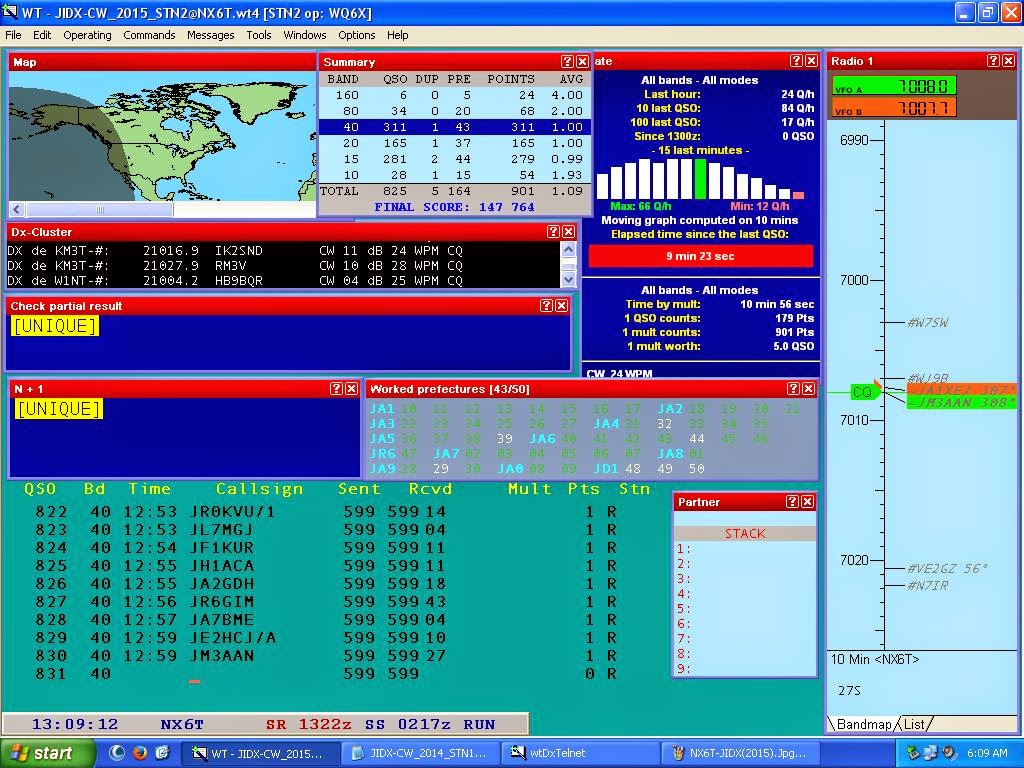
As you can see from the WQ6X prefecture tracker we managed to work all 47 of the Japanese prefectures.  On 40 & 15 meters we worked nearly all of the 47 prefectures.  Because a number of Japanese run low power on 10 meters, having better 10-meter propagation would have upped our multiplier total considerably.
 
Again this year some (solo) JA stations seem to not know their prefecture number but will give you their JCC# if you ask for it; from which you can extract the prefecture #.  Overall, I find this amazing.  Imagine a California station not knowing what county they are in during CQP.

Something I bitch about in EVERY Cw contest is the proper repeat sending of the prefecture #.  When I send to you "NR?" all I want back from you is the prefecture # - I DO NOT - Repeat DO NOT - want you to send 599 over again.

Often I am asking for a repeat because of quick-fading on your signal.  Sending 599 wastes just enough time that when you get around to sending the NR your signal has faded yet again, requiring another repeat.

All this wastes time and risks logging errors which can cost us all QSO points when the log-checking robot (LCR) evaluates our logs.

Of course we get to my MAIN beef with JIDX contests - not enough Japanese participation.
Again this year, there were 5:1 (or more) N.A. stations calling CQ JA than there were JA stations calling CQ JIDX.  Somehow we need to encourage more Japanese stations to not only play in their own contest but to run a frequency so we can find them.  The only way that can happen is if JA amateurs park themselves in front of their radios for a dozen or more hours and get down to business.

WINTEST screen at the end of JIDX 2015


Did you play in this weekend's JIDX GiG?
How many prefectures did you add to your log?

Sunday, April 5, 2015

WQ6X JOINS TEAM NX6T FOR ANOTHER MULTI-2 WPX CONTEST


This past weekend I took Amtrak to Oceanside allowing me to join up with team NX6T for the 2015 WPX SSB contest; colloquially known as the "Weird Prefix Contest".  Every year we seem to herald the arrival of an increasing number of WEIRD prefixes; altho I guess some people think of NX6 as rather weird.

NA6MB & K7BV
N6KI & KD6NON & AG6KA
We operated as a Multi-2 station using 3 K3 radios; 2 for running frequencies and search & pounce (S&P) operations and a 3rd radio to find multipliers on one of the run frequency bands using a lock-out system guaranteeing only 2 transmitted signals at a time.

At NX6T Dennis (N6KI) spent some time this weekend mentoring a couple of up-and-coming contest operators.  SSB contests are a great way to gain exposure to the contest world; the WPX being a world-wide event exposes new operators to the joys of working exotic countries in the course of contest activity.  DX type contests are also an excellent way to learn how to copy weird vocal dialects.  With CW & RTTY dialects are not a problem.  Voice contests teach operators to copy numbers under adverse conditions.

In addition to WQ6X we had quite an array of operators including: N6ERD, KB7V, NA6MB, N6KI, NN6X, N6EEG, W6JBR, WA3IHV, AG6KA, KJ6YXI & KK6NON.

Station #2 @ NX6T

In addition to an array of quality operators, at NX6T we make use of a number of operating aids, including Mr. Bill, the Easy Button and Por-Que Pig.  I even went so far as to record the Easy Button into voice memory #3 as the QRZ message while running a frequency.

We of course make use of the various DX clusters, skimmer utilities (for CW & RTTY contests) and the occasional tip off that comes by way of VHF repeaters.

As a multi-operator setup we are allowed to make use of just about any form of assistance we can think of.  That is one of the reasons we run 3 (or more radios), allowing "off duty" operators the opportunity to locate important multipliers.


Space weather wise things were not too bad altho on 10 & 15 meters the atmospheric noise was severe enough that it made many signals sound super distorted.
Once I figured this out I realized there were not a bunch of "bad" radios showing up on the air.

Super-quick fading was also noticed; especially on 10 meters where a station would jump up in strength and just as quickly disappear.  This is yet another reason (as I have pointed out in other blogs) that contest exchanges should be kept short - insuring that the entire message is exchanged before the signal fades out.
Stepp-IR + 2 el. 40 @ 70'

For this contest it initially seemed that 20-meters was going to be a dud with 40-meters being our major showing.  By the time it was over 20 meters topped at 1006 QSOs, followed by a close 988 on 15 meters.  10 & 40 meters were a close call at 752 & 739 respectively, leaving 217 & 8 QSOs on 80 & 160.  Openings to Madeira and Central/South America were a nice surprise, as was the east coast on 160.  Having a lower solar flux helped the lower bands, no doubt.
 

C-31a @ a mere 40'


As with all contests (especially DX contests) I have my share of operator complaints; but none worse than SO9Q securing a QSO with me (I had been on that frequency for 90+ minutes) and then IMMEDIATELY sliding .2kc up frequency to call CQ contest.  HuH?  Is that brazen? stupid? unconscious?
Or, is there something else I am missing?


Because the JA station frequency limitations on 75-m SSB (I displayed a picture of this in my blog about the JIDX contest) I found the best frequency to attract JA stations was: 3.747.47.  Someone gave NX6T a "spot" while I was running that frequency, probably accounting for the JA-streak I encountered Sunday morning.


While we in no way expect to take any kind of award for this contest, it DOES get us ready for the upcoming JIDX contest (where we are poised for our 5th consecutive 1st place worldwide) and then the CW WPX contest (Memorial weekend) where we will probably use the WQ6X call.


Prefixes worked screen

To me, because of the myriad of callsign prefixes that appear "out of nowhere", WPX is truly one of my favorite contests (4th favorite).  CW events are more fun however so I look forward to May.  And, I even learned a new word: ZANGO!  Do you know WHAT a Zango is, or HOW to Zango?


QSOs per hour - 214 was tops


You can view our overall score submission at the 3830 Scores website.

Did you work NX6T during last weekend's WPX contest?  On how many bands did you find us?

Friday, February 27, 2015

WQ6X & N6GEO take another 1st-place for CA in ARRL Dx Contest

 This last weekend again found me in Brentwood teamed up with George, N6GEO for the 2015 ARRL DX CW contest.  While originally slated to join team NX6T in Fallbrook, situations beyond my control relegated me to the SF bay area.  In the end it was a wise decision; I was spared the 1,000 mile drive to/from Fallbrook and had as much operating time as my aging body could manage.  Both evenings I woke from a nap to put some time on 40 & 80.

Unlike recent contests with a reasonably high solar flux index (SFI), for this contest 120 was as high as it would get.  (Does that mean that we have finally seen the end of cycle 24's solar max. days?)  Nevertheless we made do with what we had, running George's FLEX-3000 into a KPA-500 amplifier averaging 149 watts for a low power multi-single operation using the N6GEO callsign.
N6GEO pondering a multiplier

Our goal was DXCC which we nearly achieved by way of 95 countries.  For the most part we worked everyone we could hear; except for a couple of "rare" stations that were not worth braving the pileups just to snag a multiplier.  According to N1MM a multiplier was only worth 3.5 QSOs.
 
This year we worked some exciting hard to reach countries including: RI1ANZ (Antarctica), JW/DL2JRM (Svalbard), TF3CW (Iceland), VP5S (Turks & Caicos), KH8/K8GU (Amer. Samoa), 3D2KM (Fiji), FY5KE (Fr. Guiana), VR2XAN (Hong Kong), P3F (Cyprus), and 5W1SA running a whole 5 watts from Samoa.
WQ6X flooded by sunlight at 7am

In addition to exotic callsigns there were a number of propagation anomalies, such as working SJ2W (Sweden) on 15 meters at 01:45z, when all we should be hearing is Asia & Oceania (Europe shows up in the local morning hours - after 15:00z).  There were nice openings to Europe on 40 meters both evenings, which is always surprising to me when operating from California; especially when running only a 6-BTV.


As with recent contests using the N6GEO callsign many stations seem to have trouble getting the call correctly, often hearing N6GO or N6O.  To resolve that we have 2 N1MM function keys assigned for the call; the original F4 and F6 which sends N6G E O (with a space be-4/after the "E").  As needed I alternate between F4 and F6 until the station gets it.  We also assigned "CA" to F8 to repeat our exchange w/o having to send the "599" every time.

One of the weird things stations (Asians in particular) do is to ask me for my number ("NR") when in fact they mean my state or QTH.  If you don't understand what they want, there is a temptation to send "599", which is of course a number.  This creates a confusion with the fact that DX stations DO send a number (or "K" or KW"), whereas WE statesiders send a QTH (state or province).  The contest rules make this clear, so I guess either people don't READ the rules or don't understand them.

In general, my typical beef with CW contests is that operators running a frequency are often not consistent.  The operator asks for a W4 station so I standby to let the w4 have his turn; then when no W4 shows up and a W1 station calls instead he immediately works the W1 - WRONG!.  If I had known he was going to work anyone who calls in at that moment then I would have called in as well.

When running a frequency, if I make a call for a specific area and it doesn't come through, I then send QRZ to give EVERYONE a shot at me.  Stations who call out of turn will have to "get in line" like everyone else.  Running a frequency is like herding cats, you have to let them know who is running the show.  One way to teach them a lesson is to work them "accidentally" sending bogus QSO information so their log entry gets dinged by the log checking robots.  You get the QSO points regardless.

Another beef is to be calling a station who is OBVIOUSLY hearing callers, only to have them "disappear".  After several calls if I don't receive a reply I then send "QRZ?".  If no reply, I then consider the frequency fair game and start calling CQ, often to have the station show up again calling CQ.  My guess on this situation is that the station is running SO2R. 

One of my beefs with SO2R is that some stations use it to call CQ on two different frequencies/bands.  Some contests specifically prohibit calling CQ on 2 frequencies.  If you want to run a frequency, fine; otherwise S & P.  If you call CQ and I come back to you but you can't work me because you are busy calling CQ on another frequency, then you should NOT be calling CQ.  We should NOT have to wait around to work you because you are busy on another band.  Be forewarned that I notify contest committees of these violations which run the offending stations the risk of being classified as a check-log, not eligible for awards, defeating the whole purpose of running SO2R in the 1st place.


While the Stepp-IR in use at N6GEO may not have as much gain as the TH3-jr, this is outweighed by the ability to run the antenna in BI-directional mode or 180-degrees reversed to pick up stations.  We used this numerous times during the contest to switch between Europe & KH6 or Asia and South America.  Then again I was amazed how many QSOs I made off the SIDE of the yagi.

The skimmer utility also made quite a difference during the search and pounce periods.  My main beef with CW skimmer is that the callsigns must be typed manually into N1MM - there is no direct link like we find between the N1MM sub-screens themselves.


Overall this year's ARRL DX contest was a lot of fun.  While in recent contests we've had a lot of noise to contend with on 80 & 40 meters, luckily we had very little noise during this contest; probably due to the low SFI.  While I doubt we will qualify for any awards from this event, it was well worth the time we spent.  I look forward to the SSB version in March.  You can see our results on the 3830 Scores website.

Did you play in the ARRL DX contest?
Did you hear or log N6GEO?

Sunday, January 4, 2015

N6GEO & WQ6X dual-OP another RTTY RU operation for 2015

It is still hard for me to fathom that at this time last year I was lounging on the patio at Radio Reef (KP2M) on St. Croix with George (N6GEO) and his XYL after what turned out to be our triumphant 1st-place entry (worldwide) in the 2014 RTTY RU contest.


Ironically, this year we did not work, nor did we hear any stations on from the Virgin Islands; only WP3, KP4 & 8P2 from the Caribbean.

The 2-element Stepp-IR antenna has performed flawless from the N6GEO QTH for several months now.

While it LooKs tall, the military mast is barely 8-mh.  Because the QTH is located in a CC&R controlled neighborhood, we have to put the antennas up and take them down each contest weekend.  Every time we do this, some improvement is made to the system.  Who nose, one day we might even get it right.


WQ6X running a frequency on 20-Meters


This year's operation included dozens of ideas that we learned from our time in the Virgin Islands; altho the radio has grown up from the little FLEX-1500.

For 2015 we operated from N6GEO as N6GEO running George's FLEX-3000 into a KPA-500 amp dialed down to around 145 watts; except when we ran a frequency, we ran the amp at about 110 watts.  Running the KPA-500 full-duty cycle kept the fans busy.  Otherwise, the amp performed flawlessly.


For 2015, not only were we prepared in advance for a change, we actually made a showing in the 02:00z - 02:30z practice event Friday evening (local time). 

George running a bathrobe pileup.

Unfortunately, on Saturday a number of last-minute surprises (such as a middle of the night water heater failure) kept George out of the shack during much of the daytime.
To counter-balance that George put in a superb effort on 40 & 80 meters Saturday evening.  My activity on those bands was minimal - a handful of stations on 40 meters Saturday evening and 9 QSOs on 80 after 14:00z Sunday morning.  Other than that there was no greyline to be had.


While the space weather forecasts were dismal, we encountered very little geo-storm noise except on 80 meters Saturday nite.  Amazingly we encountered NO local RFI noise on 40-meters as we have during recent contest weekends.  This weekend the propagation effects I noticed were various forms of atmospheric fading: long fades on 10-meters Saturday afternoon and short, choppy fades on Sunday.

Because the VE7CC spotter was down for much of the weekend the only way I could get space weather information was from the WQ6X Beacon tracker (as you can see above).
Space weather forecasts after the contest were even WORSE (A-Index=20, K-Index=5). 


During my Saturday afternoon operating stint George lashed together an 80-meter sloping inverted "V" which we hoped would pick up where the 6-BTV on 80-meters leaves off - WRONG!
Evidently the apex of the "V" was so close to the house it acted as a noise-pickup antenna, even noisier than the vertical.  Oh well - maybe next time.

Power SDR Spectrum Display
Because the RTTY bands technically expand up to the phone bands we made QSOs as high as 14.126 and 21.139 on 20 & 15 meters respectively.

On Sunday afternoon I noticed that the NCDXF beacon on 14.100 was obliterated by scores of RTTY stations ignorant of the fact that the frequency is preferably allocated for beacon operation.
The PROPER thing to do is to grant open space a MINIMUM of +/- 3Kc (better +/- 5kc) for proper beacon operation.
Unfortunately in RTTY contests this RARELY happens,
Did you walk all over the beacons?
Whut?  You didn't even know they exist?  Shame on you!


When the RU was all over we had amassed 614 QSOs w/53 multipliers in 24 countries - not bad considering what we had to work with.
Running frequencies (10-meters on Saturday & 20-meters on Sunday) gave people an opportunity to add N6GEO to their log on several bands.


Did YOU add N6GEO to YOUR log?
On which bands?