Monday, July 22, 2013

WQ6X teams up with N6GEO for NAQP RTTY

For this summer's NAQP RTTY contest I again teamed up with N6GEO as a Multi-2 similar to what
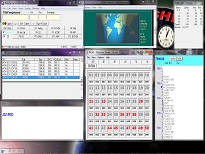
we did for the WPX RTTY event.  The difference this time is that we ran a pair of FLEX-1500 SDR radios into a pair of Tokyo Hy-Power 45 & 50 watt amplifiers.  This was part of an experiment in preparation for an upcoming RTTY expedition.
George's QTH is in an antenna restricted area so we popped a TH-3 Jr yagi antenna atop a military surplus portable tower approx. 7mh.  The yagi was shared between both radios by way of a homebrew antenna multiplexer.  We also used an 8-BTV Vertical with camouflage paint. 
By the time I left today, both antennas "mysteriously" vanished. 

The Windoze Vista laptop I used to run the FLEX 1500 encountered a number of "blue screen" events.  Because our computers were networked together we decided my station should be the Run-2 station so as to not lose access to VE7CC should another crash happen; which of course
it did not. 

Similar to Field Day I ran exclusively 20-meters, leaving the 80/40 & 15/10 meter chores to George.  Our 255 QSOs was hardly a record breaker, although for a RTTY GiG it was a great beginning. 

There was also the DMC Rtty contest running concurrently with NAQP.  Some stations worked both contests concurrently, although how they logged it is a mystery to me.  I used the DMC contest
as a warmup exercise before the NAQP started and ended up submitting an 8 QSO log for that event.  Overall, NAQP RTTY is a lot of fun.   It's nice to get to know people on a "first name basis"
in this contest.   However in the log submission soapbox I wrote the following:

So typical of competitions lately is stations not checking to see if frequencies are in use before jumping in.   We may not have had the loudest signal around, however we were noticeable enough that we were obviously hearable and yet stations moved in on us anyway.  I also noticed a lack of breathing room around the NCDXF beacon on 14.100; which to me is inexcusable.  If you don't know about the 14.100 beacons then you should not be operating 20-meter RTTY
in the first place. 

A number of stations had trouble calling me properly on frequency.  With my other radios (ICOM 7000, FT-900 & FT-920) using the RIT is a simple knob twist.   However one of the poor design features of the FLEX-1500 is its [in]ability to accomplish RIT easily.  By the time I figured out
how to use VFO-B as a RIT, the contest was nearly over. 

In general our NAQP exercise proved that the FLEX radios can easily drive a medium-power amplifier to full output.  I was amazed that the HL-45b amplifier never "broke a sweat" at
full power.   It was so cool, I couldn't use it to warm my coffee cup as I have done with other
solid-state amplifiers.  Oh well, luckily that was the only real problem I encountered with this operation. 

RTTY contests are quickly becoming a favorite with me.   Cw is of course my favorite
because it saves my voice and does not require "fancy hardware" the way RTTY does.  
However the click-and-work possibilities with SDR radios I find considerably intriguing. 
I look forward to future RTTY GiGs using software defined radios.

Monday, July 15, 2013

IARU 2013 - Weird from the start

2013's IARU Hf Contest was weird even before it started; thanks in part to the on-going solar disturbances (K-index oscillating between 2 and 4).  I intended to run an amplified Flex 1500 with my trusty ICOM 7000 as a backup radio.  Unfortunately, the receiver side of the 1500 developed a strange whistle making it unreliable for use in this weekend's radiosport.
The HF2-V installation seemed flawless, at least for the first 5 hours of the contest.   I took a 2 hour sleep break and awoke to find that the antenna would receive but not transmit even though the SWR meter indicated a less than 1.5:1 match on all bands.  Finally, after dark, a flashlight exposed the coax shield making capacitive contact with the vertical driven element.  Insulating it with red tape brought everything back to proper life.
By o6:30z, with less than 7 hours to go, I made up for lost time with some frenetic search-and-pounce on 40-meters followed by several frequency runs on 40 & 80.  On 160 I heard several California stations but could not get enough of an antenna match to work any of them, altho the HF2-V has tuned on 160 before.

This year the number of HQ stations seemed way more plentiful than in the 2012 event.  For some reason I find working HQ stations to be really cool. The W1AW callsign was /4 this year and the NU1AW call was /3.  While running a frequency it was an honor to have HQ stations calling me rather than them just sitting on a frequency waiting for us.

Noticeably missing was Hawaii (I worked only one station) as well as VE4, VE5 & VE6.  Additionally, VK seemed absent as well as BG (China) except for an HQ station there.  There were surprisingly few JA stations this year, continuing my beef that Asian stations seem to be noticeably absent from this year's radiosport events.  Brazil (PP5), Uruguay (CX3) and Columbia (HK3) were the only South American countries I could work.  Surprisingly, Europe was unhearable from my Alameda location, although I did hear EF5 and EA3.  By the time I was able to transmit, those goodies were long gone.

What amazed me this year was the blatant lack of operational courtesy and operating ethics on the part of a handful stations.  It would seem that I was the ONLY station to ask QRL before moving in on a frequency.  One station drowned out other stations to work me and then immediately moved barely 100 hz above me and began calling CQ.  When I moved up 100hz to match him, he disappeared. There was plenty of room several Khz on both sides of me.  Wassup with the 100 hz business?

Despite the horrible atmospheric noise levels, I was amazed at the stations who DiD come thru; especially on 80-meters.   The way things turned out, I ended up submitting a CW only log.

Where were you this weekend?
Did you play in the IARU Championship?
If so, was WQ6X in your log?

Sunday, July 7, 2013

W6SW does it's 18th Field Day from Mt. Abel

Field Day 2013 was the 18th event for the San Andreas Fault-line Survivors on Mt. Abel (8,250' - 50-m N/W of L.A.) using the callsign W6SW (Whiskey Six Short Wave). For our GOTA (Get On The Air [now]) station I reserved the callsign K6F (Kilowatt Six Foxtrot) which was expertly run by our newest member of the group Dennis - KJ6UVQ. K6F contributed a not insignificant 205 QSOs to our 1,604 total. While 1604 is a respectable total, it is a far cry from some of our other years; especially last year's 2700+ QSOs. Our exchange message was: 3A - SJV.
Because I took down the W6SW road signs last year, I was elected to put them in their usual places for 2013; except for sign #1 - the freeway sign. This year just before FD, the Frazier Park exit on the northbound I-5 was closed, requiring W6SW detour signs at the Gorman exit before Frazier Park.
As usual there was no cellphone service on the mountain, requiring a drive to the bottom of the mountain near the W6SW sign #4 turnoff indicator. For internet and shower access, I had to drive another 12 miles to the Flying-J station at the I-5 exit. 

Due to the fact that the majority of our younger operators have grown up and moved to various locations around the world and some of our "veteran" operators are "getting too old" to camp (then rent an RV dammit), we had a small turnout this year. Then again, those of us who DiD make it to Mt. Abel gave it our usual 300% effort and pulled off our usual bevy of miraculous feats throughout the FD weekend. 

Every year Murphy makes the most unexpected of appearances. For me, it began the weekend before with the All Asian contest when I discovered one of my 2 radio batteries could not hold a charge. That left me to using my Mercury Cougar as a battery charger that weekend and begging/borrowing batteries during Field Day. 

Jim (W6KC) had a double whammy starting with leftovers from a cold followed by the failure of his K3 radio when it was inadvertently reverse-hooked to the storage battery. We swapped in an ICOM 7000 from my car (switching to yet another IC-700 later) to keep Station #2 on the air. 

Antenna-wise we had no serious problems. In addition to the HF-2v and Sloping 8JK cobras and the infamous Inverted-Vee Slinky I used during All Asian, we hoisted a 3-element wire yagi for 20-meter Cw, altho physically it was not as high as last year. Nevertheless, I was able to work virtually every station I could hear. Station #1 also sported a 3-element 20-meter wire Yagi, while Station #2 utilized a similar 3-element Yagi for 15 meters along with a homebrew Delta Loop for 10-meters; altho 10-meters turned out to be a DuD. 

My Yaesu FT-920 certainly rose to the occasion, thanks to the newly added 500hz Cw filter and it's super duper built-in DSP unit. The 920 DSP is so good that it sidelined my external NIR-12 DSP filter - I simply didn't need it. 

Thanks to Jim setting up another ad-hoc wireless network (hanging from a tree) all 3 W6SW stations were laptop networked together. When band conditions on the band I am working slow down my contact rate, it is nice to see the other stations cranking out contacts in that very moment; and vice-verse. Late in the evening as the Station #1 & #2 operators finally crashed for the night network access allowed me to determine which band(s) I should be operating on. 

While 20-meter Cw was my primary focus, I also spent time on 10, 40 & 80 meter Cw; and even made a brief (but fruitless) appearance on 160. At around 08:00z (1:00 am) I activated my ICOM 7000 at station #2 on 75-meter SSB making 105 voice contacts. Ge'ldine! even made an appearance, but people didn't really get it so she went back into submersion. I got 3 hours sleep at 4am, awakening to Kona coffee and an hour stint at Station #1 making 52 QSOs on 20-SSB before returning to Station #3 to put the finish on 20-Cw operations until 18:00z (11:00 am). 

Because of the battery problem, I was not able to "run a frequency" on 20-Cw as continuously as I did last year (when I made 600+ QSOs on 20-Cw alone). Individually, I had the highest QSO total this year 504; consisting of: 80-Cw/75-SSB = 33/105; 40-m Cw = 79; 20-m Cw/SSB = 229/52; 15-m Cw = 4; 10-m Cw = 2. 

Friday nite, before the contest, I had a brief encounter with a bear (I was safely inside my car) who happened onto some grapes I left under the picnic table next to my car. Insuring my safety to guarantee our 11am starting time, I reclined the passenger seat and slept in a mummy bag. You can see more pictures of all this in the FD-2013 Photo Album on my Facebook page

While I was hoping to put a Flex-1500 SDR radio on RTTY for Field Day, lack of batteries and operators made that impractical - "maybe next year". We also missed out on VHF opportunities, although I did dial VFO-B on the FT-920 for an occasional listen on 6-Meters (50mhz) hoping for some stray CQ FD calls; which didn't happen. 

A notably missing occurrence was the Sunday morning calls from ZS5 stations (South Africa) on 20-meters. In fact, to my knowledge there were no non-W/K/VE/VO/VY stations in the log this year. While we were playing FD in the U.S. & Canada the pileups for "rare" EU and Africa stations (on 20-meters alone) were abundant across the globe. 

Atmospherically, while the K-Index avoided the 4 & 5 range (from the weekend before), K-3 levels certainly caused some serious noise; especially on 80-meters, early Sat. evening. So, for that I guess I should be grateful. 

The W6SW group learns a lot from our operations every year. For 2014, we already have a promise of a greater operator turnout. We have nearly 11 months to make that a reality. 

While we probably did not take a 1st place for SJV section (as we did in 2011/2102), nevertheless it was a lot of fun and very nice to hookup again with people, many whom I only get to see in June of each year. 

What was YOUR Field Day like? 
Do you have W6SW or K6F in your FD log? 

Curiously, 
    Ron 
   WQ6X

Friday, July 5, 2013

WQ6X survives 2013 All Asian C.W. on Mt. Able @ 8250'

WQ6X at Sunrise (@13:00z)
Operating tent behind an HF2-V Vertical

All Asian 2013 marks my last appearance from Mt. Abel (8,250' - 50 mi. N.w. of L.A.) for this contest (a new location for A-A in September is being sought). While Abel is a GREAT location for Field Day, Europe and South America communication paths, after four so-so A-A operations from the Abel location I am now questioning it's efficacy for California to Asia communications; although this year middle-east propagation made a surprisingly nice albeit brief appearance.

Overall, I was disappointed in the 2013 event, although I've been increasingly disappointed in Asian turnout to A-A contests for the last 3 years. If I didn't know better, I would assume that there were 5x or 10x non-Asian stations to Asian stations participating in the 2013 contest.  The lack of Asian stations was borne out by log-submission comments from over a dozen California (W6) operators.

The last 10 hours were effectively a waste off time as most Asians under retirement age are either sleeping, in preparation for going to work Monday morning, en-route to work or already at work. Most of the stations worked during this period (on 20m, 15m & 10m) were probably worked a day or two before.

The median age of operators seems to have dropped by a couple of years, spurred possibly by a pair of top-notch 19 year-old operators. Nevertheless, All Asian seems to largely be an over-50 event. 

A design flaw of this contest is the lack of of a Low Power (LP) category. I don't know of ANY contest or QSO party that is w/o a low power category. Running a barefoot FT-920 is no competition to radios running 500 - 1,000+ watts.  My mountain top location had some benefits but could not overcome the DB advantage of running the RF through an amplifier.

Thanks to a crossbow antenna line launcher, I was able to hoist a pair of sloping Cobra antennas phased in an 8JK configuration as well as an all-band inverted slinky antenna. The main antenna was a ground-mounted HF2-V Vertical with a full set of tuned radials.

For 2013 A. A., there was a substantial amount of atmospheric noise; especially on 80m and 40m. The K-Index cycled thru 4 & 5 throughout the weekend, complicating matters.  After the contest the A/K indices subsided considerably but did not return to a workable place until after Field Day.

What was your experience with the 2013 All Asian contest?  
What were the atmospheric conditions like for your location?

Curiously,
   Ron
 WQ6X

Tuesday, June 4, 2013

WQ6X does WPX-Cw as a Multi-2 - despite K-Index of 5

 
My last visit to Fallbrook was for CQ W.W. 2012 SSB.  Earlier this year WQ6X made a WPX-RTTY showing as Multi-2 and WPX-SSB as a single operator.
Because of Fallbrook's excellent DX location (900' above sea level), it made sense to run a Multi-2 from the former W6HCD location (now known as Nashville).
We ran two operating positions and two antenna towers.
We had multiple operators, including: NN6X + N6EEG, K4RB, N6KI, myself and a newbie operator KE6A, who made his contest debut Friday night on 80-meters from Station #2 while I ran pileups on 20-m & 40-m.

Station #2
Kenwood TS-950SDX  &
Centurion Amplifier
Station #1
Elecraft K3 &
ACOM 2000 Amplifier
For WQ6X in 2013 WPX Cw we had numerous visits from Murphy, not to mention a K-Index of 4 & 5 throughout the weekend. As I write this 2 weeks later, the K-Index is still roaming around a 3 - it has yet to drop back to zero for over two weeks.


We managed 1,790 actual QSOs and 666 Multipliers, for 2.5 million points,
putting us in last place of the highest-scoring Multi-2 high power operations.

Even with Mr. Bill on our side, Murphy showed up in many different ways.  The ACOM 2000 developed a bad transmit relay so we swapped it out for a replacement ACOM 2000.  Using the Centurion amplifier for station 2 required rewiring the amp for 110 instead of 220.  The 12-v power supply for the K3 took a dive requiring we swap in a replacement.  The low antenna tower developed a stuck rotor, requiring that we bang the tower bottom to free it.  And of course operating 160 for our whopping 9 QSO's RFI'd the internet router, requiring a reset after each stint of time spent on 160.  At times it seemed that the TS-950 front end had been fried (no signals on 10m & 20m).  We finally concluded that the main problem was the K-Index and not the receiver; altho excessively tight Cw filters may have contributed to the quiet signals.

Dennis N6KI made another YouTube video of our operation.
If you look closely you can still see my 4-element Inverted Vee Slinky antenna hanging from the tree.  (It has since been removed for use in Field Day with W6SW on Mt. Abel.)


Sunday, May 19, 2013

Sometimes just showing up accomplishes the Goal....


In the past I have pitched a case for just showing up and operating a radiosport contest,
regardless of
whether or not you feel you  can win a participation award.

When I enter a radiosport competition, my focus is on making QSOs per the
contest criteria. 
It's only after the contest is over that I look at the award possibility.

In many contests you can work contacts on multiple bands and then submit your log as a single-band entry.  I did this with last month's JIDX contest.  Operating as W6J, I noticed that the 65 QSOs on 40 meters constituted the biggest band.  While I submitted the entire log (to keep the log checking BoTs happy), I submitted the W6J log as a 40-meter low-power entry.
____________
 
Once I submit a log to the contest organizers, I can then forget about it until one day I get a surprise e-mail from the contest committee with a certificate attached, or I find a thin envelope waiting for me at my P.O. box.  The above two awards are cases in point.  On the left is a "1st time entry" award for my 140 point entry to last years Tennessee QSO party.  On the right is an award from the ARI contest rating me at 12th place (in the U.S.) for submitting a 2 QSO log.

There is no reason why you can't do the same thing.  All it takes is first consulting the contest calendar to find a competition to play in.  The contest calendar I find most useful is the WA7BNM website.  Next, determine which logging software is best for this contest.  
While I mostly use the N1MM logger, WINTEST is also workable, as is WriteLog.
Fire up the software and start contacting stations in the contest.

When the contest is done, make a Cabrillo log file and send in your contest entry.  While you're at it, post your contest summary results on the 3830 reflector website to let everyone know how you did - good or not so good.  
While waiting for the results (which can take up to a year) find more contests to engage in and do things all over again.  Before you know it your callsign will be in dozens of contest databases and
the accolades will start coming your way.


Thursday, April 18, 2013

WQ6X Operates as W6J in the 2013 JIDX Cw Contest

This last weekend found me operating the JIDX Cw contest again as W6J from a portable location
in Concord, Ca. (in the SF East Bay).  (Last year W6J operated portable from Monterey on the
beach - with a horribly mismatched antenna.)


As you can see, I ran the Yaesu FT-900 for the first part of the contest, switching over to the ICOM 7000 later in the contest. The antenna was my trusty Butternut HF2-V vertical with a bevy of tuned radials; it even tuned on 160 - altho there was no discernible activity. The MFJ 752-C and JPS NIR-12 noise filters made all the difference for JIDX. 

While JIDX has become one of my favorite contests, it is also consistently a disappointment in terms of the lower than expected participation from the Japanese themselves.   Most of the time it seemed like there were more stateside stations Calling CQ JA, than JA stations calling CQ JIDX. 
Eventually, I became one of those statesiders calling CQ JA.


The JIDX contest opened with a rapidly declining solar flux and a K-Index of 3.  
Just when it seemed like the K-Index was itself on a decline, a CME hit the ionosphere sending
it back to 3, taking the receive noise-level even higher.  15m and 10 m stayed open here on the west coast until after 05:00z on April 14.  Unfortunately, aside from a couple of loud kilowatt JA stations,
the rest of the signals were from Oceania and the South Pacific.

JA activity on 80 & 20 were quite a disappointment.  Not surprising, no JA signals were heard on 160.  Three years ago (JIDX 2010) 160 had lots of activity; memorable because the Centurion amplifier arced over on 160 (during receive no less) at 10:30z.

Despite my disappointments, the 2013 JIDX contest did give me an opportunity to test-run the latest release of the Prefecture Tracker by WQ6X Software.  You can see the mini version of the software
in the 2nd picture (above).  This year I expect to release Version 5 of the Prefecture tracker with its considerably more detailed screen, as shown below.

The software can input a Cabrillo .LOG file to produce the stat screen data below.
Notice that we now have the name of each prefecture in the box.  An upcoming screen will be designed around a map of Japan with call areas and prefecture #'s - for complete after-contest documentation.

Do you know of ANYONE who managed to work ALL prefectures in a JIDX contest?  
I've been close every year, but never made it.

Did you play in the JIDX contest?
If so, how did it turn out?

Curiously,
    Ron
   WQ6X
 

Monday, April 1, 2013

WQ6X Operates WPX-SSB Solo for 2013

Here are pictures from this weekend's WPX solo operation I put together on the spacious dining table at N6GEO's cabin in Twain Harte. Equipment included an ICOM 7000 with a Yaesu 
FT-900 as backup radio (its auto tuner was GREAT 
for the phased sloping Cobras) driving an SB-200 amplifier to 850w P.E.P
Work-related scheduling problems dictated that I operate WPX SSB solo this year. 
A lengthy business meeting delayed my arrival in Twain Harte to 00:15z where I put together a fully operational station in 2.5 hours on the dinning table in N6GEO's cabin. 
While there was still daylight I hoisted a pair of phased S-Style dipoles (Cobras) as a Sloping-V at about 55-feet high to compliment the OCFD dipole at 65 feet. 
The disappointing news this contest was of course the crummy solar flux, and unfortunate A-Index of 27 and K-Index of 4 (if you look closely at the 4th photo you can see the space weather forecasts to the right of the Greyline display).
While I amassed a total of 402 QSOs (for a 175k+ score) the goal of 600 Q's was derailed by the skewed propagation, thanks to geomagnetic noise induced by this weekend's solar activity.  The log-submission reports I've read from other operators confirm the fact that the noise problem was world wide.
This year, for the 1st time, I heard multi-op QSO totals over 6,000 and one beyond 7,000.

Amazingly, 75 meters was quite productive on Friday evening. D4C (Cape Verde) and a plethora of South American stations made the band worth the time spent.  I enjoy 75 meters for WPX contests because I can take a more informal ragchew attitude.  
In the spirit of ragchewing I brought the Electro-Voice 664 microphone in to compliment the Heil headset.

WPX is a contest where lengthy callsigns can become the most sought after.  
On that basis, I was disappointed by the lack of JA stations with their multitude of juicy prefix multipliers.  I was pleased by the multitude of unique prefixes from abroad as well as local ones such as WI9WI and WI0WA.

Did you play WPX?  
If so what callsign did YOU use?

Curiously,
    Ron
  WQ6X

Tuesday, March 19, 2013

WQ6X Survives the BARTG RTTY Contest

Despite a massive solar CME event and having to spend most of Sunday doing client work, I managed some operating time in the BARTG RTTY contest.  This was my first entry into this British Amateur Radio Teledata Group sponsored contest.
A CME event hit planet dirtball sometime late Sunday morning, rendering 20, 15 & 10 meters all but useless.  I put out numerous 5 minute CQ BARTG calls with no response.  At first I thought it was equipment problems or that my little hamstick antenna fell out of the tree; both ruled out.  Then, out of nowhere I would hear (and work) a station half way across the country, sounding as loud as I would expect - go figure.
Nevertheless, I found this contest to be a LOT of fun.
The exchange for this contest is a signal report (always 599) followed by a Serial # and rounded out by sending the UTC time of day.  Using N1MM with the MMTTY RTTY overlay made entering data into the log nothing more than clicking on the proper data in the receive window, which was then transferred to the next data entry box in the log window.  When its all in synch, it works great; when I got out of synch it would result in a momentary confusion.
I have enjoyed RTTY contests so much this year that I recently mused that the November Sweepstakes should have a RTTY event on the weekend BETWEEN the Cw and SSB events, or maybe during an "off" weekend in October or December  Yes, in November it would be in competition with the JIDX SSB event, but die-hard contesters (like me) would find a way to make BOTH events happen.
What are your views on this?  
If an SS-RTTY event were proposed, would you join in the fun?

Curiously,
   Ron
 WQ6X