Friday, November 18, 2022

More Random Thots on Russia's Random Beacons

Remember: beacon tracking can be relatively random with beacons such as the 18 NCDXF beacons.
When/how they operate is publicly published knowledge; we know their specific purpose, and, w/in 24-hours, we know when a beacon is out of service, as well as the status for bringing it back on the air.  The NCDXF beacons transmit the EXACT same message at the EXACT same time 24 hours
a day, into perpetuity.


With the Russian letter beacons, we can reliably determine very little.  We really don't even know EXACTLY "where" they are and "why they are there"; especially when you consider that Russian military does not even acknowledge their existence in the first place.

Recently, every evening before bed, finds me checking 7.038.8 as propagation opens up in
the Asian direction.  In recent weeks, the "F" beacon has been AWOL, while the "M" beacon has
been lacking signal strength; a result of hardware problems or poor propagation?  Meanwhile the "K" beacon has been switching its ID from "K"-"K"-"K" to "K"-"K"-"K"-"K"-"K" and then -"K"-"K"-"K"-"K" 
One evening listening on ~7.039, the "K" was silent while the "M" beacon was LOUDER than ever.   AMAZING!

It also occurred to me that I've been neglecting the Northern European beacons.  Using the Dutch university of TWENTE SDR is the best way I know to restart an EU beacon listening exercise; it is thru that system I heard all the Russian EU beacons for the 1st time.  With the Russia vs. Ukraine nonsense happening since late March, it was my hope to spot a not-known relationship between
the conflict and the beacon activity.  Thus far, no correlation has been observed.

There are NUMEROUS Numbers of SDR's available for our use, all around planet earth.


Because the Asian beacons have me so confounded, I am on the lookout for reliable SDR receivers around the E. Asian area of the "F", "M" AND "K" beacons.  It is possible they are not AWOL at all,
but simply targeting different directions other than the West coast.

On a related note, recently tuning the KFS SDR below 3.500 Mhz (80-meters), I of course encountered CHU - the Canadian Time station on 3.330.  Below that, I was surprised to
encounter a rhythmic "SQUAWK" noise.  Every minute the station ID's in Cw as "DW". 
Then, approximately every 5 minutes it sends a set of alphanumeric data; sometimes
the same as what was sent 5 minutes ago, altho sometimes one or more of the numbers
are different.  Listening on USA/Pacific SDR's, this DW station is only heard on the KFS
Web SDR in Half Moon Bay California.

What IS the "DW" station all about.  I sent an e-mail to Hugh Stegman (writer for the Spectrum Monitor magazine) about this station, hoping in all of HIS listening, he has come across it many
times and/or knows the direction to turn for finding out more about it.

 There's NO doubt about it - Beacons are fascinating mysteries to delve into on the Shortwave bands.

What beacon stations, have YOU encountered?


Thursday, November 17, 2022

WQ6X run WAE+JIDX+OK/OM Differently

Since October, WQ6X has been toying with the idea of double-and-triple OP'ing various radiosport contests, altho I have run up to 5 and 6 different contest GiGs in one weekend many times before.  While I was hoping to double-op the JIDX contest, reading the rules closely brought be the realization that in JIDX contests, double-OP'ing is expressly not-allowed.  For the 2nd contest weekend in November, the available choices were the WAE RTTY contest, the JIDX Ssb contest and the
OK/OM Cw contest.

As a multi-op operation, NX6T has earned many Top-Mop plaques, for both the Cw and Ssb JIDX GiGs.  Coincidentally, the WAE RTTY GiG offers a 48-hour opportunity to run RTTY during JIDX
off-periods, which turned out to NoT be a problem as the Japanese turnout in their own JIDX
contest was the POORest we've experienced in many years.  Seeing JH4UYB's callsign on 
all the WAE-RTTY bandmaps led me to theorize that there were more JA stations running
RTTY than Ssb in their own contest

Fortunately, the Yaesu FT-2000 transceiver is capable of running full-duty 100-watt RTTY
as well as clean Ssb.  Being a relatively recent addition to the WQ6X operation, this will
be the 1st WAE-RTTY GiG using this circa 2009 full-featured radio.  

Recently, I swapped in a new cable for the Rig-Expert rig control, only to discover that for RTTY
it doesn't properly forward soundcard data to the transceiver.  After more than an hour of futzing-around, I discovered that I could send the soundcard data to the speaker system in the 33" SONY monitor and tap the headphone audio from there, feeding it to the open jack on the back of the
FT-2000 - Voila! Instant RTTY.  The audio was actually TOO strong, requiring a dial-back of
the microphone audio-level and ensuring the speech compression is turned off.

With only a handful of QSOs in the RTTY log, I took a sleep break and then took over our newer
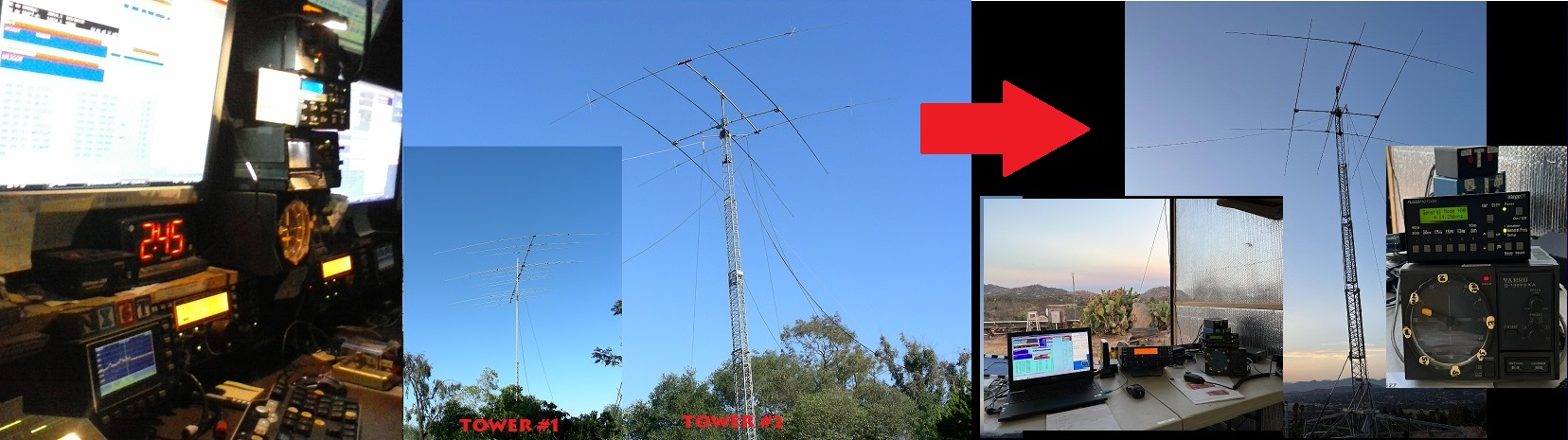
"Cliffside" station in Southern California.  The antennas for this site is "Tower 1" from the site in Fallbrook that NX6T used to run contests from, now parked at the Cliffside location.  We've not
yet setup any power amplifiers at this location, relegating us to run the JIDX GiG as a Multi-Single
low power (LP) station.  Our bay area rival (K3EST) was [hopefully] running as a Multi-2 station. 
Because the JA turnout was so poor, it turns out that we worked everyone could hear. 
"Hearing" was our problem, not them being able to hear us.  Having used an amplifier
would've made little difference.

For JIDX, on Saturday, the 2am slot ALWAYS flushes out the weird JAMMERS; not surprising when you consider that Billy-Bob (end his brother Barney) is just waking up on the east coast and looking for someone to antagonize.  The Jammer for this GiG was playing-back a delayed recording of my CQ call, but with a weird echo on it.  Luckily, Billy-Bob quickly got BORED with this and went back
to bed.  Ya' gotta acknowledge this guy's amazing use of technology.  Wouldn't it be nice if it could
be used for something constructive?

At 13:50z just before I shut things down for the morning, my run frequency became inundated with data bursts and a "WHOOP" sound.  Stations moving in on the run frequency prompted jumping around between 7.175, 7.176, 7.177 and then back again.  The weird thing was hearing the famed JE1CKA running a JIDX frequency on 7124.10, with virtually no takers.  How could there be? 
USA stations are not allowed to transmit Ssb below 7.125 - OOPS.  If he absolutely wanted to,
he could run-SPLIT, listening above 7.125.

Because a successful WAE GiG involves the successful of transmission of QTC "books"
(essentially, header messages about QSOs made previously), finding non-North American
openings at the precise time are CRUCIAL to delivering QTC traffic; there's nothing worse
than ending any WAE contest with a significant number of undelivered QTC messages.

As Saturday evening wore, on the band segments seemed to thin out in W6-Land, altho the
bandmap was consistently loaded w/EU SPOTS (spotted by other EU stations).  Out of boredom,
I noticed that the OK/OM contest was in full operation, at least on 40 meters (as 20-meters was dead on the West coast).  Seeing activity prompted me to configure a log for this GiG and make a few calls.  After 2-QSOs, the remaining spot-entries were spots by other EU stations, which of course does us no good.  At least by submitting a 2-QSO 40-meter log, I was able to post a 3-contest weekend on the 3830-Scores Website for WQ6X.

Running the Sunday morning shift for the last 3 contest hours (from 2am to 5am) was a SLOW grind, altho at least more QSOs were made than N6KI's 5-QSO 2.5-hour shift before me.  I couldn't wait for the 5am contest-end, rescuing me from Billy-Bob, his brother Barney and their cousins Bubba and Bozo who wanted to ragchew and didn't care that anyone was already using their "favorite frequencies" ("we've been meeting on this frequency every Sunday morning for the last 10 years,
and YOU should already know that".).  While the Shorty-40 yagi was pointed at 310-degrees to Asia, with only a 20-db F/B ratio, those idiots (running kilowatts to QSO 150-miles away) were pointing RIGHT AT US.

After some sleep, the rest of the WAE RTTY contest was spent mostly on 10- and 15-meters running frequencies (my CQ message said "I have QTC") while desperately trying to dump QTC traffic to those stations eager to relieve me of 1-QTC books.  When it was all over, I was stuck with 52 undelivered QTC messages; about the same as last year - Bummer DewD!

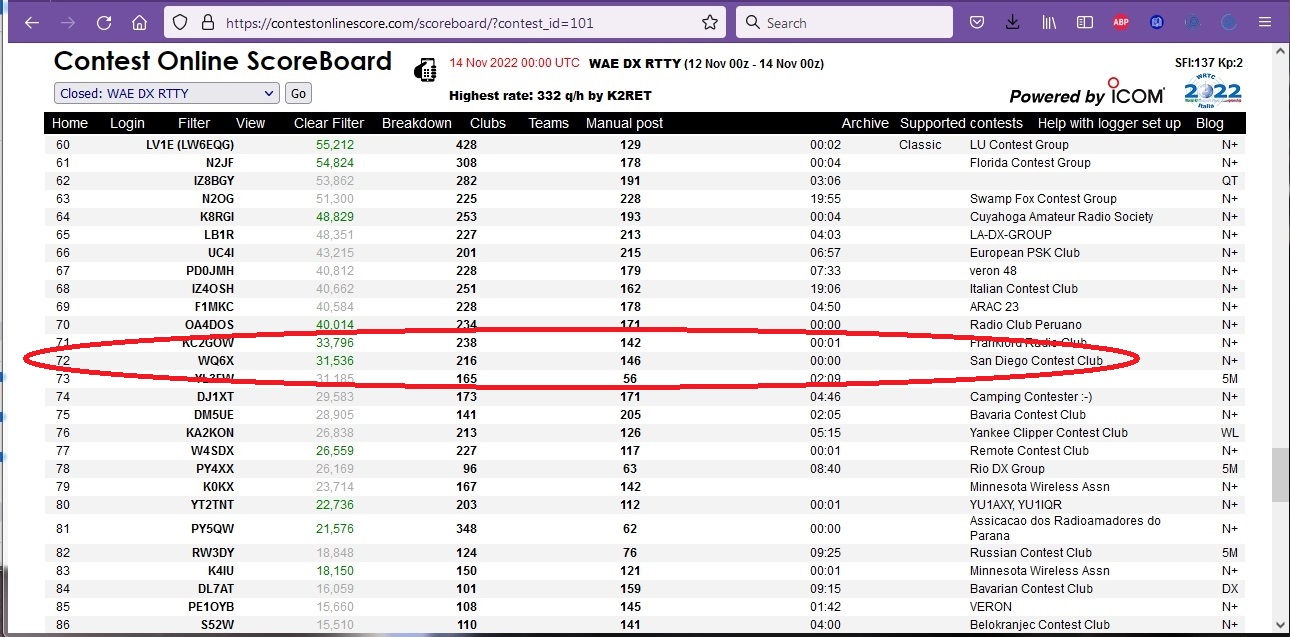
When it was all over, according to the online Scoreboard, WQ6X ended up in 72nd place worldwide.

DiD YOU work the WAE RTTY and/or JIDX Ssb contest?

Is WQ6X (or NX6T) in YOUR Log?

WQ6X Successfully Operates a 1st-time triple-OP Sweepstakes

Emboldened by the successful [multi-mode] triple-OP of the 2022 California QSO Party,
the next-in-line goal was to recreate that success for the Cw November Sweepstakes event. 
Similar to CQP, a lot of preparation was necessary to set up and test two logfiles and two sets
of function key macros.
For the 2022 Cw Sweepstakes there were several goals:
  • Take 1st-Place for East Bay (EB) section and PAC Division running
    as W6Q at the 100-watt power level.
  • Take 1st-Place for East Bay (EB) section and PAC Division running
    as WQ6X at the 5-watt (QRP) power level.
  • Set a new Cw Sweepstakes QRP record for the East Bay (EB) section.
  • Put in enough remote hours towards assisting NX6T to a multi-OP Single-xmtr win

In order to make all this work, timing would be everything, hopefully keeping any system catastrophes down to an absolute minimum; at the very least, with no "Blue Screens" happening throughout the entire weekend.  ALSO, remember that Sweepstakes handling exercise - it's STILL about getting
the message thru.

The challenge to a triple-OP operation is actually a dual-OP challenge, as the 3:30am to 6am and
the 3pm to 5pm slots were assigned well in advance of the contest weekend.  Outside of sleep and those 5.5-hours, which band to run and which mode (LP or QRP) was largely empirical guesswork; altho a number of times when I worked a particular multiplier at a given power-level, I would then switch to the "other" log (WQ6X & W6Q), shift the frequency offset slightly and call-in again.

The BiG pleasant surprise was how wide-open 10-meters was.  For BoTh callsigns, 10-meters
was THE band, followed by 40-meters.  As of late, 20-meters is the surprisingly non-producing band. 
A major focus for the Sweepstakes weekend was to become clear about the actual merits of running
5-watts (QRP).  
While breaking pile-ups is not likely to happen, later in the contest, when everybody has worked
those stations, leaving them desperate for new/unique callsigns.  Once in a while they call me as VY1AAA  DiD mid Saturday afternoon.  Being a domestic contest, sweeping the 10-meter yagi was
only necessary from 0-degrees to 100-degrees.

Sunday afternoon the REAL challenge was once again whether to run as W6Q or WQ6X.  
Then again, after the contest, the discovery made that I had over-analyzed things, not putting
enough time on-the-air as WQ6X.  While a 1st-place was secured for East Bay (EB), WQ6X
missed setting a new record by ~2.5k points while taking a 2nd-place for the Pacific Division.


DiD YOU Participate in the 2022 November Sweepstakes Cw Contest?

Is W6Q, WQ6X or NX6T in YOUR LoG?

Friday, November 11, 2022

What I Think about WAE


The WAE (Worked All Europe)radiosport GiG are, to me, an interesting conundrum. 
The Cw/Ssb variants of this contest remind me of an ARRL/CQ Dx contest (however ONLY
with European stations), with the addition of passing what are known as QTC messages. 
The RTTY variant of the WAE contest (in November) is more akin to February's WPX RTTY
contest, as we are allowed to work any RTTY station anywhere (for any reason); altho QTC
messages can ONLY be sent to stations on another continent.

Point-wise in WAE, instead of QSOs being worth 2-points (as in Dx/WPX contests), each contact
is worth only 1-point.  The 2nd-point is earned by sending a QTC message about this contact to
an EU station - unsent QTC's are points LOST, which is why there are desperate QTC solicitations during the final hours of the WAE contest.  I've often joked that there is more QTC traffic sent in the last 2-hours than actual QSOs made.

Contest-wise, WAE is relatively new to me.  Most SF East Bay QTH's I have operated from experience relatively weak signals from Europe.  For WQ6X, WAE as a possibility wasn't really possible until I discovered the November WAE RTTY contest.  

Were it not for the CTRL-Z invoked QTC message passing facility built-in to the N1MM+
contest software, I probably would NoT give WAE RTTY a consideration.  However, CTRL-Z
automates the traffic exchange beautifully, requiring only an intelligent use of the mouse for each "book" of messages sent.  Essentially, a QTC message is a message to another amateur station
(on another continent) detailing a QSO exchange made earlier in the contest; in other words, a QSO message describing a QSO message.

In recent years, I have found RTTY contests to be more attractive because I can save my voice
and I don't have to copy Morse code in my head.  Running the Yaesu FT-2000 (and previously the
FT-1000mp), these transceivers are robust enough to run at a full-duty 100-watt power-level; unlike most other radios which are recommended to be run at 1/2 of their full-power capability.

In my opinion, the November Sweepstakes (SS) and Worked All Europe (WAE) contests are excellent traffic handling training exercises.  While there is no longer a RTTY Sweepstakes contest per se', its replacement is more-or-less the RTTY Roundup (RTTY RU) event, the 1st radiosport GiG held in January of each year.

With the current military conflict happening with Ukraine, any European-based contest is tricky
at best.  Because of the conflict, several EU contests have been cancelled (or severely modified) throughout 2022 contest year.   In my mind, this is further reason to support the WAE events - letting the Europeans know that we support their radiosport efforts, regardless of anything "political" that may be going on.

What about YOU?
Do you support European contests in general and the WAE in particular?

Show your support by telling me about it.


Friday, November 4, 2022

Single-OP Two Stations (SO2S)


I often dual-OP more popular radiosport contests, like the DX contests and WPX GiGs. 
As a part of team-NX6T, I often run the "dinner shifts" followed by a sleep break followed
by the 2am to 5am GiGs, while the other OPs are sleeping.  For 5 years I used to make
the 900-mile round-trip drive for every contest.  Eventually I got tired of driving and switched
to taking the Oakland to Oceanside Amtrak run; it took the same amount of time, yet now
I could sleep, software design or compose contest Blog material like this one.

My last onsite appearance in Fallbrook was the WPX Cw contest the end of May in 2017.
I wrote a Weird Blog about this Weird Prefix event.  I had already been running NX6T in Fallbrook remotely during less popular radiosport contest events using the VNC viewer and the RCForb

software app to control the Elecraft K3 on the other end.  Currently, VNC Viewer is still our VPN
of choice.  To actually control the radio, I use a K3/0-Mini arrangement from my Alameda office
and the original K3/0 from my portable operation in Concord.

During major contests, in between the dinner and graveyard shifts, I put WQ6X on the air in
that same contest (and other minor GiGs that might also be happening that weekend), as well
as finding blocks of time for sleeping amidst all the pandemonium.  


The difference in reception quality between Concord, Fallbrook and Anza is often quite striking. 
Receivers in Anza often hear low-level layers of signals that I can only dream about in Concord. 
Then again, Concord is more-or-less positionally closer to most of Asia, altho Anza being on top
of a mountain has the advantage of elevation.


Of course, the caveat of running stations remotely is internet latency.  With the portable setup
at the Concord location I often experience periodic pulsing of the internet connection, which
can disrupt Cw/Ssb audio.  With RTTY, the decoded text is always available on the VNC screen. 
DX hounds and radiosport operators have spurred the technological advances in our radio world enabling worldwide SDR and beacon networks, as well as what I call ROIP (Radio Over Internet Protocol).

I contend that radiosport contesting can actually be a form of Emergency Preparedness training.
By running dual-OP operations, I receive TWICE the training in a single radiosport weekend. 

One weekend I actually accomplished a Triple-OP operation when I remoted into N6GEO's
radio on Friday/Saturday and then into NX6T in Anza on Saturday/Sunday, in addition to running
as WQ6X directly from Concord.  Theoretically, I could've run a Quad-OP or even Quint-OP operation. 

More recently a full-blown legitimate Triple-OP occurred during the California QSO Party.  
My goal was actually 2-part:

  • Running as K6Q, beat the Contra Costa County record, I set back in 2017 as K6T.
  • Set a first-time county QRP record running as WQ6X.

BOTH of those goals were accomplished.  Things flowed so near-flawlessly that I am now compelled to repeat this triple-OP concept for the 2022 November Sweepstakes Cw contest.   In addition to remoting in for NX6T, look for W6Q to run 100-watts from East Bay (EB) Section, interspersed
with WQ6X running 5-watts, also from the East Bay Section.

Running as 4x-OP would require 3x IP-address setup and testing before the actual remote operation.  While a bit more complex, if you can run SO2-R, you can run 4xOP - it's simply requires learning new forms of the radio juggling act. 

What about YOU?

Have you ever dual-OP'd or Triple-OP'd a radiosport weekend?

How DiD it turn out?


WQ6X thoughts on POKING-Around for Pirates

One of the more obscure yet fascinating aspects of shortwave listening is listening for Pirate
stations: [usually] low power stations that while technically illegal operations, often present some amazingly good radio programming.

For over 60+ years, radio magazines have reported listeners reports of pirate station activity.  Because most pirate activity originates from the east/Northeast sector of the United States,
most log submissions originate from those areas of the USA.  Altho there are reports of pirate
activity on the West coast, reports are [relatively] quite rare.  With all that said, following the
listening recommendations over the years, until one month ago, I've yet to actually hear an actual
Pirate broadcast.

The [so-called] "rule-of-thumb" id that most pirate broadcasts originate on Friday / Saturday evenings in one of three (3) so-called "Pirate broadcast band segments".  Recently, one Sunday evening on 6.920 USB at 02:00z, I heard an ID playout for "Black Star Radio" with the callsign "WDOG" sent
in Morse code (CW) afterwards.

Just up the band (on 6.935 AM), various pieces of orchestral and chorale music played on for hours, but with no transmission ID.  LooKing up 6.935 on Shortwave.Info, produced no "official" listings for that frequency - PERIOD.

Later @05:20z back on 6.920 I heard music by Deadmau5 (again with no ID), transmitting in LSB with a medium-level carrier present.  Later still (@06:25z) on AM, music was being played, interspersed with "Radio PUSH con website"; whatever that means.  It was eventually drowned-out by machine gun radar operating on 6.910.

The 6.9-mhz area (42m) is a known hangout for pirate sightings.  Another area is the 7.4 to 7.5 Mhz area (39m).  Other areas likely to host pirate broadcasts are frequently documented in such publications as the Spectrum Monitor ([CLICK HERE]), one of my favorites.

There are also many pirate (i.e., unlicensed station operations) littered throughout the FM broadcast band.  The FCC has convinced Congress to give them even more (unenforceable) enforcement power with the Pirate act of 2020, which is as worthless as the Electronic Communication Privacy Act (ECPA) of 1986.  I recently submitted an op-ed piece to Radio World magazine about this situation: "Pirate Hunting LooKs GooD on Paper" ([CLICK HERE] to read my submission.).

Do YOU ever go Pirate Hunting?

What nefarious stations have YOU heard?


Some Sweeping Thoughts about sweeping-up in Sweepstakes

It is no secret that the November Sweepstakes contest (Cw 1st, Phone 2nd) is my FAVorite radiosport event.  Sweepstakes has encountered a handful of incarnations since its introduction to the operator world, way back in 1929.
 
While officially radiograms are no longer sent per se', the radiogram header is the core of ALL traffic handling and therefore worthy o reinforcement, which is why I still view the November Sweepstakes contest as an emergency preparedness training exercise.

My first exposure to Sweepstakes (SS) was the Cw event, I played around in when I was 19 years old.  Over the years, I have found opportunities to run SS from QTH's in Livermore and San Jose (California), Cincinnati and w/K8CX in Northeast Ohio (1992).  Beginning in 1998, running Sweepstakes from the SB section (Ojai Valley) became an obsession - in those days,
SB section was on the Top-ten list of most-needed ARRL sections.

WQ6X.Info/Sweepstakes documents WQ6X operations from that period to today's portable setup @W7AYT's QTH in the SF East Bay (EB) section.  Numerous WQ6X contest blogs have been written about Sweepstakes.  From those blog entries it is clear that I've experienced a number of different ways to run a Sweepstakes event.  ([CLICK HERE] to see a search of some of the relevant WQ6X blog entries about Sweepstakes.)

Because Sweepstakes was (and still is) a traffic handling exercise, for me, it's all about improvement in operating acumen, leveraging as many distinct aspects of technology in order to get the message (headers) through.  Use of software macros and Cw keyer memories (built-in to the FT-2000), transmit data is the same for exchange sent.

In recent years, I have dual-OP'd Sweepstakes events, dividing the 30-hours of available op-time between WQ6X as SOALP from the ARRL EB section, while putting in time running remotely for the NX6T Multi-single operations.  

For CQP this year, I tried "something completely different" (quoting Monty Python).  I ran K6Q at the 100-watt level and put in some time for NX6T.  However, in between these op-periods I put WQ6X
on the air as a QRP station (dialing the FT-2000 down to its 5-watt minimum).  NoT surprisingly,
when switching logs back to K6Q, sometimes I would forget to turn the power-level back up to
100-watts - Oops.  The amazing thing was being able to exchange an exchange anyway.

For me, radiosport is all about trying new ideas, all in the name of emergency preparedness. 
I operate by a rather unique edict: "When in Doubt CHEAT (but within the rules)"; running a
dual-OP and triple-OP operation is clearly within the rules.

Do YOU operate the November Sweepstakes?
What unique operating setups have YOU been a part of?

Do YOU ever Cheat within the rules?


Tuesday, November 1, 2022

Encountering UTE's in the Amateur Bands


Thus far, I have written about UTE's that technically are scattered about the HF shortwave spectrum.  However, there are a handful of not-insignificant UTE stations that Pop-Up in the amateur bands; some are even permanent residents.

Case in point: while running a 75-meter frequency (3737.37) in the 2022 CQ W.W. Ssb contest,
an Asian WoODPecker showed up EXACTLY zero-beat with my run frequency - this was clearly
no accident.  Consulting the KFS webSDR confirmed its presence and location.  As you can see,
the radar pulses created an annoying background disturbance.  Switching the 80-mewter 4-Square, the signal was not heard in the N/E, S/E & S/W directions; however, switching the array back to N/W, the woodpecker came in LOUD and CLEAR.

Also that evening, while running 3747.47, just outside the K3 passband, I heard what sounded like
Cw TFFC being handled.  Then I remembered this is a frequency [evidently] claimed for use by the Chinese/Russian air force exercises - why they think the middle of the 75-meter phone band is an
OK place to conduct their exercises is beyond me.  As you can see from the above picture, I've written about this before.

Another Russian military intrusion into the amateur bands are the propagation beacons which permanently reside on ~7.039.  Initially I objected to these beacons until it occurred to me that
they can be useful predictions of
band openings to eastern Asia on
40-meters in the middle of the night.

While it is a fact that the HF frequency spectrum is a shared resource, it is also true that proper ethical decorum dictates that amateur frequency allocations should be for amateur use ONLY and NoT intruded upon for commercial or military purposes, except MAYBE in a REAL emergency situation.

I've mentioned before that during Ssb radiosport events we also encounter an influx of RTTY stations in segments of the band that are reserved exclusively for amateur voice communications (or Cw); while RTTY signal operations are technically NoT permitted.  Most annoying is what I call the "data cranker" - some sort of RTTY or FAX signal that sounds like someone manually cranking out data.

Overall, most UTE incursions on the amateur bands seem to occur [relatively] late at night (West Coast time at any rate), confirming that they are of foreign (i.e., non-U.S.) origin.  Because of this, filing reports w/the FCC or Official Observer personnel is probably a waste of time, altho the IARU monitoring people ARE interested; at least back in 2018, at any rate.

In most cases we are fortunate to have plenty of unused band spectrum available to work around many of these incursions.  However, when they specifically target a frequency I have been using
for over an hour, that riles my hackles.

Have YOU ever encountered UTE's in the amateur bands?

Tell us about it.

Why UTE's are Alright with ME


Many radio amateurs got their start as shortwave listen listeners, not just shortwave broadcasting,
but also listening to what are known colloquially known as UTE's - Utility stations.  UTE's encompass many different radio services, from military and weather-related (on one extreme) to Numbers stations and clandestines (at the other extreme).  The well-known frequency std. stations (such as WWV & WWVH and CHU) also provide time-of-day information.  As I have written in the past, there are also propagation beacons littered throughout the HF spectrum.


Popular Electronics and Popular Communications developed a registered monitor program. 
I even received a uniquely assigned monitor ID from Popular Communications: WPC6RF.

It might surprise you to know that there are many amateur advantages to engaging in shortwave listening.  Some of these advantages include:

  • It improves overall listening skills.
  • Learning to spot in-band "intruders".
  • Receive parallel indications of propagation.
  • Learning improved use of IF/DSP/AF filter combinations.
  • Time std. stations are a form of UTE whether by std. receiver or SDR.
  • Offers another perspective relating to the overall global situation, as still
    reflected in the HF SW spectrum.
  • Encourages listening to SDR receivers around the world for better reception of an initially heard UTE.  My FAV SDR's include TWENTE, HALF-Moon Bay and Northern Utah.

Number stations and CW UTE's are quietly littered throughout the SW spectrum.  Spinning the
dial on your shortwave receiver or tuning around on one of the many SDR receivers on the internet
will bring you all kinds of different UTE's.  Many may sound confusing to you.  


Case in point for me was the DW Cw beacon I stumbled onto via the Hal Moon Bay SDR. 
I noticed that the ID happened every minute and approximately every 5 minutes a set of
numbers were sent, I have yet to decipher, even tho I wrote some of the numbers down. 
BTW, notice how CLOSE the DW beacon is to CHU - the Canadian time standard station. 

Using the DW beacon, listen frequently, making detailed notes about what you hear:

 - Noting the time of day, can give clues to as
   to the specifics of what the station is about. 

- Notice here that 3 types of data is sent:
  BAT, OTMP & ITMP.

- There may be a correlation between the data
   sent and the time of day.  Daily monitoring
   for awhile will give us additional information.

- When there is uncertainty about a given
   station, sometimes listening on another
   receiver or SDR can give us some clues
   as to what the stations is all about.

- In specialty magazines (such as Spectrum
Monitor
) other readers made have reported
  the same station and provide you with
  more/detailed information.


Events around the world change, virtually every day.  Sometimes political happening around the world can have an effect on different UTE stations.  While a given/band or frequency may be quiet today, tomorrow, there could easily be a flood of station activity.  For that reason, I have been keeping an eye on the European Russian beacons.  Look for a followup on those beacons.


Additionally, Pirate stations make their own schedules separate from the geopolitical situations
going on around the globe.  Knowing when/where to listen for them can reward you with all
manner of interesting listening.

While numerous shortwave broadcast stations have ceased shortwave broadcasting,
the HF shortwave spectrum remains LOADED with interesting things to listen to. 
Some listeners want only pre-programmed programming on the radio. 
Speaking for the rest of us: "UTE's are alright with me!"

Do YOU listen for UTE's on shortwave?

What unique stations have YOU heard?