Friday, November 4, 2022

Single-OP Two Stations (SO2S)


I often dual-OP more popular radiosport contests, like the DX contests and WPX GiGs. 
As a part of team-NX6T, I often run the "dinner shifts" followed by a sleep break followed
by the 2am to 5am GiGs, while the other OPs are sleeping.  For 5 years I used to make
the 900-mile round-trip drive for every contest.  Eventually I got tired of driving and switched
to taking the Oakland to Oceanside Amtrak run; it took the same amount of time, yet now
I could sleep, software design or compose contest Blog material like this one.

My last onsite appearance in Fallbrook was the WPX Cw contest the end of May in 2017.
I wrote a Weird Blog about this Weird Prefix event.  I had already been running NX6T in Fallbrook remotely during less popular radiosport contest events using the VNC viewer and the RCForb

software app to control the Elecraft K3 on the other end.  Currently, VNC Viewer is still our VPN
of choice.  To actually control the radio, I use a K3/0-Mini arrangement from my Alameda office
and the original K3/0 from my portable operation in Concord.

During major contests, in between the dinner and graveyard shifts, I put WQ6X on the air in
that same contest (and other minor GiGs that might also be happening that weekend), as well
as finding blocks of time for sleeping amidst all the pandemonium.  


The difference in reception quality between Concord, Fallbrook and Anza is often quite striking. 
Receivers in Anza often hear low-level layers of signals that I can only dream about in Concord. 
Then again, Concord is more-or-less positionally closer to most of Asia, altho Anza being on top
of a mountain has the advantage of elevation.
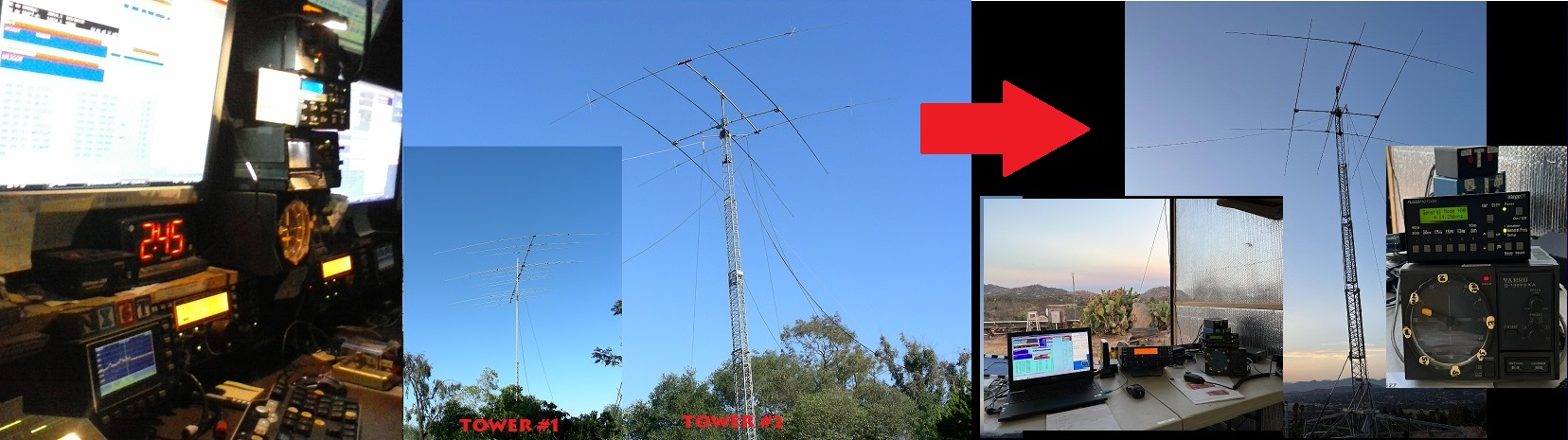


Of course, the caveat of running stations remotely is internet latency.  With the portable setup
at the Concord location I often experience periodic pulsing of the internet connection, which
can disrupt Cw/Ssb audio.  With RTTY, the decoded text is always available on the VNC screen. 
DX hounds and radiosport operators have spurred the technological advances in our radio world enabling worldwide SDR and beacon networks, as well as what I call ROIP (Radio Over Internet Protocol).

I contend that radiosport contesting can actually be a form of Emergency Preparedness training.
By running dual-OP operations, I receive TWICE the training in a single radiosport weekend. 

One weekend I actually accomplished a Triple-OP operation when I remoted into N6GEO's
radio on Friday/Saturday and then into NX6T in Anza on Saturday/Sunday, in addition to running
as WQ6X directly from Concord.  Theoretically, I could've run a Quad-OP or even Quint-OP operation. 

More recently a full-blown legitimate Triple-OP occurred during the California QSO Party.  
My goal was actually 2-part:

  • Running as K6Q, beat the Contra Costa County record, I set back in 2017 as K6T.
  • Set a first-time county QRP record running as WQ6X.

BOTH of those goals were accomplished.  Things flowed so near-flawlessly that I am now compelled to repeat this triple-OP concept for the 2022 November Sweepstakes Cw contest.   In addition to remoting in for NX6T, look for W6Q to run 100-watts from East Bay (EB) Section, interspersed
with WQ6X running 5-watts, also from the East Bay Section.

Running as 4x-OP would require 3x IP-address setup and testing before the actual remote operation.  While a bit more complex, if you can run SO2-R, you can run 4xOP - it's simply requires learning new forms of the radio juggling act. 

What about YOU?

Have you ever dual-OP'd or Triple-OP'd a radiosport weekend?

How DiD it turn out?


WQ6X thoughts on POKING-Around for Pirates

One of the more obscure yet fascinating aspects of shortwave listening is listening for Pirate
stations: [usually] low power stations that while technically illegal operations, often present some amazingly good radio programming.

For over 60+ years, radio magazines have reported listeners reports of pirate station activity.  Because most pirate activity originates from the east/Northeast sector of the United States,
most log submissions originate from those areas of the USA.  Altho there are reports of pirate
activity on the West coast, reports are [relatively] quite rare.  With all that said, following the
listening recommendations over the years, until one month ago, I've yet to actually hear an actual
Pirate broadcast.

The [so-called] "rule-of-thumb" id that most pirate broadcasts originate on Friday / Saturday evenings in one of three (3) so-called "Pirate broadcast band segments".  Recently, one Sunday evening on 6.920 USB at 02:00z, I heard an ID playout for "Black Star Radio" with the callsign "WDOG" sent
in Morse code (CW) afterwards.

Just up the band (on 6.935 AM), various pieces of orchestral and chorale music played on for hours, but with no transmission ID.  LooKing up 6.935 on Shortwave.Info, produced no "official" listings for that frequency - PERIOD.

Later @05:20z back on 6.920 I heard music by Deadmau5 (again with no ID), transmitting in LSB with a medium-level carrier present.  Later still (@06:25z) on AM, music was being played, interspersed with "Radio PUSH con website"; whatever that means.  It was eventually drowned-out by machine gun radar operating on 6.910.

The 6.9-mhz area (42m) is a known hangout for pirate sightings.  Another area is the 7.4 to 7.5 Mhz area (39m).  Other areas likely to host pirate broadcasts are frequently documented in such publications as the Spectrum Monitor ([CLICK HERE]), one of my favorites.

There are also many pirate (i.e., unlicensed station operations) littered throughout the FM broadcast band.  The FCC has convinced Congress to give them even more (unenforceable) enforcement power with the Pirate act of 2020, which is as worthless as the Electronic Communication Privacy Act (ECPA) of 1986.  I recently submitted an op-ed piece to Radio World magazine about this situation: "Pirate Hunting LooKs GooD on Paper" ([CLICK HERE] to read my submission.).

Do YOU ever go Pirate Hunting?

What nefarious stations have YOU heard?


Some Sweeping Thoughts about sweeping-up in Sweepstakes

It is no secret that the November Sweepstakes contest (Cw 1st, Phone 2nd) is my FAVorite radiosport event.  Sweepstakes has encountered a handful of incarnations since its introduction to the operator world, way back in 1929.
 
While officially radiograms are no longer sent per se', the radiogram header is the core of ALL traffic handling and therefore worthy o reinforcement, which is why I still view the November Sweepstakes contest as an emergency preparedness training exercise.

My first exposure to Sweepstakes (SS) was the Cw event, I played around in when I was 19 years old.  Over the years, I have found opportunities to run SS from QTH's in Livermore and San Jose (California), Cincinnati and w/K8CX in Northeast Ohio (1992).  Beginning in 1998, running Sweepstakes from the SB section (Ojai Valley) became an obsession - in those days,
SB section was on the Top-ten list of most-needed ARRL sections.

WQ6X.Info/Sweepstakes documents WQ6X operations from that period to today's portable setup @W7AYT's QTH in the SF East Bay (EB) section.  Numerous WQ6X contest blogs have been written about Sweepstakes.  From those blog entries it is clear that I've experienced a number of different ways to run a Sweepstakes event.  ([CLICK HERE] to see a search of some of the relevant WQ6X blog entries about Sweepstakes.)

Because Sweepstakes was (and still is) a traffic handling exercise, for me, it's all about improvement in operating acumen, leveraging as many distinct aspects of technology in order to get the message (headers) through.  Use of software macros and Cw keyer memories (built-in to the FT-2000), transmit data is the same for exchange sent.

In recent years, I have dual-OP'd Sweepstakes events, dividing the 30-hours of available op-time between WQ6X as SOALP from the ARRL EB section, while putting in time running remotely for the NX6T Multi-single operations.  

For CQP this year, I tried "something completely different" (quoting Monty Python).  I ran K6Q at the 100-watt level and put in some time for NX6T.  However, in between these op-periods I put WQ6X
on the air as a QRP station (dialing the FT-2000 down to its 5-watt minimum).  NoT surprisingly,
when switching logs back to K6Q, sometimes I would forget to turn the power-level back up to
100-watts - Oops.  The amazing thing was being able to exchange an exchange anyway.

For me, radiosport is all about trying new ideas, all in the name of emergency preparedness. 
I operate by a rather unique edict: "When in Doubt CHEAT (but within the rules)"; running a
dual-OP and triple-OP operation is clearly within the rules.

Do YOU operate the November Sweepstakes?
What unique operating setups have YOU been a part of?

Do YOU ever Cheat within the rules?


Tuesday, November 1, 2022

Encountering UTE's in the Amateur Bands


Thus far, I have written about UTE's that technically are scattered about the HF shortwave spectrum.  However, there are a handful of not-insignificant UTE stations that Pop-Up in the amateur bands; some are even permanent residents.

Case in point: while running a 75-meter frequency (3737.37) in the 2022 CQ W.W. Ssb contest,
an Asian WoODPecker showed up EXACTLY zero-beat with my run frequency - this was clearly
no accident.  Consulting the KFS webSDR confirmed its presence and location.  As you can see,
the radar pulses created an annoying background disturbance.  Switching the 80-mewter 4-Square, the signal was not heard in the N/E, S/E & S/W directions; however, switching the array back to N/W, the woodpecker came in LOUD and CLEAR.

Also that evening, while running 3747.47, just outside the K3 passband, I heard what sounded like
Cw TFFC being handled.  Then I remembered this is a frequency [evidently] claimed for use by the Chinese/Russian air force exercises - why they think the middle of the 75-meter phone band is an
OK place to conduct their exercises is beyond me.  As you can see from the above picture, I've written about this before.

Another Russian military intrusion into the amateur bands are the propagation beacons which permanently reside on ~7.039.  Initially I objected to these beacons until it occurred to me that
they can be useful predictions of
band openings to eastern Asia on
40-meters in the middle of the night.

While it is a fact that the HF frequency spectrum is a shared resource, it is also true that proper ethical decorum dictates that amateur frequency allocations should be for amateur use ONLY and NoT intruded upon for commercial or military purposes, except MAYBE in a REAL emergency situation.

I've mentioned before that during Ssb radiosport events we also encounter an influx of RTTY stations in segments of the band that are reserved exclusively for amateur voice communications (or Cw); while RTTY signal operations are technically NoT permitted.  Most annoying is what I call the "data cranker" - some sort of RTTY or FAX signal that sounds like someone manually cranking out data.

Overall, most UTE incursions on the amateur bands seem to occur [relatively] late at night (West Coast time at any rate), confirming that they are of foreign (i.e., non-U.S.) origin.  Because of this, filing reports w/the FCC or Official Observer personnel is probably a waste of time, altho the IARU monitoring people ARE interested; at least back in 2018, at any rate.

In most cases we are fortunate to have plenty of unused band spectrum available to work around many of these incursions.  However, when they specifically target a frequency I have been using
for over an hour, that riles my hackles.

Have YOU ever encountered UTE's in the amateur bands?

Tell us about it.

Why UTE's are Alright with ME


Many radio amateurs got their start as shortwave listen listeners, not just shortwave broadcasting,
but also listening to what are known colloquially known as UTE's - Utility stations.  UTE's encompass many different radio services, from military and weather-related (on one extreme) to Numbers stations and clandestines (at the other extreme).  The well-known frequency std. stations (such as WWV & WWVH and CHU) also provide time-of-day information.  As I have written in the past, there are also propagation beacons littered throughout the HF spectrum.


Popular Electronics and Popular Communications developed a registered monitor program. 
I even received a uniquely assigned monitor ID from Popular Communications: WPC6RF.

It might surprise you to know that there are many amateur advantages to engaging in shortwave listening.  Some of these advantages include:

  • It improves overall listening skills.
  • Learning to spot in-band "intruders".
  • Receive parallel indications of propagation.
  • Learning improved use of IF/DSP/AF filter combinations.
  • Time std. stations are a form of UTE whether by std. receiver or SDR.
  • Offers another perspective relating to the overall global situation, as still
    reflected in the HF SW spectrum.
  • Encourages listening to SDR receivers around the world for better reception of an initially heard UTE.  My FAV SDR's include TWENTE, HALF-Moon Bay and Northern Utah.

Number stations and CW UTE's are quietly littered throughout the SW spectrum.  Spinning the
dial on your shortwave receiver or tuning around on one of the many SDR receivers on the internet
will bring you all kinds of different UTE's.  Many may sound confusing to you.  


Case in point for me was the DW Cw beacon I stumbled onto via the Hal Moon Bay SDR. 
I noticed that the ID happened every minute and approximately every 5 minutes a set of
numbers were sent, I have yet to decipher, even tho I wrote some of the numbers down. 
BTW, notice how CLOSE the DW beacon is to CHU - the Canadian time standard station. 

Using the DW beacon, listen frequently, making detailed notes about what you hear:

 - Noting the time of day, can give clues to as
   to the specifics of what the station is about. 

- Notice here that 3 types of data is sent:
  BAT, OTMP & ITMP.

- There may be a correlation between the data
   sent and the time of day.  Daily monitoring
   for awhile will give us additional information.

- When there is uncertainty about a given
   station, sometimes listening on another
   receiver or SDR can give us some clues
   as to what the stations is all about.

- In specialty magazines (such as Spectrum
Monitor
) other readers made have reported
  the same station and provide you with
  more/detailed information.


Events around the world change, virtually every day.  Sometimes political happening around the world can have an effect on different UTE stations.  While a given/band or frequency may be quiet today, tomorrow, there could easily be a flood of station activity.  For that reason, I have been keeping an eye on the European Russian beacons.  Look for a followup on those beacons.


Additionally, Pirate stations make their own schedules separate from the geopolitical situations
going on around the globe.  Knowing when/where to listen for them can reward you with all
manner of interesting listening.

While numerous shortwave broadcast stations have ceased shortwave broadcasting,
the HF shortwave spectrum remains LOADED with interesting things to listen to. 
Some listeners want only pre-programmed programming on the radio. 
Speaking for the rest of us: "UTE's are alright with me!"

Do YOU listen for UTE's on shortwave?

What unique stations have YOU heard?


Monday, October 31, 2022

Stereo Ssb: It's STILL Easier than you Think

For WQ6X, the use of stereo receive audio has revolutionized station operations, especially
when it comes to running radiosport contest events.  While stereo-Cw makes for most stereo
audio processing, I have also found dual-channel audio separation to be effective when running
RTTY contests; and yes, even in Ssb GiGs.  Here is what I have said about it before:

  • [X] - Stereo Cw: It's easier than you think
  • [X] - Stereo Cw: Advancing the Art of Equalization
  • [X] - Stereo RTTY - Is it Possible?
  • [X] - Stereo Cw - Enhancing your FAVorite Radio receiver
  • [X] - How Stereo-Cw becomes Stereo Ssb
  • [X] - Stereo Cw - Learning to Navigate PILE-Ups

Yes, I have found many ways to leverage the stereo audio facility built-in to the Yaesu FT-1000mp, and now this year, the Yaesu FT-2000.  While I have used many different audio filters and DSP units, the Autek QF-1A SSB/Cw AM Filter is in a sense the most versatile of all the filters.  

For the 2022 CQ W.W. Ssb contest, I used a pair of QF-1A's to process the dual-receive audio
from the Yaesu FT-2000 and the remote audio from the K3/0.  As I said in my write-up about the event, the QF-1A's provided notch-filtering and audio shaping that neither the Yaesu or the Elecraft transceivers could match.

With Stereo-Cw, the goal is to have stations arrayed audio-wise around the more-or-less 180-degree (left-to-right) listening experience.  With Stereo Ssb, the goal was to process the audio differently in the left and right ears to make a given voice become readable. 

Bottom-Line: Stereo audio processing can be JUST as useful for Ssb operation as it can be for Cw and RTTY.  And, with devices like the Autek QF-1A's I get more knobs to twiddle, enforcing the illusion that every signal can be copied through all manner of uncomfortable conditions.

Have YOU ever run stereo audio processing in your station operations?

How DiD it work out for YOU?


WQ6X Works the World TWICE in CQ World-Wide Contest

This last weekend took advantage of radio/internet technology at all levels; not only in Anza but equally from my portable setup at W7AYT's Concord QTH.  Anza being a fully featured SO2-R capable station allowed for 2-separate contest operations (N7NR & VE4EA on Stn-1 and N6KI & WQ6X on Stn-2) to run simultaneously throughout the weekend.  Altho there is inter-station chat software between BOTH stations (STN-1 & STN-2), cellphone texting is overall still easier.

Throughout the weekend, I ran several different OP-shifts remotely from STN-2, interspersed with searching & pouncing as WQ6X from Concord; altho on Sunday, WQ6X ran the last 45-minutes calling CQ on 10-meters sweeping the Hy-Gain 3-el Long John 10-m yagi back and forth between Japan and the South Pacific.

While every contest has its difficult moments, world-wide Ssb contests are uniquely challenging
due to what I call the "language barrier".  While the English language (assisted by the use of Q-Codes) is considered the de-facto standard on the air (similar to Air Traffic Control), many
OPs know only enough English to only say "FIVE NINE XX".  Telling a station they are a DUPE
is usually a waste of time, they probably won't submit a log anyway.

Just in time for Halloween, this weekend brought us a mixture of Strange-QRM (intentional jammers) and Strange-QRN (weird Space-WX).  While BOTH the FT-2000 and K3/0 are replete with numerous QRM and QRN filters, what REALLY made the difference was the pair of Autek QF-1A analog audio filters for processing the myriad of different voices - differently for each ear.  The Aux. notch filer knob in each unit accomplished what the IF filters built-in to each transceiver could not.

The contest weekend was riddled with Space-WX anomalies, altho the upper bands were
amazingly wide open.  Missing here on the west coast were European signals.  While the combination of analog/digital filtering helped immensely with the eradication of weird noise
patterns and adjacent-channel QRM, it was virtually helpless in eliminating intentional QRM;
such as non-amateur Chinese/Russian military traffic on 3.749 (@11:48z) and the intentional
bubbly sounds and "PoP" on 28.555 (@22:50z).

This contest brought us a bevy of Tune-Up Turkeys on virtually every band, throughout every day
and evening.  The I-F auto-notch in the K-3 and the audio-based auto-notch in the FT-2000 all but eliminated the careless carriers.  I also announced (to the "Peanut Gallery") that they were wasting their time for that reason.  That was enough to "swat the flies away"; unfortunately, like REAL flies, they came back many times before giving up, putting on their jammies and slinking off to bed.

I have said many times that Ssb contests on 40-meters bring the intentional RTTY-QRM jammers out
of the rafters to exact their revenge against (what they call) "those pesky contesters". 
Their favorite time of night is between 09:30z and 11:30z (2:30am to 4:30am)  
 
In addition to the pesky Tune-Up Turkeys, at 11:38z, out of nowhere appeared what I have often termed a "data cranker", while running a frequency on 7.130.
At 20:55z FT8-QRM showed-up and dominated the station running 21.225.  
 
 
Running the math on this, gives us a 3rd-harmonic from the ubiquitous 7.075 FT8-cluster frequency; the BiG question being whose FT-8 signal this actually was from.  It is hardly unheard-of that 3rd-harmonic signals can sometimes be heard quite a distance away from the transmitting location.

At 10:35z N2KI replied to my CQ calls with "QRZ?".  HuH?  WTF?!!
Later, tuning around 10-meters, a Cw station was encountered on 28425.89 sending seemingly-coherent Cw, but no callsign-ID.  While the 8th-harmonic of 3.553 could account for this, except unless it was "next door", it would be extremely weak; additionally, at 22:00z it is unlikely anyone would be running Cw on 80-meters.
 
At 10:35z N2KI repeatedly replied to my CQ calls with "QRZ?".  HuH?  WTF?!!


Behind the scenes on 75-meters was an Asian WooDPecker station that centered itself
EXACTLY on top of my 3747.47 run frequency.  While moving to far-removed 3766.66 helped out somewhat, the spectrum analyzer waterfall displayed the wide-bandwidth effects of this station.  Switching the 4-Square array to N-E, S-E & S-W, everything was quiet; switching the antenna
to N-W brought us the woodpecker assault - FULL-strength.

The last thing I have to say about CQ W.W. contests is that this is the only specifically world-wide
DX contest where Billy-Bob, his brother Barney and all their buddies can call-in for a QSO, altho much of the time they didn't know what a CQ Zone-# is.

When it was all over, it would seem that NX6T took 35th-place overall and 1st-place for Zone-3,
W6 (California) and the Southwest ARRL section.  Because most of the WQ6X QSOs were made
on 10-meters, I submitted the log as SOA10m (Single-OP Assisted, 10-meters).  Doing so put WQ6X in 2nd-place for Zone-3 and 1st-place for W6 (California) and N/W.

DiD YOU work the CQ World Wide DX contest?

Is WQ6X or NX6T in YOUR Log?

Rising to the Challenge in Radiosport and Toastmasters

While I discovered Amateur Radio in high school, in those days I didn't think of myself as possessing much in the way of leadership qualities.  Even with that deficit, members of the LHS radio club elected me president for 3 out of 4 years (they were either too scared or too lazy to take on the role).  In retrospect, I simply followed the Joe Walsh (WB6ACU) style of leadership: tell everyone you've got things under control - they will not only believe you, they will assist you in accomplishing the desired goals.

Having been president of the Alameda Tongue Twisters Toastmasters club several times, I used
pretty much the same method.  The most important thing a president can do for their organization
is to envision one-or-more goals for the club, while creating the operating "space" for that to happen. 
I delegate tasks I am not so good at to others who are more capable in that area.

With the Amateur Radio Club of Alameda (ARCA), I was quietly encouraged into becoming the club president.  In all honesty, any club successes are largely attributable to the other members of the board.  I simply keep the club spirit alive and work with the others to keep this club with a long history, alive and prospering.

With ARCA, I get to find keynote speakers for our club meetings.  This year alone, we have hosted: Bob Heil, Time Duffy (K3LR), president of DX engineering and Ed Fong, a noted antenna expert.  When a speaker can't make it, I give fill-in presentations.  We even have Gordon (WB6NOA) slated
for our March 2023 meeting.  Schmoozing around the recent Pacificon convention allowed me to pass out president cards to attracting future speakers and speaking engagements w/other clubs.

In Toastmasters, one of the joys of being president is handing out ribbons and awards to guests and club members, as they wind their way thru the Pathways program.  As a Toastmaster Area Directors for the San Leandro area, I visited each club venue several times, encouraging them to take their club to the next level, while filling-in as a guest speaker with a hip pocket ("Hot Pocket"?) speech from time to time.

For ARCA, as president I have spearheaded event operations for CQP and Field Day, while other club members keep VHF emergency preparedness nets alive throughout each week, rotating net control duties amongst the members every month.  I just step back out of the way, creating space for them to do what they do best.

I guess in summary, we could say that success is largely based on creating space for others to deliver the best performance.

What about YOU?

What are YOUR Secrets of Success?


Sunday, October 30, 2022

WQ6X Muses Wonderfully over the Wonderful Differences between 160 & 10 Meters


One Hundred Sixty (160) meters is in a way the most historic of all HF bands, followed closely
by10-meters.  In the early 1920's, when amateur activity was BANISHED from operating on any wavelength "above" 200 meters and below, 160-meters was our 1st stop.  (As it turns out 1.8-mhz
is harmonically related to 3.6-mhz, 7.2-mhz, 14.4-mhz and 28.8-mhz.)  Following the 1920's, a series
of wars and other military/naval factions managed to BULLY their way into our already small 1.8-mhz to 2.0-mhz playpen.  Fortunately, low-band marine activity has been supplanted with VHF/UHF leaving us with the entire 200-khz spectrum for widely divergent amateur use.

For the most part, 28-mhz (10-meters) has always been with us, altho in 1920 it was labeled
a "waste-land".  In the 20's tube technology was often unstable above the "enormously high" frequencies above ~20-mhz.  As I have written previously, 160 and 10 meters are more-or-less diametrically opposed.  In general, sunspot cycle peaks favor 10-meters while sunspot troughs
tend to favor 160-meters.

We have been emerging from a protracted period in the sunspot cycle "cellar" (SFI: 59 - 72). 
In the last year, the SFI has swung through a wide range (~116 TO 166) and is destined for 200+.

Some of the drawbacks to successful operating on 160-meters include:
  • Daytime reception is almost non-existent (except during sunspot cycle troughs).
  • Spectrum allocation is only 200-khz - the smallest (non-WARC) HF band.
  • Low wintertime noise-levels, offset by weather-induced static crashes.
  • Antenna length is 260' for 1/2-wave (130' for 1/4 wave)
  • Band is largely immune to most solar disturbances.
  • Summertime noise levels are generally quite high
  • NVIS ground-wave communication is common.
Then again, by contrast, 10-meters (at the other end of the spectrum) bring us:
  • Nighttime reception is almost non-existent (except during sunspot cycle peaks)
  • Band noise-level and signal-levels are easily affected by solar disturbances.
  • Spectrum allocation is HUGE 1700-khz - the LARGEst HF band.
  • Antenna length is 16.7' for 1/2-wave (8.3' for 1/4 wave)
  • Auroral and Sporadic-E occurrences are quite common.
As you can see, 160 & 10 meters truly are diametrically opposed.  While this brings diametrically opposed challenges, having an understanding of BOTH ends of the spectrum guarantees that one-way or another, we always have workable access to the electromagnetic radio spectrum.  No matter what time of year, or what point we are in 11/22 years sunspot cycle, there will always be a radio band open to somewhere at EVERY hour of the day - IF you know when/where to look.

Operators who are always bemoaning ".....but the bands are DEAD", are obviously lost in the 80 to 15 meters middle.  When the middle fails us, looking at the bands on the outer edge may often find open propagation paths.

Then again, if EVERYBODY is listening and NOBODY is transmitting, any band will SOUND dead, when in fact it isn't.  I've written about this phenomenon before ([CLICK HERE] to read about it.)  When in DOUBT, find a clear frequency and put out a CQ call for 5 - 10 minutes.  Don't be surprised
if several stations call in at once.

Bottom-Line: Knowledge Truly IS power - in this case band power.  To maximize on-the-air satisfaction in Amateur Radio, pay attention to 160 and 10 meters.  The efficacy of 10-meters
may be no secret (during major sunspot peaks), however the quietly hidden magical wonders
of 160-meters often are. 

For me, musing wonderfully is part of the Magic of Amateur Radio operating - DAY or NiTe.