Friday, November 3, 2017

BLAST's from the PAST: November Sweepstakes

Why November Sweepstakes is my FAVorite Radiosport Contest

This BLOG is the first in a series called: Blasts from the Past.
Each BLOG in this series will focus on some major contest activity from WQ6X years past.
To begin this series let's begin with my favorite radiosport contest: the November Sweepstakes.

In preparation for the 2017 November Sweepstakes CW contest this coming weekend, I took a journey down memory lane beginning with WQ6X's first portable Sweepstakes operation in the Ojai Valley (Santa Barbara (SB) section) to more recent operations from the East Bay (EB) section.

To quote the Grateful Dead: ".....What a long, strange trip it's been".
Sometime ago I put up a web section on the WQ6X.Info website dedicated
to the November Sweepstakes.  [CLICK HERE] to read that write up.

Sweepstakes is a traffic handling exercise dating back to 1930.
Unlike many contests which send 59 or 599 as part of the exchange,
Sweepstakes stations exchange pertinent information based on the radiogram format.
Considering all the hurricane & fire disasters, Sweepstakes contributes to emergency preparedness.

While I first participated in Sweepstakes back in 1972 and have played around in it at various Ohio locations (which includes operating as WA6LKB in Cincinnati and guest op-ing @ K8CX), it wasn't until 2007 that I began serious Sweepstakes operations, beginning with portable operations as W6K from a large under construction house in Ojai California - Santa Barbara section.
This was also the 1st use of the W6K callsign for Sweepstakes operations.

Like CQP, Sweepstakes has given me the opportunity to engage in all manner of portable
operations and guest operations. While each event is different they all have the same goal: emergency preparedness.

Here are the highlights from those events.


2007 Sweepstakes - Ojai Valley - Santa Barbara Section (SB) - W6K

CW Sweepstakes as W6K
Sweepstakes Phone as W6K


Both events were run out of the garage of an multi-story house under-construction. I used the Mercury Cougar's battery as a power source.  The garage door was opened every hour to start the engine and charge the battery.


2008 Sweepstakes - Ojai Valley - Santa Barbara Section (SB) - W6K

2008 Sweepstakes Phone as W6K
For 2008 I brought-in a 20-amp power supply and operated from an upstairs bedroom. 
Having a beautiful autumn view made it all the more aesthetically enjoyable.


2009 Sweepstakes - Guest operator @ NX6T in Fallbrook - NX6T
Guest operating my 1st time @ NX6T
In the Fall of 2009 I was doing neurotherapy research work in the Los Angeles area and had completely forgotten about Sweepstakes.  My last minute chance e-mail to a fellow ham
somehow found it's way to N6KI, who invited me to join the NX6T crew in Fallbrook. 
It was my first trip up the mountain followed by several dozen trips since; not to
mention all the remote access to NX6T.


2010 Sweepstakes - Ojai Valley - Santa Barbara Section (SB) - W6K


In 2010 I made one more Sweepstakes trip to Ojai.  In those days the Santa Barbara (SB) section was hard to find.  For those who worked W6K, it was a welcome relief; my motivation for returning
to this location, even though it was not a great operating location (however it was FREE).

Two downsides to the Ojai Valley operation included the fact that being in a valley swallowed
1/2 the signals to and from the unfiltered Kenwood TS-50 radio.  The other difficulty came from N6VR's MONSTER signal up the hill (1/2 mile - line of sight) with his dual FT-1000mp's into BEEFY amplifiers, feeding 60-ft high antennas.  Any time I pointed the antennas N-E, even off the back of his beams, N6VR's signals swamped the poor little TS-50.

Who would have guessed that 5 years later I would OWN one of those two FT-1000mp's
(KB7V bought the other one) - it's my most favorite transceiver EVER.  Like so many hams,
Ray sold his (originally $3,000) Yaesu radio radios replacing them with Elecraft K3's. 

From my perspective, while K3's may offer a better dynamic range and the like, for me,
the ergonomics SUCK - give me an FT-1000mp ANY DAY.


2011 Sweepstakes - Carpinteria Beach - Santa Barbara Section (SB) - N6K

My proposed N6K operation was sidelined literally 5 minutes before
I got started. (I paid $100 to set up there.)  I was told I had permission
to setup an HF2-V vertical next door.

The building manager at the last minute decided that I did not have permission and booted me out. 

Had I already made a QSO from that location, technically, I would've been
"out of business" for the weekend.


At a mom and pop sporting good
store near Carpinteria State beach
I got a deal on a Coleman Insta-Tent ($100 for a $250 tent).  Setting up a camp site near the beach I was finally
in operation by 00:30z - JUST in time
for a MAJOR rain storm.  

Unfortunately, I was required to vacate that camp spot Sunday morning and move to (what turned out to be a better location) across the park.

Operating as N6K, things finally settled down; except that I learned an even MORE serious lesson. 

Using the N6K call found half the callers thinking I was N6KI, requiring me to correct that information.  Weeks later, Dennis (N6KI) said "you'll never do
THAT again" - he was right.


The only REAL good thing I can say about this operation is the 1st place certificate from SB section.


2012 Sweepstakes CW - Multi-OP w/N6GEO - Brentwood Ca. (EB) - W6K

After having survived a DISASTROUS CQP operation to Modoc county as K6M ([CLICK HERE] to read about that) we  decided to run Sweepstakes from his CC&R controlled home.  Every Friday afternoon we put up a 25-ft military-style crank-up mast with a TH-3jr and a 6BTV vertical across the lawn. 

By 7:30pm on Sunday - Antennas? WHUT antennas?  In the CW GiG
we managed a 1st place for East
Bay (EB) section.


2012 Sweepstakes Phone - Hayward Ca. (EB) - W6K


For Sweepstakes phone in 2012 I setup from the 3rd story of a hotel in Hayward, running the HF2-V vertical as a multi-band radiator. 


While I won no awards for that event it was an interesting challenge I am glad
I committed to.


2013 Sweepstakes - Multi-OP w/N6GEO - Brentwood Ca. (EB) - W6K


Hot off a successful return to Modoc county as W6C for CQP ([CLICK HERE] to read about that), 2013 brought WQ6X back to N6GEO's QTH to take a 1st place for East Bay (EB) section in the
CW GiG and even accomplish a clean sweep (working all ARRL sections).
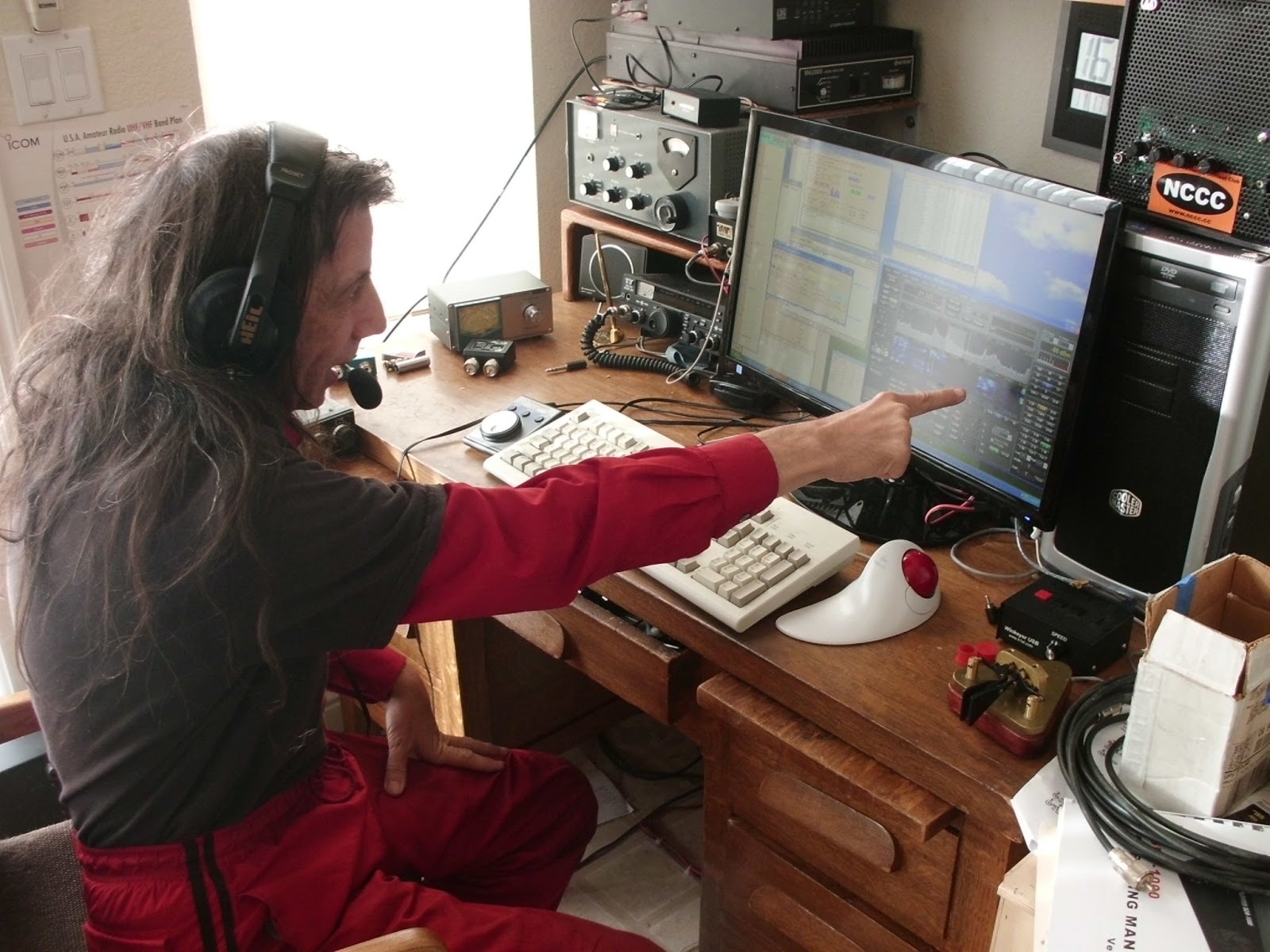


For the 2013 Sweepstakes phone contest, the multi-OP with N6GEO found us test-driving a FLEX-3000 SDR radio.

While we did not accomplish a sweep,
we DiD take 1st place for EB section.


2014 Sweepstakes - Multi-OP w/N6GEO - Brentwood Ca. (EB) - W6K


WQ6X enjoying a Mimosa @3:05z after SS)


For 2014, N6GEO and WQ6X ran their best Sweepstakes operation to date, taking a CW plaque for the entire Pacific Division (PAC)

As a team we have yet to duplicate
it, except for the RTTY RU plaque we earned for our WP2/WQ6X operation
on St. Croix in January of 2014.


2014 Sweepstakes - Single-OP - Brentwood Ca. (EB) - W6K


For the 2014 Sweepstakes phone, N6GEO family commitments kept
him out of the ham shack so I ran as
a single-OP.  While I DiD take a 1st place for East Bay (EB) section, the unfortunate highlight of that weekend was the NIGHTLY RFI NOISE from
(what turned out to be) a poorly designed power supply in the neighbor's hot tub. 
Oh the suffering we endure
to win a certificate.


2015 Sweepstakes - WQ6X @ W7AYT - Concord, Ca.

For 2015 I setup another portable operation from W7AYT's Concord QTH.
This was my FIRST use of the newly acquired FT-1000mp (from N6VR) on CW - I was still learning all the knobs and settings.

I SHOULD have taken 1st place for
EB section except that I filed my log
as Unlimited HIGH power (instead of Unlimited Low), giving the 1st place slot for East Bay to another lucky operator.  (He should THANK ME - HI!)


Two weekends later I redeemed myself with another Sweepstakes operation from W7AYT taking a 1st place for the Pacific Division (PAC), receiving my
2nd division win plaque. 

Similar to our 2014 WP2/WQ6X worldwide win plaque, THIS one
I did not see coming.


2016 Sweepstakes - WQ6X @ W7AYT - Concord, Ca.


For 2016 WQ6X made the 1st run
of SO2-V (Single-OP 2 VFO's).

For this particular weekend I had access to a HUGE table and an even BIGGER monitor, allowing me to run split screen. 

All of this came together for another
1st place from East Bay (EB) section.


For the 2016 Sweepstakes phone contest I made another operation similar to the CW GiG two weekends prior. 

While I only managed a 2nd place
(no certificate) I DiD manage to perfect the art of SO2-V on SSB.  For that reason alone, this GiG was a success.

As you can see, the November Sweepstakes can take on many forms,
altho message formats never change.


How often do YOU play in the November Sweepstakes?

Is WQ6X and N6K or W6K in one YOUR logs?

Look for WQ6X in the 2017 November Sweepstakes.


Wednesday, October 25, 2017

WQ6X runs 8 Radiosport contests in October


WPX-CW @ NX6T (2013) before the station revamp
It's no secret that I love to engage in all manner of radiosport activities: CW, RTTY, SSB; domestic as well as DX contests. Domestic contests include the numerous state QSO parties throughout the year.
My FAVorite domestic contest is of course the November Sweepstakes; the CW version in particular as it saves
wear/tear on my vocal chords.

Every October there are numerous QSO parties beginning with
my FAVorite: The California QSO party (CQP). CQP is so important
to me that I maintain a complete web section on the WQ6X.Info website for CQP: http://WQ6X.Info/CQP.

For 2017 it would seem that operating as K6T (Kilowatt Six Tango) achieved a new county record for Contra Costa county. (Last year running solo as W6K a county record was secured for Tuolumne county). For me, one of the more enjoyable aspects of CQP is being sought after. Hard to believe, for many county hunters, Contra Costa county is more difficult to work than Tuolumne or even Stanislaus.

RCForb software screen
Although CQP was operated [if you will]
"live", the rest of October's radiosport events have been run remotely from NX6T.

Using the VNC Viewer VPN software to run Station #1's computer the Elecraft K3 itself is run via the RCForb rig interface software.


I have yet to figure out how to invoke the actual Receiver Incremental Tuning (R.I.T) facility when accessing the K3 remotely. Instead, the solution is to synchronize the 2 VFO's and then run SPLIT. While this allows me to tune in stations who are GROSSLY off frequency, when the contact is logged, the log's frequency reference is to the "RIT" frequency, not the transmitted frequency (which never changes).
At LEAST I have a way to bring stations thru.

This year, once CQP became a distant memory it was time to support others in their QSO parties, as well as play around in a couple of RTTY events. All this was done remotely from NX6T. Outside of CQP, for WQ6X other QSO parties included:
  • PAQP - Pennsylvania QSO Party
  • AZQP - Arizona QSO Party
  • ILQP - Illinois QSO Party
  • NYQP - New York QSO Party
  • I saw the SDQP (South Dakota) on the calendar yet heard NO SD stations during the alleged 24 hour contest period. This just furthers my complaint that other than CQP not enough stations participate in their OWN QSO parties.

    Operating the NX6T station remotely gave me a bunch of different antennas to choose from. On 80, 40 & 20 I heard ALL MANNER
    of stations surrounding South Dakota, most with nice signals.
    You mean to tell me that the radiosport Gods caused a South
    Dakotan BLACKOUT? I don't thingk so. 

    The JARTS RTTY Screen remotely
    RTTY-wise, October found me playing around in the Makrothen RTTY contest on October 14th and the Japanese JARTS RTTY contest on the 21st. These two gigs are similar except that the contest exchange includes our GRID Square ID for the Makrothen contest and (similar to All Asian) our AGE for the JARTS event.

    In the Makrothen GiG, QSO points are awarded for each contact based on the DISTANCE between the GRID ID for both stations. Working primarily DX stations can result in ridiculously high scores, which makes things completely different than most other contests;
    and, definitely more fun.

    Tower #2 @ NX6T

    Because tower #1 was trailered to a "secret" CQP location, I did not have access to the C-31 yagi for October.


    Instead, all I had access to was a 3-element Stepp-IR, 2 elements on 40 and a sloppy inverted VEE on
    80 - all 13mh.


    For the RTTY contests, I would often run the Stepp-IR Bi-directional when running a frequency to enjoy QSOs from Asia and South America or N.E. USA/Canada and KH6/VK/ZL.

    When non hams ask why I play in so many radiosport GiGs (72 so far this year), I remind them that not only is it FUN, it keeps my operating skills at their highest level should further disasters (like hurricanes, fires and earthquakes) suddenly occur.

    I have setup so many different portable stations in the last 8 years that I am prepared for just about anything. Operating from Mt. Able, Ojai Valley, Carpinteria State Beach, Mt. Diablo, as well as 3rd, 5th and even 30th story hotel rooms has taught me a lot about operating
    under adversity, making operations like WP2/WQ6X, or multi-opping
    from NX6T or N6GEO a pleasant relief.

    
    NX6T after dark
    For me, Radio sport has an important purpose. Until something/someone else comes along with a "higher" purpose, this is one hobby I am going to keep playing around in.

    As a teenager, amateur radio kept me out of jail, I was too busy on the air to find time for drinking drugs or stealing cars;

    all that came MUCH later, and instead of ME stealing cars, it was my Honda Accord which was stolen - TWICE this year (the 1st time for its license plates and the
    2nd time probably for parts).

    Radiosport has enabled/encouraged me to play around with numerous radio equipment configurations in addition to trying out add-on devices like the QF-1A, NIR-12 and the MFJ 1026 noise canceller, in addition to a number of wireless headset configurations.
    (I hate being "wired" to a wireless radio.)

    FT-1000mp + outboard filters
    October is not yet over.

    Next month brings us the November Sweepstakes, the JIDX SSB and WAE RTTY contests, as well as a number of QSO parties and small DX contests.

    I thoroughly enjoy sitting at a real radio in Fallbrook or my Yaesu FT-1000mp with its "billions and billions of knobs" (to paraphrase Carl Sagan).


    Additionally, because I often see Biofeedback clients on weekends,
    I am fortunate to have access to NX6T remotely. Often my remote operations help the techs in Fallbrook to debug an equipment or latency problem - I get to play and they get "stress analysis" on
    the equipment and internet configuration.

    Have you been playing in the dozen or so Radiosport GiGs
    during the month of October?

    Is WQ6X or K6T in your log?


    Wednesday, October 18, 2017

    WQ6X sets CQP county record for Contra Costa


     Operating as K6T (Kilowatt Six Tango), 2017 marked my 17th California QSO Party (CQP) radiosport contest (in this lifetime anyway). In 2014, operating as K6U with N6GEO, our original
    trip to Tuolumne county was postponed until CQP-50 in 2015;
    instead, we engaged in a makeshift operation from his QTH in Brentwood and inadvertently set a county record for
    Contra Costa county.
    ([CLICK HERE] to read about that event.)

    Last year, operating solo from N6GEO's Twain Harte cabin (George was on vacation with the XYL) again, W6K inadvertently set a county record for Tuolumne county.
    ([CLICK HERE] to read about that event.)


    For 2017 I was presented with a quandary: cart the FT-1000mp
    and its myriad of external accoutrements to Twain Harte to run
    multi-OP with George N6GEO, or take the easy route and run
    another portable operation from W7AYT's Concord QTH - this
    time as K6T - "hoping" I could surpass the current 34K point
    record for Contra county.

    If you want to skip ahead to the results, you can look at the 3830Scores website or CQP section of the WQ6X-Info website

    Pursuing a multi-OP county record for Tuolumne is tricky at best.
    While George & I make a great 2-operator team, unfortunately there
    is no Multi-2 classification in the CQP contest; maybe its about time there is. So we either compete as a multi-single (no fun for operators who like to operate) or as a multi-multi (no fair).

    I believe my operating choice for 2017 was the correct one. K6T's 59k score should set a new county record, while N6GEO & WQ6X ended up as competitors in the in-state single-OP operation classification.


    In addition to pursuing county records, I set out to make a number of minor equipment configuration changes.

    For openers, I discovered a way to jumper the switch lugs inside the WQ6X coaxial switch box,
    allowing the selection of W7AYT's CHA-250 vertical, the WQ6X
    8JK Cobra Sloper-V, or the two antennas "in parallel"; which sometimes works and sometimes doesn't.

    On Thursday & Friday before CQP, a not-insignificant amount of
    time was spent running the FT-1000mp in a CW CQ-Loop (particularly
    on 10 & 15 meters) checking in with DXMaps.Com and the Reverse Beacon Network (RBN) to see where the K6T callsign was being spotted. In particular, this allowed rotating the 10-meter yagi, noting the changes (if any) in where the K6T signal was being heard.

    On the audio end of things I have been experimenting with cascading a number of external audio filters, taking advantage
    of the Yaesu FT-1000mp split audio features. For CQP, this experimentation included: a 20 year old JPS NIR-12, to process RCVR-A's audio (for the left ear) and a classic Autek QF-1A filter to process audio for RCVR-B (to the right ear). Because the FT-1000mp uses a clever separation algorithm for split audio, it turns out that the NIR-12 can be set/forget (until I switch modes) while using the QF-1a to effectively "shift" the audio around between the ears.


    While running a frequency , a clever trick I discovered is to use the
    QF-1A to PEAK the sidetone while calling CQ. (If it's too loud I turn down the Moni gain.) Then, using the R.I.T. knob I can tune each individual signal looking for that pitch; at which time it JUMPS into the audio passband - way better than any $1,000 DSP circuit could ever accomplish.

    With all the equipment under control I was ready for the CQP practice event at 02:15z (7:15pm) on 20 meters. At 02:30z the practice event was moved down to 40 meters. At 2:45z we moved down one more time to 80/75 meters. As it turns out, I made ONE Cw contact on each band during the practice GiG; SSB signals were not heard. Shortly after 03:00z I slipped down to 160 meters looking for indications the CHA-250 vertical might add a couple of 160 Q's to the log; the following evening, 3 160-CW QSOs DiD make it to the log.


    With the equipment intact, I got some preciously deserved sleep. At precisely 1600z I fired up CQP with a brief run on 40 CW to snag some local California and Northwest stations before alternating time between 20 & 15 meters for several hours until the one and only 10 meter opening occurred for K6T at 20:45. Installation of the 10-meter yagi two weekends before paid off with 27 CW and 4 SSB QSOs; including HI8 & PY2.

    An interesting aside is that I accidently discovered that the FT-1000mp can tune the 10-meter yagi on 15 meters (with a 1.25 SWR) and actually make QSOs.


    Overall, I believe the signal was MUCH stronger to those areas using the WQ6X sloper. It wasn't long before 10 & 15 were gone; from which I took refuge on 40-meter SSB to work as many California stations as possible. While California stations derive no multiplier benefit from working other California stations, QSO points accrue for all communications; California or otherwise.

    After a brief stint on 20 meters, I was back on 40 at 00:15z; now on CW. Because we are in a sunspot cycle low period, the move to 80/75 meters occurred early in the evening (02:00z). With some begging and pleading K6T even managed 3 CW QSOs on 160 (at 03:30z, 05:30z and 06:59z with N6GEO).


    For every CQP contest, I devise an evolving webpage for that year. ([CLICK HERE] to see the CQP 2017 page.) One of the reasons I do this in advance is so that out-of-staters can get an idea of what bands to look for K6T on at any given time of day. Because I am a consistent contest creature, this plan rarely varies; nevertheless, I publish it anyway - each year begins anew.

    QRM-wise, this CQP event was mostly QRM-free; shocking when I compare this operation to other contests and other years. Ending the contest on 40 SSB I was annoyed by a VFO-swisher - I guess some people just get bored and can't wait for the 3pm ending of CQP.
    As soon as CQP was over, so was the VFO-swishing.

    The evening before CQP I was solicited to join the MLDXCC (Mother Lode DX Contest Club) in order that they can include my score as part of their CQP Club submission. One of these days I will send them $15 to enjoy all the perks and benefits of being a PAID member.


    Overall, for CQP 2017 I accomplished everything I set out to do. The before-CQP antenna farm revamp @ W7AYT turned out to be time well spent.

    While K6T was HARDLY the loudest low power California signal, stations throughout the U.S. and Canada reported the signal levels from Contra Costa county to be quite good.


    Being able to switch between the Vertical & Sloper array on the low bands made all the difference. Additionally, despite poor band condx on 10-meters, the 3-el yagi (with its alleged 8.5 db gain) made the time spent on 10 meters fun and worthwhile. LooK for WQ6X in December's ARRL 10-meter contest.


    Now that CQP 2017 is behind us and the logs submitted, it would seem to be a good idea that George (N6GEO) and I operated solo separately. K6T's 59K score has clearly set a record for Contra Costa county - just as I had planned - and N6GEO most likely took 1st place for Tuolumne. Then, depending on what the Log Checking Robots whittles our scores down to, N6GEO may eventually slip ahead of
    K6T - this is why accurate logging is so important.


    As you can see from the ending screen, the K6T GiG was indeed
    an SO2-V operation. Throughout 2017 I have posted contest BLOG entries describing my use of SO2-V with the Yaesu FT-1000mp. Overall I am getting the hang of it; however as I have said before,
    if I get too confused running split audio, I immediately shutdown VFO-B and focus only on the run frequency.

    I missed a sweep due to lack of hearing: ND, NE, RI, MS, AK,
    AB & MR. County-wise, 42 counties ended up in the K6T log.
    Numerous stations made the log on multiple band-modes - CooL!
    Where were the ladies on the air this weekend?
    I only worked 2 of them.

    Did YOU play in the California QSO Party?

    Is K6T (or N6GEO) in YOUR Log?

    Wednesday, October 4, 2017

    WQ6X rallies in RTTYand raises antennas

    For many amateurs, the CQ World Wide DX contest marks the beginning of the fall contest season; unless of course you happen to live in California; in which case, CQP would be the REAL beginning.

    However if you are a RTTY contester, the absolute REAL beginning of the contest season happens
    in late September by way of the CQ W.W. RTTY event; so in a way, CQ W.W. DOES mark the beginning of fall contest season.

    For 2017 I decided to do things a little different. During two weekends in September I assisted W7AYT in doing a complete antenna revamp. The CHA-250 vertical was moved from the front to the front-side of the house. In its place we installed a 40 foot Rohn mast in order to put up a 3-el 10-meter yagi. 10-meters? Isn't 10 dead? Well, maybe yes, but not for long as solar cycle 24 slowly transforms into cycle 25. The yagi was "free" (not including the coax, rotor cable, guy ropes and the Rohn mast itself) so who could resist?

    Additionally, we strapped a pulley just under the yagi allowing me to hoist the tenuous horizontal Cobra Vee antenna and convert it into a real sloping VEE. Initial tests suggest this Sloper possesses greater signal gain than when it ran horizontally.

    Since then I have added a 2nd Cobra Vee, slightly ahead and in phase with
    the original. Signals seem even stronger. The CQP (California
    QSO Party) contest will give all
    this a thorough test-drive.

    For the world wide RTTY contest it was clear that the modest antenna setup @ W7AYT would not even begin to do the job in a worldwide event. Additionally, the new AFSK cabling system being worked on was certainly not ready for extensive contest use. As an interesting compromise I chose
    to run WQ6X remotely from NX6T's station #1 in Fallbrook pushing the ACOM 2000a amplifier
    to a CooL 500+ watts into a C-31 yagi, 2-elements on 40 and a droopy inverted VEE for 80 meters.

    While it was hardly quiet, atmospheric noise was not much of a problem. Any real difficulty encountered in making QSOs was due to IDIOT operators, more than an atmospheric problem.

    10 & 15 meters have been largely absent in Fallbrook during recent
    contest dabbling's.

    After a LoT of CQ'ing and S&P'ing,
    a whole 8 QSOs ended up with a frequency on 28 MHz; and MOST of them with South America - go figure.


    What this tells me is that 10 meters isn't as DEAD as we think it is,
    In the end those CQ calls netted 5 countries on 10-meters.

    When a 15 meter opening occurred on Sunday afternoon, I switched antennas to make use of a 3-element Stepp-IR running Bi-directional to Asia and South America enjoying QSOs from both continents while calling CQ on 21.095.95. Switching towers allowed the "wrecking crew" to
    come in and dismantle the unit for transport to a secret, unnamed CQP location.

    Even though I didn't use it for local contest operation, having a larger screen available for this GiG actually encouraged me to Search & Pounce more; something I am often reluctant to do when running RTTY remotely. The "Goal Posts" on MMTY's decoder screen made it relatively easy for RCForb's radio emulation to nudge the VFO frequency up/down, lining up the Mark/Space signals.

    As a result, approx. 7% of the 512 claimed QSOs came from Searching & Pouncing (when running remotely, it is usually < 1%). This contest operation was purposely run as ASSISTED in order that I could click on stations and the "quickly" tune them in; unfortunately, nearly 50% of the spots had the offset WAY OFF.

    In both endeavors (RTTY and Antenna Raising) the watchwords were: Flexibility, Workability, Ingenuity & Sustainability. I could probably write an entire BLOG entry on these four concepts.
    Keep your eyes open for that possibility.

    A frustrating bummer during the RTTY weekend is that while I finally worked out the audio filters for RTTY on the FT-1000mp, because those filters are on the REMOTE side of the radio transmission, they are too late for the decoding on the Fallbrook end. Theoretically, I could run a standalone copy
    of MMTY (without N1MM+) on my end and decode the audio filtered by the NIR-12 and the Autek
    QF-1A. Stay tuned for that experiment.

    Considering the storm devastation in Puerto Rico, it was no surprise to hear no activity from WP3M or any other P.R. station. However I WAS surprised to hear many XE stations and 8 Cuban stations on RTTY. 

    This RTTY GiG enabled a LoT of good frequency runs; especially on 15 meters.

    At 23:15z the Elecraft K3 radio was moved down to 20 meters one last time to run the remaining 45 minutes of the contest.

    Band propagation held up reasonably well, allowing me to settle in a run yet another frequency.
    Then, at 23:45z (with 15 minutes to go) the internet connection in Fallbrook COMPLETELY DIED - No Response. That was the end of CQ WW RTTY for 2017. (The culprit who PURPOSEFULLY shutoff the microwave link has been thoroughly FLOGGed.)

    Unique to the RTTY flavor of CQ W.W. DX contests, is that QSOs with your own country are worth 1 point (0 points on SSB & CW). Continent-wise, I would have liked to have HEARD more stations in Africa. The bandmap spots were certainly there, however if you can't hear'em you can't work'em.


    After all the crazed pandemonium had died down, it was time to take a closer look at QSO counts for the individual bands. 40 meters (followed by 15 meters) was top band so I submitted
    the log as: SO(A)SB40HP.  

    According to the 3830Scores website, WQ6X takes 1st. place for USA, 2nd place for NA and 4th place world wide.

    Did you play in the CQ W.W. RTTY contest?

    Is WQ6X in YOUR Log?


    Tuesday, September 12, 2017

    Solar Cycle 25 Opens September Contest Season


    NX6T undergoing computer retrofit


    I open this WQ6X Contest Blog entry by welcoming the existence of recently emerged
    Solar Cycle #25. (More on this later)

    For 2017, the month of September has ushered in a number of radiosport surprises.
    As I wrote in the previous Blog Entry this year's All Asian SSB contest turned into a 1 QSO
    affair for WQ6X.  Instead, COQP and TNQP received all the attention in the WQ contest activities.


    For WQ6X activities, this weekend
    was quite similar to the last with a surprising difference: It would seem
    (to me anyway) that the end of Solar Cycle 24 has been abruptly transformed into Cycle 25, creating an interesting backdrop to the long-awaited (for Europeans anyway) WAE (Worked
    all Europe) SSB contest.


    Last month I played around in the CW version of the WAE contest ([CLICK HERE] to read about that). Later this month I will give the RTTY version of this GiG a good run.

    Because the antenna system @ W7AYT (where I often run the FT-1000mp portable) doesn't usually do well into Europe, I turned to running as WQ6X remotely from NX6T (Fallbrook, Ca,)
    as my solution.

    Station #2's computer is out of commission, being given new life by the computer doctor (W6JBR)
    in the same way he brought station #1's computer back into action; except that the transmit audio
    line FOR STATION #1 was never tested - until this weekend - discovering that there is some sort
    of cabling problem. Oooopppsss. What to do?

    Studying WA7BNM's contest calendar, I noticed two CW events scheduled:
  • The FOC QSO Party - an event new to me
    •  
  • The N.A. SPRINT - a 4 hour pandemonium which I haven't engaged in for nearly 5 years.


  • For openers, while technically not
    a contest, the FOC (First Class CW Operators Club) QSO Party certainly seems like one; except according to
    the FOC Website no logs need to be submitted; and yet they give out
    awards - HuH? (See below)

    In the FOC GiG, FOC members work everyone and non-members Search & Pounce (S&P), looking for FOC members.


    I chose NoT to call CQ as non-members would have no way of knowing I was not an
    FOC member and attempt to make a QSO (worth 0 points).

    Not hearing much in the way of Europe on SSB, I switched over to CW and joined in the
    FOC fray @ 01:30z; only 90 minutes late. Because computer #2 is not in the shack, I had
    no way of accessing the WinTest rotor control program, leaving all yagi's pointing Northeast
    (at least I HOPE that's where they were pointed) to Europe and most of the USA.

    As I said, according to the FOC Website, their QSO Party is not a contest which might
    explain the laid back attitude on the air and the passage on the website that reads:

    No logs or verification are required.
    Send your report to: kz5d@aol.com no later than 14 days after the event.
    Results will be posted on the FOC Web site and published in the FOC’s

    quarterly magazine, FOCUS.

    I wrote to KZ5D asking how one goes about submitting a "Report".
    It will be interesting to read his reply.

    The FOC QSO Party no sooner ended when the 4 hour CW N.A. SPRINT contest picked up where the FOC
    GiG left off.

    While the FOC event is laid back, the SPRINT contest is anything BUT that; calling it a frenetic activity is being kind.

    I had forgotten how AGRESSIVE
    the SPRINT contest seems to be
    in comparison to other GiGs;
    DX and domestic.

    The one thing I NEVER hear in this contest is "QRL?" before calling CQ; evidently there is not enough time
    for that.


    Because stations are packed together in the CW spectrum like sardines in a can, often
    a station 300hz below me will believe his QSO was with me and put WQ6X in his log.

    To reduce the risk of "false positives", when in doubt, I sent the callsign of the station
    I am working.  A little trick to reducing the QSY pandemonium is to work a station, allow
    him to call CQ and then call the station after he works him.  After that,  I am allowed to
    work any station that then calls me.


    From the West coast, I tend to run the SPRINT contest beginning on 20-meters, then working down to 40 and 80; with one or more 40 & 80 sweeps up until end of the contest @04:00z. While my score was about 1/3 of my SCCC#1 team compatriots, at least I broke the 100
    QSO mark, despite starting nearly 30 minutes late.


    In recent contests I have been testing the Autek QF-1a audio filter on the remote receive audio with great results overall.

    For now I am pairing it with the JPS NIR-12 in use @W7AYT.

    In it's place I have replaced the QF-1A with the MFJ 752-C that has been in use @W7AYT.


    For remote purposes, the 752-C provides nowhere near the signal shaping that the QF-1A does, even though in concept, both circuits are designed to accomplish essentially the
    same thing.  Possibly a circuit alignment (per the manual) will change my thinking.

    Barely 24+ hours after the weekend events ended, the
    SFI has plummeted to a paltry 79, returning the propagation predictions to their "bleak"
    status of just a few days ago.

    This of course raises the question as to whether or not the 228 SFI was in some way a statistical aberration or at the very least
    a one-time event.

    Did you work the WAE Contest, FOC QSO Party, or North American SPRINT?

    Is WQ6X in YOUR Log?
     
    Today (01-03-2018) I received the following certificate for my participation in September's 2017 FOC QSO Party; proof once again that you can't win if you don't play.

    Wednesday, September 6, 2017

    WQ6X turns All-Asian BUST into a TRIUMPH


    This last weekend was ostensibly to be about the All Asian SSB contest, with minor attention to
    the COQP and TNQP QSO parties. As it turns out, the All Asian event turned out to be a complete
    BUST; not just for WQ6X and NX6T, but for amateurs the world over.

    I was originally planning to operate from NX6T in Fallbrook. A misplaced cellphone sidelined any travel. Next up was an internet outage in Fallbrook which was resolved at the last minute on Friday. Unfortunately, we never worked out what the problem was in playing my WQ6X .Wav files during
    a contest with that particular setup. Later, a failing A.C. system @ "NashVille", sidelined the rest
    of the operation.

    The NX6T outages prompted me to make a last minute operation @W7AYT in Concord (in the SF East Bay).

    I ran the usual FT-1000mp with a new external audio filter combination, running the MFJ-752c in the left ear and an Autek QF-1a filter to the right.

    Running SO2V, I effectively had DSP
    in stereo for CW & SSB.


    Because operation in the state QSO parties was run using mixed mode, CW was run with the
    Main-RX (Left ear) and SSB with the Sub-RX (Right ear).


    An interesting curiosity occurred with the QF-1a causing a left-right shift between the ears as the Autek's frequency setting was changed.

    For the next contest @W7AYT I will run the Autek QF-1A in conjunction with the JPS NIR-12.

    For All Asian, I did the best I could with the
    limited antenna system @W7AYT, however I
    am beginning to think Dennis' Concord, (Ca.)
    QTH has an energy vortex enroute to Asia; Oceania is not bad, just Asia.

    As usual, my main beef with the All Asian contest is that not enough Asian stations participate in their own event and/or are hearable with the combo CH-250 Vertical and a Horizontal VEE @W7AYT.


    For the COQP QSO party, I didn't get started until 17:20. 20 meters quickly went long and 15 never materialized so I switched to the CWops Open contest.

    This was my 1st time running a CWops GiG; surprising when you consider how long it has been around. (Next time around during the next CWops Open, look for me to run all 3 events.) What I like about CWops is the short 4-hour length - like SPRINT, but w/o the QSY pandemonium.

    When CWops ended at 00:00z the 40 meter band showed promise to Colorado and eventually on SSB as well.


    Unfortunately, Colorado participation was noticeably lacking on 40 & 80 meters; on BOTH CW and SSB. Asia wasn't really happening so QSO party operators should have FLOODed the lower bands. What am I missing here?

    COQP ENDing Screen

    TNQP materialized at 18:00z on Sunday. Unfortunately, similar to All Asian, my main beef with TNQP is that ONLY a handful of TN stations are hearable with the combo CH-250 Vertical and a Horizontal VEE. Considering the size of our CQP (California QSO Party) event, GiGs like COQP and TNQP are a disappointment by comparison. During CQP ALL 58 counties sport fixed station representation.

    In most other state QSO parties (TNQP in particular), reliance on "rover" operations is essential.
    I enjoy QSO parties so you can be sure I'll be back next year - especially if the All Asian contest
    is a bust like it was here this year.

    CH-250 Vert. + Horiz. Cobra

    Considering the limited antenna resources
    at W7AYT (a CH-250 Vertical and a Cobra horizontal Vee) as an alternative to All Asian activity I chose to spend time with the DXMaps.Com website.

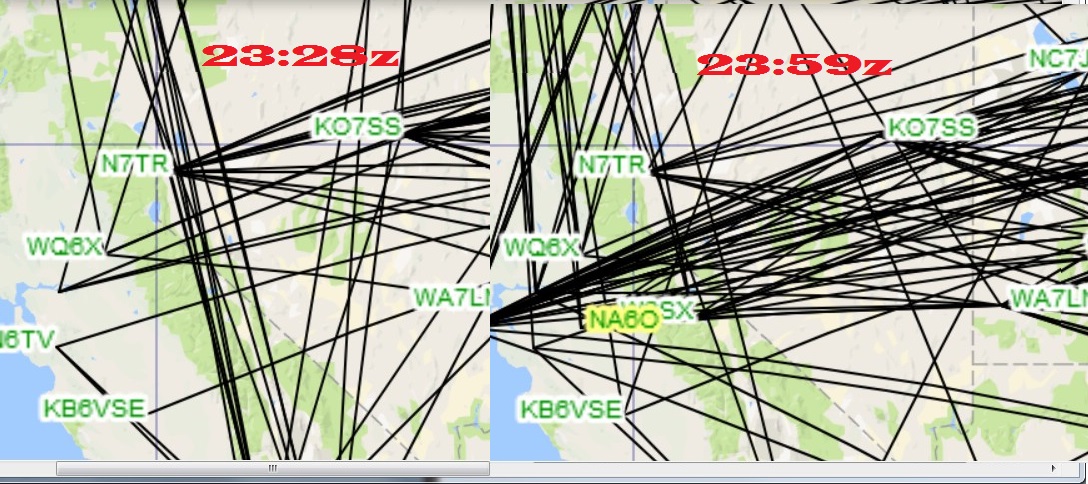
    It has been quite a learning experience to bring up a band display for, say, 40 meters, take a screen shot of the BE-4 condition and then issue some sort of contest CQ call, monitoring how long it takes for the WQ6X callsign to show
    up on the DX-Map.

    Usually the WQ6X call appeared in under 30 - 60 seconds, and yet, there seemed to be no takers. At one point I was beginning to think
    that I was louder on the other end than stations are in Concord.


    I then raised the question of which antenna was being heard where.
    Using the WQ6X coax switch (along
    with the A/B switch of the FT-1000mp)
    it is easy to select either antenna;
    and if desired, the two cables can
    be paralleled together.

    On 40 & 80, calling CQ with JUST the Cobra-Vee elicited no spots. Switching to the CH-250 immediately brought several spots in Oregon, Washington, and eventually Utah. Paralleling the two often produced a path towards Arizona.

    During the last 1/2 hour of the CWops GiG, 40 meters made a west coast appearance, being what
    20 meters was like 1/2 hour before. If I could make even HALF of the QSOs that are implied in this picture, this weekend would have been a total success. Unfortunately, statistics don't always
    bring us the truth.

    WQ6X 40-meter SPOTs
    While I only published this one picture (so as not to overrun the whole concept), using the NeuroLogiK Solutions SNAP-SHOT program allowed me to make nearly 3-dozen screen
    captures documenting the several hours of CQ'ing .vs. antenna testing that was run from
    W7AYT.
    More than just Alt-Prtsc, with Snap-Shot I am able to capture, timestamp and organize the unique screen images that you see throughout the WQ6X Contest BLOG entries.

     [CLICK HERE] to buy your own copy
    of Snap-Shot! for only $19.95.

    Looking back on this last weekend, the way things turned out reminds me of how my local Toastmaster's club (The Alameda Tongue Twisters) works.


    We often experience last minute changes to our meeting structure (as happened last night), and yet, we ALWAYS rise to the occasion and make it all work; often learning new things in the process.

    Last-minute learning was certainly a factor for WQ6X in last weekend's contest mélange'.

    Did YOU participate in COQP, TNQP, CWops or the All Asian contest?

    How many QSOs did you add to YOUR Log?

     
    ADDENDUM:
    Received today (12-18-17) was the following certificate from the TNQP:

    Wednesday, August 30, 2017

    When in Doubt: CHEAT! (but within the rules)


    It might surprise you
    to know that I advocate cheating in radiosport.

    In this context I define "cheating" as doing things that are NoT pro-hibited
    by the rules, yet no one has thought to consider them before.

    It is from this spirit that today we have spotting networks, Skimmers, SO2V and SO2R.

    There was a time when many serious contesters considered these methods to be cheating;
    or at the very least, operators using them were considered disingenuous.

    For example, long before we had voice Keyers (like the MFJ Voice keyer or the WQ6X voice keyer software) many people solved the overdoing of one's voice problem by using various forms of tape recorders/players to call CQ and the like. As KX6H in Redondo Beach, I remember using a cassette recorder to make use of a 5-second telephone answering machine OGM tape to call CQ.

    Long before there was readily available contest logging software (such as CT, and now N1MM+, WINTEST & WriteLog) a handful of contesters (such as myself) wrote their own custom software.
    I once operated an All Asian CW contest from my 2nd floor cubicle at Data General's Western Education center in Manhattan Beach, Ca.


    Thanks to the rooftop being 6 stories high I stealthily setup an 8JK flattop yagi barely a foot above the rooftop, orienting it N/W & S/E to broadside into Asia and the Atlantic Ocean on the back end.

    With the operating QTH less than a mile from the beach, this antenna turned the ICOM 740's 103 watts into +5 db. punch giving the KX6H callsign (my call at the time) recognition into Asia. 

     Because All Asian is a 48-hour contest, after everyone in the office went home for the weekend,
    I snuck in a sleeping bag to crash unobserved under my desk throughout the weekend.


    In addition to the 6-story height advantage, a reason I wanted to operate from my office is that it would provide access to the DG MV/10000 computer network we maintained for student training purposes.
    Altho running AOS/Vs on the MV/10000, I made a special backwards compatible installation of DG's eXtended Basic software development IDE under which 


    I wrote prototype code for a never-released KX6H-Logger program.

    While nothing like today's professionally designed software, that program could DUPE check
    callsigns and complete entered QSO data with data from a previous QSO with that callsign. The software produced a .Contest file (essentially a cross between a .Text and a .INI file). While the file format was hardly as robust as the currently accepted CABRILLO format, being a .Text file it could be easily printed and snail-mailed (we didn't have e-mail back then).


    When the word got out that many operators were making use of computers
    to assist them in contesting, some people decried these users as in some way CHEATing.


    Today, not only are logging programs ubiquitous, some programs are ALMOST
    (I stress the word almost) capable of running
    a contest without an operator in the chair.

    Thanks to .WAV files and keyboard macros which can be auto-invoked, today's operator
    can find free time in between CQ's to eat some bites of food or pop a brewski. Then, when a station calls in, the press of another function
    key sends the needed information.


    It's not completely automated, however.  
    Even in today's contest operations the operator must still type (or click for RTTY) the data into the entry boxes. However, the computer gives us immediate feedback when we've made a mistake.

    Fortunately, as it turns out, the use of computers in radiosport occurred because a bunch of operators around the world had enough foresight to use them. Today, most serious contest operators would CRINGE at the thought of hand logging a contest. Consider also that because most radiosport GiGs encourage improvement in operating efficiency, use of computers contributes to improved emergency preparedness.


    Being innovative can easily make its way into SSB operations. Recently several SSB contests have inspired 
    me to include playback of the EASY Button during the
    "Thank You" message that originates when function key
    F3 is pressed, saying "Thank You! [That was EASY] - QRZ, WQ6X".  In contests like JIDX and All Asian, most people don't "get" it so I don't use it.

    Another idea that worked out I implemented several years ago putting together a Multi-OP ARRL 10-meter contest operation from W7AYT's QTH in Concord Ca. (altho at the time Dennis was not a licensed ham). 

    Remember that in 2011 Solar Cycle 24 was on the way up (about 60% of its eventual peak).
    At that time in the sunspot cycle, 10-meters opened relatively early in the morning and remained active until well after sunset, during the month of December (which is when the 10-meter contest
    is run).

    On Saturday in this contest, some friends came over to enjoy a Dennis-created meal. Not only did
    I put Kathy & Brian behind the microphone, I wrote a script for each of the 4 voice keyer memories
    in the ICOM-7000, having Kathy speak them into the radio. For the next 18 hours after she left, Kathy's voice ran the SSB part of the 10-meter contest while the N1MM CW macros ran the code
    side of things.

    Now, it all sounds easy; and it is - with LoTsa practice.  Remember, YOU are still the control operator; you are the 
    one who must push the function keys
    in the right order.  
    You must correctly type information
    you receive during each QSO.


    If in the end, mistakes are made attributable to the use of a computer, then you neglected
    to test-drive one of the most important contest tools today: the LOGGING Computer itself

    Automation can be a good thing if properly configured and tested BEFOREHAND.
    For example, the N1MM+ software which I use much of the time makes a weekly software
    update available virtually every Wednesday or Thursday. The week of an upcoming contest
    event, no later than Thursday, I fire-up N1MM+ on the computer I will be running it from and
    wait for the "Update is Available...." message.  After installing the update, I read the update file
    to notice if the update might in some way be relevant to what I will be doing. Information is Power.


    As a contest weekend rolls around,
    I keep an eye on space WX conditions to get an idea what propagation may be like for that contest.

    Websites like DXMaps give yet another look at possible propagation anomalies
    I might encounter.

    The trick is knowing what the data means and/or how to interpret it.

    No matter what degree of technology you employ to make your radio operations work better, there is still
    no substitute for a highly rehearsed, expertly trained operator.

    When you engage in radiosport, do YOU Cheat (but within the rules)?

    Tell me about your exploits.

    Ron
    WQ6X