Wednesday, June 22, 2016

WQ6X joins NX6T for 2016 All Asian Contest


For me, the All Asian DX contest is a mixture of enjoyment and frustration coupled into one weekend; be it the CW weekend, or the SSB weekend.


Because All Asian is situated between the WPX C.w. contest and Field Day, I never know what I am going to do for the event, almost until it happens.


A couple of years ago I operated All Asian (solo) and Field Day (w/team W6SW) from a campsite on Mt. Abel.  Last year I joined up with the nerds at NX6T (literally, one was N6ERD) where we took 1st place for North America, before driving to Mt. Abel and joining team-W6SW.


This year, client requirements prevented me from putting together a full station on the mountain.  Like last year for 2016 I not only joined the team @ NX6T, I again allowed Amtrak to escort me to Oceanside, instead of making a 10+ hour drive.  I am writing this blog entry on the return train to Oakland at 5:00 in the morning.

This year's All Asian contest is proof that we are nearing the BOTTOM of solar cycle 24 - bummer dewd.  Then again, the sooner we get it over with, the better.

For the 2016 All Asian contest, the bad news this year is that 10 meters never happened, even though I gave CQ's on Saturday and Sunday. I saw a couple of South American stations on the bandmap, but that was it.  15 meters presented us with barely 100 QSOs.

Throughout, the contest, 15 meters was open to Asia with STRONG signals yet the actual number of those signals was a fraction of last year.  I attribute this to poor participation, not so much poor propagation.

This situation mirrors a complaint I've had for years - not enough Asian stations play in their own contests.  It seems like I heard more stateside stations calling CQ test than Asian stations.  On 15 & 20, the few stations there were usually very loud; again suggesting the problem was participation not propagation.
Am I missing something?

On Saturday, West Virginia held a state QSO party.  Except for an AA8 station calling (after my CQ AA), I heard no other WV stations.  I was prepared to put some morning time into their QSO party, but as it turns out it was not necessary.

Between N6KI and myself, plus N6CY (attempting remote access) and N6ERD + N6EEG we managed just under 27 hours of actual OP time out of the 48.  This year due to a shortage of operators I ran the night shift alone both evenings and ran much of the day shift on Saturday and Sunday.

Equipment-wise we ran the usual bevy of Elecraft K3 radios into ACOM 2000-a amplifiers.  Unfortunately, an ACOM reported tube failure side-lined one of the amplifiers; replaced by a manually tuned (but fully equivalent) Ameritron AL-82a.


The antennas included a 3-el Stepp-IR with 160 & 80 meter inverted V's hanging from atop the mast, topped with a 2-element 40 meter yagi.

On a separate tower sits a numerous-element C-31 yagi.


Similar to the recent WPX contest, All Asian brought us all kinds of bogus QRM to deal with; not the least of which was the nightly South American SSB QRM on 7.018.18  mhz.  This time a couple of those stations purposely zero-beat me; when I moved they followed me exactly - wassup with THAT?!

There seemed to be a lot of tuner-uppers. Many Japanese stations are notorious for tuning up on my frequency before I get the contact.


This weekend was largely carriers without QSOs; such is the world of shared frequency space.  Fortunately, there were again no Russian beacons on 7.039 to contend with.  There also seemed to be FEWER JA stations on 40 than heard in the previous WPX contest. 

Space weather wise while the A & K indexes seemed low, the upper band conditions seemed rather poor.  While much of the signal lack was due to poor participation, that didn't explain weak signals or hearing a UA9 station (working Europe) at 06:300z, when the band "officially died" in the San Diego area by 02:30z.

Compared to last year and years prior, I noticed that the average (mean) operator age had risen significantly.  During the last 5 hours of the contest, most under 62 Asian hams were either AT working or in the process of traveling to work.  Virtually every JA station worked during that period was 65 or older


QSO wise, for 2016 our QSO total nowhere neared our 1400+ QSO 1st place from last year making this year's event a bit of a disappointment.

Nevertheless we DiD make 4th place worldwide and 2nd place for North America - not bad for a last minute effort.


Did YOU play in the 2016 All Asian Cw contest?

How many Asian stations are in YOUR log?

Tuesday, June 21, 2016

WQ6X makes a notable appearance in WPX Cw 2016


When I join up with the crew at NX6T for WPX, Dennis N6KI always chooses that we use my WQ6X callsign because as he put it "there are too many NX6 calls on during WPX".  Really?  I've never heard one.  I think the REAL reason my callsign is chosen is that it relieves him of the massive QSL card duties - WQ6X receives hundreds of QSL cards every WPX contest.

For this  year's WPX contests I booked client business in Huntington Beach during the weekdays leading up to the contest event.  For the Cw GiG I arrived "NashVille" at 22:00z allowing me to get settled into the operator's apartment next door to the radio shack.  Unfortunately, we had a shortage of available operators so unusual for me, I opened the contest.

Equipment-wise we ran the usual bevy of Elecraft K3 radios into ACOM 2000-a amplifiers.  The antennas include a 3-el Stepp-IR with 160 & 80 meter inverted V's hanging from atop the mast, topped with a 2-element 40 meter yagi.  On a separate tower sits a numerous-element C-31 yagi.

In general, I rarely start a contest on time.  Because the original plan was to operate NX6T from a new remote location, N6KI did a spectacular job of preparing the NX6T site for my arrival.  Except for failing to test some of the Wintest CW macros beforehand, I was ready to go at 23:53z when I received a call from TF3DC (on 21.036 mhz)  in response to my T-E-S-T-ing calls.
We had a nice ragchew and he became the first QSO in WQ6X's WPX log.

Before the evening was long in play, N6KI suddenly showed up at NashVille declaring that the remote operation for NX6T was a bust, taking over the operator's chair after dinner (05:35z).

From that point on it was like old times - Dennis rousting me @ 2am for the graveyard shift - the real reason I'm needed in NashVille.


Space weather wise, propagation conditions were quite dismal.  Luckily, working domestic callsigns is a large part of the WPX contest.

Unlike weeks before, 2016 WPX Cw brought us all kinds of bogus QRM to deal with; not the least of which was the nightly South American SSB QRM on 7.018.18  mhz.


I also encountered the "Woodpecker" radar (base freq. around 6.935) and what sounded like a data "cranking machine" at 11:44z on 7.031.   Fortunately, there were no Russian beacons on 7.039.

Unfortunately, on 80 meters I experienced QRM from data bursts while I was calling CQ on 3.535.35 @ 12:38z and again at 12:56z.  Then, as mysteriously as it showed up, it was gone.  If I had thought about it in time, I could have enabled the K3's 2nd receiver in data mode and attempted to copy the RTTY (if it was in fact 170 hz or 850hz); of course a GooD QRMer would use some other RTTY mode so as to remain virtually undetectable.


Lacking operators made all the difference here.  Compared to last year (10 operators), our 3 guys managed to make nearly 2/3's of last year's QSOs and nearly 40% of the score; not bad considering the age of the three operators.

(The San Diego contest club has yet to recruit some young bloods to the CW crew.)


While it was a fun Weird Prefix Contest, the number of really weird callsigns was way down, compared to last year.  For us, the only calls which qualified under the heading of "weird" include: WA0WWW, XR0YS, HW1SA, WT0O, UX5UO, PX4X, 4T4T, WU6X/XE1, DP65SC, CW4MAX & OM0M.


Did you work the WPX contest?
How many weird prefixes did YOU work?

Is WQ6X in YOUR log?

Monday, May 9, 2016

WQ6X runs 5 contests simultaneously


For radiosport contest aficionados, the 1st weekend in May brings us 4 state QSO parties
(7QP, INQP, DEQP & NEQP) along with the Italian ARI DX contest.

My first exposure to this weekend was 5 years ago with N6KI operating NX6T in Fallbrook,
attempting to log all the contests by way of one logging program.
Since then NX6T has managed to win a couple of plaques for the NEQP and a 2nd place in the 7QP.

For 2016 I was not up to a long drive to Fallbrook and running remote would not have worked in
a multi-mode Multi-single operation with 5 operators.  Instead, I chose to setup my FT-1000mp at W7AYT's QTH in Concord (California), giving his recently installed Comet CH-250 vertical
a thorough test.

All the contests allowed multi-mode operation and a couple of the QSO parties plus the ARI contest also allow the use of RTTY which I considered for extra fun until I realized that my West Mountain Plug-N-Play interface was cabled for the ICOM 7000, not the (more recently acquired) FT-1000mp.
Until I work out the 1000mp cabling for RTTY, the Plug-N-Play is simply relegated to CW keying;
which it does extremely well.  As it turns out there was virtually no contest RTTY activity.
Then again, if I had been calling CQ on RTTY, I might well have paved the way for legitimate activity.

Comet CH-250 Vertical
 Each contest this weekend had a different length
and a unique starting time:

12:00z (5am PDT) --- ARI Dx Contest
13:00z (6am PDT) --- 7QP QSO party
15:00z (8am PDT) --- INQP QSO party
17:00z (10am PDT) --- DEQP QSO party
20:00z (1pm PDT) --- NEQP QSO party

Rather than use a single N1MM log, I made logs for
each contest switching to the proper log for each group
of contacts.

After 4 hours sleep I fired up the coffee pot and the
FT-1000mp for a 12:30z start.  Because in years past (operating from NX6T) I experienced LoTs of ARI contest activity, I was expecting the same for 2016 - WRONG!  NX6T's ACOM 2000 amps into 70' high yagi's and the Fallbrook location make all the difference;
literally in the world.

Evidently, 100 watts into a vertical from the SF east bay is not enough to play like the big boys and girls in the ARI contest.  Fortunately, this fate did not apply to the state QSO parties.  By the end of the ARI contest Sunday morning I had amassed a whopping 4 QSOs.  Other than the 2 European stations worked, I heard no one else calling CQ.

Throughout Saturday day and evening I would periodically put out a CQ ARI Test call on CW,
with no callers other than a couple of frustrated 7QP stations who didn't understand why I was sending a serial # and not my state.  If they had ACTUALLY LISTENED to my CQ call they would have KNOWN  I wasn't playing 7QP at THAT moment in time.  They SHOULD have been calling
CQ 7QP for me to work them in their own contest! - Oh WELL!

Within minutes after 13:00z, 40 & 20 meters came alive with 7QP calls.  For 7QP-2016 I was pleasantly surprised at how many stations were operating on county lines and in one operation
a county from each of two states - how cool is that?!

7QP Summary Statistics
Multi-contest weekends often have interesting quirks.Notable this year
was WJ9B calling CQ IDQP (not INQP).  When I called him I got no reply. 
His contest exchange said he was in IDAHO, so he should have been calling CQ 7QP.  Eventually he figured it out - when I finally worked him he was calling CQ for 7QP.

Of all the contests, I made more
QSOs in the 7QP (185) than any other, followed by NEQP (28), ARI (4), INQP (2) & DEQP (1).  INQP was over at 04:00z and 7QP ended at 07:00z (midnight PDT).

As it turns out, for 7QP my score took 1st place for low power mixed mode.


NEQP Summary Statistics

With DEQP & NEQP on hold until Sunday morning, all that was left was the ARI contest.  Calling CQ for over an hour on 80 & 40 meters produced no results so I called it quits at 09:00z for 7 hours sleep.

By Sunday morning the K-Index had risen to 5 (and eventually 6) which all but nullified any upper band activity.
I managed one more NEQP QSO before calling it quits at 21:00z and taking down the radio.


Poor space weather probably had a lot to do with sparse contest activity;
such is the unknown variable in every contest weekend.

DiD YOU play in this last weekend's contests?

Is WQ6X in YOUR log?


This certificate was received on June 10th 2016 - these guys are QUICK!

1st place outside of the 7th call area
is QUITE an honor when you consider what I had to work with.

The last weekend of July brought this plaque to my mailbox.  Who woulda thunk?

WQ6X RTTYily dabbles in SP-DX RTTY Contest


The end of April found me in Westminster (Orange county, S. California) on business.  For the first Saturday I drove in from the Bakersfield area.  My thinking was to get situated at the Super 8 and initiate multi-band activity in the SP-DX RTTY contest, operating remotely using STN#1 @ NX6T in Fallbrook (aka "NashVille").  As it turns out I accomplished about 1/2 that.


At NX6T, renovations to STN#2 limited multi-band opportunities for me, requiring that I pick one band and stick with it.  Because the contest period was 12:00z Saturday to 12:00z Sunday, I realized that nearly half of the contest period was behind me.  Based on propagation predictions I decided that 40 meters would be the best all around band, allowing me to work stations right up to the contest end. 


Most DX contests allow single-band submissions; all but this one.  By contest end my log was lumped in with all the SOAB LP stations, so the only thing I won was a self-pat on the back.  Instead, I used operation in the SP-DX contest to learn new operating techniques with N1MM (for me the preferred RTTY contest logging program).

While N1MM was auto-CQ'ing I spent the listening time writing the JIDX blog entry and at one point even playing in a poker tournament online.  Result?  I just missed the final table in the tournament and managed a whopping 2 QSOs in 2.5 hours. 

Then I got a brilliant idea: I turned the 2 element 40 meter yagi towards Japan calling CQ contest
to enjoy the usually expected dozens of JA QSOs.  The result?  0 QSOs. 
I guess JA's don't play in SP-DX RTTY contests. 
Bummer Dewd!

There was virtually none of the usual 40-meter intentional contest QRM even tho RTTY stations ran as low as 7.035.  Amazingly, a number of CW stations were able to co-exist; many intermingled between a dozen RTTY stations.  I was amused to hear a CW station calling CQ on a nearby frequency while I called CQ SP-DX on RTTY. 

Over the period of an hour the CW station enjoyed several ragchews, seemingly oblivious to my RTTY operations next door to him.  Because this area of 40 meters is also used for SSB operations in regions 1 & 3, it is proof that we CAN share areas of the RF spectrum effectively.

2-el 40 Yagi w/Stepp-IR


Equipment-wise I ran an Elecraft K3 barefoot at 62 watts as I was unable to turn on the KPA-500 remotely.  I worked every station I could hear, so running low power was not an issue. 


In fact, I was surprised when I received a call from ZS6WB (South Africa).  At first the ZS6 prefix looked so much like just a jumble of characters that I ignored it. 


When the same "jumble of characters" showed up again I took a chance by pasting the ZS6 callsign into the callsign window and pressing the INS key to initiate a QSO.  Receiving a correct reply I logged the QSO for my only non North American QSO during this contest.


While I was severely limited in what I could do remotely, it WAS a lot of fun working the SP-DX RTTY contest to the degree that I did.  After all, amateur radio contesting is about being prepared for
just about anything which comes our way during the contest period. 
For the SP-DX contest I certainly got to make that happen.

What about you?  Did You play in the SP-DX RTTY contest?
How manny RTTY exchanges ended up in YOUR Log?


Monday, April 25, 2016

W6J takes North America for JIDX 2016 CW contest


For JIDX 2016 client commitments relegated me to remain in the SF bay area so I setup the Yaesu FT-1000mp at W7AYT's QTH, allowing us to test his newly installed Comet CH-250 Vertical antenna.  As in years past, I registered the W6J callsign to commemorate the Fukushima cleanup actions.

Originally, the setup began with just a Toshiba computer.
Later it occurred to me I could affect an HDMI hookup to
a 35" Sony TV in the room as the contest monitor.

Opening conditions were not all that great.   40 meters was quite limited.  A couple of weak JA's could be heard on 80, but no QSOs made in this contest even though several listen periods were made both evenings and a series of CQ calls in the last few hours of the contest.


The weak signals or lack of them probably had as much to do with the
use of a vertical as did the poor solar conditions.

One of the BEST sounding JA signals was a JA0/6Y5 station who always had a pile-up of JA stations to work.

Unfortunately, in the JIDX contest,
6Y5 prefixes don't count for stations
like W6J.


This weekend was shared by the GA and NM QSO parties (during which I heard very few stations and worked none), as well as the Yuri Gagarin DX contest, during which I managed to work two stations: one stateside and one in Russia.

W6J 20 meter spot on DX-Maps

10 meters was a complete no-show, while 15 meters was the way 10 meters often is; it seemed dead
and then a JA station would jump
out at S-7 or more.
Signals on 20 meters were also lacking, making the "best" DX band quite a disappointment.

As you can see I WAS being heard
in Japan on 20 meters.


40 meters finally came alive 24 hours into the contest.  Luckily, for this contest, the only "intentional" QRM came from JA stations tuning up on frequency before calling me - at least I got the QSO.


Because the 1000mp's auto-notch is so good it can't be used on CW; however, the manual notch really worked well here.


Amazing enough, no Russian beacon stations were heard on 7.039.

Unlike previous JIDX contests, this year all the JA stations I worked knew their prefecture #; confusion on this usually occurs only in SSB JIDX contests.


For people who know their way around JA callsigns and prefecture numbers, these are easily verifiable.  Because signal levels were so marginal I managed only 32 prefectures out of the
possible 47.  Next year will always be better.

As I report in every blog entry on JIDX contests (and Asian contests in general), my biggest beef with these events is not enough participation by the target stations themselves; in this case, the Japanese.
Looking at the QSO total for NX6T (800+ for 2016 versus 1000+ last year) this would seem quite evident.  Then again, had I joined the team at NX6T, with my after midnite assistance, the QSO total might have been as high as 1100+ - who nose.  While I am bummed that I couldn't join up with NX6T,
I enjoyed myself and managed a 1st-place for North America - just by screwing around.


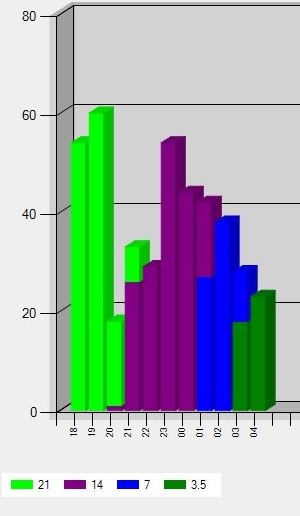
As you can see from the stats, 40-meters was my best band influencing my decision to submit the log as a single band 40 meter entry.

Based on that submission, it looks like WQ6X will take 1st place for North America in the 40 meter low power category. 
Go Figure!


Did YOU play in the JIDX contest?
How many different prefectures
are in YOUR log?

Monday, March 28, 2016

WQ6X runs BARTG RTTY & Russian DX contests remotely


Lately, business traveling has demanded that for contest operations I largely operate NX6T remotely from the bay area.  Some of the contest gigs I've operated remotely this year include:  RTTY RU, the CQ 160 contest, ARRL DX CW and NAQP RTTY.

This past weekend left me with no client commitments.  Instead of running my usual portable operation from W7AYT's QTH in Concord Ca. (East Bay section) requiring extensive equipment and antenna setups, I decided to book a room with a view for the weekend at the Clarion Hotel near the Concord airport and run this weekend's contest events remotely from NX6T (Fallbrook); otherwise known as "Nashville".
Listed on the contest calendar were the BARTG RTTY and Russian DX contests,
along with the LA & VA state QSO parties; in that priority order.

Unlike CQP, it is typical of many state QSO parties that they last only 12 hours.
By the time 40 & 80 meters finally come alive those QSO parties are over; as happened with this year's LA QSO party.  Although the VA QSO party had a 2nd run on Sunday, while working the final portion of the BARTG contest I never heard any VA stations - so much for the weekend's QSO parties.

Running remote, CW contests are the easiest to operate.
While I largely prefer to sit on run frequencies, attracting stations to my signal, it also pays to search and pounce from time to time; either by tuning the radio "manually" or - if I am running assisted - by clicking callsigns on the bandmap.

Because tuning RTTY stations remotely is tricky (even with negligible internet latency), for contests like BARTG & the RTTY RU, I prefer to run a frequency to reduce the operating complexity.
The 5% (or so) S&P contacts made in these contests largely happen "by accident".


One of the many desirable aspects of the BARTG is the contest length (48 hours) starting @ 02:00z; just after dinner PDT time.

An order of takeout sushi set the stage for a somewhat productive Friday evening on 20 meters and later, on 40.
Hamachi (Yellow tail tuna) is one of my favorite sushi rolls.


Using LogMeIn Hamachi on the Toshiba laptop gave me access to the NX6T VPN allowing remote access to station 1's Toshiba laptop and control of the K3 radio and KPA-500 amplifier.

At NX6T, STN's #1 & #2 are now both remote capable so this weekend I got to share the Nashville antenna farm with other operators who wanted to run the BARTG gig along side the Russian DX contest, but on SSB instead.

For STN#1 my configuration was relegated to running BARTG @ 65 watts onto a 2-el yagi on 40 meters and via the KPA-500 amp (at about 360 watts) into a 3-El Stepp-IR yagi for 20 & 15 meters (both antennas 15mh high).

While I was able to turn the rotor remotely, switching between 20 & 15 meters on the Stepp-IR required the next door neighbor walk into the ham shack and manually turn the bandswitch on the WX0B SIX Pack antenna switch box.

For the Russian DX contest I ran the K3 @ 100 watts on 40 and 360 watts on the high bands.  Unfortunately I was unable to run 80 or 10 meters for those contests.

A problem I increasingly encounter when running RTTY contests  remotely is an increasing number of stations increasingly off frequency when responding to my CQ test calls.   If I were running my FT-1000mp, I would simply turn on the RIT and tune them in; rewarding poor operating procedure.  These stations either have THEIR Rit on or they found me via a DX spot entry on the internet that listed my MARK frequency incorrectly.  Rather than check to see if they could decode my data correctly BEFORE transmitting, they just blindly press F4, sending their callsign off frequency.

My solution to this was to define N1MM's F-10 key to send "UR OFF FREQUENCY - PLEASE TUNE ME IN", followed by the F9 Key ("CALLSIGN?").  After a short pause, most stations tune me in and a proper QSO is made.  Unfortunately, some stations don't get it and eventually disappear; probably cursing me for not working them.


Although the Russian DX Contest started at 12:00z (5am PDT) because the BARTG contest was my weekend priority I didn't begin until after 22:00z.

Running the DX contest on CW became my priority, with brief segments of BARTG activity in between until it was finally over at 12:00z on Sunday.


As you can see, I managed 139 QSOs on 40 & 20 meters, enough for a 6th place in the USA and 7th place for North America; although not enough to take any awards.


Nevertheless it was a LoT of fun.
I look forward to next year with a more focused effort.

Did you play in the BARTG and Russian DX contests?

Is WQ6X in YOUR Log?

WQ6X & N6KI team up as NX6T for 1st S-A 10-meter Contest.


Over the years, team NX6T has put together operations for an array of different radiosport events.

This year for the 1st time we decided to participate in the South American 10 meter (SA10) contest.  Considering that Sunspot Cycle 24 is well on its way out, the more 10 meter GiGs we can operate the better.  Next year may clearly find us in the SFI basement; we're already getting close to that point as it is. 


For a 24 hour (only) contest it was not cost/time effective to make a drive to the NX6T site in Fallbrook.  Instead, we perfected the remote access to NX6T.  Overall the internet latency was hardly noticeable.  Because the contest started at 12:00z 10-meters was not yet open in Southern California.
I started CQ'ing for the contest at 15:15z, making my 1st QSO at 15:44z.


As it turns out only WQ6X and N6KI were available to run this gig.  While Dennis slept, I fired up the contest on CW running NX6T remotely from a "secret location" in the bay area, with the objective to run mostly CW with a little SSB.  

Without full SSB control remotely, I had to limit voice
operation to searching and pouncing, allowing me to "talk" using pre-programmed N1MM  macro keys to play .WAV files.  As it turns out, the SSB to CW ratio was exactly equal;
39 QSOs in each mode.

Like the ARRL 10-meter contest, the SA-10 contest is a multi-mode affair (CW & SSB).

Essentially, stations worldwide can work each other, however we make MORE points working South American stations.


Equipment-wise we ran the usual Elecraft K3 radio into an ACOM 2000 amplifier. 
The antenna was a 3-element Stepp-IR running BI-Directional, allowing us to work
Japan as well as South America.


As contests go, this gig was a bit of a ho hummer.
Additionally, because this is a 24-hour contest, for us left coasters we get one shot at 10 meters - when its gone,
it's GONE; there is no redo on this one.

Being a single band contest, ten meters is either open or
it isn't.  At the Fallbrook location, once the band was open and stable (around 15:30z) it remained intact up to the time
I turned it over to N6KI to finish the event - 22:15z.

Despite Dennis' best efforts he could only manage 5 more QSOs for the contest; evidently, I worked all there was to work otherwise - go figure.  By 00:30z the band was gone and so was the contest for us.


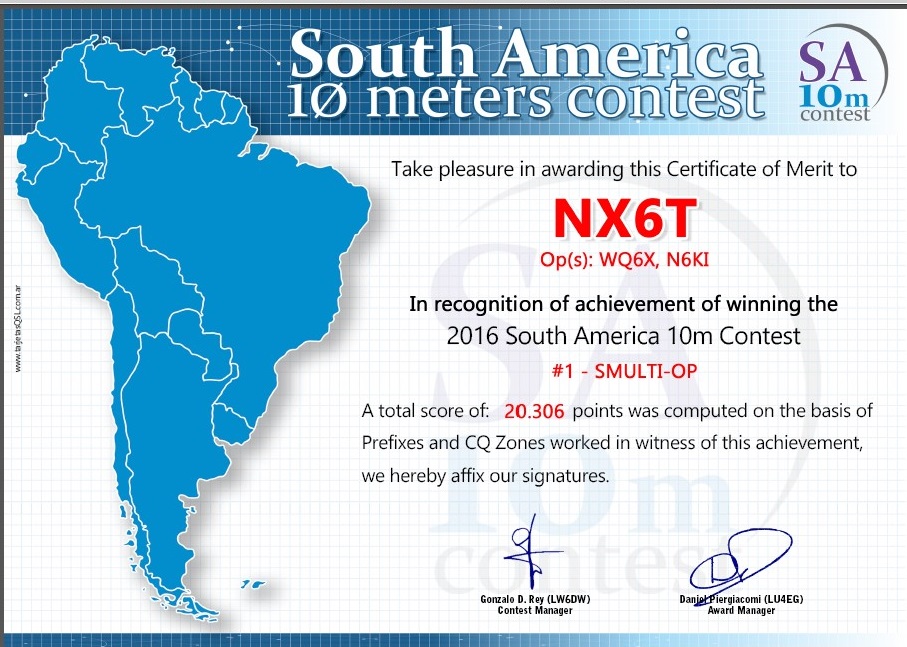
Our 78 QSOs netted over 20k points, which while a pittance (by other contest standards) may be just enough for NX6T to take 1st place worldwide (outside of South America).


As you can see from the 3830 Scores website (CLICK HERE), our closest competitor (W3HAC from the PVRC) made only 29 QSOs for 3,300 points.  Theoretically, we should get a 1st place certificate as compensation for all the effort we expended operating this South American GiG.

 
Did YOU work the SA-10 contest?
Is NX6T in YOUR Log?

Tuesday, March 1, 2016

WQ6X runs NAQP RTTY Remotely from Laughlin

For the third weekend in a row I have run remote contest operations from NX6T in Fallbrook (aka "Nashville").  This last weekend found me going all out in the NAQP RTTY contest; a 12 hour event
(10am to 10pm PST) during which the rules allowed me to operate only 10 hours of the contest period.
Because the contest exchange is Name and QTH, the event has more of a personal feel to it.
Contact w/NE6I put me on one of the Southern California Contest Club (SCCC) contest teams
(Team #1).


In the past (the 2016 RTTY RU contest) to run full low power we set up STN#1
to run into a KPA500 amplifier allowing 100 or 150 watts full duty for RTTY.  Recently the KPA500 has been tripping out under marginal SWR issues.

After a call to Elecraft, N6KI and W6JBR devised a solution to this problem by running the K3 at near-full power (92 watts) with a huge cooling fan pointing head-on at the transceiver.


Operating from Harrah's hotel in Laughlin, I encountered virtually no latency problems during this contest.  Nevertheless, because tuning  RTTY signals remotely is tricky at best I chose to run frequencies 95% of the time.

The use of macros in N1MM make operations run smoothly.  Using Ctrl-K from time to time is the equivalent of sending manually with a key paddle in CW contests.


As I experience consistently in RTTY contests stations call me way off frequency.
While I can hear them, FLDIGI cannot decode their data.  If I was sitting in front of my FT-1000mp,
I would simply turn on the RIT and tune the signal in; something virtually impossible (in a timely fashion) when running RTTY remotely.  Instead, I would press Ctrl-K and type "You're off frequency - please tune me in", then send "QRZ?".  Most of the time they would shift frequency and we would establish contact.

My question is: how can you tune me in well enough to copy my "CQ NAQP" call and yet be OFF frequency when it comes time to transmit?  Most likely these stations found me through a spotting network with an incorrect frequency cited in the spot entry.  Rather than blindly call a station found
in a spot, LISTEN FIRST to make sure you have an ACTUAL copy on their data transmission.

In all NAQP contests single operators are allowed to operate 10 hours max out of the 12 hour contest period.  The gamble is, which 2 hours do I sacrifice?  If I run the 1st 10 hours consecutively then end of contest is 04:00z (8pm local time) missing out on 80/40 meter opportunities ending the contest. 
If I wait until noon to start, I miss out on any 10/15 meter exclusive morning openings.  Then, if I get called away from the radio at any time during the remaining 10 hours I will have wasted part of that obligatory off time.


For this event my  choice was to begin on time, take an hour
off mid day and end the contest at the start of the last hour.  Because off times must be 30+ minutes I took 40 minutes for lunch, requiring that I cease operations at 04:40z (8:40 local time); more or less in line with my original strategy.


My only regret for this NAQP GiG was that I did not give
10 meters any attention Saturday morning; instead I ran frequencies on 15 meters for 2+ hours.  By the time I took a look 10 meters was already gone.  I ended the contest moving from 40 down to 80 to wrap things up.  I was amazed to find a nice 80 meter opening across the U.S. to the Eastern seaboard.


True to infamous 40 meter contest fame, this year's NAQP RTTY experienced the typical 40 meter intentional QRM I have come to expect during contests.  Only this time while running a frequency (7.070.70) at 02:10z I was barraged with howling and rumbling noises, followed by what sounded
like the whine of a dropping bomb, again and again.  Go Figure.  At least the bomb drop noises showed some originality.  As with ALL intentional QRMers they soon get bored and either give
up entirely or find someone else to bother.  An hour later I am STILL on that same frequency
with another 40 QSOs in the log.

As it is, because 7.070 is in the middle of the international phone band (for Regions 1 & 3), QRM
from ssb stations allowed to share the spectrum is to be expected.  Then again, at 02:30z 7.070 became the National Tuneup Frequency as many stations began testing (saying "helllllllooooo  helllllllooooo").   If they ended up near my frequency I could understand that. 
However when they are EXACTLY zero beat with me, that is NO accident.

Now, to voice one of my main RTTY contest beefs: NCDXF beacon QRM on 14.100.
What?  You didn't know there is a propagation beacon on 14.100 24/7?  They been there for over 20 years.  (Co-relatively, are you aware of the beacon segment occupying the ENTIRE 28.200 to 28.300 segment of 10 meters?)  NCDXF beacons provide 24 hour propagation assistance for free; the least we can do is give them "room" to operate.  It's one thing to be on a nearby frequency and splatter onto 14.100; it's another thing entirely to have your center frequency EXACTLY at 14.100.

CLICK HERE to learn more about the NCDXF beacons and the service that these beacons provide.
There is no reason why we can't operate a RTTY contest and avoid the 14.097 to 14.103 corridor.
In fact, I did just that running a frequency for over an hour on 14.107 and later on 14.092.


Because I have been on the road for business the last 10 days, playing in the NAQP this last weekend was relaxing and fun, even tho I was inside all day on a sunny Saturday.
I had a nice view of the desert hills from my window while typing away.  In common with CW contests, running RTTY saves my voice (I had been teaching advanced therapy techniques all week).

Like last week's DX contest, I had no rotor control on the yagi's at NX6T, so essentially, the C-31 and 40-meter yagis were pointed 45-degrees (N-W), limiting who could hear me.  This becomes evident as I did not work a single
KH6 station and virtually none in S. America; altho
I was called by an AH2/W6 station - go figure.
As a result I was only able to work 47 out of the 58 multipliers, missing many of the Northwest states
and most of the crucial VE/VY sections.


Overall, I worked the high bands moving to
the lower bands as the contest progressed.
Mid afternoon, jumping between 15 & 20 meters allowed me fresh QSOs when I had worked all
a run frequency could provide.

Then, coming back to a band on a different frequency allowed other stations to encounter me "newly".


Did you play in the NAQP RTTY contest?

Is WQ6X in YOUR Log?

Monday, February 22, 2016

WQ6X runs ARRL DX Contest remotely from the Gold Strike casino hotel


This has been a busy February.  Last weekend my attempts at running the WPX RTTY contest remotely was a complete BUST due to horrible internet latency.
The last 1/2 hour of the event settled down enough for me to make 18 QSOs allowing me to submit a log with a WHOPPING 21 QSOs - at least I DiD submit a log,


Last week I had client work in Pasadena and am heading to Las Vegas to work with other clients this coming week.  In the middle of it all I managed to operate the ARRL Dx Cw contest from NX6T remotely; Friday evening from Southern California and the rest of the weekend from the Gold Strike casino hotel off I-15 en route to Las Vegas.

WQ6X's operating position
Friday evening, the issue of internet latency was quite a problem, limiting my success.

Saturday I drove to Jean Nevada hanging out at the Gold Strike hotel to participate in the ARRL DX contest and play a little Blackjack.

Because casino hotels want us to play in the casino not on the internet, they charge significantly for the online privilege.


As it turns out, a $12 investment in super-speed internet access all but eliminated the latency problem during contest operations.  Because the latency was so low I managed to run several frequencies until each one of them eventually QRM'd out.

STN#1 @ NX6T
Operationally I ran STN#1 (an Elecraft K3) barefoot into a C-31 yagi at 40' and a 40-meter yagi at 70' feet, with an 80-meter inverted Vee at its apex.  Unfortunately remote rotor operation was not possible so I dealt with fixed positioning of the yagi's.

Nevertheless, it was better than no operation at all.  As I have in the past, I used the LogMeIn Hamachi software and again for dinner enjoyed a hamachi (Yellowtail) sushi roll - go figure.


Staying up into the late night hours allowed me to sleep in, but probably caused me to miss 10/15 openings both mornings.  On both days, 10-meters seemed to "go long" early in the afternoon and close up early.
40 meters turned out to be THE band, allowing me to work 57 countries on that band alone.
Luckily, the bogus QRM I usually experience during 40 meter contest periods didn't materialize; all except the Russian "K" beacon on 7.030 mhz.  Why is it I only hear the 40-meter Russian beacons during contest weekends and never during the middle of the week?

Next to 40, 15 meters was my best operation.  Openings to Africa were certainly there on 15, altho so were the DX cluster fueled pileups, so no Africa in this year's log.

What was really strange is DX stations asking me for my NR (number).  While they send ME a number (their power level), the only NR I send is "599".  While I finally realized they wanted my QTH (state), beginning contesters may not understand this.  The correct request is: "SEC?"

While there were a surprising number of openings to South America because I was not able to point the antennas in that direction to work many of those stations, relying on back of beam access to South America and Oceania.  Then again, a north pointing C-31 yagi made working UA0 easy and afforded a late afternoon opening  into Northern Europe on 15 meters.

Overall, I managed about 18 hours of actual operating time making 364 QSOs in over 70 countries for a score of just slightly over 172k points.  While I won't win any awards for this one it was a LoT of fun to work so many countries from a casino hotel room.

That evening the one 6-deck Blackjack table in the casino gave me a run for my money.

Next weekend is the NAQP RTTY contest which I will probably run remotely,
so look for WQ6X ("Ron in CA") during that event.

Did you play in this weekend's ARRL DX contest?

Is WQ6X in YOUR Log?