Monday, February 22, 2016

WQ6X runs ARRL DX Contest remotely from the Gold Strike casino hotel


This has been a busy February.  Last weekend my attempts at running the WPX RTTY contest remotely was a complete BUST due to horrible internet latency.
The last 1/2 hour of the event settled down enough for me to make 18 QSOs allowing me to submit a log with a WHOPPING 21 QSOs - at least I DiD submit a log,


Last week I had client work in Pasadena and am heading to Las Vegas to work with other clients this coming week.  In the middle of it all I managed to operate the ARRL Dx Cw contest from NX6T remotely; Friday evening from Southern California and the rest of the weekend from the Gold Strike casino hotel off I-15 en route to Las Vegas.

WQ6X's operating position
Friday evening, the issue of internet latency was quite a problem, limiting my success.

Saturday I drove to Jean Nevada hanging out at the Gold Strike hotel to participate in the ARRL DX contest and play a little Blackjack.

Because casino hotels want us to play in the casino not on the internet, they charge significantly for the online privilege.


As it turns out, a $12 investment in super-speed internet access all but eliminated the latency problem during contest operations.  Because the latency was so low I managed to run several frequencies until each one of them eventually QRM'd out.

STN#1 @ NX6T
Operationally I ran STN#1 (an Elecraft K3) barefoot into a C-31 yagi at 40' and a 40-meter yagi at 70' feet, with an 80-meter inverted Vee at its apex.  Unfortunately remote rotor operation was not possible so I dealt with fixed positioning of the yagi's.

Nevertheless, it was better than no operation at all.  As I have in the past, I used the LogMeIn Hamachi software and again for dinner enjoyed a hamachi (Yellowtail) sushi roll - go figure.


Staying up into the late night hours allowed me to sleep in, but probably caused me to miss 10/15 openings both mornings.  On both days, 10-meters seemed to "go long" early in the afternoon and close up early.
40 meters turned out to be THE band, allowing me to work 57 countries on that band alone.
Luckily, the bogus QRM I usually experience during 40 meter contest periods didn't materialize; all except the Russian "K" beacon on 7.030 mhz.  Why is it I only hear the 40-meter Russian beacons during contest weekends and never during the middle of the week?

Next to 40, 15 meters was my best operation.  Openings to Africa were certainly there on 15, altho so were the DX cluster fueled pileups, so no Africa in this year's log.

What was really strange is DX stations asking me for my NR (number).  While they send ME a number (their power level), the only NR I send is "599".  While I finally realized they wanted my QTH (state), beginning contesters may not understand this.  The correct request is: "SEC?"

While there were a surprising number of openings to South America because I was not able to point the antennas in that direction to work many of those stations, relying on back of beam access to South America and Oceania.  Then again, a north pointing C-31 yagi made working UA0 easy and afforded a late afternoon opening  into Northern Europe on 15 meters.

Overall, I managed about 18 hours of actual operating time making 364 QSOs in over 70 countries for a score of just slightly over 172k points.  While I won't win any awards for this one it was a LoT of fun to work so many countries from a casino hotel room.

That evening the one 6-deck Blackjack table in the casino gave me a run for my money.

Next weekend is the NAQP RTTY contest which I will probably run remotely,
so look for WQ6X ("Ron in CA") during that event.

Did you play in this weekend's ARRL DX contest?

Is WQ6X in YOUR Log?

Sunday, January 31, 2016

WQ6X joins NX6T remotely for 2016 CQ 160 meter contest

The RCFORB radio control software

It's been several years since I last participated in the CQP 160 meter contest.  It doesn't make sense for me to make the 10 hour drive to Fallbrook to operate what is essentially  a night-time only contest, even though two nights are involved.  In order to participate, the OPs at NX6T enabled my remote access to STN #1 during the dinner hour and the post-midnight to sunrise periods.  While I was able to make this work, the internet latency (especially during the dinner hour) was HORRIBLE.
No antenna tuner needed here
The 160-m Inverted Vee @70'

Equipment wise we ran a bevy of Elecraft K3's into an ACOM 2000 amplifier out to a 160 meter inverted vee 70' high at the apex.  Remote facilities included Logmein-Hamachi, RCFORB & the VNC Viewer.

For the 2016 contest, the noise at the NX6T was an intrusive factor; largely S-8 on Friday evening.
While there are DNR noise filters in the Elecraft K-3 they are not easy to manipulate by way of the RCFORB remote radio software so I suffered through.
Then again, because this contest had no 40 meter operation, I was spared the usual belches, VFO sweeps Russian beacons and phantom RTTY signals I usually have to slog through during the 10:00z to 12:00z time frame on 40 meters during most CW contests.

STN#1 during the dinner hour
The idea was for me to takeover STN#1 at 10:00z (2am).  As I was about to settle into a 2 hour nap at midnite the call came in and I was soon running a frequency (1.807 mhz).  While the noise levels were high, running a frequency (as opposed to S&P'ing) worked out very well.

As sunrise made it's way I had made over 200 QSOs including a handful of countries thanks to a greyline-style opening to Asia Saturday morning just before the band faded into oblivion.


For Saturday evening, because the band opened "late" and the fact that we had worked a majority of stateside stations the pace started out slow.  When I took over at 04:00z for the dinner hour the internet latency was at its worst, altho eventually settled down affording a nice frequency run on 1.848 (mhz).
After the operator change-back I took to the world of sleep.
Because my cellphone was on the charger while I slept I didn't hear the 20+ attempts by N6KI to roust me from my slumber.  Eventually I rolled out of bed, fired up a middle-of-the-night Kona  coffee and hit the couch.  While the internet latency had settled down, there were not a lot of stations to work,
so at N6KI's recommendation I S&P'd for the 1st hour until I could find nothing left.
By 12:00z I was calling CQ on 1.802.76. 

Sunday morning the signal strength of W6's & W7's nearly burned out the cheap headphones I was using.  In retrospect I shoulda brought in my Heil headset from the trunk of my car, but I was too lazy to make the trip.  (I own the Heil PRO headset with the phase-switch on the left ear).
Sunday morning did not produce the desired repeat of Saturday morning's greyline, so by 14:30z
I shutdown the remote connection and went back to bed - effectively ending the contest for us.

Despite the frustrating internet latency problems, overall, this was a fun CQ 160 contest; all of which could be run via a laptop on the living room coffee table.  I recently upgraded my Toshiba laptop to a solid state disk drive, keeping Windows 7 rather than upgrade to Windoze 10.
As I have experienced recently, remote radio operations seem to run more smoothly with this configuration.  Looking at the contest results from the 3830 Scores website it looks as tho we took 23rd place worldwide and quite likely 1st place for California.


The view from NX6T's Fallbrook location

In the last 2 months I have been fortunate to join NX6T's Fallbrook operations remotely from a number of different locations on my part.

While the internet enables many amazing things in the 21st century I want to warn radio operators not to become overly reliant on an infrastructure that can be disrupted at any moment.
I still love sitting in front of a radio with knobs; tuning stations via a software screen is marginally effective, and, in the case of RTTY very tricky at best.


N6KI's formula for winning contests


For me, next up operation-wise is February's ARRL Dx CW contest, which will most likely include 160 meter operations.


DiD YOU join in this year's CQ 160 contest?

Is NX6T in YOUR log?

Monday, January 18, 2016

WQ6X runs NAQP SSB Solo portable

Being a part of NX6T's CW NAQP 2nd place last weekend was quite a thrill.
While I would have liked to join them for the NAQP SSB GiG, business demands made it impossible to make the trek to Fallbrook.  Even taking the train would have been too complicated for a contest that only lasts
12 hours, of which I probably would have had 4 hours of OP time available to me.

Instead, I decided to put together another infamous WQ6X ad-hoc operation; this time from the 3rd floor of a hotel.  Because my hotel room window there faced more or less east, I thought it would provide a decent possibility of working the contest.


While the solar flux index (SFI) was only 104, all the solar storms seemed to be behind us, as evidenced by an A-index of 6 and a K-Index of 0.


Unfortunately what sounds good in theory doesn't always turn out in the real world.

I tried three different antenna configurations before settling in on something that would actually work.

I ended up running the radio into a cobra dipole hung from the window curtain rods, with their wires hanging out the window.


The 1000mp's antenna tuner had little trouble tuning the radio on 80 thru 10 meters.
Unfortunately, signal levels were way down, altho I was able to work just about anyone I could hear.
To wrap 15 meters, I enjoyed a groundwave QSO on 15 meters with KG6LRI who was just learning the details of playing in the NAQP.

After a lunch break, I came back to discover 10-meters gone (it barely opened up) with 15-meters right behind it. Moving down to 20 meters I managed a whopping 16 QSOs before the band quickly disappeared.  No problem I figured, I'll just move down to 40 and then 80 - WRONG!

At 00:00z switching to 40-meters found an S-9 to +10 noise level, virtually obscuring any signals
that might have been there.  80 meters brought an S-7 noise level with the same problem.

Because of the noise, I was only able to manage 1 QSO on 40 meters (a W6 station) before getting real and realizing that NAQP was over for the  weekend.  Checking back throughout the evening found the S-9+ noise level continuing, until well after midnight.

Notice the S-7+ noise level on the S-Meter
 In essence, the highlight of this portable operation was being able to test the FT-1000mp features under adverse conditions.

I spent considerable time with the operators manual tweaking many of the numerous menu settings that are behind the scenes of the FT-1000mp transceiver.


This weekend also gave a thorough test to the recent addition of a solid-state disk drive to the laptop I use for running contests.  There is no doubt that faster disk I/O makes contest running (especially remote contest operations) perform more effectively.
The next operating goal for the Yaesu FT-1000mp will be CQ WPX RTTY contest next month.

Because of my dismal QSO total I almost did not submit a log but then remembered my own advice from an earlier BLOG entry I wrote this year on the subject of always submitting a log.
It isn't so important how MANY QSOs I make, but just showing up that really makes the difference.

The NX6T crew managed over 1200 QSOs altho complained of poor condx on 20 meters, a slow to open 40 meters and high noise on 80 & 160.  At least they heard signals on those bands.


While I was bummed by the small number of QSOs made, I nevertheless enjoyed what operating time I was able to manage.

Until N6GEO manages a new setup or at least a functional setup remotely from Twain Harte, I am going to have to come up with other ideas for bay area operations.

DiD YOU play in the NAQP SSB?

How did it turn out?

Is WQ6X one of the RARE QSOs in YOUR Log?

Wednesday, January 13, 2016

NX6T takes 2nd place in NAQP CW

H u H?
For serious contesters who did not play in the Jan 2nd/3rd RTTY RU, the NAQP CW GiG is the first "real" contest of the new year.  Having run RTTY RU remotely from Fallbrook the weekend before, it was time to sit down in front of a radio with knobs I can twiddle; even if it was a K3 (I prefer my FT-1000mp).


I used Friday evening as a time to settle in and scan the lower bands (160, 80 & 40), giving me an idea of what things will be like Saturday evening.  Luckily no space weather anomalies occurred during the weekend.


While I normally don't drive all the way to Fallbrook to participate in a 12 hour Multi-OP contest, this year  I was already in Burbank for the week; another 2.5 hour drive on Friday was no big deal.


We had a relatively small crew for this event; namely: N0DY, N6CY, N6KI, W6JBR and myself.  Nevertheless, we were all in top form.  Together we turned our Multi-2 operation into a 2nd place finish behind K7JR (manned remotely by KL9A & N5RZ).

N6CY w/N6KI looking for mults

At 10:00 am (local) I opened the contest for the 1st hour on 10 meters.  By 11:30 N6CY made the scene and put STN#2 on 15 meters.  Because we were both running a frequency NX6T ended up on many spotting networks.

By 12:30, N6KI joined us to S&P on 15 meters from STN#3 interspersed with Rick (N6CY) while I mopped up 10 meters via S&P before finally heading to 20 meters to run a frequency.  By 2:00 we lost N6CY, and added N0DY to spell me on 20 allowing N6KI to take over running 15 meters.

After a short nap I came in at 5 pm (01:00z) to see N0DY on STN#2 running a frequency on 40 meters.  Moving him to STN#1 to continue the pileup run allowed N6KI and I to dual-op 80 meters, which was wide open by 5:30 (local).
By 6pm we included a look at 160 into the game altho 160 wouldn't deliver until later in the evening.


N0DY & N6KI running frequencies

By 7:30 N6KI drove into town to bring back some Italian food while I worked 80 and eventually found a nice opening on 1.818.18 mhz to run the frequency.  Using the bandmap and 2nd VFO I was able to sneak in an occasional S&P QSO on 160 during lulls in frequency running.


An important note about 160 meters and NAQP: Just Do It!
I think of 160 meter QSOs as "free" QSOs and in the case of NAQP "free" multipliers; all just for showing up.
160 meters was worth 52k points to us.


Because the C-31 and Stepp-IR yagis are gain antennas and this was largely a North American contest, during the daytime we left the masts in their lower position.  As we moved down to 40 meters, the main tower was raised to 70', enabling the 80/160 inverted V's and taking the 2-el 40 meter yagi to the next level.


For the evening shift W6JBR joined us to wrap things up.  By the time 06:00z (10pm) arrived we were contested-out.  As you can see, our QSO total was quite an impressive 6-band score.

While I was not part of NX6T's NAQP GiGs last year, it is clear that our gang-of-5 operators easily surpassed last year's NX6T score.

DiD YOU play in this year's NAQP?
Is NX6T in YOUR Log?

Sunday, January 10, 2016

WQ6X Ron runs RTTY RU Remotely and Robustly

It's hard to believe that it has been two years since N6GEO and myself engaged in a 1st place (worldwide) RTTY RU event as WP2/WQ6X.  Last year (2015) operating as N6GEO we took 1st place for East Bay (EB) section operating from George's Brentwood QTH.

Since last year the Brentwood QTH has been sold.  While George has been working on a remote operation setup from his cabin in Twain Harte, it was unfortunately not ready for this year's RTTY RU.
Client commitments made it impossible for me to make the trek to the NX6T site in Fallbrook so I looked into the possibility of operating remote from Fallbrook's Stn#1 altho actually setup at the W7AYT qth.

With incredible assistance from JR W6JBR we eventually made that happen; altho unfortunately, the 1st QSO didn't happen until 02:15z (8 hours into the contest) - meaning that I missed out on a days worth of access to the 20-15-10 meter bands.
 
On Sunday, either 10 meters opened up before I rolled out of bed at 10 am and then quickly closed or in fact the band never materialized into the San Diego area.  Either way, missing 10 certainly didn't help my score.  Surprisingly, 20 meters was the worst band of all - missing Saturday afternoon cost me a lot.

40 meters was more packed then I have seen in many a RTTY RU.  I felt sorry for the CW guys; especially that lone station on 7.045 blindly calling CQ at 15 WPM.  I don't know if he ever got a QSO, but he certainly was a brave man to attempt such a feat amidst the cacophony of RTTY signals surrounding him.


Remotely, this was my 4th experience (1st RTTY experience) operating "from" NX6T in Fallbrook.  Because internet latency is at the core of remote operations, for me personally, remote operating an SSB contest is NOT going to happen.  I get confused enough on CW and even more so running RTTY remote; attempting to run SSB would probably spin out my sanity.


One of the secrets to remote operation is PATIENCE, coupled with no negative self-labeling.  Running the 10-meter contest remote was tricky enough running only CW; I purposely chose NoT to run SSB.

Once I got into action, my biggest BEEF was the fact that most of the spots in the bandmap, while they yielded signals, the offset was wrong giving no decoding.  On my FT-1000mp I would just turn the tuning knob until the decoding starts.  Using a "tuning knob" over the internet is tricky enough on CW, however add to it a little internet latency and tuning RTTY becomes nearly impossible;
which is why some companies sell a remote operation tuning knob.

My solution to the tuning problem was to pick a "quiet" frequency and call CQ.  After awhile WQ6X was spotted by the skimmers.  (Because the WQ6X callsign is embedded in every lookup database, recognition of my callsign was automatic.)  Stations lined up and I would get an hour run here and there.
In the end, I probably made 15% of the QSOs by way of S&P; I let the rest come to me. The rest as they say is history.

Because I had to be in Burbank on business, I was originally going to make the drive at noon or 2:00.
Then the internet latency again set in.  To make up for lost QSOs I operated all the way to the 00:00z contest end and was on the 680 freeway at 4:40.


While the 273 QSOs is not all that impressive, research on 3830Scores.Com indicates that after all this I may actually sneak a 1st place win for the San Diego section - GO Figure.


 As I said in my previous blog entry, you never know when submitting a "marginal" log will win an award; so, just DO IT!


DiD YOU play in the 2016 RTTY RU?
Is WQ6X in YOUR Log?


Thursday, January 7, 2016

The Importance of Submitting a Log for every contest

In May of 2013 I wrote a Blog entry about the importance of submitting a log for every contest you participate in, regardless of how few QSOs you actually make.  (Click here to read that Blog entry.)
Recent events have inspired me to revisit this point.

Submitting a log after every contest has its benefits.
  1. It actually makes the log checking process EASIER and FASTER when everyone sends in a log.  Callsigns are less likely to be considered "unique" when they are from a station who also submitted a log.
  2. Your callsign is more likely to be included in the callsign lookup database(s) for future contests making it easier for operators to conclude that your call is valid when they see it pop up on check-partial lists.
  3.  You might actually win a certificate or plaque - which is what this blog entry is all about.
From a competitive contesters' point of view, #3 is the most important.
My attitude USED to be that I would not submit a log unless I thought it would be a clear winner, or at least a contender.  Because we used paper logs and dupe sheets in those days getting a log ready for submission was quite a chore.  Needless to say, I rarely submitted a log.

One year while checking the Sweepstakes results I discovered I would have won a certificate for East Bay (EB) section if only I had submitted a log - my competitor's log ended up being disqualified and became a "check log".  Oooops.  Had I submitted a log, my 2nd place score would have become a 1st place winner.

In the 2014 Sweepstakes phone contest while there were several school club stations on the air evidently none of them submitted a log - no plaques were issued for that category.  A school making 1 QSO could have submitted a log and received a piece of wood - go figure.

Today, thanks to the Cabrillo log format, submitting a log could not be easier.
As I said in the [original blog entry] on this topic, now I submit logs for EVERY contest I play in.
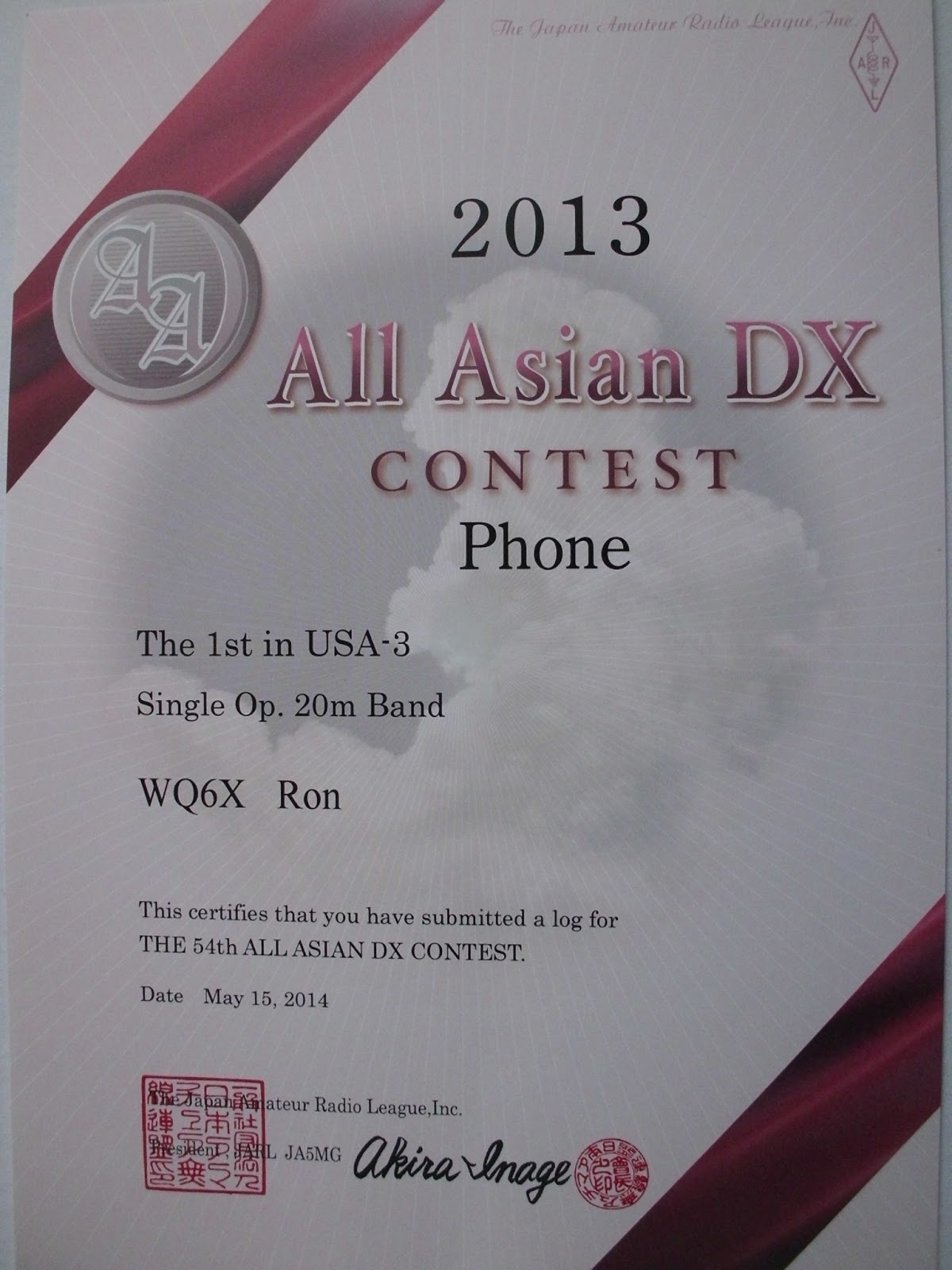
Because I like to piddle around in the numerous "mini" contests, in recent years I have submitted DOZENS of logs for those events.  From time to time I receive unexpected envelopes at my P.O. Box with certificates like this one.


The important thing to note about this contest entry is that I spent barely an hour making those 12 QSOs (9 on CW and 3 on SSB) while waiting for 10 & 15 meters to open up during the tail end of the All Asian SSB contest.  That evening I web-submitted the contest log and then moved on to other things.
100+ days later I am rewarded with the above 1st place certificate.

While we ran 1.3kw for the SSB contest, for TNQP I simply ran one of NX6T's auxiliary K3 radios barefoot into a sufficiently high C-31 yagi, offering lots of signal gain.

From the NX6T Fallbrook location there didn't seem to be a lot of TNQP activity.
In desperation I switched from CW to SSB to make 2 final SSB QSOs before hearing 15 meter Asian signals waft into the Station #2 speaker.   By the time the All Asian contest was over so was TNQP.
After wrapping up the All Asian log I made a Cabrillo file for the TNQP and web-submitted it before
leaving the mountain and heading back to the "real world".

Because QSO party hosts like those running TNQP make it so easy to submit a log, in my opinion there is no legitimate reason to not make a submission.  Wherever possible I submit logs on the same day a contest ends to get it out of my mind.  I also begin writing up the text for what will be the next entry to the WQ6X contest blog.  Before submission I write up a SOAPBOX entry for the log which can also be used for my contest summary submission to the 3830 Scores website.

Contrary to popular belief, contest organizers DO read soapbox entries and sometimes even use them in their results write up for the contest.  N6GEO and I discovered this to be true when we read the 2014 RTTY RU contest result - they printed a quote right from the soapbox comments I wrote for our WP2/WQ6X 1st place (worldwide) finish in that event.  You can see this write up at the WQ6X.Info/WP2 page.

The CQP organizers went one step further by putting operator pictures from our 2013 CQP event page on the CQP home page for nearly 6 months in 2014.  How cool is that?!

Another point should be noted about log submissions.  Some contests (like All Asian) allow you to work stations on multiple bands and then submit the entire log as a single band entry.  Because 20 meters was my best band, for the 2013 All Asian phone contest I ended up submitting the log as a single band 20 meter entry which gave me a 1st place win for USA.
I truly did not see that coming.

While the log submission was a single band entry, the remaining QSOs in the log become a "check log" (making the contest log checking duties easier for the contest organizers), and I ended up with an unexpected 1st place certificate.

The above points are all things to consider when you engage in contest activities.  The bottom line is - ALWAYS SUBMIT A LOG - you never know when it will turn out to be a winner.

Do you dabble in radio contest activities?
Do YOU submit a log for every event?
If not...... WHY NOT?!


Friday, December 18, 2015

WQ6X test drives the 1000MP for 2015 10-meter contest

2015 marked one of the most dismal ARRL 10-meter contests I've ever been a part of.
Between work commitments, a hastily assembled 2nd story portable operation and horrible
space weather, I amassed only 3 dozen QSOs.


In order to make things easier to setup, I chose to run CW only.
To computer run CW I use a West Mountain Plug-N-Play unit for keying the Yaesu FT-1000MP.

Because I operated from a 2nd story hotel room, antenna-wise a Cobra dipole was draped 1/2
across the ceiling, and 1/2 hung out the window.  While the 1000MP was able to tune this dipole sometimes the tuner gears needed some grinding before a match could be worked out.   When
I later encountered problematic RFI floating around the room, that the tuner  took so long doesn't
now surprise me.  At one point I got a laser-point RF burn when my hand bumped one of the wires
on the 4:1 balun.  Indoor antennas always have some nice surprises.

While I ran only CW, I made use of the DUAL receive capability in the 1000MP by putting the 2nd receiver into phone band looking for area openings.  The 1000MP has excellent audio mixing abilities; one receiver in each air.  Because I ran as ASSISTED, the bandmap helped me locate new multipliers.

I was not able to setup before the contest and missed whatever band opening existed in the first 4 hours of the contest.  So in fact, I made the 1st QSO mid Saturday morning.


10-meter band conditions were poor
all weekend from my east bay location.

As it turns out, most Californians had
a similar experience.  During my hours on the air Europe and Africa never materialized; either in the receiver
or on the bandmap.  I saw many VK's ZL's and JA's in the bandmap but
never heard any of them. 


While I could work everyone I heard,  that reach was only as far as Canada, the U.S., Mexico and Bonaire.  Because the signals were often weak, I made extensive use of the Yaesu's contour control and pair of 250-hz filters to pop stations above the noise.


Due to a late morning band opening and afternoon work commitments I barely had time for 90 minutes of operation on Sunday.  When I arrived back at the hotel at 23:30z 10 meters was already gone for the day leaving me with a grand total of 36 QSOs in the log.


While this year's 10-meter contest was a ho-hummer (years past events have resulted in 1st place finishes from EB section), what was important is that the newly acquired
FT-1000MP was put through a number of difficult situations which needed to be tested.


 For example, the previous radio owner had installed a pair of 250 hz filters yet never enabled them via the menu system.  I was not aware these filters were even installed until I attempted to menu enable them and found that they existed and worked.

This year's 10-meter contest provided verification of the fact that solar cycle 24 is nearing its end.
While summertime brings increased 10-meter activity, the winter months ahead will find fewer/poorer band openings.  However just because 10 meters sounds dead does not mean there is no available activity.
If everybody is listening and no one is calling CQ, the band may appear to be dead.
When in doubt, put in a call yourself - you may be surprised at who returns that call.

During last year's 10 meter contest, while the band seemed rather quiet at 3:30z (7:30 pm local time),
a "CQ contest" flushed out over a dozen stations lurking about.  When you work a station calling
CQ contest at times like this, be sure to spot the station in one or more DX clusters.
Operators seeing it popped into their bandmap will then be more likely to spend
more time on the seemingly "dead" band - something to THINGK about.

Even with declining sunspot activity, 10 meters can be a lot of challenging fun.

Did you work this year's 10 meter contest?

Is WQ6X one of the rare QSOs in your log?

Sunday, December 13, 2015

WQ6X runs 2015 ARRL 160 contest remotely


For the 2015 ARRL 160-Meter contest I was unable to make it to Fallbrook for an NX6T multi-OP GiG.  Evidently neither could anyone else, so Dennis N6KI opted to run solo.  He offered up STN#1 for me to run remote after 1am local time.  Unfortunately, Saturday morning, the remote hookup was out of commission which left me with 6 hours Sunday morning for WQ6X to make an appearance on 160 meters.


Equipment-wise, I ran a K3 radio thru a KPA-500 amplifier into a 160-dipole @ 70 feet broadside Northeast / Southwest.  Running the amplifer during a remote operation was a risk because if an operational fault were to occur with the amp not only would I not have 500 watts but would be running at the 30-watt drive level the K3 was set at. 
Luckily, that never happened.


Because I started at the tail end of the contest I  decided to spend my first operating hour running stations on 1.806.  Everyone was so desperate for new callsigns that they lined-up to work another RARE California station.  During that hour I handed out nearly 60 QSOs.

For those stations who heard me, if my operation seemed a bit erratic  it was due to internet latency disrupting an otherwise orderly operation.  A number of times the internet connection would deteriorate requiring me to quickly reestablish the connection; at which time the internet latency would drop to under 0.8 seconds.  Nearly a dozen function key macros allowed me to run as if I was using a keyer paddle at the radio itself.


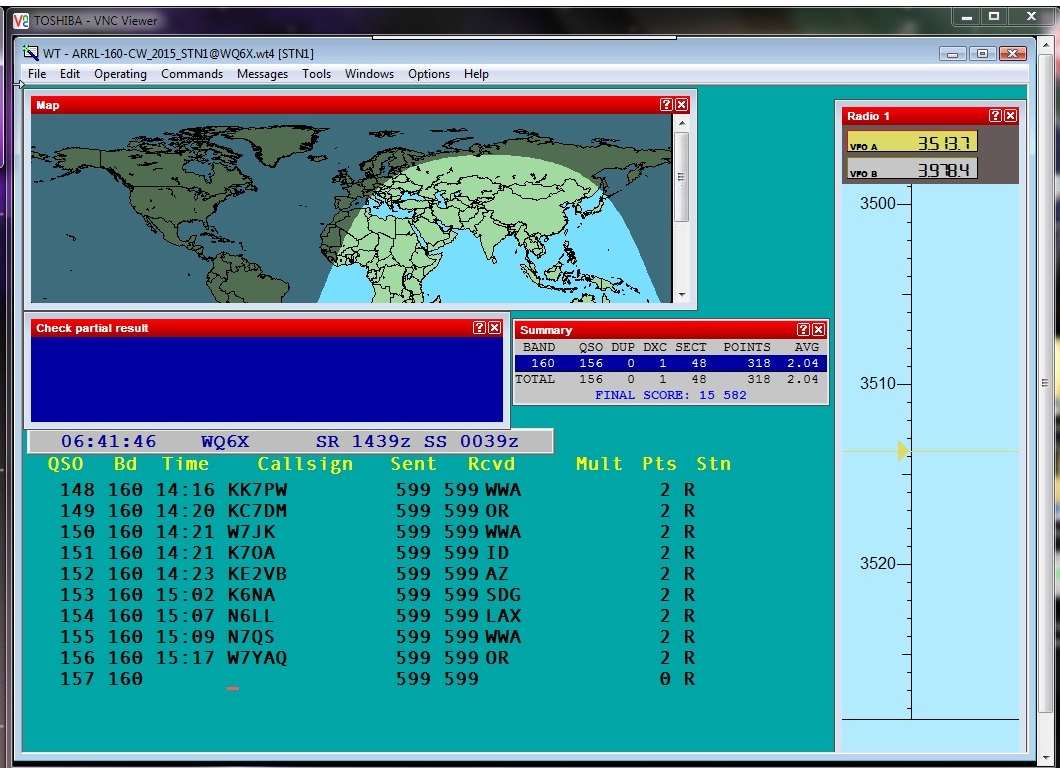
When the contest ended at 7am,  I had managed 156 QSOs in 48 sections; not bad for under 6 hours of OP time.  While I win no awards for this operation it was fun to work 160 and even more exciting to run it remotely from the SF bay area.


Did you work the ARRL 160 GiG?
Is WQ6X in YOUR Log?

Wednesday, December 2, 2015

WQ6X runs CQ WW CW Remotely from Nashville

This weekend's CQ WW contest was one of the uniquely WILD contest runs I have ever done.
What made this weekend different is that instead of a long drive to Fallbrook to operate the NX6T station (aka "Nashville"), I chose to run as WQ6X but REMOTELY from the NX6T location.
Friday evening I ran 80 & 40 meters from the  Pismo Beach Quality Inn.
Saturday evening and all day Sunday I operated from the Burbank Quality Inn.
As it turns out, while I was running STN#1 remotely STN#2 was being retrofitted with
"Version 2" of remote access.

With remote operation, internet latency is a primary concern.   Because of latency issues, had this been an
SSB contest I don't think it would
have worked.
Luckily, for CW, all transmission originations occurred on the NX6T
end of things; the only audio
transmitted was from the receiver.
 I typically experienced latency of approximately 0.5 - 0.8 seconds.


When it would slow down to 2 - 3 seconds, I would disconnect and reconnect to bring it all back.
Because the contest was function key driven, I didn't need to figure out how employ an external keying paddle.

For logging WinTest was the program of choice.
Like N1MM, function key macros allow 95+ of contest activity to be handled with no problem.
For unusual situations using Alt-K to type takes care of the rest.


The radio was an Elecraft K3 running barefoot into a C-31 Yagi for the upper bands, a 2-el 40 meter yagi and a semi inverted Vee for 80 meters.  Being that Fallbrook is already 900' above sea level, my low power signal held its own. 
I was able to bust major pileups on the 1st call over 70% of the time.   Rarely did I have to call more than 2 or 3 or more times.

I believe one thing that helped is WQ6X callsign recognition from other contests, including CQ WW from last month.
This is another reason to submit a log, not only to the contest hosts but also to SuperCheckPartial.Com.

My biggest beef this year is with stations like OL5T who call CQ and then wait 0.5 secs before calling the next CQ.  Not surprising they made few QSOs during that period because by the time we take 1-second to decide if we should press FK-4, they are calling CQ again.

I hear this kind of behavior in most major CW contests and wonder what the operators behind this are or are not thinking.  Frequently when I look up their callsigns I see that their QSO total is not in the top 10 - gee I wonder why?!

Another beef is a station who is running a frequency and disappears every minute or so.
I now realize that means the station is either running SO2-R or multiple transmitters with a lock-out mechanism.  If I were not running remote I would have done what I now do in these situations.
If the station makes no reply to 3 calls and does not call CQ I send "QRL?" twice.
If still no reply then the frequency is now mine and I begin calling CQ.
Should the station come back I remind them that they stopped using it so now I am.
On CW I simply send "QRL - QSY" and then continue running the frequency.

My main beef with the above scenario is that the bands are already crowded during contest periods.  Unless you are running Multi-2 or Multi-Multi, to hog 2 frequencies concurrently is a violation of contest ethics, or at least overall fairness.

Region wise I was disappointed in
the turn out from Oceania - in the
SSB contest they were everywhere.
Conversely, I was also surprised by the plethora of Canadian stations on the air.
While they are only 2 points for us Californians, they are an easy 2 points.
South America and European stations were everywhere this year.
As usual, I heard few stations from Africa but worked virtually everything
I heard.

QRM-wise, I was disappointed in the filter system of the K3 this weekend, making me wish I could have been running the FT-1000MP.  The rig control software for this operation didn't make it easy to invoke the DSP & shift facilities in the K3.  The 500hz filter seemed like a 1800hz filter in the presence of S9+ signals.  Oh well you can't have everything.

Amazingly, there was very little weird 40-meter QRM; no belches or VFO swoops or strange
RTTY - I didn't even hear the illegal South American SSB stations in the CW band.
What DiD stand out however was a BUZZER sound on 7004.72 @ 14:00z - WEIRD!


In total, I managed nearly 24 hours
of actual operating time.  I was able to make a presence on all bands (80 - 10 meters) when propagation permitted it.

Shortly after the contest the SFI went
on a decline and the atmospheric noise worsened.


During the contest because I had no way to rotate the antennas, any positional-related noise could not be eliminated by turning the antenna(s).

As you can see 15 meters was the top band for my operation, followed by 40, 20, 80 & 10. 
Zone-wise I worked some incredibly "rare" zones (such as Iceland - Zone 40), however overall I managed only
22 out of the 40 zones.


While getting setup for remote operation requires a lot of software downloads/installs, once done it seems to flow rather smoothly; although for the future extending the desktop onto an external monitor would make things a LoT easier.

So now, the question is: which contest do I run remote next?

Did you work the CQ WW 2015 CW contest?
Is WQ6X in YOUR Log?